Texas hosts hundreds of native bee species. The 49 now in Pollinator Patch are the ones most likely to visit a typical Texas yard, each with a full profile covering nesting habits, diet, seasonal activity, and the ecoregions where the species is most commonly found.
Key takeaways
- Pollinator Patch now covers 49 Texas native bee species, each with ecoregion, nesting, and host-plant data.
- Native bees pollinate Texas wildflowers through buzz pollination and body size matched to native blooms, covering work honey bees cannot do.
- Your ecoregion predicts which bees your yard can attract. Edwards Plateau, Blackland Prairie, Piney Woods, South Texas, and Trans-Pecos each host different flagship species.
- HOA-friendly native beds can support bees by leaving bare soil patches, winter stem stubble, and staggered bloom through the year.
Why your ecoregion matters for bees
A garden in El Paso and a garden in Nacogdoches sit in the same state but share almost no plants, soils, or seasonal rhythms. Native bees follow the same logic. Specialist species often track one plant genus across a narrow range. Even generalists show strong regional variation in abundance and activity months.
Knowing which ecoregion your yard falls in is the fastest way to build realistic expectations and choose plants that actually close the loop between flower and bee.
Five ecoregions, five flagship bees
Edwards Plateau
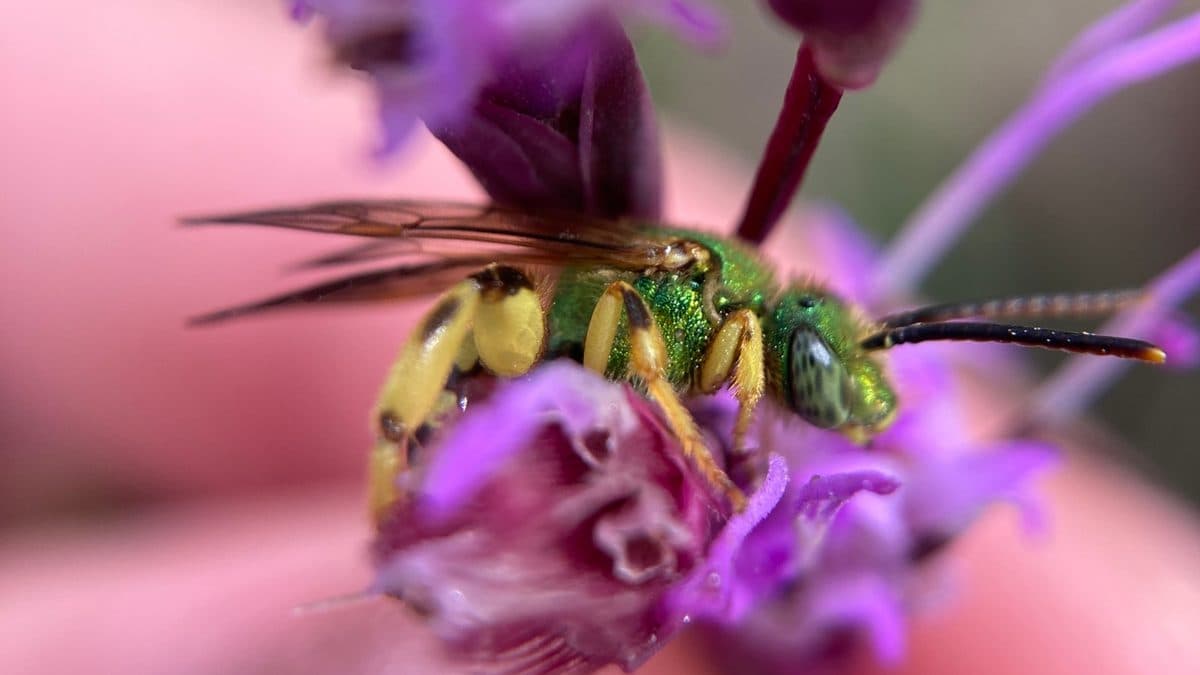
The Hill Country's limestone terrain and hot dry summers suit the Splendid Sweat Bee (Agapostemon splendens), a metallic green bee that forages across a wide range of native wildflowers. Southern Carpenter Bees (Xylocopa micans), larger than a bumblebee, nest in dry wood and work Salvia and Anacacho Orchid Tree particularly well. Texas Mountain Laurel and Mealy Blue Sage are reliable plant pairings for this region.
Blackland Prairie
The heavy clay soils of the Blackland Prairie support the American Bumble Bee (Bombus pensylvanicus), one of the more commonly seen bumble bees in Texas gardens. Ligated Sweat Bees (Halictus ligatus) are also abundant here, often forming small communal nests near garden edges. Black-eyed Susan, Purple Coneflower, and Little Bluestem hold the best forage value in this ecoregion.
Piney Woods
Eastern Texas supports the Black-and-Gold Bumble Bee (Bombus auricomus), a bumblebee with a distinctive yellow-and-black pattern, alongside the Brown-Belted Bumble Bee (Bombus griseocollis). The higher humidity and acid soils shift the plant palette toward Lanceleaf Coreopsis, Wild Bergamot, and native blueberries. Specialist bees tied to the blueberry genus (Vaccinium) are active here in early spring.
South Texas Plains
Longer growing seasons in South Texas extend bee activity well into fall and early winter. Eastern Carpenter Bees (Xylocopa virginica) are active from March through October and are strong pollinators of Turk's Cap, Coral Bean, and Flame Acanthus. Yards with wood features like fence posts, arbors, or unpainted softwood trim can often support nesting carpenter bees year-round.
Trans-Pecos
The Chihuahuan Desert edge and sky island habitats of West Texas require the most deliberate plant selection for bee support. The Blue Orchard Bee (Osmia lignaria) is active in early spring, timed closely to desert wildflower bloom. Desert Willow and Cenizo provide reliable forage across hot, dry summers when few other flowers remain.
Three garden actions that support bees without signaling neglect
Bee habitat often runs counter to the look of a conventional yard. Bare soil, dead stems, and sparse mulch read as low maintenance when they are actually precise habitat choices. The following three actions can be placed and maintained in ways that satisfy typical HOA visual standards.
- Bare soil patches tucked into beds. Around 70 percent of Texas native bees are ground nesters. A small patch of exposed, lightly compacted soil at the back or side of a planting bed gives ground nesters a place to dig without creating a visible void from the street. Thin mulch margins work the same way.
- Stem stubble left through winter. Cavity and stem nesters overwinter as larvae inside hollow or pithy stems. Leaving 12 to 18 inches of stem on perennials like Maximilian Sunflower or Prairie Verbena through winter provides nest sites. Cut back in March when new growth breaks, not in November.
- Staggered bloom through the season. No single plant covers the full Texas bee season, which runs from February into October depending on ecoregion. A combination of early bloomers (Antelope Horns Milkweed, Bluebonnet), mid-season (Blackfoot Daisy, Mealy Blue Sage), and late (Goldenrod, Aromatic Aster) keeps multiple species active across the full year.
Browse 49 Texas native bees with full profiles in the app
Each profile includes ecoregion, nesting type, activity months, diet, and host plants. Filter by your region to see which species are most likely in your yard.
Download FreeFurther reading
The Xerces Society for Invertebrate Conservation maintains the most current conservation research and practical planting guidance for native bees. Their Pollinator Conservation (opens in new tab) program covers habitat restoration, red list status tracking, and South Central region resources specific to Texas.
For deeper taxonomy, nesting ecology, and a full Xerces reference list, read the Texas Native Bees Field Primer in the Learn section.