Canadian Goldenrod
Solidago canadensis
Last reviewed: October 2026
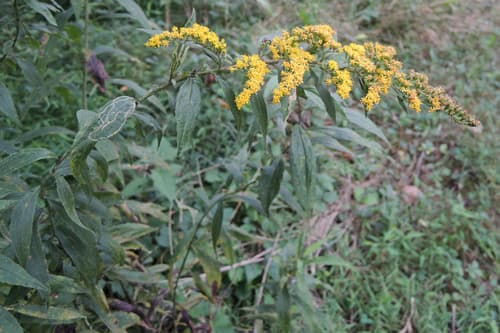
Solidago canadensis is a tall perennial forb that blooms with bright yellow flower clusters from August through October and attracts bees, butterflies, wasps and beetles.
Toxicity unknown
Canadian Goldenrod (Solidago canadensis) is not listed by the ASPCA Animal Poison Control Center (opens in new tab) or the other sources we check, so we have no verdict for it either way. Absence from those lists is not a clearance. If your pet shows symptoms after eating any plant, call the ASPCA at (888) 426-4435.
Light
full sun
Water
medium
Size
24"–60" H × 18"–36" W
Bloom
Aug, Sep, Oct
Native to
AR, AZ, CA, CO and 38 more states
Pollinators
bees, butterflies, wasps, beetles
Before you buy
Your city may pay you to plant this
Cities and water utilities offer rebates for replacing lawn with native and water-wise plants. We track 460 programs across 44 states, each with a link to the provider and the date we last checked it.
Find rebates in your areaPicture natives in your own yard
Upload a photo of your yard and Patch Vision shows a rendering of it planted with natives for your region, like Canadian Goldenrod.


Browse plants for this ecoregion
Canada goldenrod is a tall, rhizomatous perennial in the aster family known for its dense, arching clusters of small yellow flowers in late summer and fall. It spreads readily by underground rhizomes and often forms colonies in open, sunny areas.
Growing Canadian Goldenrod
Grow Canadian Goldenrod in full sun and medium water. Mature plants reach 24 to 60 inches tall and spread 18 to 36 inches wide. Expect moderate maintenance to keep it looking intentional in a front yard.
How to care for Canadian Goldenrod, by region
How to care for Canadian Goldenrod where it is actually grown: year-round basics plus what to do each season, region by region, with the sources for each.
Care guidance last updated: September 2026
Central Appalachians (includes Johnstown, PA)
Year-round
Canada goldenrod is a tough native perennial that does well in Johnstown's clay soils and cool mountain summers, but it spreads by both seed and roots, so plan for room or containment.
- Plant in full sun, at least 6 hours of direct light a day
- Tolerates Johnstown's heavier clay and loam soils, prefers evenly moist conditions but is not fussy
- Spreads by rhizomes and self-seeding, a single plant can become a wide patch within a few years
- Grows 2 to 5 feet tall in most home settings, taller in rich, moist soil
- Blooms late summer into fall, a key nectar source right before frost
- Divide or dig out spreading rhizomes each spring to keep it inside a bed rather than the whole yard
Because it spreads on its own, giving it a bounded bed or root barrier from the start keeps the front yard looking tended rather than overgrown.
Fall
Fall is Canada goldenrod's moment in Johnstown, with bright yellow blooms from August into October, right up to the average first frost in late September.
- Blooms August through October, one of the last strong nectar sources before frost for bees and migrating monarchs
- First frost in Johnstown typically arrives around late September, flowering tapers off after that
- Goldenrod is not the cause of fall allergies, ragweed blooming at the same time is usually the culprit
- Deadhead spent flower heads before they set seed if the goal is limiting how far it spreads next year
- Seed heads left standing feed birds into winter if spread control is not a concern
Winter
Johnstown winters are cold and snowy, generally USDA zone 6a, and Canada goldenrod, hardy well into colder zones, needs no protection to get through them.
- Leave dried stems standing through winter for structure and bird food, or cut back to the ground after hard frost for a tidier look
- No mulch or winter protection needed, this plant is hardy far colder than Johnstown gets
- Rhizomes stay alive underground and resume spreading as soon as the soil warms in spring
- Canada goldenrod is not on the ASPCA toxic plant list for dogs or cats, though eating any plant material in quantity can upset a pet's stomach
- A different plant, rayless goldenrod, is toxic to horses, but that is a separate species not grown in home gardens here
Spring
Spring in Johnstown, with a last frost typically in late May, is the best time to divide goldenrod clumps and get ahead of its spread.
- Dig out and divide rhizomes in early spring before new shoots reach more than a few inches, the easiest time to control spread
- New divisions can go in the ground once the risk of hard frost passes, typically late May in Johnstown
- Water new divisions regularly for the first few weeks
- Watch the edges of the patch, rhizomes travel underground and can pop up several feet from the original plant
- No fertilizer needed, this plant grows vigorously on its own
Spring is the cheapest time to install a root barrier or edging, doing it now avoids a bigger digging job later.
Summer
Through Johnstown's warm, humid summers, goldenrod mostly takes care of itself and just keeps getting taller until it flowers in late summer.
- No supplemental watering needed once established, even in a dry stretch
- Tall stems can flop after heavy summer rain, especially in rich soil, staking or planting behind sturdier neighbors helps
- Keep pulling any rhizome shoots that show up outside the bed, summer is an easy season to catch them
- Foliage stays green and vigorous through summer with little pest pressure
- Flower buds begin forming in late summer ahead of the fall bloom
Sources: Lady Bird Johnson Wildflower Center, Solidago canadensis native range, NC State Extension Gardener Plant Toolbox, Solidago canadensis, ASPCA, Toxic and Non-Toxic Plants list, Old Farmer's Almanac, Johnstown, Cambria County, PA planting calendar (community tip), Prairie Nursery, Controlling Canada Goldenrod in a Prairie Restoration
In an HOA neighborhood
Canadian Goldenrod is an HOA-friendly choice in the right placement. Maintenance level: moderate. Tidiness: 2 out of 5.
Works well in: back border, pollinator meadow section, naturalized area.
- Spreads by rhizomes and can form large colonies if not contained
- Often mistaken for ragweed and blamed for allergies, though goldenrod pollen is heavy and insect-carried rather than airborne
Wildlife value
Host plant for wavy-lined emerald moth.
Goldenrod species are among the most valuable late-season nectar and pollen sources for bees, migrating monarchs, and other butterflies, per the Xerces Society. The plant also hosts several moth caterpillars.
Common questions
- When does Canadian goldenrod bloom?
- Solidago canadensis typically flowers from late summer into fall, with blooms appearing in August, September and October.
- What pollinators visit Canadian goldenrod?
- Its late season flowers draw a wide range of pollinators including bees, butterflies, wasps and beetles seeking nectar and pollen.
- What growing conditions does Canadian goldenrod prefer?
- This forb grows best in full sun to part shade and adapts to medium or low soil moisture, making it suitable for open fields, roadsides and disturbed meadows.
- Does Canadian goldenrod lose its leaves in winter?
- Yes, it is a deciduous perennial that dies back to the ground each winter and regrows from its root system in spring.
- Is Canadian Goldenrod HOA-friendly?
- Canadian Goldenrod is generally an HOA-friendly choice in the right placement, with moderate maintenance.
These answers were drafted with an AI model from this plant's data. Verify care details with a local expert.
Native range data from the World Checklist of Vascular Plants (Kew). Pollinator and host plant associations compiled from GBIF, iNaturalist, and published ecological literature.
If something looks wrong
Common plant problems, and what to check first
These come up on almost any plant. Each guide lists the likely causes in the order they are worth ruling out, with one thing to check before you act on any of them, and links to the source it came from.
- It is dying right after planting
- Leaves turning yellow
- Wilting even though I watered it
- Brown crispy leaf tips
- Bugs on the plant
Ready to grow Canadian Goldenrod? Add it to your garden in Pollinator Patch to track it and get season-by-season care guidance.