Lewis's mock orange
Philadelphus lewisii
Last reviewed: October 2026
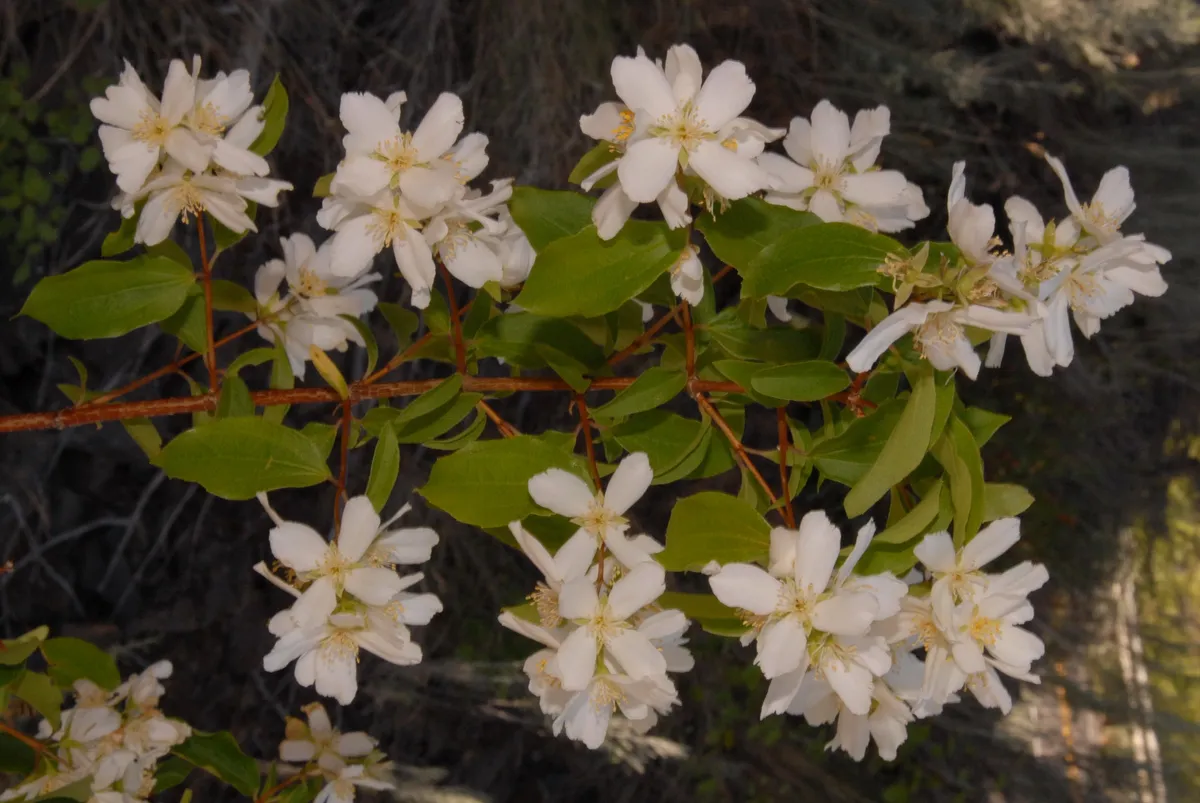
Philadelphus lewisii is a deciduous shrub found along streambanks, canyon slopes and open woodlands from the Pacific Northwest into the northern Rockies, with fragrant white flowers opening in May and June.
Toxicity unknown
Lewis's mock orange (Philadelphus lewisii) is not listed by the ASPCA Animal Poison Control Center (opens in new tab) or the other sources we check, so we have no verdict for it either way. Absence from those lists is not a clearance. If your pet shows symptoms after eating any plant, call the ASPCA at (888) 426-4435.
Light
full sun
Water
medium
Size
60"–120" H × 60"–96" W
Bloom
May, Jun
Native to
CA, ID, MT, OR and 1 more states
Pollinators
bees, butterflies
Before you buy
Your city may pay you to plant this
Cities and water utilities offer rebates for replacing lawn with native and water-wise plants. We track 459 programs across 44 states, each with a link to the provider and the date we last checked it.
Find rebates in your areaPicture natives in your own yard
Upload a photo of your yard and Patch Vision shows a rendering of it planted with natives for your region, like Lewis's mock orange.


Browse plants for this ecoregion
This mock orange is a deciduous, multi-stemmed shrub known for its arching branches and clusters of fragrant, four-petaled white flowers in late spring. Found naturally along stream banks, rocky slopes, and open woodlands, it has an informal, airy habit suited to naturalized borders and mixed shrub plantings.
Growing Lewis's mock orange
Grow Lewis's mock orange in full sun and medium water. Mature plants reach 60 to 120 inches tall and spread 60 to 96 inches wide. Expect low maintenance to keep it looking intentional in a front yard.
How to care for Lewis's mock orange, by region
How to care for Lewis's mock orange where it is actually grown: year-round basics plus what to do each season, region by region, with the sources for each.
Care guidance last updated: July 2026
Willamette Valley (includes Portland, OR)
Year-round
Lewis' mock orange is a deciduous, multi-stemmed shrub that grows up to about 12 feet tall, with arching branches and clusters of fragrant white flowers in late spring. It is native to the Willamette Valley and much of the Pacific Northwest, from British Columbia south into northern California, per the Lady Bird Johnson Wildflower Center. Give it full sun to part shade and let it dry out between waterings once established, it tolerates lean, rocky soil well.
- Establishment: water a newly planted shrub deeply once or twice a week through its first growing season so the root system settles in.
- Once established: it is a genuinely low water shrub and does best with infrequent deep watering rather than frequent shallow watering, per the USDA NRCS plant guide.
- It tolerates a wide range of soils, including rocky or lean ground, and does not need fertilizer to perform well.
- Its arching form benefits from occasional thinning of older canes at the base rather than shearing, which preserves the natural shape.
Its naturally arching, informal form reads best as part of a mixed shrub border or screening planting rather than a clipped formal hedge, and a light thinning after bloom keeps it looking maintained.
Fall
Fall brings the return of Willamette Valley rains, which is typically enough to carry an established shrub through the season without supplemental watering.
- This is a good secondary planting window for new shrubs, cooler temperatures and returning rain reduce transplant stress.
- Clean up any fallen leaves at the base to reduce fungal issues over winter.
- No pruning is needed now, save any shaping for right after next spring's bloom.
Winter
Winter is dormancy. The deciduous leaves drop and the shrub's bare, arching branch structure is visible until new growth returns in spring.
- No care is needed during dormancy beyond avoiding heavy foot traffic or soil compaction near the root zone.
- If any structural pruning is needed, wait until right after next spring's bloom rather than cutting into dormant wood now, since flower buds are already set.
- A light layer of mulch over the root zone is optional and helps moderate soil temperature, but this shrub does not need winter protection in the Willamette Valley climate.
Spring
Spring is the main bloom window. Around Portland, Lewis' mock orange typically flowers from April into June, with clusters of fragrant, orange-blossom-scented white flowers covering the arching branches.
- This is the best time to plant new shrubs from containers, before summer heat and dry weather set in.
- Avoid pruning now, flower buds form on the previous year's wood, so a spring cut removes this year's bloom.
- Water new plantings regularly as spring rains taper off, to help roots establish before the dry season.
Summer
Summer in the Willamette Valley is typically dry, and Lewis' mock orange, rated low water use by the USDA once established, needs little supplemental irrigation beyond an occasional deep soak in a long dry stretch.
- Prune right after flowering finishes, removing spent flower clusters and thinning a few of the oldest canes at the base.
- Newly planted shrubs still benefit from a deep watering every one to two weeks through the dry season.
- Established plants tolerate the region's dry summers without irrigation, per the USDA plant guide's low water-use rating.
Sources: Lady Bird Johnson Wildflower Center, Philadelphus lewisii, USDA NRCS Plant Guide, Lewis' Mockorange (Philadelphus lewisii)
In an HOA neighborhood
Lewis's mock orange is an HOA-friendly choice. Maintenance level: low. Tidiness: 3 out of 5.
Works well in: mixed shrub border, naturalized planting, screening.
- informal, arching habit needs room to spread
- may need occasional thinning after bloom to maintain shape
Wildlife value
Profuse, fragrant late-spring flowers attract bees and butterflies for nectar and pollen.
Common questions
- When does Lewis's mock orange bloom?
- It flowers in May and June, producing clusters of fragrant white blossoms along its arching branches.
- What pollinators visit Lewis's mock orange?
- Bees and butterflies are the main visitors, drawn to the fragrance and open shape of the white flowers.
- How much light does this shrub need to flower well?
- It flowers most heavily in full sun but will still bloom, with a somewhat looser habit, in part sun or part shade.
- How much water does Lewis's mock orange need?
- It grows best with medium moisture and appreciates some water during dry summer stretches, though established plants can handle brief periods of low water once rooted in.
- What kind of habitat suits this shrub?
- It is often found on canyon slopes, along streambanks, and at the edges of open woodlands, where it gets good drainage and some seasonal moisture.
- Is Lewis's mock orange HOA-friendly?
- Lewis's mock orange is generally an HOA-friendly choice in the right placement, with low maintenance.
These answers were drafted with an AI model from this plant's data. Verify care details with a local expert.
Native range data from the World Checklist of Vascular Plants (Kew). Pollinator and host plant associations compiled from GBIF, iNaturalist, and published ecological literature.
If something looks wrong
Common plant problems, and what to check first
These come up on almost any plant. Each guide lists the likely causes in the order they are worth ruling out, with one thing to check before you act on any of them, and links to the source it came from.
- It is dying right after planting
- Leaves turning yellow
- Wilting even though I watered it
- Brown crispy leaf tips
- Bugs on the plant
Ready to grow Lewis's mock orange? Add it to your garden in Pollinator Patch to track it and get season-by-season care guidance.