Election-pink
Rhododendron periclymenoides
Last reviewed: June 2026
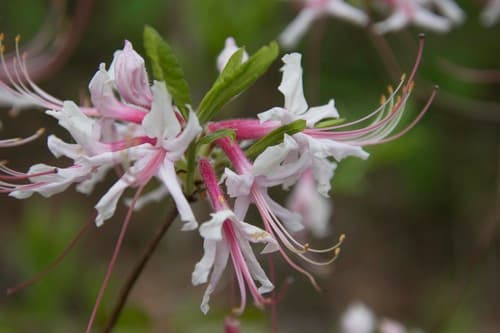
Rhododendron periclymenoides is a native deciduous shrub blooming pink flowers in May and June across eastern states from Georgia to Vermont. This election-pink attracts bees and butterflies in partial shade gardens.
Election-pink is toxic to dogs and cats.
Listed as toxic by the ASPCA Animal Poison Control Center (opens in new tab) (last reviewed 2026-05-21). If your pet has been exposed, call the ASPCA Animal Poison Control Center at (888) 426-4435and your veterinarian's emergency line.
Pollinator Patch flags toxic plants so you can choose a pet-safe native alternative for your yard.
The USDA PLANTS Database (opens in new tab) does not flag Election-pink as toxic to livestock.
Light
part shade
Water
medium
Size
48"–120" H × 48"–120" W
Bloom
May, Jun
Native to
AL, CT, DE, GA and 15 more states
Pollinators
bees, butterflies
Pinxter azalea is a native deciduous shrub that produces clusters of fragrant pink flowers in late spring before the leaves fully emerge. This shrub provides excellent seasonal interest with its showy blooms and fall color.
Growing Election-pink
Grow Election-pink in part shade and medium water. Mature plants reach 48 to 120 inches tall and spread 48 to 120 inches wide. Expect low maintenance to keep it looking intentional in a front yard.
In an HOA neighborhood
Election-pink is an HOA-friendly choice. Maintenance level: low. Tidiness: 4 out of 5.
Works well in: front yard, foundation, mid zone.
- Large mature size requires adequate spacing
- May look sparse in winter as deciduous shrub
Wildlife value
The flowers attract native bees, butterflies, and hummingbirds during its May-June bloom period. As a native azalea, it supports specialized native pollinators that have co-evolved with this species.
Common questions
- When does Rhododendron periclymenoides bloom?
- Rhododendron periclymenoides blooms in May and June, producing clusters of fragrant pink flowers that attract pollinators.
- What pollinators visit election-pink azalea?
- Bees and butterflies are the primary pollinators of Rhododendron periclymenoides, visiting the flowers for nectar during the spring blooming period.
- Where is Rhododendron periclymenoides native?
- This species is native to eastern North America, ranging from Georgia and Alabama north through the Mid-Atlantic states to Vermont and west to Illinois and Kentucky.
- What growing conditions does election-pink prefer?
- Rhododendron periclymenoides thrives in partial shade with medium moisture, though it can tolerate a range of light and water conditions in woodland gardens.
- Is Election-pink toxic to dogs?
- Yes. Election-pink is listed as toxic to dogs by the ASPCA Animal Poison Control Center (aspca.org). If your pet has been exposed, call the ASPCA Animal Poison Control Center at (888) 426-4435.
- Is Election-pink toxic to cats?
- Yes. Election-pink is listed as toxic to cats by the ASPCA Animal Poison Control Center (aspca.org). If your cat has been exposed, call the ASPCA Animal Poison Control Center at (888) 426-4435.
- Is Election-pink toxic to livestock?
- The USDA PLANTS Database does not flag Election-pink as toxic to livestock.
- Is Election-pink HOA-friendly?
- Election-pink is generally an HOA-friendly choice in the right placement, with low maintenance.
Native range data from the USDA PLANTS Database and regional native plant society lists. Pollinator and host plant associations compiled from GBIF, iNaturalist, and published ecological literature.
Pollinator Patch flags toxic plants like Election-pink and shows pet-safe natives for your ecoregion instead.
Not sure where to start? Take the 2-minute yard quiz