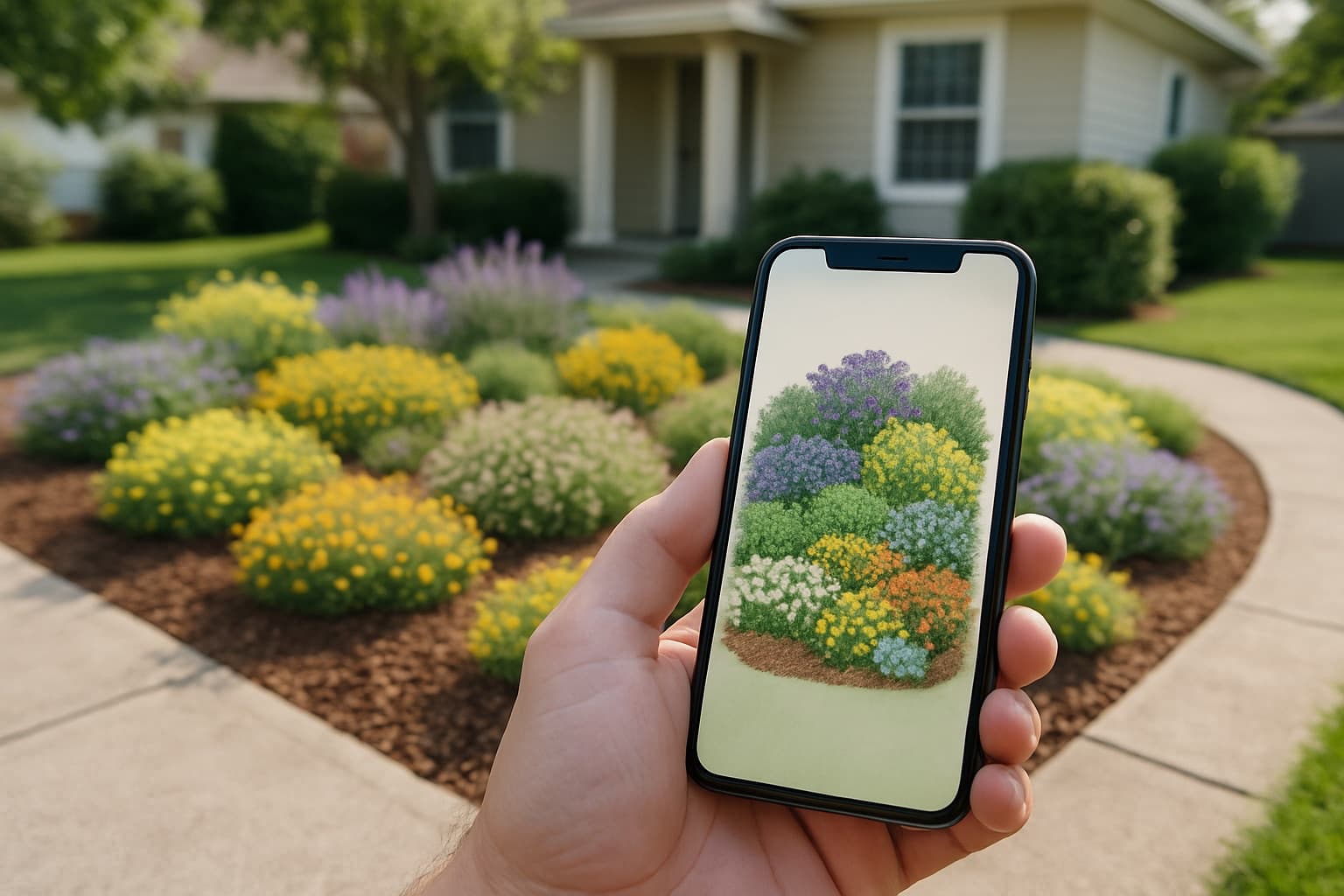
Garden and Plant Apps in 2026: A Field Guide to What They Actually Do
The short version
- Garden apps do five different jobs: plant ID, plant care, AI yard renders, native planning, and HOA/rebate help. Most apps are good at one.
- Plant ID is mature and mostly free: Pl@ntNet and iNaturalist are research-backed and free; PictureThis and PlantSnap are freemium.
- AI yard visualizers (FlorAI, Yard AI, iScape) make inspiring renders but often do not confirm the plants are native to your region or HOA-friendly.
- Native plant planners (Wild Thumb for Texas, Native Garden Planner) start from what belongs in your ecoregion.
- Almost no app covers HOA-conscious design plus rebate guidance. That gap is where Pollinator Patch focuses, nationwide.
Quick answer
Garden and plant apps do five different jobs: identify a plant, remind you to care for it, redraw your yard with AI, plan a region-appropriate native garden, or help you get a native yard past an HOA. Most apps are very good at one job. Plant ID (PlantSnap, Pl@ntNet, PictureThis, iNaturalist) and AI yard renders (FlorAI, Yard AI, iScape) are crowded. The job almost no app covers is HOA-conscious native design with rebate guidance, which is where Pollinator Patch focuses.
2026 has been a flood year for garden apps. AI tools made it cheap to ship one, so the app stores now carry everything from plant scanners to photo-to-render yard designers, many launched in the last few months. The names blur together and the screenshots look alike, which makes it hard to tell what any given app actually does for you. The useful way to sort them is by the job they do, not by how the listing looks. Here is the whole field, grouped by job, and where Pollinator Patch sits in it.
The field at a glance
The short version: for a fast photorealistic render, Gardenly or FlorAI; for naming a plant, Pl@ntNet or iNaturalist, both free; for keeping plants alive, Planta; for free Texas-only native planning, Wild Thumb; and for planning an HOA-conscious native front yard nationwide, with region-matched plants and the rebate programs at your address, Pollinator Patch. The table sorts the field by the job each app does best.
| App | Best at | Native-first? | Platforms | Price (July 2026) |
|---|---|---|---|---|
| Pollinator Patch | HOA-conscious native front-yard planning plus rebate lookup | Yes, by ZIP and ecoregion | iOS, Android, web | Free; Pro $5.99/mo or $44.99/yr |
| Native Garden Planner | True-to-scale drag-and-drop native layout | Yes, 2,000+ natives | Web only | Free tier; paid Pro for designers |
| Wild Thumb | Texas native planning, nonprofit | Yes, Texas ecoregion | iOS, Android | Free |
| Gardenly | Fast photorealistic AI yard render | Partial, climate-adapted | iOS, web | Paid; $54/yr Starter, $84/yr Pro |
| iScape | DIY and pro landscape design with AR and 3D | No, general landscape | iOS, Android | Free tier; Pro $29.99/mo or $299.99/yr |
| PictureThis | Plant identification | No, ID only | iOS, Android | $39.99/yr after a 7-day trial |
| Pl@ntNet, iNaturalist | Free plant ID and citizen science | No, ID only | iOS, Android, web | Free |
| Lady Bird Johnson Wildflower Center | Native plant reference database | Yes, national | Web | Free |
Prices verified against each app's official pricing page and App Store listing in July 2026. Subscription prices change and often vary by region, so check the current listing before you buy.
The five jobs garden apps actually do
Almost every gardening app on the App Store or Google Play is built around one of five jobs. A few try to span two. Knowing which job you need is most of the decision.
- Plant identification. Point your camera at a plant and get a name.
- Plant care and reminders. Track what you own and get watering or fertilizing nudges.
- AI yard visualization. Upload a photo of your yard and get an AI-rendered redesign.
- Native plant planning. Get plants that belong in your region and lay them out.
- HOA and rebate navigation. Design a native yard that reads as intentional to an HOA, and find money to fund it.
Plant identification apps
This is the most crowded category and the most mature. These apps are genuinely good at naming a plant from a photo, and several are free or close to it.
- Pl@ntNet is a free, research-backed identifier run by a consortium of French scientific institutions. No ads, no upsell, strong accuracy on wild flora.
- iNaturalist and its Seek companion are free, run by the California Academy of Sciences and National Geographic, and double as a citizen-science platform. Your observations feed real biodiversity data.
- PictureThis and PlantSnap are the big freemium players. Fast identification, large databases, plus care tips, with most depth behind a subscription.
- Google Lens identifies plants for free inside a tool most people already have, with no gardening features attached.
- Garden Answers pairs identification with a plant-problem and pest angle.
If naming a plant is your only need, you are spoiled for choice and you do not need to pay. Pollinator Patch is not trying to win this job. Its in-app assistant, Ask Patch, answers plant and care questions, but a dedicated identifier will out-scan it on raw photo ID.
Plant care and reminder apps
These keep houseplants and garden plants alive with schedules and logging. Planta is the standout, with watering schedules tuned to light and species, a clean interface, and a subscription model. Greg and Vera play in the same space. They shine for container and indoor collections. They do little for the question of what to plant in the ground in your specific region, which is a different job handled below.
AI yard visualizers
This is the category that exploded in 2026. You upload a photo of your yard and an AI returns a redesigned version in seconds. The renders are genuinely fun and useful for getting unstuck on a blank yard.
- FlorAI turns a yard photo into a photorealistic redesign and offers style presets including pollinator and native-plant looks, plus plant identification and plant-health checks. It launched in April 2026.
- Yard AI focuses on backyard renders with hardscape presets like patios, pergolas, and fire pits.
- iScape and DreamzAR have been in this space longer, with more hands-on placement tools alongside the AI generation.
The honest limit of this category is the gap between a render and a plantable plan. A photorealistic image of your yard is inspiration. It usually does not tell you whether the plants in the picture are native to your area, whether they will survive your soil and rainfall, how big they get, or whether the look will read as intentional to an HOA reviewer. Many of these apps treat plant choice as an aesthetic style rather than a regional fact. Pollinator Patch sits on the design side too, with its Garden Planner before-and-after view, which generates its renderings with an AI image model as well, but the plants it places come from a database matched to your ZIP and ecoregion, so the picture maps to a yard you can actually buy and plant.
Native plant planners
This smaller group starts from the right question: what belongs in your region. Pollinator Patch lives here, and so do two others worth knowing.
- Wild Thumb is a free app from the non-profit Texas Parks and Wildlife Foundation. It detects your Texas ecoregion from your ZIP code, recommends native plants from a curated climate database, and includes a landscape design tool, care reminders, freeze alerts, and a native-nursery locator. It is a genuinely good, mission-driven app, and if you garden in Texas it is well worth having. We wrote a full Wild Thumb and Pollinator Patch comparison for Texas gardeners deciding between or combining the two.
- Native Garden Planner is a web-based design tool with a catalog of more than 2,000 native plants filterable by region, sun, soil, bloom time, and pollinator value, plus true-to-scale drag-and-drop layouts and PDF export.
For a Texas-specific look at the native planners, including iNaturalist, iScape, and Yardzen, see our best native plant apps for Texas roundup.
HOA and rebate navigation: the job almost nobody covers
Here is the gap. Plenty of apps will name a plant, render a pretty yard, or list native species. Very few help with the two things that actually stop HOA-conscious homeowners from converting a front yard: will this get a complaint, and can I get help paying for it.
On the HOA side, design choices matter as much as plant choices. Low borders, mounded shapes, clean mulched edges, and visible structure are the cues that read as intentional to a reviewer. Where state law applies, it can also be on your side. Texas Property Code §202.007, for example, limits how an HOA can restrict water-conserving landscaping. Pollinator Patch is built around this, designing layouts that lean on those cues of care, and its library of HOA articles walks through pre-approval, violation letters, and what is and is not enforceable.
On the money side, hundreds of US cities and water utilities pay homeowners to replace turf with water-wise landscaping. Those programs are real but scattered, and each utility runs its own estimator and application. Pollinator Patch looks up the rebate programs available at your address and points you to the official source. A render of your yard will not tell you that your city offers a few dollars per square foot to do the project.
How to choose: the five questions that sort the field
Run any garden app through these five questions and the right pick for your situation falls out quickly.
- Does it ground plant picks in your ecoregion, not just your USDA zone? Zone tells you cold tolerance. Ecoregion tells you what actually belongs there. Pollinator Patch and Wild Thumb work from ecoregion. Most ID and render apps do not.
- Does it help with HOA acceptance? Design cues, pre-approval paperwork, and the law in your state. This is rare. Pollinator Patch is built around it.
- Does it surface rebates? Money to fund the conversion. Almost no consumer app does this. Pollinator Patch does.
- Does it cite its sources? Pet toxicity, legal claims, and native range should point to a real authority. Pollinator Patch flags plant toxicity to dogs, cats, and horses using the ASPCA Animal Poison Control Center plant database.
- Does it cover your state? Wild Thumb is Texas only today. Pollinator Patch works nationwide, with the deepest plant data in Texas and California.
Where Pollinator Patch fits
Pollinator Patch is not the app to grab if you just want to name a houseplant or generate a one-off render to show your spouse. The dedicated identifiers and the AI visualizers do those single jobs well. Pollinator Patch is for the homeowner who wants to convert a front yard to natives, keep the HOA quiet while doing it, and get a rebate to help pay for it. That full path, from region-matched plants to HOA-conscious layout to local rebate, is the job the rest of the field leaves mostly uncovered. You can try it free on the web with no signup.
Frequently asked questions
What is the best garden app in 2026?
It depends on the job. For naming a plant, Pl@ntNet and iNaturalist are free and excellent. For keeping plants alive, Planta leads. For a quick AI render, FlorAI and Yard AI are fast. For planning a region-appropriate native yard, getting it past an HOA, and finding rebates, Pollinator Patch covers the whole path.
Are AI garden design apps accurate?
AI render apps produce convincing, inspiring images, but the picture is the easy part. Many do not confirm that the plants shown are native to your area, suited to your soil and rainfall, or sized for the space. Treat the render as inspiration and check the plant list against a regional source before you buy.
Which garden app helps with HOA rules?
Very few. Most apps stop at plant choice. Pollinator Patch is built around HOA-conscious design, with layouts that use cues of care and a library of articles on pre-approval and enforceability. Where state law applies, such as Texas Property Code §202.007 on water-conserving landscaping, it can also work in your favor.
Is there a free garden app?
Yes. Pl@ntNet, iNaturalist, and Google Lens are free for plant ID. Wild Thumb is fully free for Texas native gardening, from the Texas Parks and Wildlife Foundation. Pollinator Patch is free to start, with a Pro tier for advanced features.
What is the difference between a plant ID app and a garden design app?
A plant ID app names a plant you point your camera at. A garden design app lays out a yard. A native plant planner does design while making sure the plants belong in your region. They are different jobs, and many homeowners end up using one of each.
Plan a native front yard with Pollinator Patch
Get plants matched to your ZIP and ecoregion, an HOA-conscious layout, and the rebate programs available in your city. Free to try on the web.
Open the appSee a finished plan for a yard like this
Find our guides useful? Add Pollinator Patch as a preferred source on Google and articles like this one will show up higher in your own search results.