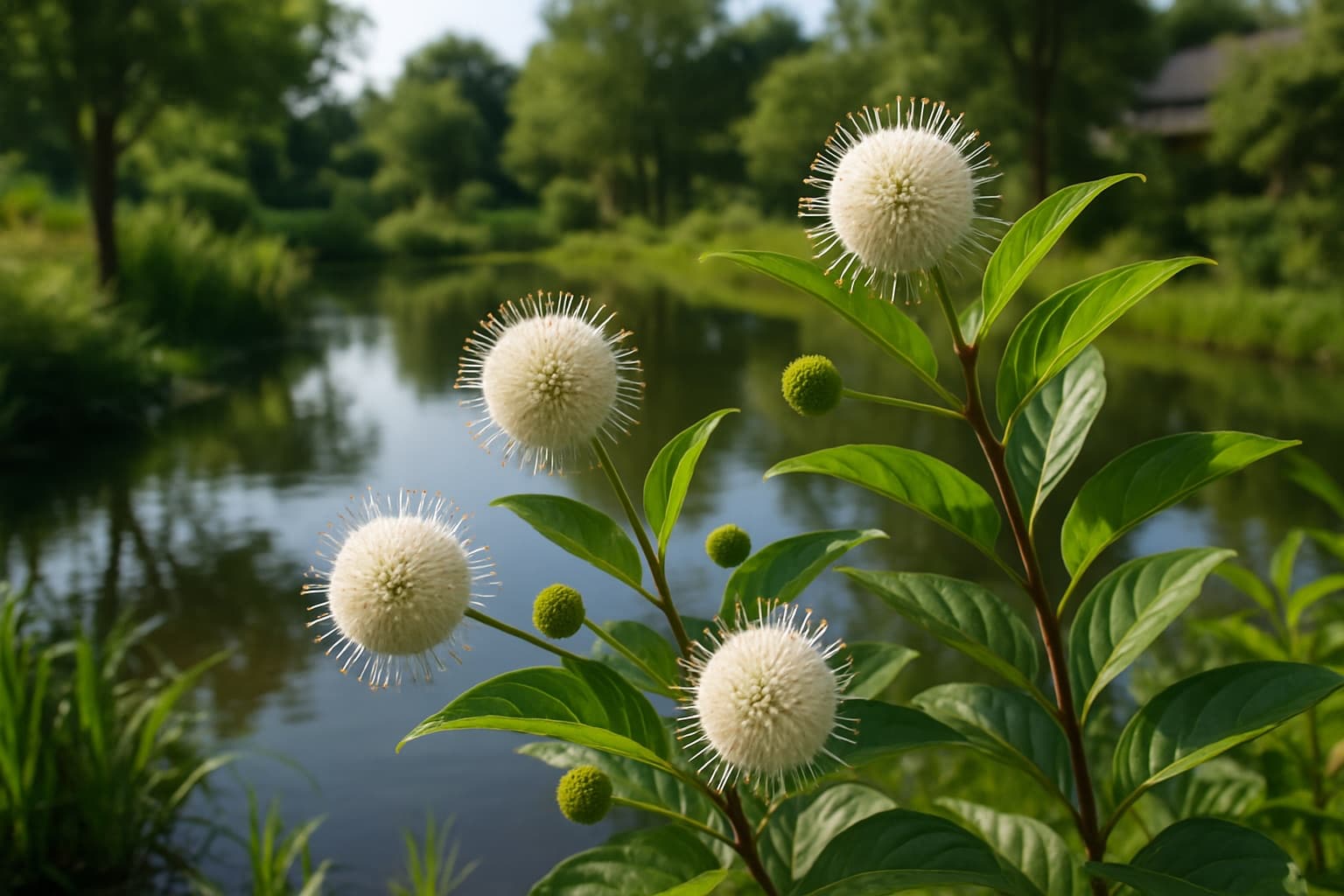
Is Buttonbush Toxic to Dogs?
The short version
- Buttonbush (Cephalanthus occidentalis) is not on the ASPCA toxic plant list for dogs, cats, or horses.
- Native to the Texas Post Oak Savanna (College Station area), thriving at pond and creek edges.
- Separately documented as a cattle forage hazard in some livestock literature, distinct from the ASPCA companion-animal list.
Quick answer
Buttonbush (Cephalanthus occidentalis) is not on the ASPCA Animal Poison Control Center toxic plant list for dogs, cats, or horses. It is not considered toxic to pets by that standard, which makes it a solid pick for the wet, low spot in a Texas yard where a dog also spends time. As with any plant, a dog that eats a large amount can get mild stomach upset. If that happens, call the ASPCA Animal Poison Control Center at (888) 426-4435.
Most Texas yards have one spot that stays soggy longer than the rest, a low corner, a ditch line, the edge of a drainage swale, and most classic shrubs sulk or rot there. Buttonbush is built for exactly that ground. It is native to Texas, it tolerates standing water without complaint, and for a dog owner deciding what to plant in a wet corner, it does not carry the ASPCA toxicity concerns that come with several popular ornamentals.
What the ASPCA says
Buttonbush (Cephalanthus occidentalis) does not appear on the ASPCA Animal Poison Control Center toxic plant list for dogs, cats, or horses. Older livestock and forage toxicology references have flagged buttonbush leaves as a hazard to cattle in some contexts, so it is worth being transparent about that distinction rather than treating the plant as risk-free for every animal. But for dogs, cats, and horses specifically, it does not show up on the ASPCA's list, and you can check that list directly at aspca.org/pet-care/animal-poison-control/toxic-and-non-toxic-plants.
The usual caveat still applies. A dog that eats a large quantity of any plant material, leaves, stems, or flowers, can end up with mild gastrointestinal upset, and that is true of most landscape plants regardless of ASPCA status. Buttonbush is not an exception to that general rule, it is simply not one of the species with a documented systemic toxin on the ASPCA's dog, cat, and horse list.
Why Buttonbush earns a spot in a wet corner of a Texas yard
Buttonbush is native and widespread across most of Texas, particularly at pond edges, ditches, and wetland margins, and it is strongly present in the Post Oak Savanna (College Station area), per the Lady Bird Johnson Wildflower Center. It is a deciduous native shrub, typically 6 to 12 feet, that grows naturally at pond and creek edges, which is a hint about where it will actually thrive in a home landscape. In summer it produces round, spherical white flower balls, often described as pincushions, that draw a steady stream of pollinators. Butterflies, including swallowtails, and native bees work the blooms heavily, and buttonbush also serves as a larval host plant for the titan sphinx moth.
The practical case for a dog owner is the wet-soil tolerance itself. Two of the most common toxic ornamentals people reach for in Texas yards, oleander and azalea, do not tolerate standing water the way buttonbush does, so a soggy low spot rarely suits them well anyway. Buttonbush fills that same low, poorly-drained ground with a native shrub that is not on the ASPCA toxic list and that pulls its weight for pollinators through the summer.
If something goes wrong
ASPCA Animal Poison Control Center: (888) 426-4435 (24/7, fee may apply). Have the plant name ready when you call.
Checking more than one plant? See the full list of plants toxic to dogs and cats, with native alternatives, covering every plant on the ASPCA list.
See a finished plan for a yard like this
Find our guides useful? Add Pollinator Patch as a preferred source on Google and articles like this one will show up higher in your own search results.