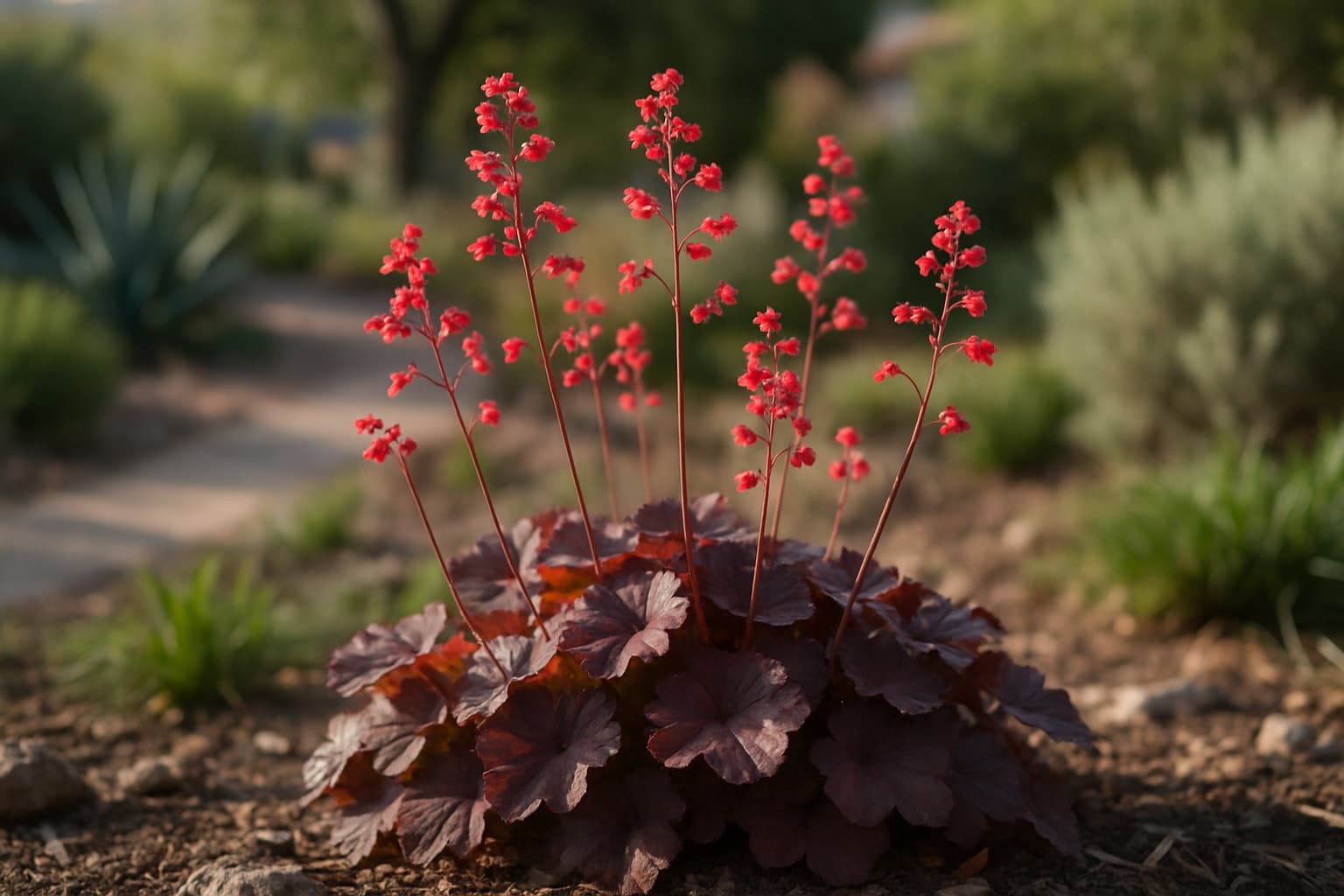
Is Coral Bells Toxic to Dogs?
The short version
- Coral Bells (Heuchera sanguinea) carries an explicit ASPCA non-toxic listing under both "Coral Bells" and "Alumroot".
- Native to the Trans-Pecos / Chihuahuan Desert mountains of far West Texas (El Paso area), not the whole state.
- A compact, colorful perennial whose red-coral flowers draw hummingbirds.
Quick answer
Coral Bells (Heuchera sanguinea) carries an explicit non-toxic listing from the ASPCA Animal Poison Control Center under both the names Coral Bells and Alumroot. That is a real entry stating the plant is not toxic to dogs, not just an absence from the toxic list. As with any plant, a dog that eats a large amount can get mild stomach upset. If that happens, call the ASPCA Animal Poison Control Center at (888) 426-4435.
Coral Bells is a compact, colorful perennial grown mostly for its mounded foliage and its thin stems of small bell-shaped flowers. It is also one of the stronger picks for a dog owner, since the ASPCA database does not just skip over it, the database lists it by name as non-toxic.
What the ASPCA says
Coral Bells (Heuchera sanguinea) appears in the ASPCA Animal Poison Control Center plant database under both of its common names, Coral Bells and Alumroot, with an explicit non-toxic listing for dogs. That is a stronger signal than simply not finding a plant on the toxic list: the ASPCA has evaluated the species and recorded it as safe from a toxicity standpoint. You can verify at aspca.org/pet-care/animal-poison-control/toxic-and-non-toxic-plants.
The usual caveat still applies. A dog that eats a large quantity of any plant material, including foliage or flowers that are not toxic, can end up with mild gastrointestinal upset simply from the volume and fiber involved. That is not a toxicity concern, just a reason to keep an eye on a dog that decides to graze.
Where Coral Bells is actually native in Texas
Heuchera sanguinea is native to the southwestern United States and northern Mexico, and within Texas its native range is limited to the mountains of the Trans-Pecos, the Chihuahuan Desert ecoregion around the Davis Mountains and Chisos Mountains in the far west of the state. The honest anchor for this range is the Trans-Pecos / Chihuahuan Desert (El Paso area), per the Lady Bird Johnson Wildflower Center, not the rest of Texas.
Most Coral Bells sold at Texas nurseries are hybrid cultivars bred from Heuchera sanguinea and related species, chosen for foliage color rather than for matching the wild Trans-Pecos native form. That is worth knowing before calling a nursery plant "native" outside far West Texas: the species is a mountain native there, while the cultivars sold statewide are garden hybrids rather than the wild plant itself.
Why it earns a spot in a dog yard
Coral Bells is a low, clumping perennial, evergreen to semi-evergreen, that typically reaches 12 to 18 inches tall in bloom. Most of that height comes from tall, thin, wiry flower stems topped with small bell-shaped red to coral blooms in late spring and summer, blooms that hummingbirds visit regularly. The foliage itself stays low and mounded, rounded and lobed, and depending on the cultivar can run green, purple, or bronze.
It handles part shade to full sun in cooler areas and, once established, tolerates drought well. The tidy, compact mound it forms reads as an intentional planting rather than something that got away from the gardener, which makes it an easy choice for a border or rock garden in an HOA-conscious front bed.
If something goes wrong
ASPCA Animal Poison Control Center: (888) 426-4435 (24/7, fee may apply). Have the plant name ready when you call.
Checking more than one plant? See the full list of plants toxic to dogs and cats, with native alternatives, covering every plant on the ASPCA list.
See a finished plan for a yard like this
Find our guides useful? Add Pollinator Patch as a preferred source on Google and articles like this one will show up higher in your own search results.