Bahama coffee
Psychotria ligustrifolia
Last reviewed: September 2026
Toxicity unknown
Bahama coffee (Psychotria ligustrifolia) is not listed by the ASPCA Animal Poison Control Center (opens in new tab) or the other sources we check, so we have no verdict for it either way. Absence from those lists is not a clearance. If your pet shows symptoms after eating any plant, call the ASPCA at (888) 426-4435.
Light
part shade
Water
medium
Size
36"–96" H × 36"–72" W
Bloom
Apr, May, Jun
Native to
FL
Pollinators
bees, butterflies
Before you buy
Your city may pay you to plant this
Cities and water utilities offer rebates for replacing lawn with native and water-wise plants. We track 452 programs across 44 states, each with a link to the provider and the date we last checked it.
Find rebates in your areaBrowse plants for this ecoregion
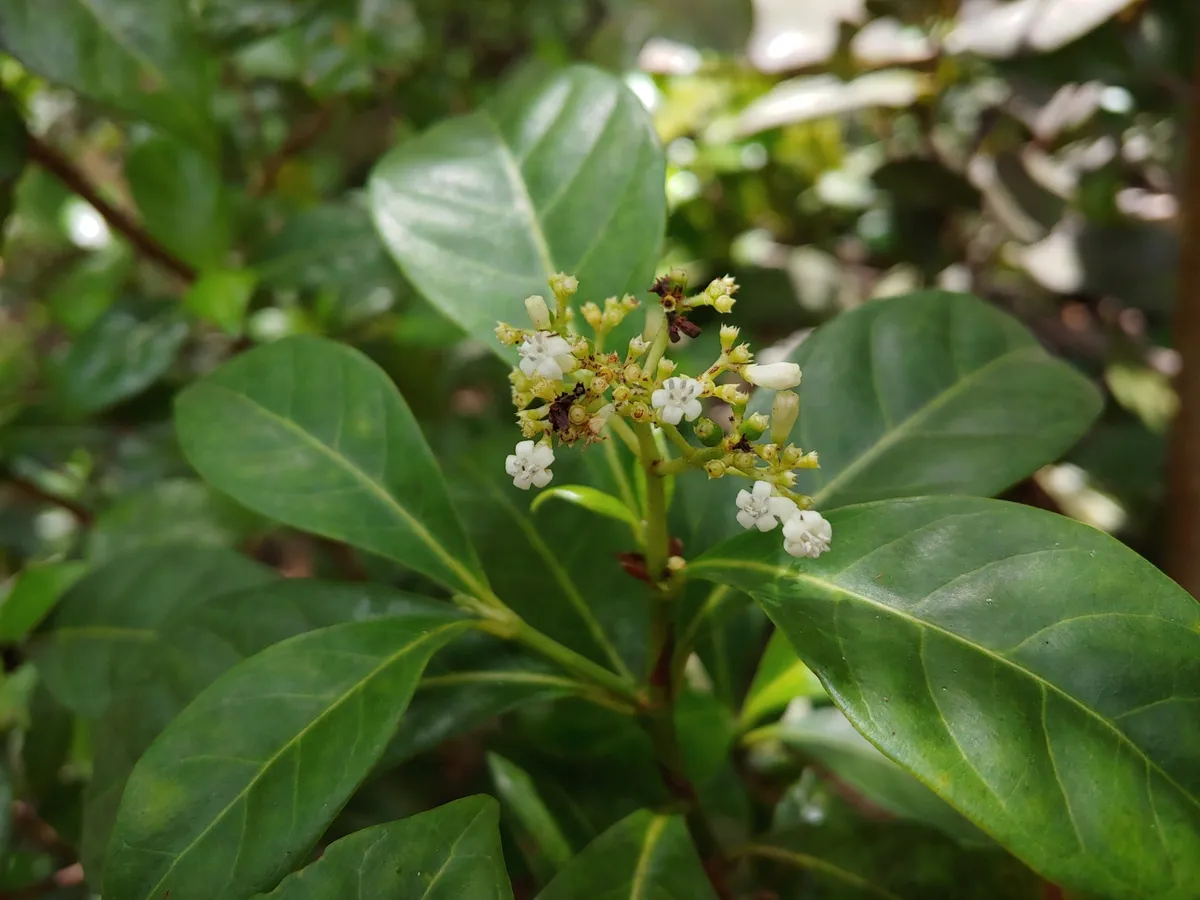
A dense, evergreen shrub with glossy, dark green, leathery leaves and small clusters of white flowers followed by red or black berries. Grows in the shaded understory of tropical hardwood hammocks.
How to care for Bahama coffee, by region
How to care for Bahama coffee where it is actually grown: year-round basics plus what to do each season, region by region, with the sources for each.
Care guidance last updated: September 2026
Southern Coastal Plain (includes Orlando, FL)
Year-round
Bahama coffee is native to South Florida's rockland hammocks (the Keys and Miami-Dade County) and the Bahamas, not to the Orlando area. Grown here it works as a compact, glossy-leaved hedge or accent shrub, but it needs a warm, sheltered spot and winter protection since Orlando sits right at the cold edge of where this plant reliably survives outdoors.
- Give it part sun to full sun with soil that stays evenly moist. It is not built for standing water or for long dry stretches once established.
- Plant it in a sheltered spot, close to the house or under high tree canopy, since UF/IFAS rates it for USDA zones 9b through 11 and Orlando's occasional hard freezes fall right at that edge.
- Expect a rounded shrub in the 3 to 4 foot range with dense, dark green, shiny leaves, smaller and more compact than the more common wild coffee (Psychotria nervosa) sold in most Central Florida nurseries.
- White flowers and red berries can show up nearly year round in a mild year, drawing butterflies to the flowers and birds to the fruit.
Its naturally tidy, rounded habit and glossy foliage make it a good low hedge or foundation shrub choice without much shaping needed.
Fall
Growth slows as fall arrives in Orlando, making this a good window for the season's real shaping cut before cooler weather sets in.
- Do a light shaping prune in early fall while the plant is still actively growing, rather than waiting until after the first cold snap.
- Hold off on fertilizing by mid to late fall so the plant is not pushing tender new growth right before Orlando's first cool nights, which typically arrive in November or December.
- Keep an eye on the extended forecast. UF/IFAS rates this species for zones 9b through 11, and Orlando can dip into the upper 9b range on a cold fall night.
- Refresh the mulch ring around the base going into fall to help buffer the roots ahead of winter.
A fall shaping prune and fresh mulch ring give the shrub a clean, edged look going into the season, useful for an HOA-conscious front yard.
Winter
Winter is the main risk period for Bahama coffee in Orlando. A hard freeze can knock it back to the ground, though UF/IFAS notes it usually regrows from the base once warm weather returns.
- Mulch the root zone before the first freeze. UF/IFAS recommends mulching wild coffee species in Florida's cooler regions to buffer the roots.
- Cover the shrub or move container plants to a sheltered spot when a hard freeze is forecast, since this species is rated for zones 9b through 11 and Orlando sits right at that line.
- Leave frost-blackened leaves and stems in place until spring instead of cutting them back right away. UF/IFAS notes this species usually regrows from the base once warm weather returns.
- Water the plant well before a freeze rather than during one. A well-watered plant tends to handle cold stress better than a drought-stressed one.
Frost-damaged growth can look rough for a few weeks in winter. It's worth leaving in place for the plant's health rather than cutting it back right away for a tidy look, since that pruning is better done once spring growth resumes.
Spring
Spring is when Bahama coffee wakes up from any winter dieback and pushes fresh growth. It is also the best window to clean up frost damage and to start new plants.
- Check the base of the plant for new shoots before assuming a plant that looked bare in January is dead. UF/IFAS notes this species usually regrows from the ground after a hard freeze.
- Once new growth is a few inches long, cut back any dead winter twigs the plant did not regrow.
- Spring and early summer are the best window for rooting softwood cuttings, 2 to 4 inches long, if you want to propagate more plants.
- Start watering deeply once a week if Orlando's spring dry spell sets in (typically March through May), since the plant does not handle long dry periods well.
- Apply a slow-release fertilizer around the base as new growth begins, following the product label.
Clearing out winter-damaged stems in spring keeps the shrub looking tidy again after a rough winter, rather than left visibly bare.
Summer
Summer is Orlando's rainy season and Bahama coffee's peak bloom and growth period, so the main job is managing the extra rain and keeping the shrub in shape.
- Make sure the planting spot drains well. Orlando's daily summer thunderstorms can leave standing water, and this species prefers evenly moist soil over waterlogged soil.
- This is the plant's main bloom season for the small white flowers that draw butterflies, so hold off on heavy pruning while it is in full flower.
- Trim lightly for shape after a flush of new growth rather than a hard cutback. It tolerates shade through full sun, so a spot under high canopy still performs well through Orlando's peak heat.
- Watch new leaves for scorch in full-sun spots during the hottest weeks. Part shade is a gentler choice for a plant naturally suited to hammock understory.
A light summer trim keeps a hedge or foundation planting looking neat through the peak growing season, since this is when it grows fastest.
Sources: Lady Bird Johnson Wildflower Center: Psychotria ligustrifolia, Florida Native Plant Society: Psychotria ligustrifolia, UF/IFAS Extension EP651: How to Identify and Propagate Different Types of Wild Coffee for Your Florida Garden
Want these tasks as reminders timed to your yard? Pollinator Patch turns this guidance into a season-by-season care plan for the plants you actually grow.
Wildlife value
The flowers attract small bees and butterflies, and the berries are an important food source for understory birds.
Common questions
- How much sun does Bahama coffee need?
- Bahama coffee grows best in part shade conditions.
- When does Bahama coffee bloom?
- Bahama coffee blooms in April, May, and June.
- Where is Bahama coffee native?
- Bahama coffee (Psychotria ligustrifolia) is native to FL, per the World Checklist of Vascular Plants (Kew).
- What pollinators does Bahama coffee attract?
- Bahama coffee draws bees and butterflies.
Native range data from the World Checklist of Vascular Plants (Kew). Pollinator and host plant associations compiled from GBIF, iNaturalist, and published ecological literature.
If something looks wrong
Common plant problems, and what to check first
These come up on almost any plant. Each guide lists the likely causes in the order they are worth ruling out, with one thing to check before you act on any of them, and links to the source it came from.
- It is dying right after planting
- Leaves turning yellow
- Wilting even though I watered it
- Brown crispy leaf tips
- Bugs on the plant
Ready to grow Bahama coffee? Add it to your garden in Pollinator Patch to track it and get season-by-season care guidance.
Planning a bed around it? Start a free plan with this plant
Not sure where to start? Take the 2-minute yard quiz