Greene's mountain ash
Sorbus scopulina
Last reviewed: November 2026
Watering reminders and freeze alerts for Greene's mountain ash, free in the app.


Toxicity unknown
Greene's mountain ash (Sorbus scopulina) is not listed by the ASPCA Animal Poison Control Center (opens in new tab) or the other sources we check, so we have no verdict for it either way. Absence from those lists is not a clearance. If your pet shows symptoms after eating any plant, call the ASPCA at (888) 426-4435.
Light
part sun
Water
medium
Size
72"–144" H × 60"–120" W
Bloom
May, Jun, Jul
Native to
AZ, CA, CO, ID and 8 more states
Pollinators
bees, flies, beetles
Before you buy
Your city may pay you to plant this
Cities and water utilities offer rebates for replacing lawn with native and water-wise plants. We track 465 programs across 44 states, each with a link to the provider and the date we last checked it.
Find rebates in your areaPicture natives in your own yard
Upload a photo of your yard and Patch Vision shows a rendering of it planted with natives for your region, like Greene's mountain ash.
Browse plants for this ecoregion
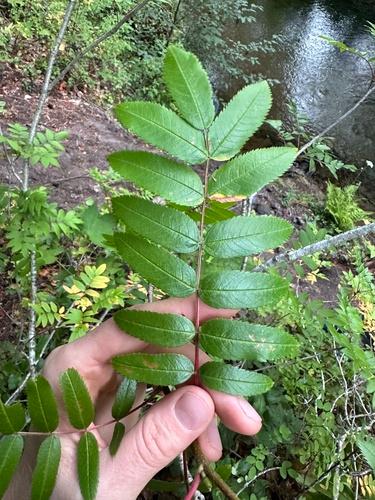
Greene's mountain ash is a multi-stemmed deciduous shrub with pinnate leaves, flat clusters of creamy white spring flowers, and showy red-orange berry clusters that persist into fall. Fall foliage turns orange to red.
How to care for Greene's mountain ash, by region
How to care for Greene's mountain ash where it is actually grown: year-round basics plus what to do each season, region by region, with the sources for each.
Care guidance last updated: November 2026
Snake River Plain (includes Boise)
Year-round
Greene's mountain ash is a native multi-stemmed shrub with white spring flower clusters and orange-red berries in fall.
- It grows in full sun to part shade and prefers moist, well-drained soil.
- It reaches roughly 6 to 12 feet tall.
- Water deeply during dry spells in the first few years.
Light annual pruning keeps it a tidy, upright shrub.
Fall
Fall brings orange-red leaves and ripe berries.
- Leave the berries for birds.
- Water once or twice before the ground freezes.
- Rake leaves off the crown if they pile up.
Raking fallen leaves keeps the bed neat.
Winter
Winter is dormancy.
- Do any structural pruning while the plant is leafless.
- Check mulch depth.
- No extra watering unless the soil is dry and unfrozen.
Winter pruning keeps the form clean.
Spring
Spring brings new leaves and flower clusters.
- Water deeply if spring is dry.
- Add an inch or two of mulch, kept off the stems.
- Prune only damaged or crossing branches.
Removing crossing branches keeps the shape neat.
Summer
Summer is berry set and steady growth.
- Water deeply every week or two in dry weather.
- Keep mulch topped up to hold moisture.
- Berries ripen toward fall and feed birds.
A mulched ring keeps the base tidy.
Sources: Wikipedia, Sorbus scopulina (deciduous multi-stemmed shrub native to western North America, white flower clusters, orange-red berries, fall color) (community tip)
Wildlife value
Flowers draw bees, flies, and beetles, and the berries are eaten by many songbirds and small mammals.
Common questions
- How much sun does Greene's mountain ash need?
- Greene's mountain ash grows best in part sun conditions.
- When does Greene's mountain ash bloom?
- Greene's mountain ash blooms in May, June, and July.
- Where is Greene's mountain ash native?
- Greene's mountain ash (Sorbus scopulina) is native to AZ, CA, CO, ID and 8 more states, per the World Checklist of Vascular Plants (Kew).
- What pollinators does Greene's mountain ash attract?
- Greene's mountain ash draws bees, flies, and beetles.
Native range data from the World Checklist of Vascular Plants (Kew). Pollinator and host plant associations compiled from GBIF, iNaturalist, and published ecological literature.
If something looks wrong
Common plant problems, and what to check first
These come up on almost any plant. Each guide lists the likely causes in the order they are worth ruling out, with one thing to check before you act on any of them, and links to the source it came from.
- It is dying right after planting
- Leaves turning yellow
- Wilting even though I watered it
- Brown crispy leaf tips
- Bugs on the plant
Ready to grow Greene's mountain ash? Add it to your garden in the Pollinator Patch App to track it and get season-by-season care guidance.