Hairy matilija-poppy
Romneya trichocalyx
Last reviewed: October 2026
Hairy matilija-poppy (Romneya trichocalyx) is a perennial forb native to CA. It blooms in May, June, July, and August. The flowers draw bees.
Toxicity unknown
Hairy matilija-poppy (Romneya trichocalyx) is not listed by the ASPCA Animal Poison Control Center (opens in new tab) or the other sources we check, so we have no verdict for it either way. Absence from those lists is not a clearance. If your pet shows symptoms after eating any plant, call the ASPCA at (888) 426-4435.
Light
full sun
Water
low
Size
48"–96" H × 60"–120" W
Bloom
May, Jun, Jul, Aug
Native to
CA
Pollinators
bees
Before you buy
Your city may pay you to plant this
Cities and water utilities offer rebates for replacing lawn with native and water-wise plants. We track 458 programs across 44 states, each with a link to the provider and the date we last checked it.
Find rebates in your areaPicture natives in your own yard
Upload a photo of your yard and Patch Vision shows a rendering of it planted with natives for your region, like Hairy matilija-poppy.


Browse plants for this ecoregion
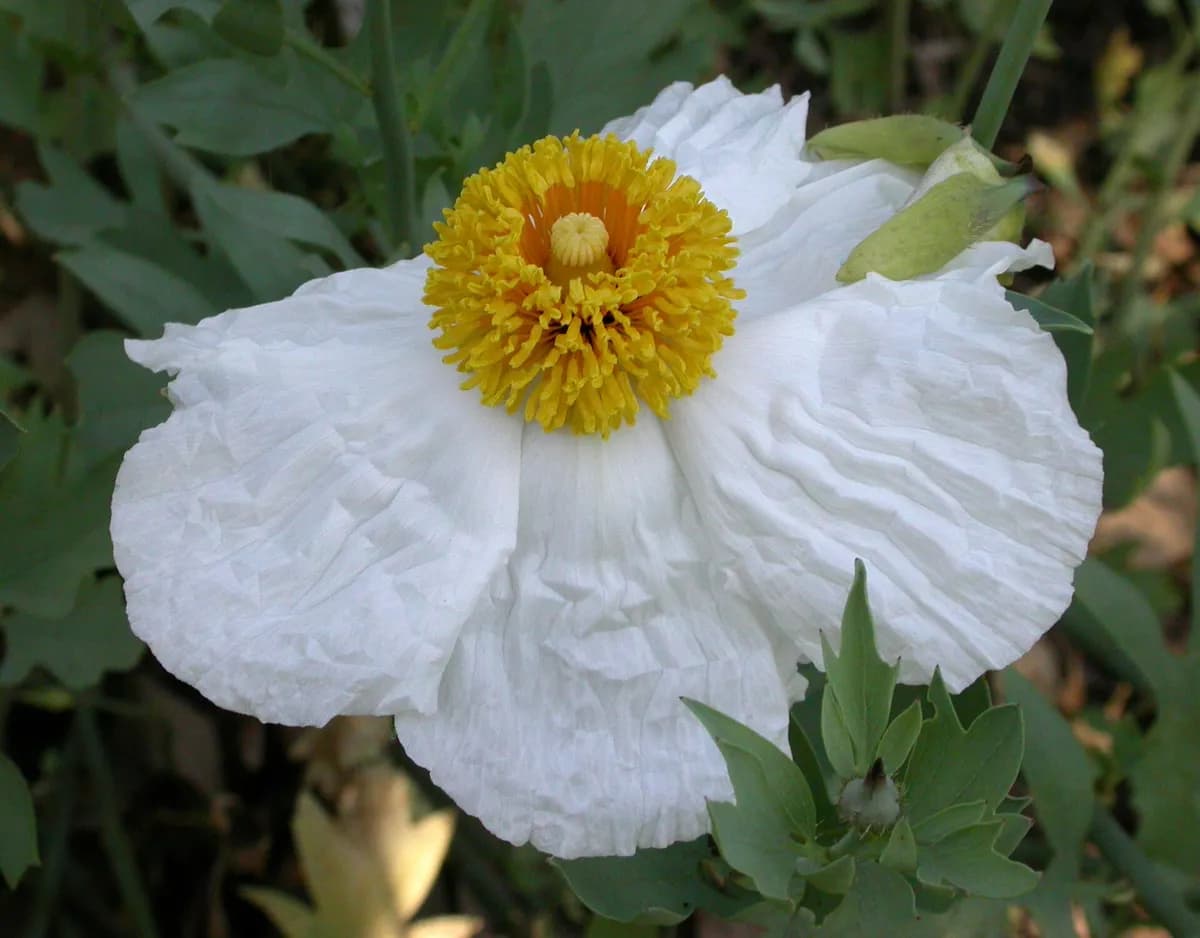
A large, woody-based perennial with silvery-blue lobed leaves and huge crepe-paper white flowers with a bright golden center. Spreads by rhizomes into vigorous colonies on dry slopes and can outgrow tidy garden beds quickly.
Growing Hairy matilija-poppy
Grow Hairy matilija-poppy in full sun and low water. Mature plants reach 48 to 96 inches tall and spread 60 to 120 inches wide.
How to care for Hairy matilija-poppy, by region
How to care for Hairy matilija-poppy where it is actually grown: year-round basics plus what to do each season, region by region, with the sources for each.
Care guidance last updated: September 2026
Southern California/Northern Baja Coast (includes Los Angeles, CA)
Year-round
Bristly Matilija poppy grows wild in dry canyon washes across coastal Southern California chaparral and coastal sage scrub, in a range that runs from Ventura County south through the Los Angeles basin's canyon country into San Diego County and northern Baja California. It is a large, spreading perennial known for its huge white, crepe paper like flowers with a bright yellow center. In a Los Angeles yard it wants full sun, fast draining soil, and almost no water once it settles in.
- Give it a spot in full sun with sandy or gravelly, fast draining soil. In heavier clay it will survive but bloom less and grow smaller.
- Once established, this plant does not want summer irrigation in most Los Angeles yards. Water weekly through its first summer only, then step back to occasional or no supplemental water.
- It spreads by underground rhizomes and can cover a wide area over a few years, so give it its own bed away from smaller companion plants.
- Its large white flowers draw native bees, including the ligated furrow bee and Texas leafcutter bee, and it is a documented host plant for one native moth.
Because it spreads and can reach several feet tall and wide, plant it in a dedicated bed set back from the front walkway or property line rather than a tight foundation strip, so it reads as an intentional planting rather than something that got away.
Fall
Fall, once the first rains arrive, is the best time to plant Matilija poppy in Los Angeles. It also marks the window when its rhizomes can be divided or transplanted with the best chance of success.
- Plant new Matilija poppy in fall so roots can establish over Los Angeles's mild, wet winter before next summer's heat and drought arrive.
- This is the best window to divide or move rhizomes if you want to start new plants elsewhere in the yard. Disturbing the roots outside this window often kills the plant.
- If the plant went summer deciduous and dropped leaves, do not assume it died. Fresh growth typically returns with the season.
- Cut old woody top growth back to about 6 inches if it looks tired or overgrown before new growth resumes.
Winter
Winter is Los Angeles's rainy season, and Matilija poppy is well adapted to it. Established plants need little from you this time of year beyond staying out of the way of the rhizomes.
- Let winter rain do the watering. Established plants in Los Angeles almost never need supplemental irrigation once the rains start.
- If you did not get to it in fall, an old, woody clump can still be cut back to about 6 inches in early winter to rejuvenate it before spring growth.
- New rhizome growth may show up several feet from the original planting. Decide early whether to let it spread or dig out unwanted shoots while they are small.
- Avoid walking on or disturbing the root zone. The rhizomes are easily damaged and slow to recover.
Spring
Spring is when Matilija poppy starts its main show in Los Angeles, with the first of its huge white flowers typically opening by late spring.
- Expect flower buds to form as days lengthen, with the big white, crepe paper blooms usually opening from late spring into summer.
- Keep watering minimal even as new growth appears. Overwatering an established plant in spring is more likely to cause problems than underwatering.
- Watch for new rhizome shoots coming up around the original clump. This is normal spreading, not a sign of stress.
- Cut flowers hold up well in a vase mixed with sages or other native blooms if you want to bring some indoors.
Summer
Summer brings the last of the bloom and, in many years, the point where Matilija poppy goes summer deciduous in Los Angeles's dry heat. That dieback is part of its normal cycle, not a problem.
- Do not add supplemental water to an established plant. This species is adapted to little to no summer irrigation in Southern California's dry season, and extra water invites root problems.
- If leaves yellow and drop by mid to late summer, that is the plant's natural summer deciduous habit responding to heat and drought, not a sign it needs more water.
- Deadhead spent flowers if you want a tidier look, though seed left in place will not usually produce many seedlings since this species spreads mainly by rhizomes.
- Keep an eye on how far the rhizomes have traveled. Summer's slower growth is a good time to plan where you will want to contain or divide the clump in fall.
If the plant drops leaves and looks bare by late summer, a light tidy up of dead stems keeps the bed looking deliberate until fall regrowth starts.
Sources: Calscape, Romneya trichocalyx (Bristly Matilija Poppy) plant profile (native range, water, soil, pollinators), Theodore Payne Foundation Native Plant Database, Romneya trichocalyx (range, habitat, care), Las Pilitas Nursery, Romneya trichocalyx (Matilija Poppy) care notes
Wildlife value
The oversized flowers provide abundant pollen for native bees, especially bumble bees, though it offers no nectar.
Common questions
- How much sun does Hairy matilija-poppy need?
- Hairy matilija-poppy grows best in full sun conditions.
- When does Hairy matilija-poppy bloom?
- Hairy matilija-poppy blooms in May, June, July, and August.
- Where is Hairy matilija-poppy native?
- Hairy matilija-poppy (Romneya trichocalyx) is native to CA, per vouchered herbarium specimen records and regional native plant society lists.
- What pollinators does Hairy matilija-poppy attract?
- Hairy matilija-poppy draws bees.
Native range data from vouchered herbarium specimen records and regional native plant society lists. Pollinator and host plant associations compiled from GBIF, iNaturalist, and published ecological literature.
If something looks wrong
Common plant problems, and what to check first
These come up on almost any plant. Each guide lists the likely causes in the order they are worth ruling out, with one thing to check before you act on any of them, and links to the source it came from.
- It is dying right after planting
- Leaves turning yellow
- Wilting even though I watered it
- Brown crispy leaf tips
- Bugs on the plant
Ready to grow Hairy matilija-poppy? Add it to your garden in Pollinator Patch to track it and get season-by-season care guidance.