Palmer's dudleya
Dudleya palmeri
Last reviewed: September 2026
Palmer's dudleya (Dudleya palmeri) is a perennial succulent native to CA. It blooms in May, June, and July. The flowers draw bees and hummingbirds. It reads as an intentional, HOA-friendly planting in the right spot.
Toxicity unknown
Palmer's dudleya (Dudleya palmeri) is not listed by the ASPCA Animal Poison Control Center (opens in new tab) or the other sources we check, so we have no verdict for it either way. Absence from those lists is not a clearance. If your pet shows symptoms after eating any plant, call the ASPCA at (888) 426-4435.
Light
full sun
Water
low
Size
4"–8" H × 6"–14" W
Bloom
May, Jun, Jul
Native to
CA
Pollinators
bees, hummingbirds
Before you buy
Your city may pay you to plant this
Cities and water utilities offer rebates for replacing lawn with native and water-wise plants. We track 459 programs across 44 states, each with a link to the provider and the date we last checked it.
Find rebates in your areaPicture natives in your own yard
Upload a photo of your yard and Patch Vision shows a rendering of it planted with natives for your region, like Palmer's dudleya.


Browse plants for this ecoregion
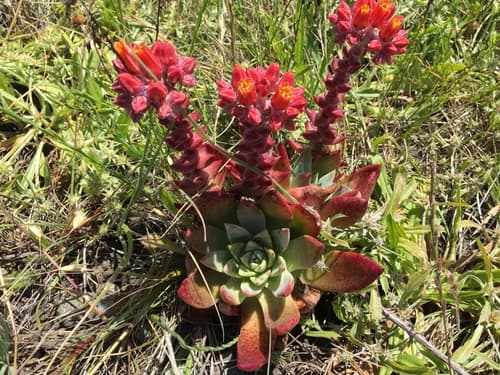
A low, clumping succulent that forms a rosette of lance-shaped leaves in pale to bright green, sometimes tinted pink, on rocky coastal slopes and cliffs. A slender flowering stem rises above the rosette in late spring, carrying small orange to red flowers over yellow or pink.
Growing Palmer's dudleya
Grow Palmer's dudleya in full sun and low water. Mature plants reach 4 to 8 inches tall and spread 6 to 14 inches wide. Expect low maintenance to keep it looking intentional in a front yard.
How to care for Palmer's dudleya, by region
How to care for Palmer's dudleya where it is actually grown: year-round basics plus what to do each season, region by region, with the sources for each.
Care guidance last updated: August 2026
Central California Foothills and Coastal Mountains (includes San Francisco, CA)
Year-round
Palmer's dudleya is a low, rosette-forming succulent native to rocky coastal slopes and cliffs from Monterey County south toward the Los Angeles area, per Calflora. It stays compact, under a foot tall and about a foot wide, with lance-shaped leaves in pale to bright green, sometimes tinted pink. Give it fast-draining, sandy soil and full sun near the coast, and water sparingly, per Theodore Payne Foundation and Calscape.
- Plant it in fast-draining, sandy or gritty soil. Heavy clay that holds water is its biggest risk, per Theodore Payne Foundation.
- Near the coast it takes full sun to part sun without trouble, per Theodore Payne Foundation.
- This is a low water-use native once established, per Calscape. Water only occasionally and let the soil dry between waterings.
- Its compact, foot-wide rosette suits rock gardens, raised beds, coastal slopes, and containers.
Its tidy, low rosette habit reads as deliberate in a rock garden or foundation bed rather than unkept.
Fall
Fall brings the return of cooler, wetter weather around San Francisco, which this coastal succulent takes well after its dry summer rest.
- Fall is a good secondary planting window, with cooling temperatures and less risk of heat stress on a new rosette.
- Once fall rain returns, supplemental watering usually is not needed beyond an occasional light soak in a dry stretch.
- No pruning is needed now. Save any cleanup of old leaves for when they are fully dry and easy to remove by hand.
Winter
Winter is a quiet, actively growing season for this coastal succulent around San Francisco rather than a true dormancy, since its rosette stays evergreen year round, per Calscape.
- The rosette holds its leaves through winter. No winter protection is needed in this climate.
- Winter rain is usually enough on its own. Hold off on extra watering unless the season turns unusually dry.
- Avoid walking near the base or compacting the soil around the shallow root zone while the ground is wet.
Spring
Spring is the start of the bloom window for Palmer's dudleya around San Francisco. Tall, slender flower stalks rise above the rosette and open their first flowers, ranging from orange to red over yellow or pink, by May, per Theodore Payne Foundation.
- Spring, before bloom, is a good window to plant a new succulent from a container while the weather is still mild and moist.
- As flower stalks extend, keep water light. Wet soil around the base while buds are forming raises the risk of crown rot.
- No fertilizer is needed. This coastal native is adapted to lean, sandy soils, per Theodore Payne Foundation.
Summer
Bloom continues into summer around San Francisco, with flower stalks typically still showing color through June and July, per Theodore Payne Foundation. Once flowering finishes, this is the plant's main dry season and it wants very little supplemental water.
- Let the soil dry out between waterings. This is a low water-use native and overwatering in summer is the most common way to lose it, per Calscape.
- Coastal fog and cool summer temperatures mean it usually needs less irrigation here than an inland garden would.
- Once the flower stalks fade, they can be cut back at the base. Leave the rosette itself alone.
Sources: Calflora, Dudleya palmeri, Calscape (California Native Plant Society), Palmer's Dudleya, Theodore Payne Foundation, Dudleya palmeri
Southern California/Northern Baja Coast (includes Los Angeles, CA)
Year-round
Palmer's dudleya is a low, rosette-forming succulent native to rocky coastal slopes and cliffs reaching south toward the Los Angeles area, per Calflora. It stays compact, under a foot tall and about a foot wide, with lance-shaped leaves in pale to bright green, sometimes tinted pink. Inland from the coast it does best with some afternoon shade, fast-draining soil, and infrequent water, per Theodore Payne Foundation and Calscape.
- Plant it in fast-draining, sandy or gritty soil. Heavy clay that holds water is its biggest risk, per Theodore Payne Foundation.
- Inland gardens around Los Angeles should give it some afternoon shade; coastal sites can take more direct sun, per Theodore Payne Foundation.
- This is a low water-use native once established, per Calscape. Water only occasionally and let the soil dry between waterings.
- Its compact, foot-wide rosette suits rock gardens, raised beds, coastal slopes, and containers.
Its tidy, low rosette habit reads as deliberate in a rock garden or foundation bed rather than unkept.
Fall
Fall brings cooler weather and the return of rain around Los Angeles, which this coastal succulent takes well after its dry summer rest.
- Fall is a good secondary planting window, with cooling temperatures and less risk of heat stress on a new rosette.
- Once fall rain returns, supplemental watering usually is not needed beyond an occasional light soak in a dry stretch.
- No pruning is needed now. Save any cleanup of old leaves for when they are fully dry and easy to remove by hand.
Winter
Winter is a quiet, actively growing season for this coastal succulent around Los Angeles rather than a true dormancy, since its rosette stays evergreen year round, per Calscape.
- The rosette holds its leaves through winter. No winter protection is needed in this climate.
- Winter rain is usually enough on its own. Hold off on extra watering unless the season turns unusually dry.
- Avoid walking near the base or compacting the soil around the shallow root zone while the ground is wet.
Spring
Spring is the start of the bloom window for Palmer's dudleya around Los Angeles. Tall, slender flower stalks rise above the rosette and open their first flowers, ranging from orange to red over yellow or pink, by May, per Theodore Payne Foundation.
- Spring, before the bloom stalks extend, is a good window to plant a new succulent from a container while temperatures are still mild.
- As flower stalks extend, keep water light. Wet soil around the base while buds are forming raises the risk of crown rot.
- No fertilizer is needed. This coastal native is adapted to lean, sandy soils, per Theodore Payne Foundation.
Summer
Bloom continues into summer around Los Angeles, with flower stalks typically still showing color through June and July, per Theodore Payne Foundation. Once flowering finishes, this is the plant's main dry season and inland heat makes overwatering the bigger risk than underwatering.
- Let the soil dry out between waterings. This is a low water-use native and overwatering in summer heat is the most common way to lose it, per Calscape.
- Give it afternoon shade if it sits in a hot, inland exposure, per Theodore Payne Foundation.
- Once the flower stalks fade, they can be cut back at the base. Leave the rosette itself alone.
Sources: Calflora, Dudleya palmeri, Calscape (California Native Plant Society), Palmer's Dudleya, Theodore Payne Foundation, Dudleya palmeri
In an HOA neighborhood
Palmer's dudleya is an HOA-friendly choice. Maintenance level: low. Tidiness: 4 out of 5.
Works well in: rock garden, slope or bluff stabilization, low water foundation bed.
- needs sharp drainage and can rot in heavy or regularly irrigated soil
Wildlife value
Its late-spring flower spikes draw bees and hummingbirds at a time when few other succulents are blooming.
Common questions
- How much sun does Palmer's dudleya need?
- Palmer's dudleya grows best in full sun conditions.
- When does Palmer's dudleya bloom?
- Palmer's dudleya blooms in May, June, and July.
- Where is Palmer's dudleya native?
- Palmer's dudleya (Dudleya palmeri) is native to CA, per vouchered herbarium specimen records and regional native plant society lists.
- What pollinators does Palmer's dudleya attract?
- Palmer's dudleya draws bees and hummingbirds.
- Is Palmer's dudleya HOA-friendly?
- Palmer's dudleya is generally an HOA-friendly choice in the right placement, with low maintenance.
Native range data from vouchered herbarium specimen records and regional native plant society lists. Pollinator and host plant associations compiled from GBIF, iNaturalist, and published ecological literature.
If something looks wrong
Common plant problems, and what to check first
These come up on almost any plant. Each guide lists the likely causes in the order they are worth ruling out, with one thing to check before you act on any of them, and links to the source it came from.
- It is dying right after planting
- Leaves turning yellow
- Wilting even though I watered it
- Brown crispy leaf tips
- Bugs on the plant
Ready to grow Palmer's dudleya? Add it to your garden in Pollinator Patch to track it and get season-by-season care guidance.