Prairie alumroot
Heuchera richardsonii
Last reviewed: September 2026
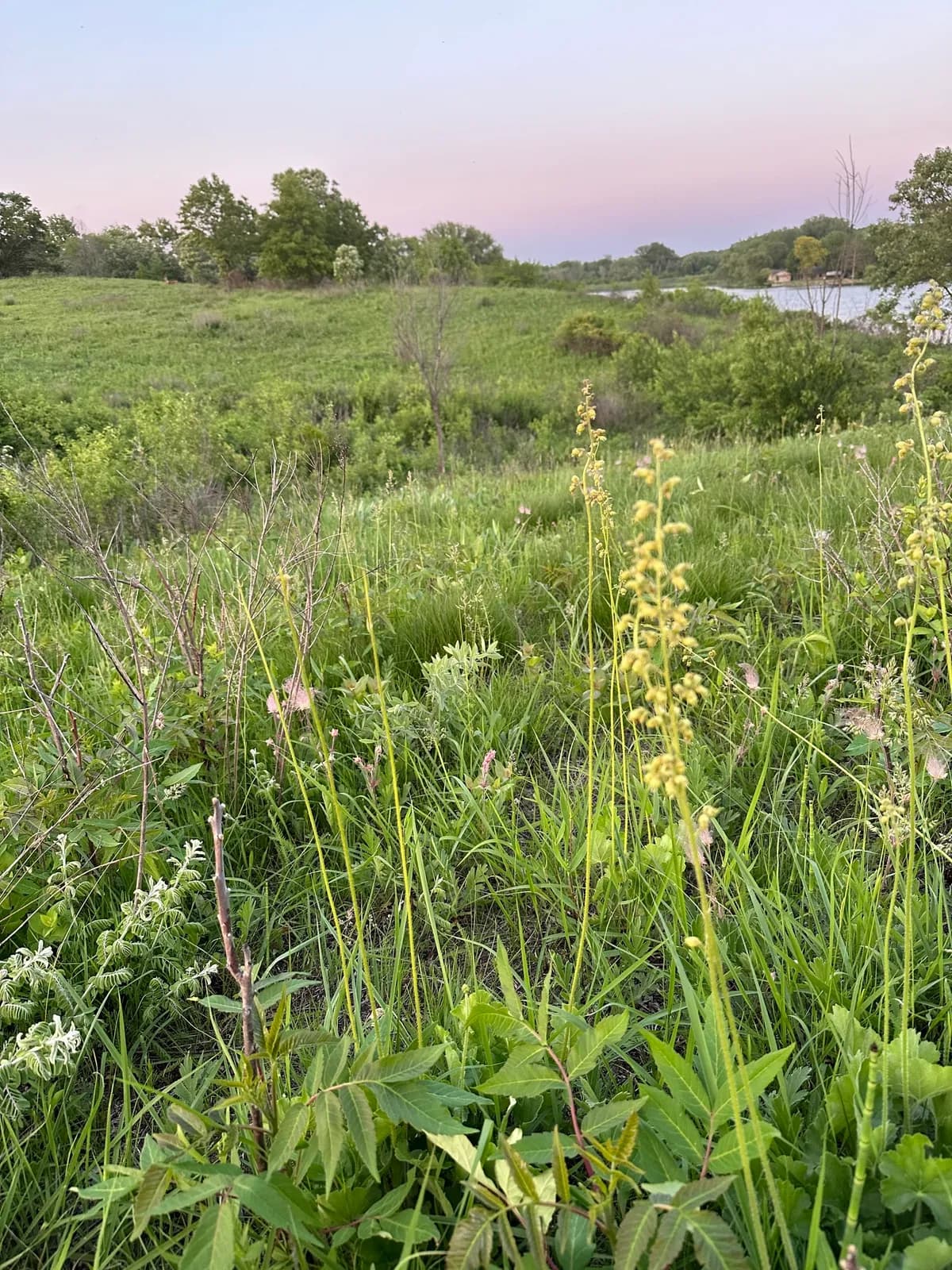
Heuchera richardsonii, or prairie alumroot, is a low water forb that blooms May through July with slender spikes of greenish flowers. It grows well in part sun prairie and open woodland settings across the central and northern Great Plains.
Toxicity unknown
Prairie alumroot (Heuchera richardsonii) is not listed by the ASPCA Animal Poison Control Center (opens in new tab) or the other sources we check, so we have no verdict for it either way. Absence from those lists is not a clearance. If your pet shows symptoms after eating any plant, call the ASPCA at (888) 426-4435.
Light
part sun
Water
low
Size
12"–24" H × 12"–18" W
Bloom
May, Jun, Jul
Native to
CO, IA, IL, IN and 11 more states
Pollinators
bees
Deer
Resistant (per Prairie Moon Nursery)
Before you buy
Your city may pay you to plant this
Cities and water utilities offer rebates for replacing lawn with native and water-wise plants. We track 459 programs across 44 states, each with a link to the provider and the date we last checked it.
Find rebates in your areaPicture natives in your own yard
Upload a photo of your yard and Patch Vision shows a rendering of it planted with natives for your region, like Prairie alumroot.


Browse plants for this ecoregion
A clumping perennial forb with a basal rosette of rounded, lobed, hairy green leaves and slender flower stalks bearing loose, airy clusters of small greenish-white bell-shaped flowers in late spring. Adapts to a range of soils from prairie clay to rocky ground, preferring partial sun and low to average moisture.
Growing Prairie alumroot
Grow Prairie alumroot in part sun and low water. Mature plants reach 12 to 24 inches tall and spread 12 to 18 inches wide. Expect low maintenance to keep it looking intentional in a front yard.
How to care for Prairie alumroot, by region
How to care for Prairie alumroot where it is actually grown: year-round basics plus what to do each season, region by region, with the sources for each.
Care guidance last updated: October 2026
Central Corn Belt Plains (includes Chicago, IL)
Year-round
Prairie alumroot is a native Illinois prairie perennial with a low rosette of rounded leaves and tall, airy flower stalks. It suits sunny to lightly shaded spots in Chicago-area gardens.
- It is native to Illinois prairies, savannas, and rocky open woods, and it is commonly grown in Chicago-region native plant gardens.
- It does best in full sun to partial shade with well-drained soil, and it tolerates both sandy and average garden soil once established.
- Small greenish-white to cream, bell-shaped flowers bloom on wiry stalks from late May through summer, attracting butterflies and hummingbirds.
- It is a low-maintenance, deer-resistant choice that handles dry spells well once its roots are established.
Fall
Fall is cleanup time for prairie alumroot in Chicago. Cut back the dried flower stalks and let the foliage clump settle in before winter.
- Cut spent flower stalks back to the basal leaves once they have dried and turned brown.
- The rounded leaves often stay semi-evergreen into winter in a sheltered Chicago yard, especially in a mild year.
- A mulch layer once the ground starts to cool helps protect the shallow crown from freeze and thaw heaving.
- Fall is a fine time to divide overcrowded clumps if spring did not work out.
Cutting the dried flower stalks back to the tidy basal clump keeps a front-yard bed looking neat through fall, which is HOA-friendly.
Winter
Through Chicago's winter, prairie alumroot's foliage may hold on under snow, and the dormant crown mostly needs protection from freeze and thaw cycles.
- In a sheltered spot, the basal leaves can stay semi-evergreen through a mild Chicago winter.
- A layer of winter mulch over the crown helps guard against freeze and thaw heaving in the clay soils common around Chicago.
- No watering or feeding is needed. The plant rests until warmer weather returns in spring.
- Keep foot traffic off the bed when the ground is frozen. The shallow crown can be damaged easily.
Spring
In spring, prairie alumroot in the Chicago area sends up fresh basal leaves, with flower stalks following as the weather warms into May.
- New rosette leaves emerge from the crown once the soil warms. Remove any winter mulch as growth resumes.
- Divide clumps that are crowded or more than a few years old to keep the foliage healthy and airy.
- Spring planting gives the roots time to establish before Chicago's hot, humid summer arrives.
- Water new plants regularly through their first few weeks. Once rooted, they need very little extra water.
Summer
Summer brings prairie alumroot's bloom period in Chicago, with tall stalks of small flowers rising over the basal foliage clump.
- Flower stalks can reach two to three feet and carry small, bell-shaped blooms from late May into August in the Chicago region.
- Once established, the plant shrugs off Chicago's hot, dry summer stretches without extra watering.
- Deadheading is optional. Leaving spent stalks in place lets seed form for the following season.
- In the heavier clay soil common around Chicago, good drainage matters more than fertilizing.
Sources: Lady Bird Johnson Wildflower Center, Heuchera richardsonii (Richardson's alumroot), Chicago Botanic Garden Plant Finder, Heuchera richardsonii (Prairie Alumroot), Missouri Botanical Garden Plant Finder, Heuchera richardsonii, Prairie Moon Nursery, Heuchera richardsonii Prairie Alumroot, University of Illinois Extension, Hort Answers: Prairie Alumroot (Heuchera richardsonii)
Cross Timbers (includes Fort Worth, TX)
Year-round
Prairie alumroot is grown for its leaves, not its flowers. It builds a low rosette of round, shallow lobed, hairy leaves about a foot across, then sends up thin wiry stalks of tiny greenish white bells in late spring and early summer. Those flowers are quiet rather than showy, so treat the stalks as airy height above the rosette and let the foliage do the real work. It is a tallgrass prairie perennial sitting at the very warm edge of its documented range in Dallas and Fort Worth, so where you put it matters more here than it would farther north. Give it drainage and afternoon shade and one clump will hold its shape for years.
- Botanical authorities map this species across the upper Midwest and northern Great Plains, from Michigan and Minnesota west to Montana and south only as far as Missouri, Oklahoma and Colorado, and Texas is not on that list, so in a DFW yard treat it as a prairie perennial from farther north rather than a local wildflower (Lady Bird Johnson Wildflower Center).
- Prairie Moon Nursery rates it for USDA zones 3 through 8, which puts Dallas and Fort Worth right at the warm limit, and the same source says partial shade is preferred in hot, dry or more southern climates (Prairie Moon Nursery).
- The ASPCA lists alumroot, also sold as coral bells, under Heuchera sanguinea as non-toxic to dogs, non-toxic to cats and non-toxic to horses, and that determination is for the garden coral bells species rather than a species level ruling on prairie alumroot (ASPCA).
- Missouri Botanical Garden calls for dry to medium moisture in well drained soil and notes it grows well in shallow rocky or gravelly ground as readily as in richer loam, so whether your yard is Cross Timbers sand over sandstone or Blackland black clay, the same answer applies: set it high on a slight mound or a raised bed instead of a low spot that holds water (Missouri Botanical Garden).
- Illinois Wildflowers reports that white-tailed deer browse prairie alumroot foliage sparingly, and NC State Extension attributes that to tannins in the leaves, so expect it to be passed over most of the time rather than never touched at all (Illinois Wildflowers).
- NC State Extension warns that heucheras are usually short-lived perennials unless they are divided regularly, about every three or four years, which is the single most useful thing to know before you plant one (NC State Extension).
One clump reads as a neat, low, rounded mound roughly a foot across, which sits comfortably along a front bed edge and keeps a planting looking HOA-friendly. The bloom stalks are thin and see-through, so they add late spring height without crowding a walkway.
Fall
Fall is the second good stretch of the DFW year for this plant. The heat breaks, rain returns, and the rosette usually pushes fresh leaves. This is the season to check the crown, top off mulch, and fix any drainage problem the summer exposed. It is not the season to divide, so hold that until spring.
- University of Vermont Extension recommends a generous layer of mulch around the plant in fall to reduce the chance of it heaving out of the ground over winter (University of Vermont Extension).
- Check that the crown is still sitting level with the soil surface, because Missouri Botanical Garden notes these clumps are shallow rooted and develop woody bases rather quickly, and a crown creeping upward is the first sign it will need replanting (Missouri Botanical Garden).
- Texas A&M AgriLife Master Gardeners describe Blackland vertisols cracking up to four inches wide and six feet deep in dry weather, so after a dry September walk the bed and press soil back around any clump the cracks have worked loose (Texas A&M AgriLife Master Gardeners).
- A plant set out this fall still needs consistent moisture to establish, which University of Illinois Extension flags as this species' main weak point, so do not let fall rain be the whole watering plan (University of Illinois Extension).
- Skip the fertilizer and the fall haircut. Missouri Botanical Garden rates maintenance low and reports no serious insect or disease problems, so autumn care here really is just mulch and drainage (Missouri Botanical Garden).
Winter
Cold is not what threatens this plant in DFW. Missouri Botanical Garden rates it hardy to zone 3, so our winters are nowhere near its limit. The actual winter risk is freeze and thaw swings lifting a shallow rooted crown up out of the ground, which is a slow problem you only notice if you look. Leaves often hold their color through a mild winter and a hard freeze can brown them without killing the plant.
- Missouri Botanical Garden rates prairie alumroot hardy in USDA zones 3 through 9, so a DFW winter needs no cold protection for this plant on its own account (Missouri Botanical Garden).
- The winter problem is heaving, and Missouri Botanical Garden explains why: the clumps are shallow rooted, so a mulch layer applied once the ground has frozen is what holds them down through repeated freeze and thaw swings (Missouri Botanical Garden).
- If you find a clump standing proud of the soil after a freeze, do not stomp it back down. University of Vermont Extension says to replant it at the right depth in spring as soon as the soil is workable (University of Vermont Extension).
- The rosette often stays green or bronzed through a mild winter here, since NC State Extension describes heucheras as evergreen to semi-evergreen and Prairie Moon Nursery says that quality depends on winter temperatures and the microclimate of the exact spot (Prairie Moon Nursery).
- Leave browned leaves in place until spring, because NC State Extension notes that removing ragged foliage stimulates new leaf growth, and that is a spring job rather than a winter one (NC State Extension).
- Winter is when Blackland clay stays wet longest, and NC State Extension notes heucheras dislike heavy clay and want moist, well drained ground, so the clump in a low spot that puddles after a January rain is the one most likely to be lost (NC State Extension).
A rosette that keeps its shape in January is one of the few things in a Texas front bed still holding form in the dormant season, so leave it standing rather than clearing it. That bit of structure is what keeps the bed reading as tended and HOA-friendly all winter.
Spring
Spring is when this plant does nearly everything. Fresh leaves push out of the rosette, the wiry bloom stalks go up, and it is the only window the authorities recommend for dividing or replanting. In Dallas and Fort Worth the mild stretch is short and turns hot fast, so do the digging work early instead of following a northern calendar. Anything you plant or divide now needs steady water through its first spring to get roots down before June arrives.
- Divide clumps in spring every three to four years, which Missouri Botanical Garden recommends because the shallow rooted clumps develop woody bases rather quickly and slow down in the middle (Missouri Botanical Garden).
- If a clump lifted out of the ground over winter, University of Vermont Extension says to replant it in spring as soon as the soil is workable, and to set the crown level with the soil surface rather than buried below it (University of Vermont Extension).
- Expect bloom stalks from late spring into early summer, with published windows running anywhere from April through July depending on how far north the plant is growing, and expect tiny greenish white bells rather than a color show (Lady Bird Johnson Wildflower Center).
- University of Illinois Extension notes this species can suffer drought damage and benefits from consistent moisture while establishing, so water a spring planting deeply once a week through May even though a mature clump is drought tolerant (University of Illinois Extension).
- Missouri Botanical Garden says it grows well in nearly any well draining soil, so Cross Timbers sand needs little help, while Blackland clay does: Texas A&M AgriLife Master Gardeners recommend working in compost or expanded shale to speed drainage and add air pockets before planting (Texas A&M AgriLife Master Gardeners).
- The small greenish flowers feed small wild bees, and Illinois Wildflowers records one of them, Colletes aestivalis, as a specialist that gathers pollen only from alumroots, so those unshowy stalks are worth more than they look (Illinois Wildflowers).
Dividing leaves a bare gap in a front bed for a few weeks. If the clump sits in a visible spot, split one plant at a time and get the divisions back in the ground the same day so the bed never looks torn up.
Summer
Summer is the real test for this one in DFW. We run past 100F for weeks from late June into September, and this is a prairie species whose documented range stops well north of here. A settled clump is drought tolerant, but the thing that takes it out is heat plus full afternoon sun, not dryness by itself. Your summer job is shade and drainage rather than constant watering.
- Missouri Botanical Garden says it prefers full sun in the northern part of its range but appreciates some afternoon shade in climates with hot, humid summers, which describes a Dallas or Fort Worth July almost word for word (Missouri Botanical Garden).
- NC State Extension flags leaf scorch as a problem for heucheras grown in full sun during hot, dry conditions, so brown crispy leaf edges in August usually mean too much afternoon sun rather than too little water (NC State Extension).
- Water deeply and infrequently instead of daily, because Missouri Botanical Garden rates it drought tolerant and calls for dry to medium moisture, and a shallow rooted clump sitting in warm wet ground is in more trouble than one that dries out between waterings (Missouri Botanical Garden).
- Leave the clump alone through the heat. Both University of Vermont Extension and Missouri Botanical Garden put division in spring, so a summer move gives the roots no time to recover before the next stress (University of Vermont Extension).
- Prairie Moon Nursery notes prairie alumroot has relatively shallow roots, which is why a couple of inches of mulch over the root zone does more for it in a Texas summer than extra water does (Prairie Moon Nursery).
- If you want more plants, seed ripens in dark brown capsules about three to four weeks after flowering, and the Lady Bird Johnson Wildflower Center says the black seed can be dried and held in a refrigerated container (Lady Bird Johnson Wildflower Center).
Spent bloom stalks turn tan and stay standing, which is the one stretch of the year this plant can read as untidy from the street. Cutting them at the base in early summer keeps the front bed looking intentional.
Sources: Lady Bird Johnson Wildflower Center: Heuchera richardsonii (Richardson's alumroot), Missouri Botanical Garden Plant Finder: Heuchera richardsonii, ASPCA Animal Poison Control: Alumroot (Heuchera sanguinea), Illinois Wildflowers: Prairie Alumroot (Heuchera richardsonii), Prairie Moon Nursery: Heuchera richardsonii Prairie Alumroot, NC State Extension Plant Toolbox: Heuchera (Alumroot, Coral Bells)
Driftless Area (includes Galena, IL)
Year-round
Year-round care for prairie alumroot around Galena, IL: sun to part shade, well-drained soil, dry to mesic moisture.
- Give it sun to part shade.
- It does best in well-drained sandy, gravelly or rocky soil and prefers dry to mesic conditions.
- It needs minimal care once established and does not need extra water in dry conditions.
- The leafless flower stalks rise 1 to 3 feet above the leaves in late spring and early summer.
- It works well as a groundcover.
A low leaf mound along a bed edge reads as tidy and intentional, and the thin flower stalks stay see-through.
Sources: Lady Bird Johnson Wildflower Center: Heuchera richardsonii, Illinois Wildflowers: Heuchera richardsonii
North Central Hardwood Forests (includes Minneapolis, MN)
Year-round
Year-round care for prairie alumroot around Minneapolis, MN: sun to part shade and well-drained soil.
- It grows in full sun to part shade, and prefers full sun in northern regions.
- Water needs are dry to medium, and it tolerates drought.
- It grows in nearly any well-draining soil, including rocky, gravelly or humusy loams.
- Plants reach 1 to 2 feet tall and 1 to 1.5 feet wide.
- Apply winter mulch after the ground freezes in cold areas to prevent root heaving.
- Divide clumps every 3 to 4 years in spring.
A compact mound of leaves that works as a ground cover at the front of a bed.
Sources: Missouri Botanical Garden: Heuchera richardsonii, Lady Bird Johnson Wildflower Center: Heuchera richardsonii, Minnesota Wildflowers: Heuchera richardsonii
Northern Minnesota Wetlands (includes Baudette, MN)
Year-round
Year-round care for prairie alumroot around Baudette, MN: sun to part shade, well-drained soil, dry to mesic moisture.
- Give it sun to part shade.
- It does best in well-drained sandy, gravelly or rocky soil and prefers dry to mesic conditions.
- It needs minimal care once established and does not need extra water in dry conditions.
- The leafless flower stalks rise 1 to 3 feet above the leaves in late spring and early summer.
- It works well as a groundcover.
A low leaf mound along a bed edge reads as tidy and intentional, and the thin flower stalks stay see-through.
Sources: Lady Bird Johnson Wildflower Center: Heuchera richardsonii, Illinois Wildflowers: Heuchera richardsonii
Southeastern Wisconsin Till Plains (includes Milwaukee, WI)
Year-round
Prairie alumroot is a native Wisconsin prairie perennial with a low clump of rounded, hairy leaves and tall, wiry flower stalks. It is a low-maintenance choice for sunny to lightly shaded spots in Milwaukee-area gardens.
- It is one of the only Heuchera species native to Wisconsin, found in prairies, savannas, and rocky uplands across most of the state.
- It grows best in full sun to partial shade with well-drained, sandy or gravelly soil.
- Small greenish-white to cream, bell-shaped flowers open on tall stalks from late May into July and draw in hummingbirds and butterflies.
- Once its roots are established, it handles dry spells well and needs very little extra care.
Fall
Fall cleanup for prairie alumroot in Milwaukee means cutting back the spent flower stalks and letting the basal foliage settle in before winter.
- Cut the dried flower stalks down to the basal leaf clump once they have browned, usually in late fall.
- The rounded leaves often stay semi-evergreen through a mild Wisconsin winter, especially in a sheltered spot.
- Add a layer of mulch after the first hard frost. It helps keep the shallow crown from heaving out of the soil during freeze and thaw.
- Fall is also a fine time to divide overcrowded clumps if you did not get to it in spring.
Cutting the dried flower stalks back to the tidy basal clump keeps a front-yard bed looking neat through fall, which is HOA-friendly.
Winter
Through winter, prairie alumroot's basal foliage may hold on under snow in Milwaukee, and the dormant crown mostly just needs protection from freeze and thaw.
- In a sheltered spot, the leathery basal leaves can stay semi-evergreen through a mild winter, especially under snow cover.
- A layer of winter mulch over the crown helps guard against the freeze and thaw cycles common in Wisconsin winters.
- No watering or feeding is needed. The plant is dormant or semi-dormant until spring.
- Keep foot traffic off the bed. The shallow crown can be damaged more easily when the ground is frozen.
Spring
In spring, prairie alumroot pushes out fresh basal leaves in the Milwaukee area, with flower stalks following once the soil warms up.
- New leaves emerge from the crown as the soil warms. Pull back any winter mulch once you see growth starting.
- Spring is a good time to divide clumps that are three or more years old, to keep air moving through the leaves and cut down on disease.
- Plant new starts in spring so the roots have a full growing season to settle in before Wisconsin's cold winter returns.
- Water new plantings regularly for the first few weeks. Once established, the plant gets by on typical Wisconsin spring rain.
Summer
Summer is bloom time for prairie alumroot in Milwaukee, with tall wiry stalks of small flowers lasting several weeks.
- Flower stalks reach about two feet tall and carry small, greenish-white to cream, bell-shaped blooms into July.
- The plant handles Wisconsin's summer dry stretches well once it is established, so extra watering usually is not needed.
- Deadheading spent flower stalks is optional. Leaving some lets seed develop for next year.
- Check the basal leaves for slug damage during humid stretches, especially in shadier spots.
Sources: Lady Bird Johnson Wildflower Center, Heuchera richardsonii (Richardson's alumroot), Urban Ecology Center, Native Plant - Prairie Alumroot (community tip), Missouri Botanical Garden Plant Finder, Heuchera richardsonii, Prairie Moon Nursery, Heuchera richardsonii Prairie Alumroot, Chicago Botanic Garden Plant Finder, Heuchera richardsonii (Prairie Alumroot)
Texas Blackland Prairies (includes Dallas, TX)
Year-round
Prairie alumroot is grown for its leaves, not its flowers. It builds a low rosette of round, shallow lobed, hairy leaves about a foot across, then sends up thin wiry stalks of tiny greenish white bells in late spring and early summer. Those flowers are quiet rather than showy, so treat the stalks as airy height above the rosette and let the foliage do the real work. It is a tallgrass prairie perennial sitting at the very warm edge of its documented range in Dallas and Fort Worth, so where you put it matters more here than it would farther north. Give it drainage and afternoon shade and one clump will hold its shape for years.
- Botanical authorities map this species across the upper Midwest and northern Great Plains, from Michigan and Minnesota west to Montana and south only as far as Missouri, Oklahoma and Colorado, and Texas is not on that list, so in a DFW yard treat it as a prairie perennial from farther north rather than a local wildflower (Lady Bird Johnson Wildflower Center).
- Prairie Moon Nursery rates it for USDA zones 3 through 8, which puts Dallas and Fort Worth right at the warm limit, and the same source says partial shade is preferred in hot, dry or more southern climates (Prairie Moon Nursery).
- The ASPCA lists alumroot, also sold as coral bells, under Heuchera sanguinea as non-toxic to dogs, non-toxic to cats and non-toxic to horses, and that determination is for the garden coral bells species rather than a species level ruling on prairie alumroot (ASPCA).
- Missouri Botanical Garden calls for dry to medium moisture in well drained soil and notes it grows well in shallow rocky or gravelly ground as readily as in richer loam, so whether your yard is Cross Timbers sand over sandstone or Blackland black clay, the same answer applies: set it high on a slight mound or a raised bed instead of a low spot that holds water (Missouri Botanical Garden).
- Illinois Wildflowers reports that white-tailed deer browse prairie alumroot foliage sparingly, and NC State Extension attributes that to tannins in the leaves, so expect it to be passed over most of the time rather than never touched at all (Illinois Wildflowers).
- NC State Extension warns that heucheras are usually short-lived perennials unless they are divided regularly, about every three or four years, which is the single most useful thing to know before you plant one (NC State Extension).
One clump reads as a neat, low, rounded mound roughly a foot across, which sits comfortably along a front bed edge and keeps a planting looking HOA-friendly. The bloom stalks are thin and see-through, so they add late spring height without crowding a walkway.
Fall
Fall is the second good stretch of the DFW year for this plant. The heat breaks, rain returns, and the rosette usually pushes fresh leaves. This is the season to check the crown, top off mulch, and fix any drainage problem the summer exposed. It is not the season to divide, so hold that until spring.
- University of Vermont Extension recommends a generous layer of mulch around the plant in fall to reduce the chance of it heaving out of the ground over winter (University of Vermont Extension).
- Check that the crown is still sitting level with the soil surface, because Missouri Botanical Garden notes these clumps are shallow rooted and develop woody bases rather quickly, and a crown creeping upward is the first sign it will need replanting (Missouri Botanical Garden).
- Texas A&M AgriLife Master Gardeners describe Blackland vertisols cracking up to four inches wide and six feet deep in dry weather, so after a dry September walk the bed and press soil back around any clump the cracks have worked loose (Texas A&M AgriLife Master Gardeners).
- A plant set out this fall still needs consistent moisture to establish, which University of Illinois Extension flags as this species' main weak point, so do not let fall rain be the whole watering plan (University of Illinois Extension).
- Skip the fertilizer and the fall haircut. Missouri Botanical Garden rates maintenance low and reports no serious insect or disease problems, so autumn care here really is just mulch and drainage (Missouri Botanical Garden).
Winter
Cold is not what threatens this plant in DFW. Missouri Botanical Garden rates it hardy to zone 3, so our winters are nowhere near its limit. The actual winter risk is freeze and thaw swings lifting a shallow rooted crown up out of the ground, which is a slow problem you only notice if you look. Leaves often hold their color through a mild winter and a hard freeze can brown them without killing the plant.
- Missouri Botanical Garden rates prairie alumroot hardy in USDA zones 3 through 9, so a DFW winter needs no cold protection for this plant on its own account (Missouri Botanical Garden).
- The winter problem is heaving, and Missouri Botanical Garden explains why: the clumps are shallow rooted, so a mulch layer applied once the ground has frozen is what holds them down through repeated freeze and thaw swings (Missouri Botanical Garden).
- If you find a clump standing proud of the soil after a freeze, do not stomp it back down. University of Vermont Extension says to replant it at the right depth in spring as soon as the soil is workable (University of Vermont Extension).
- The rosette often stays green or bronzed through a mild winter here, since NC State Extension describes heucheras as evergreen to semi-evergreen and Prairie Moon Nursery says that quality depends on winter temperatures and the microclimate of the exact spot (Prairie Moon Nursery).
- Leave browned leaves in place until spring, because NC State Extension notes that removing ragged foliage stimulates new leaf growth, and that is a spring job rather than a winter one (NC State Extension).
- Winter is when Blackland clay stays wet longest, and NC State Extension notes heucheras dislike heavy clay and want moist, well drained ground, so the clump in a low spot that puddles after a January rain is the one most likely to be lost (NC State Extension).
A rosette that keeps its shape in January is one of the few things in a Texas front bed still holding form in the dormant season, so leave it standing rather than clearing it. That bit of structure is what keeps the bed reading as tended and HOA-friendly all winter.
Spring
Spring is when this plant does nearly everything. Fresh leaves push out of the rosette, the wiry bloom stalks go up, and it is the only window the authorities recommend for dividing or replanting. In Dallas and Fort Worth the mild stretch is short and turns hot fast, so do the digging work early instead of following a northern calendar. Anything you plant or divide now needs steady water through its first spring to get roots down before June arrives.
- Divide clumps in spring every three to four years, which Missouri Botanical Garden recommends because the shallow rooted clumps develop woody bases rather quickly and slow down in the middle (Missouri Botanical Garden).
- If a clump lifted out of the ground over winter, University of Vermont Extension says to replant it in spring as soon as the soil is workable, and to set the crown level with the soil surface rather than buried below it (University of Vermont Extension).
- Expect bloom stalks from late spring into early summer, with published windows running anywhere from April through July depending on how far north the plant is growing, and expect tiny greenish white bells rather than a color show (Lady Bird Johnson Wildflower Center).
- University of Illinois Extension notes this species can suffer drought damage and benefits from consistent moisture while establishing, so water a spring planting deeply once a week through May even though a mature clump is drought tolerant (University of Illinois Extension).
- Missouri Botanical Garden says it grows well in nearly any well draining soil, so Cross Timbers sand needs little help, while Blackland clay does: Texas A&M AgriLife Master Gardeners recommend working in compost or expanded shale to speed drainage and add air pockets before planting (Texas A&M AgriLife Master Gardeners).
- The small greenish flowers feed small wild bees, and Illinois Wildflowers records one of them, Colletes aestivalis, as a specialist that gathers pollen only from alumroots, so those unshowy stalks are worth more than they look (Illinois Wildflowers).
Dividing leaves a bare gap in a front bed for a few weeks. If the clump sits in a visible spot, split one plant at a time and get the divisions back in the ground the same day so the bed never looks torn up.
Summer
Summer is the real test for this one in DFW. We run past 100F for weeks from late June into September, and this is a prairie species whose documented range stops well north of here. A settled clump is drought tolerant, but the thing that takes it out is heat plus full afternoon sun, not dryness by itself. Your summer job is shade and drainage rather than constant watering.
- Missouri Botanical Garden says it prefers full sun in the northern part of its range but appreciates some afternoon shade in climates with hot, humid summers, which describes a Dallas or Fort Worth July almost word for word (Missouri Botanical Garden).
- NC State Extension flags leaf scorch as a problem for heucheras grown in full sun during hot, dry conditions, so brown crispy leaf edges in August usually mean too much afternoon sun rather than too little water (NC State Extension).
- Water deeply and infrequently instead of daily, because Missouri Botanical Garden rates it drought tolerant and calls for dry to medium moisture, and a shallow rooted clump sitting in warm wet ground is in more trouble than one that dries out between waterings (Missouri Botanical Garden).
- Leave the clump alone through the heat. Both University of Vermont Extension and Missouri Botanical Garden put division in spring, so a summer move gives the roots no time to recover before the next stress (University of Vermont Extension).
- Prairie Moon Nursery notes prairie alumroot has relatively shallow roots, which is why a couple of inches of mulch over the root zone does more for it in a Texas summer than extra water does (Prairie Moon Nursery).
- If you want more plants, seed ripens in dark brown capsules about three to four weeks after flowering, and the Lady Bird Johnson Wildflower Center says the black seed can be dried and held in a refrigerated container (Lady Bird Johnson Wildflower Center).
Spent bloom stalks turn tan and stay standing, which is the one stretch of the year this plant can read as untidy from the street. Cutting them at the base in early summer keeps the front bed looking intentional.
Sources: Lady Bird Johnson Wildflower Center: Heuchera richardsonii (Richardson's alumroot), Missouri Botanical Garden Plant Finder: Heuchera richardsonii, ASPCA Animal Poison Control: Alumroot (Heuchera sanguinea), Illinois Wildflowers: Prairie Alumroot (Heuchera richardsonii), Prairie Moon Nursery: Heuchera richardsonii Prairie Alumroot, NC State Extension Plant Toolbox: Heuchera (Alumroot, Coral Bells)
In an HOA neighborhood
Prairie alumroot is an HOA-friendly choice. Maintenance level: low. Tidiness: 4 out of 5.
Works well in: front yard, foundation, mid zone.
Wildlife value
Spring flower clusters provide a modest nectar and pollen source for bees.
Common questions
- When does prairie alumroot bloom?
- Prairie alumroot typically flowers from May through July, producing tall wiry stalks of small greenish-white to greenish-yellow blooms above a low mound of scalloped leaves.
- What pollinators visit prairie alumroot?
- Bees are the primary visitors to prairie alumroot flowers, drawn to the nectar produced along the slender bloom spikes.
- How much water does prairie alumroot need?
- This plant is adapted to low water conditions once established and tolerates dry, well-drained soils typical of prairie and rocky open sites.
- How much light does prairie alumroot prefer?
- Prairie alumroot grows best in part sun but can also handle full sun with adequate soil moisture, and it tolerates part shade in hotter climates.
- Is Prairie alumroot HOA-friendly?
- Prairie alumroot is generally an HOA-friendly choice in the right placement, with low maintenance.
These answers were drafted with an AI model from this plant's data. Verify care details with a local expert.
Native range data from the World Checklist of Vascular Plants (Kew). Pollinator and host plant associations compiled from GBIF, iNaturalist, and published ecological literature.
If something looks wrong
Common plant problems, and what to check first
These come up on almost any plant. Each guide lists the likely causes in the order they are worth ruling out, with one thing to check before you act on any of them, and links to the source it came from.
- It is dying right after planting
- Leaves turning yellow
- Wilting even though I watered it
- Brown crispy leaf tips
- Bugs on the plant
Ready to grow Prairie alumroot? Add it to your garden in Pollinator Patch to track it and get season-by-season care guidance.