Century Plant
Agave americana
Last reviewed: August 2026
Agave americana is a large rosette succulent suited to hot, dry gardens in the Southwest, thriving in full sun with little water and sending up a tall flower stalk once after many years, usually in summer.
Toxicity unknown
Century Plant (Agave americana) is not listed by the ASPCA Animal Poison Control Center (opens in new tab) or the other sources we check, so we have no verdict for it either way. Absence from those lists is not a clearance. If your pet shows symptoms after eating any plant, call the ASPCA at (888) 426-4435.
The USDA PLANTS Database (opens in new tab) does not flag Century Plant as toxic to livestock.
Light
full sun
Water
low
Size
48"–72" H × 36"–60" W
Bloom
Jun, Jul, Aug
Native to
AZ, TX
Pollinators
bees
Before you buy
Your city may pay you to plant this
Cities and water utilities offer rebates for replacing lawn with native and water-wise plants. We track 452 programs across 44 states, each with a link to the provider and the date we last checked it.
Find rebates in your areaBrowse plants for this ecoregion
Century Plant is a dramatic architectural succulent with thick, blue-gray leaves arranged in a striking rosette pattern. This slow-growing agave can take 10-30 years to bloom, producing a spectacular tall flower spike before the plant dies and is replaced by offspring.
Growing Century Plant
Grow Century Plant in full sun and low water. Mature plants reach 48 to 72 inches tall and spread 36 to 60 inches wide. Expect low maintenance to keep it looking intentional in a front yard.
How to care for Century Plant, by region
How to care for Century Plant where it is actually grown: year-round basics plus what to do each season, region by region, with the sources for each.
Care guidance last updated: September 2026
Cross Timbers (includes Fort Worth, TX)
Year-round
Century Plant is a big gray succulent that wants full sun and fast draining soil, and it needs almost no water once it is settled in. Two things surprise buyers: every leaf ends in a hard needle-sharp point, and the plant flowers only once (usually somewhere between year 10 and year 25) and then dies, leaving small pups behind.
- Give it room. In the ground it reaches about 3 to 6 feet tall and 6 to 10 feet across, so leave at least 4 feet of clear space between the outer leaves and any walkway, driveway, porch step or play area.
- Plan the soil for drainage, because sitting wet is what kills it. In heavy black clay, set it on a raised mound 8 to 12 inches high and mix in coarse sand or decomposed granite; in the sandier soils west of the metro it drains fine on flat ground but will want water a little more often the first summer.
- Wear leather gloves, long sleeves and eye protection any time you plant, dig or cut it. The sap carries needle-shaped calcium oxalate crystals and soap-like compounds that can cause an itchy red rash, and case reports in the medical literature describe exactly that after people cut agave leaves.
- Know that it dies after it blooms. When it finally sends up its 15 to 30 foot flower stalk, the mother rosette is finishing its life. Cut the dead rosette out and keep one of the pups at the base as the replacement.
- This one comes from Mexico, not from North Texas, so it is a decorative desert plant here rather than a native. Pair it with true North Texas natives if you want it to feed local pollinators.
Because this plant is spiny and large, siting is what makes it read as intentional rather than risky. Set it well back from the sidewalk in a gravel or crushed granite bed with a clean edge, keep it as a single focal specimen instead of a row along the walk, and neighbors read it as a designed accent. Note that Pollinator Patch does not treat Century Plant as an HOA-friendly front-yard pick, so check your own community's landscape rules before making it a street-facing feature.
Fall
Fall is the tidy-up and thin-out season. Take off the pups you do not want, clean the dried lower leaves, and then start backing the water off so the plant goes into winter on the dry side.
- Do the pup removal in late September or October, while it is still warm enough for cuts to dry. Slice each pup free with a sharp spade a few inches out from the mother plant, and leave at most one or two if you want a replacement in place.
- Trim the papery brown lower leaves flush to the base with a pruning saw or lopper. Wear leather gloves, long sleeves and eye protection, since the sap can raise an itchy red rash on bare skin.
- Cut watering back through October and November. After the first cool spell, stop supplemental water entirely and let autumn rain do the rest, so the plant is not soaked going into freezing weather.
- Rake fallen tree leaves out of the center of the rosette. Wet leaf litter sitting in the crown all winter is a rot problem waiting to happen.
- No fall fertilizer and no fall planting of new agaves in the ground. Woody shrubs like autumn planting, but this succulent does much better set out in spring.
A fall pass on this plant is mostly about the base. Once the dried brown skirt is cut away, the pups are thinned out and the gravel is edged in a clean line, the whole bed reads as a deliberate low-water design instead of something that got away from you.
Winter
North Texas sits right at the cold edge for this plant. It handles a normal mild winter and short freezes, but the botanical record says damage shows up once winter lows drop into the low teens, so a severe Arctic outbreak is the real risk.
- Do not water at all from December through February unless the plant is in a container and bone dry. Cold plus wet soil does far more damage than cold alone.
- When the forecast calls for the upper teens or lower, throw a frost cloth or an old blanket over the whole rosette in the afternoon and weigh the edges down with bricks, then pull it off once the temperature is back above freezing.
- Move potted plants against a south or west facing wall, or into an unheated garage, for the few nights of a hard freeze. Pots freeze through in a way ground plantings do not.
- After a freeze, leave the mushy or bleached leaves in place until spring. They shield the center of the plant, and cutting into cold wet tissue opens the door to rot.
- Do not scrape ice or knock frozen leaves around. Frozen agave leaves snap, and the leaf tips are hard and needle sharp at about knee to waist height, which the Wildflower Center flags as a hazard to people and pets when the plant is sited near foot traffic.
Frost cloth is the part neighbors notice. Use a single neutral tan or green cover, tuck the edges under bricks so it is not flapping, and take it off the morning the freeze breaks, so the protection looks like planned winter care rather than a tarp left in the yard.
Spring
Spring is when you plant it and when you clean up whatever winter chewed on. Wait until after the mid March last frost and the soil has warmed, then plant high and water very little.
- Plant between late March and mid May. Dig a hole no deeper than the root ball, and set the crown (where the leaves meet the roots) slightly above the surrounding soil so water runs away from it.
- In heavy black clay, build a mound or a raised gravel bed and mix coarse sand or decomposed granite into the backfill; in the sandier loam west of the metro plant at grade and skip the amendment.
- Water once at planting, then wait about 2 weeks before watering again. Through April and May, a slow soak every 2 to 3 weeks is plenty, and skip it entirely in a week with a real spring storm.
- Cut off leaves that winter turned brown, mushy or collapsed. Take them at the base with a sharp pruner, wearing leather gloves and eye protection, since the cut sap can leave an itchy rash.
- Skip fertilizer. This plant grows in poor rocky ground on purpose, and feeding it just makes soft floppy leaves.
Removing the winter-damaged leaves in March is the single thing that makes this plant read as cared for rather than neglected. A clean rosette with no brown flags hanging off it, sitting in a freshly raked gravel bed, looks intentional from the street.
Summer
July and August are easy for this plant and hard for the gardener standing over it with a hose. Heat and weeks without rain are exactly what it is built for, and the most common way to lose it in summer is too much water.
- Water an established plant once a month at most, and only if there has been no rain for 4 weeks. A plant in its first summer can take a slow soak every 2 to 3 weeks, a little more often in sandy soil, a little less in clay.
- Never water it on a sprinkler schedule with the lawn. If your irrigation zone covers it, cap or redirect that head, because repeated wet soil in 100 degree heat is what causes root rot.
- Leave the leaves alone in the heat. Do not cut, dig or divide from June through August; wounds in hot wet weather invite rot and the agave weevil.
- Look into the center of the rosette once a month. If the middle leaves go soft, loose or wobbly and pull out easily, that is the agave weevil or rot, and the plant usually cannot be saved, so remove it and start over with a pup in fresh well drained soil.
- Do not add mulch right up against the base. Keep bark or compost 6 inches back and use gravel next to the plant so the crown stays dry.
Sources: Lady Bird Johnson Wildflower Center, Native Plant Database: Agave americana, Missouri Botanical Garden Plant Finder: Agave americana, Brazzelli et al., Acute irritant contact dermatitis from Agave americana L., Contact Dermatitis 1995, NC State Extension Gardener Plant Toolbox: Agave americana
Edwards Plateau (includes San Antonio, TX)
Year-round
Century plant (Agave americana) is a large, slow-growing succulent that fits San Antonio's hot, dry-summer climate well. It wants full sun, soil that drains fast, and very little supplemental water once it is established. According to the Lady Bird Johnson Wildflower Center's Native Plant Database, this species is native to Texas.
- Plant in full sun in fast-draining, gritty or rocky soil. Heavy clay or a low spot that holds water after rain is the most common way these plants fail.
- Water deeply but infrequently during the first year to help roots establish, then let San Antonio's normal rainfall carry most of the plant's needs.
- Keep it well back from walkways, patios, and play areas. The rigid leaf-tip spine and the sharp teeth along the leaf margins can cause deep puncture wounds.
- Wear gloves and long sleeves when trimming or handling cut leaves. Published case reports describe the sap as an irritant that can cause a painful contact dermatitis.
- Agave americana is not on the ASPCA's list of plants toxic to dogs and cats, but the spines and irritant sap can still injure a pet that brushes against or chews the leaves.
Its clean rosette form and gray-green color read as intentional xeriscape design, which many HOA-conscious homeowners like, but keep it planted well back from sidewalks and property lines so the spine tips do not reach into shared space.
Fall
Fall is a good time to establish a new century plant, since the extreme summer heat is easing, but the first freeze date matters for timing so a young plant has a chance to root before cold weather hits.
- San Antonio's first fall freeze typically lands in mid-to-late November. If planting late in the season, get the plant in the ground early enough to root before then.
- Taper off watering as temperatures cool; the plant does not need frequent water once fall arrives.
- A container-grown or young plant can be moved to a covered patio or garage on nights near freezing until it is more established.
- Skip fertilizing this late in the year. New growth pushed by fall feeding is the growth most likely to suffer freeze damage in winter.
Winter
Century plant tolerates a typical San Antonio winter but can show real freeze damage in a hard cold snap. Established plants usually recover even when leaves are burned.
- Mature Agave americana generally tolerates cold into the low-to-mid 20s F, which covers most San Antonio winters at USDA zone 8b to 9a. A harder freeze below that can blacken or turn leaves mushy.
- Cover the plant with a breathable frost cloth, not plastic, or move a potted plant to a garage ahead of a forecast hard freeze or ice event.
- Avoid watering right before or during a freeze. Wet soil around the crown increases cold injury risk.
- Leave freeze-damaged leaves in place until new growth appears in spring rather than cutting them right away; the remaining tissue can still protect the crown.
Spring
Spring is the main growth window in San Antonio. Freeze risk fades after the last winter cold snaps, making late winter into spring the safest stretch to plant, transplant, or clean up any cold damage from the prior winter.
- Wait until after San Antonio's typical last freeze before planting a new century plant outdoors or moving a potted one back outside; the USDA places most of the city in hardiness zone 8b to 9a.
- Trim away any leaves left blackened or mushy from winter freeze damage using clean, sharp shears. New growth from the center will replace them.
- Spring rainfall is usually enough on its own; skip supplemental watering unless several weeks pass with no rain.
- After a spring storm, check that water drains away from the base within a day or two. Standing water invites root rot.
Summer
San Antonio summers are hot and largely dry, which is the climate century plant is built for. The main task is resisting the urge to add water, not increasing it.
- Give a newly planted or potted agave a deep soak every two to three weeks during long dry stretches. An established in-ground plant usually needs no supplemental water at all.
- Full, unfiltered summer sun is fine and generally preferred; unlike many plants, century plant does not need afternoon shade in San Antonio heat.
- Watch for mushy, yellowing leaves near the base. That points to overwatering or poor drainage, not heat stress.
- After a heavy summer storm, confirm the site drains within a day so the crown does not sit in wet soil.
Sources: Lady Bird Johnson Wildflower Center, Native Plant Database: Agave americana, ASPCA, Toxic and Non-Toxic Plants (letter L), PubMed: Purpuric irritant contact dermatitis induced by Agave americana, USDA Plant Hardiness Zone Map, Central Texas Gardener: Agaves for the Landscape (community tip), National Weather Service, Austin/San Antonio Local Climate Records
Mississippi Valley Loess Plains (includes Memphis, TN)
Year-round
Century plant is a large, spiny succulent that is not native to the Memphis area but can be grown here with the right spot and some winter planning.
- Give it full sun, at least 6 hours of direct light a day, and soil that drains fast, such as sandy or gritty soil.
- It is very drought tolerant once established and does not want to sit in wet soil.
- It grows slowly and can take many years to reach full size, so give it room to spread 6 to 10 feet wide.
- Each leaf ends in a sharp spine and the sap can irritate skin, so wear gloves and long sleeves when you work near it.
- The Merck Veterinary Manual lists it as toxic to animals, the sap has calcium oxalate crystals that irritate the mouth and skin, so keep dogs and cats from chewing on the leaves.
Fall
Fall is when you plan ahead for winter, since a century plant is usually hardy only into the warmer end of zone 8, one zone warmer than the Memphis area.
- Start easing back on watering in early fall so the plant is on the drier side heading into winter.
- If it is in a pot, plan where you will move it, an unheated garage, sunroom, or other sheltered spot, before your first hard freeze.
- If it is planted in the ground, a bed on the south or west side of the house is often the warmest, most sheltered spot in a yard.
- Have frost cloth or an old blanket ready so you can cover an in-ground plant on nights near or below freezing.
Winter
Memphis winters, roughly USDA zone 7b to 8a, run colder than the zone 8a to 11b range century plant is rated for, so it needs some help to get through outdoors.
- NC State Extension lists Agave americana as hardy in USDA zones 8a through 11b, so an unprotected Memphis winter can be too cold for it, especially in a hard freeze.
- Keeping it in a pot is the easiest way to protect it here, move the pot into an unheated garage, sunroom, or near a bright window and water only a little all winter.
- For an in-ground plant, cover it with a breathable frost cloth, not plastic, during freezes and take the cover off once temperatures climb back above freezing.
- Keep the soil on the dry side all winter, cold wet soil is more likely to kill this plant than cold air alone.
If you cover an in-ground plant with frost cloth during a cold snap, take the cover off as soon as the freeze passes so the front yard does not look untidy to an HOA-conscious neighbor.
Spring
Spring is when you check a Memphis century plant for winter damage and get it growing again.
- Once nights are reliably staying above freezing, take off any frost cover or move a potted plant back outside.
- Trim off any leaves that turned mushy, brown, or black from winter cold, cutting back to firm healthy tissue.
- Wear thick gloves when trimming, the spines and the sap that comes out of a fresh cut can irritate skin.
- Start watering again as new growth appears, but let the soil dry out between waterings.
Trimming off winter-damaged leaves in spring keeps a front-yard century plant looking tidy for HOA-conscious neighbors.
Summer
Memphis summers are hot and often humid, so the main job with a century plant is keeping its roots from staying wet.
- It handles Memphis summer heat well and needs little to no extra water once it is planted in fast draining soil.
- Skip daily watering, a deep soak every so often matches how this plant grows in the wild better than frequent light watering.
- Check the base of the plant after heavy summer rain, soggy soil around the roots can cause rot faster here than in its native drier climate.
- If you are removing offsets (the small pups that grow at the base) or trimming leaves, wear gloves for the spines and sap.
Sources: NC State Extension Plant Toolbox: Agave americana, Merck Veterinary Manual: Houseplants and Ornamentals Toxic to Animals
Texas Blackland Prairies (includes Dallas, TX)
Year-round
Century Plant is a big gray succulent that wants full sun and fast draining soil, and it needs almost no water once it is settled in. Two things surprise buyers: every leaf ends in a hard needle-sharp point, and the plant flowers only once (usually somewhere between year 10 and year 25) and then dies, leaving small pups behind.
- Give it room. In the ground it reaches about 3 to 6 feet tall and 6 to 10 feet across, so leave at least 4 feet of clear space between the outer leaves and any walkway, driveway, porch step or play area.
- Plan the soil for drainage, because sitting wet is what kills it. In heavy black clay, set it on a raised mound 8 to 12 inches high and mix in coarse sand or decomposed granite; in the sandier soils west of the metro it drains fine on flat ground but will want water a little more often the first summer.
- Wear leather gloves, long sleeves and eye protection any time you plant, dig or cut it. The sap carries needle-shaped calcium oxalate crystals and soap-like compounds that can cause an itchy red rash, and case reports in the medical literature describe exactly that after people cut agave leaves.
- Know that it dies after it blooms. When it finally sends up its 15 to 30 foot flower stalk, the mother rosette is finishing its life. Cut the dead rosette out and keep one of the pups at the base as the replacement.
- This one comes from Mexico, not from North Texas, so it is a decorative desert plant here rather than a native. Pair it with true North Texas natives if you want it to feed local pollinators.
Because this plant is spiny and large, siting is what makes it read as intentional rather than risky. Set it well back from the sidewalk in a gravel or crushed granite bed with a clean edge, keep it as a single focal specimen instead of a row along the walk, and neighbors read it as a designed accent. Note that Pollinator Patch does not treat Century Plant as an HOA-friendly front-yard pick, so check your own community's landscape rules before making it a street-facing feature.
Fall
Fall is the tidy-up and thin-out season. Take off the pups you do not want, clean the dried lower leaves, and then start backing the water off so the plant goes into winter on the dry side.
- Do the pup removal in late September or October, while it is still warm enough for cuts to dry. Slice each pup free with a sharp spade a few inches out from the mother plant, and leave at most one or two if you want a replacement in place.
- Trim the papery brown lower leaves flush to the base with a pruning saw or lopper. Wear leather gloves, long sleeves and eye protection, since the sap can raise an itchy red rash on bare skin.
- Cut watering back through October and November. After the first cool spell, stop supplemental water entirely and let autumn rain do the rest, so the plant is not soaked going into freezing weather.
- Rake fallen tree leaves out of the center of the rosette. Wet leaf litter sitting in the crown all winter is a rot problem waiting to happen.
- No fall fertilizer and no fall planting of new agaves in the ground. Woody shrubs like autumn planting, but this succulent does much better set out in spring.
A fall pass on this plant is mostly about the base. Once the dried brown skirt is cut away, the pups are thinned out and the gravel is edged in a clean line, the whole bed reads as a deliberate low-water design instead of something that got away from you.
Winter
North Texas sits right at the cold edge for this plant. It handles a normal mild winter and short freezes, but the botanical record says damage shows up once winter lows drop into the low teens, so a severe Arctic outbreak is the real risk.
- Do not water at all from December through February unless the plant is in a container and bone dry. Cold plus wet soil does far more damage than cold alone.
- When the forecast calls for the upper teens or lower, throw a frost cloth or an old blanket over the whole rosette in the afternoon and weigh the edges down with bricks, then pull it off once the temperature is back above freezing.
- Move potted plants against a south or west facing wall, or into an unheated garage, for the few nights of a hard freeze. Pots freeze through in a way ground plantings do not.
- After a freeze, leave the mushy or bleached leaves in place until spring. They shield the center of the plant, and cutting into cold wet tissue opens the door to rot.
- Do not scrape ice or knock frozen leaves around. Frozen agave leaves snap, and the leaf tips are hard and needle sharp at about knee to waist height, which the Wildflower Center flags as a hazard to people and pets when the plant is sited near foot traffic.
Frost cloth is the part neighbors notice. Use a single neutral tan or green cover, tuck the edges under bricks so it is not flapping, and take it off the morning the freeze breaks, so the protection looks like planned winter care rather than a tarp left in the yard.
Spring
Spring is when you plant it and when you clean up whatever winter chewed on. Wait until after the mid March last frost and the soil has warmed, then plant high and water very little.
- Plant between late March and mid May. Dig a hole no deeper than the root ball, and set the crown (where the leaves meet the roots) slightly above the surrounding soil so water runs away from it.
- In heavy black clay, build a mound or a raised gravel bed and mix coarse sand or decomposed granite into the backfill; in the sandier loam west of the metro plant at grade and skip the amendment.
- Water once at planting, then wait about 2 weeks before watering again. Through April and May, a slow soak every 2 to 3 weeks is plenty, and skip it entirely in a week with a real spring storm.
- Cut off leaves that winter turned brown, mushy or collapsed. Take them at the base with a sharp pruner, wearing leather gloves and eye protection, since the cut sap can leave an itchy rash.
- Skip fertilizer. This plant grows in poor rocky ground on purpose, and feeding it just makes soft floppy leaves.
Removing the winter-damaged leaves in March is the single thing that makes this plant read as cared for rather than neglected. A clean rosette with no brown flags hanging off it, sitting in a freshly raked gravel bed, looks intentional from the street.
Summer
July and August are easy for this plant and hard for the gardener standing over it with a hose. Heat and weeks without rain are exactly what it is built for, and the most common way to lose it in summer is too much water.
- Water an established plant once a month at most, and only if there has been no rain for 4 weeks. A plant in its first summer can take a slow soak every 2 to 3 weeks, a little more often in sandy soil, a little less in clay.
- Never water it on a sprinkler schedule with the lawn. If your irrigation zone covers it, cap or redirect that head, because repeated wet soil in 100 degree heat is what causes root rot.
- Leave the leaves alone in the heat. Do not cut, dig or divide from June through August; wounds in hot wet weather invite rot and the agave weevil.
- Look into the center of the rosette once a month. If the middle leaves go soft, loose or wobbly and pull out easily, that is the agave weevil or rot, and the plant usually cannot be saved, so remove it and start over with a pup in fresh well drained soil.
- Do not add mulch right up against the base. Keep bark or compost 6 inches back and use gravel next to the plant so the crown stays dry.
Sources: Lady Bird Johnson Wildflower Center, Native Plant Database: Agave americana, Missouri Botanical Garden Plant Finder: Agave americana, Brazzelli et al., Acute irritant contact dermatitis from Agave americana L., Contact Dermatitis 1995, NC State Extension Gardener Plant Toolbox: Agave americana
Want these tasks as reminders timed to your yard? Pollinator Patch turns this guidance into a season-by-season care plan for the plants you actually grow.
In an HOA neighborhood
Century Plant takes more care to keep looking intentional in a front yard. Maintenance level: low. Consider it for backyard or mid-zone beds rather than the street edge.
Works well in: backyard only.
- Height exceeds typical HOA-friendly range
Wildlife value
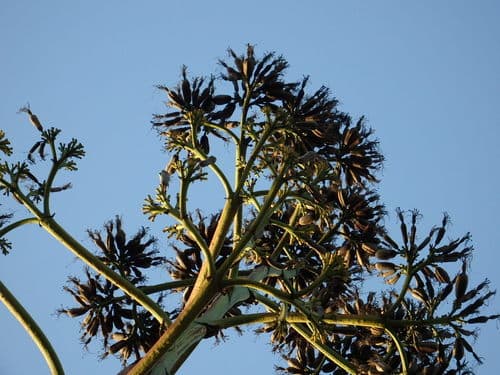
The impressive summer flower spike attracts bees and other pollinators with its abundant nectar. The plant also provides nesting sites for desert birds.
Common questions
- When does Agave americana bloom?
- Agave americana typically flowers in June, July, or August, producing one tall branched stalk of yellow flowers. Each rosette blooms only once in its lifetime, often after ten to twenty years of growth, and the main rosette dies after flowering.
- How much water does Agave americana need?
- This succulent stores water in its thick leaves and prefers low, infrequent watering. Well drained, gritty soil is important since soggy conditions around the roots can cause rot.
- What pollinates Agave americana flowers?
- Bees are commonly observed visiting the flowers of Agave americana for nectar and pollen once the plant sends up its tall bloom stalk.
- Does Agave americana lose its leaves in winter?
- No. It is evergreen and keeps its thick, gray-green rosette of leaves year round in climates like Arizona and Texas where it is grown.
- Is Century Plant toxic to livestock?
- The USDA PLANTS Database does not flag Century Plant as toxic to livestock.
- Is Century Plant HOA-friendly?
- Century Plant takes more care to look intentional in a front yard. Consider it for backyard or mid-zone beds rather than the street edge.
These answers were drafted with an AI model from this plant's data. Verify care details with a local expert.
Native range data from the World Checklist of Vascular Plants (Kew). Pollinator and host plant associations compiled from GBIF, iNaturalist, and published ecological literature.
If something looks wrong
Common plant problems, and what to check first
These come up on almost any plant. Each guide lists the likely causes in the order they are worth ruling out, with one thing to check before you act on any of them, and links to the source it came from.
- It is dying right after planting
- Leaves turning yellow
- Wilting even though I watered it
- Brown crispy leaf tips
- Bugs on the plant
Ready to grow Century Plant? Add it to your garden in Pollinator Patch to track it and get season-by-season care guidance.
Planning a bed around it? Start a free plan with this plant
Not sure where to start? Take the 2-minute yard quiz