Engelmann's sage
Salvia engelmannii
Last reviewed: October 2026
Engelmann's sage is a low-water forb found on rocky limestone slopes and open grasslands in central Texas, blooming from March through May in full sun.
Toxicity unknown
Engelmann's sage (Salvia engelmannii) is not listed by the ASPCA Animal Poison Control Center (opens in new tab) or the other sources we check, so we have no verdict for it either way. Absence from those lists is not a clearance. If your pet shows symptoms after eating any plant, call the ASPCA at (888) 426-4435.
Light
full sun
Water
low
Size
12"–24" H × 12"–18" W
Bloom
Mar, Apr, May
Native to
TX
Pollinators
bees, butterflies
Before you buy
Your city may pay you to plant this
Cities and water utilities offer rebates for replacing lawn with native and water-wise plants. We track 459 programs across 44 states, each with a link to the provider and the date we last checked it.
Find rebates in your areaPicture natives in your own yard
Upload a photo of your yard and Patch Vision shows a rendering of it planted with natives for your region, like Engelmann's sage.


Browse plants for this ecoregion
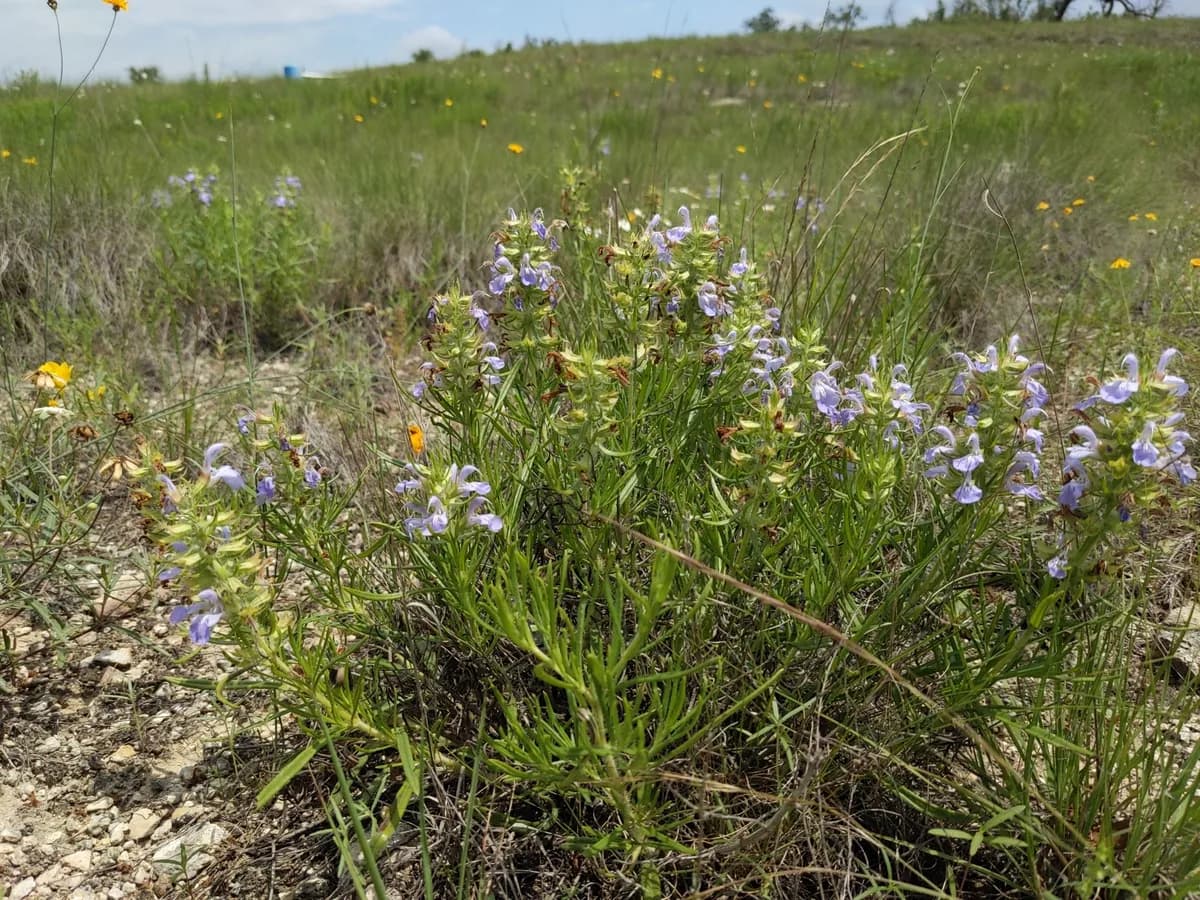
A compact, clump-forming herbaceous perennial with soft gray-green leaves and short spikes of pale blue to lavender flowers in spring. Well adapted to shallow, rocky, alkaline soils and dies back in dry dormancy.
Growing Engelmann's sage
Grow Engelmann's sage in full sun and low water. Mature plants reach 12 to 24 inches tall and spread 12 to 18 inches wide. Expect low maintenance to keep it looking intentional in a front yard.
How to care for Engelmann's sage, by region
How to care for Engelmann's sage where it is actually grown: year-round basics plus what to do each season, region by region, with the sources for each.
Care guidance last updated: July 2026
Cross Timbers (includes Fort Worth, TX)
Year-round
Engelmann's sage is a low, tidy mound of soft gray-green leaves and pale blue-lavender flower spikes, native to the limestone hills and prairies of North Texas. It wants full sun and very little supplemental water once it settles in.
- Plant it somewhere it gets 6 or more hours of direct sun a day, it will get leggy and bloom poorly in shade
- Give it sharp drainage: in heavy black clay, plant high on a slight mound or amend with expanded shale or coarse compost; in the sandier soils west of the metro it drains fine on its own but will need water more often through the first summer
- Expect a compact mound around 12 to 24 inches tall and wide, good for a low front border
- Skip fertilizer, rich soil makes it floppy and shortens bloom
Its neat, low mound shape and pale flower spikes read as an intentional, cared-for border plant rather than an overgrown patch.
Fall
Fall's cooler, wetter weather is a fine second planting window for this species, though it is grown as a perennial forb here, not a woody plant, so spring stays the priority window.
- If planting in fall, get it in the ground by mid October so roots have time to establish before the mid November first frost
- Cut back to remove any leggy summer growth once flowering has fully stopped, usually by late September
- Keep watering light, once every 7 to 10 days is plenty as temperatures drop and rainfall typically picks up
- Clear fallen leaves or mulch that piles against the base of the mound to keep air moving through the foliage
Winter
North Texas winters are generally mild enough that this plant holds some structure, but a hard Arctic freeze can knock top growth back to the ground.
- Leave the stems standing through winter for a little structure and cold protection for the crown
- If a hard freeze (mid 20s F or below) blackens the foliage, leave the damaged stems in place until new growth appears at the base rather than cutting back right away
- Once you see new green growth emerging low on the plant, usually by late February, cut the old stems back to that point
- Do not water during freezes or while the ground is cold and wet, this plant is prone to root rot in soggy winter soil
Blackened, frost-killed stems left standing after a freeze can look neglected; if it bothers you visually, a light tidy-up is fine, but wait for new basal growth before cutting hard so you do not remove live wood.
Spring
Spring is bloom season and the best time to plant it in North Texas, right after the mid March last frost.
- Set new plants out from late March through April once the frost danger has passed
- Water new plantings two to three times a week for the first month, then taper off as roots establish
- Watch for pale lavender to blue flower spikes on 4 to 6 inch stalks from March into May
- Cut back any dead or frost-damaged stems to where new green growth is emerging at the base before the plant leafs out fully
The spring flower spikes are the plant's best curb-appeal window, a full flush of pale blue blooms against gray-green foliage.
Summer
Once established this plant handles North Texas heat well and wants to be left mostly alone through July and August.
- Water newly planted specimens (first summer only) once a week during 100F stretches with no rain; established plants rarely need any supplemental water
- Do not water on a fixed schedule, overwatering in summer is the more common way to lose this plant than drought
- Trim spent flower spikes back to the foliage in June to tidy the plant, this will not force major rebloom but keeps it from looking ragged
- Hold off on any fertilizer, it pushes soft growth that wilts fast in the heat
A light June trim of the spent flower spikes keeps the mound looking maintained through the hottest, least active months.
Sources: Lady Bird Johnson Wildflower Center, Salvia engelmannii
Texas Blackland Prairies (includes Dallas, TX)
Year-round
Engelmann's sage is a low, tidy mound of soft gray-green leaves and pale blue-lavender flower spikes, native to the limestone hills and prairies of North Texas. It wants full sun and very little supplemental water once it settles in.
- Plant it somewhere it gets 6 or more hours of direct sun a day, it will get leggy and bloom poorly in shade
- Give it sharp drainage: in heavy black clay, plant high on a slight mound or amend with expanded shale or coarse compost; in the sandier soils west of the metro it drains fine on its own but will need water more often through the first summer
- Expect a compact mound around 12 to 24 inches tall and wide, good for a low front border
- Skip fertilizer, rich soil makes it floppy and shortens bloom
Its neat, low mound shape and pale flower spikes read as an intentional, cared-for border plant rather than an overgrown patch.
Fall
Fall's cooler, wetter weather is a fine second planting window for this species, though it is grown as a perennial forb here, not a woody plant, so spring stays the priority window.
- If planting in fall, get it in the ground by mid October so roots have time to establish before the mid November first frost
- Cut back to remove any leggy summer growth once flowering has fully stopped, usually by late September
- Keep watering light, once every 7 to 10 days is plenty as temperatures drop and rainfall typically picks up
- Clear fallen leaves or mulch that piles against the base of the mound to keep air moving through the foliage
Winter
North Texas winters are generally mild enough that this plant holds some structure, but a hard Arctic freeze can knock top growth back to the ground.
- Leave the stems standing through winter for a little structure and cold protection for the crown
- If a hard freeze (mid 20s F or below) blackens the foliage, leave the damaged stems in place until new growth appears at the base rather than cutting back right away
- Once you see new green growth emerging low on the plant, usually by late February, cut the old stems back to that point
- Do not water during freezes or while the ground is cold and wet, this plant is prone to root rot in soggy winter soil
Blackened, frost-killed stems left standing after a freeze can look neglected; if it bothers you visually, a light tidy-up is fine, but wait for new basal growth before cutting hard so you do not remove live wood.
Spring
Spring is bloom season and the best time to plant it in North Texas, right after the mid March last frost.
- Set new plants out from late March through April once the frost danger has passed
- Water new plantings two to three times a week for the first month, then taper off as roots establish
- Watch for pale lavender to blue flower spikes on 4 to 6 inch stalks from March into May
- Cut back any dead or frost-damaged stems to where new green growth is emerging at the base before the plant leafs out fully
The spring flower spikes are the plant's best curb-appeal window, a full flush of pale blue blooms against gray-green foliage.
Summer
Once established this plant handles North Texas heat well and wants to be left mostly alone through July and August.
- Water newly planted specimens (first summer only) once a week during 100F stretches with no rain; established plants rarely need any supplemental water
- Do not water on a fixed schedule, overwatering in summer is the more common way to lose this plant than drought
- Trim spent flower spikes back to the foliage in June to tidy the plant, this will not force major rebloom but keeps it from looking ragged
- Hold off on any fertilizer, it pushes soft growth that wilts fast in the heat
A light June trim of the spent flower spikes keeps the mound looking maintained through the hottest, least active months.
Sources: Lady Bird Johnson Wildflower Center, Salvia engelmannii
In an HOA neighborhood
Engelmann's sage is an HOA-friendly choice. Maintenance level: low. Tidiness: 4 out of 5.
Works well in: front yard, foundation, street edge, mid zone.
Wildlife value
Spring flowers provide an early-season nectar source for bees and butterflies.
Common questions
- When does Engelmann's sage bloom?
- Engelmann's sage typically flowers from March through May, producing small pale blue to lavender blooms along upright stems.
- What growing conditions does Engelmann's sage need?
- It grows best in full sun with well-drained, often rocky or limestone-based soil, and needs only low amounts of supplemental water once established.
- What pollinators visit Engelmann's sage?
- Bees and butterflies are the most common visitors, drawn to the plant's spring flowers for nectar.
- Is Engelmann's sage HOA-friendly?
- Engelmann's sage is generally an HOA-friendly choice in the right placement, with low maintenance.
These answers were drafted with an AI model from this plant's data. Verify care details with a local expert.
Native range data from vouchered herbarium specimen records and regional native plant society lists. Pollinator and host plant associations compiled from GBIF, iNaturalist, and published ecological literature.
If something looks wrong
Common plant problems, and what to check first
These come up on almost any plant. Each guide lists the likely causes in the order they are worth ruling out, with one thing to check before you act on any of them, and links to the source it came from.
- It is dying right after planting
- Leaves turning yellow
- Wilting even though I watered it
- Brown crispy leaf tips
- Bugs on the plant
Ready to grow Engelmann's sage? Add it to your garden in Pollinator Patch to track it and get season-by-season care guidance.