Fringed Bluestar
Amsonia ciliata
Last reviewed: September 2026
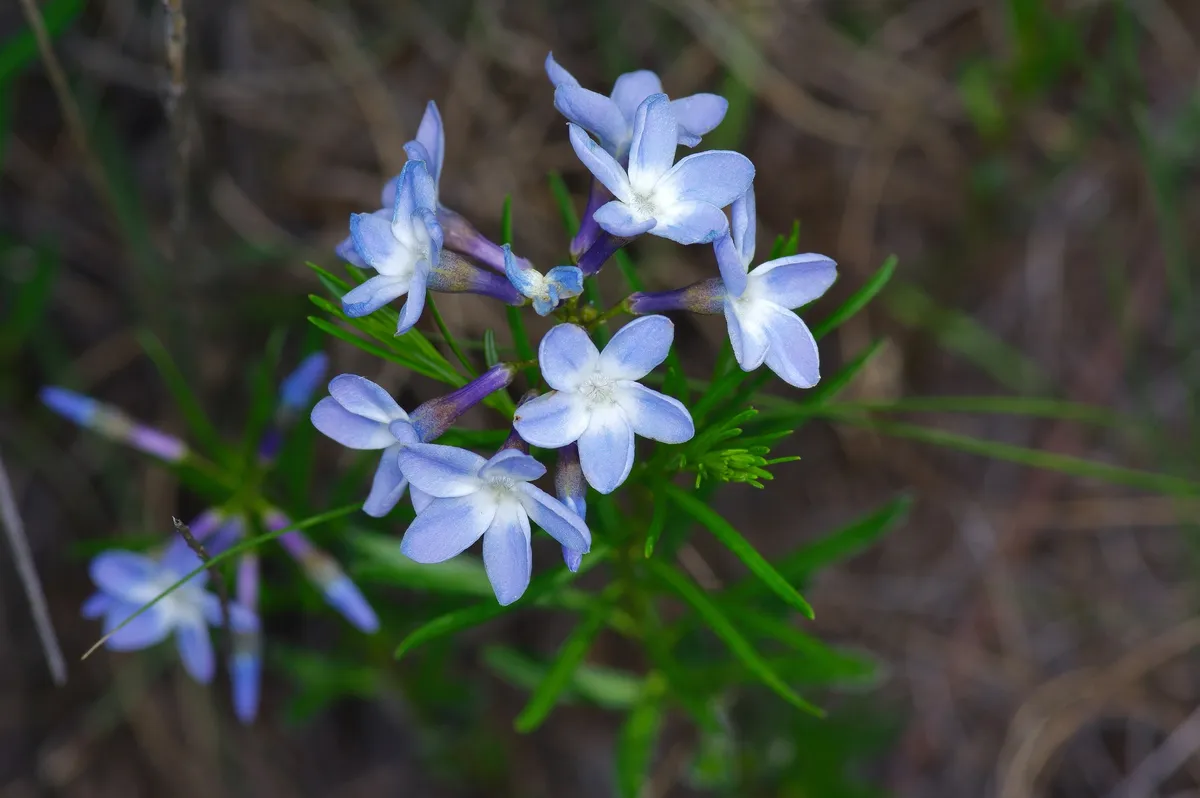
Amsonia ciliata, or fringed bluestar, is a drought-tolerant forb with narrow, hairy leaves and pale blue, star-shaped flowers blooming April through June. It grows well in sandy, well-drained soil in full sun.
Toxicity unknown
Fringed Bluestar (Amsonia ciliata) is not listed by the ASPCA Animal Poison Control Center (opens in new tab) or the other sources we check, so we have no verdict for it either way. Absence from those lists is not a clearance. If your pet shows symptoms after eating any plant, call the ASPCA at (888) 426-4435.
Light
full sun
Water
low
Size
12"–36" H × 12"–24" W
Bloom
Apr, May, Jun
Native to
AL, AR, FL, GA and 5 more states
Pollinators
bees, butterflies
Before you buy
Your city may pay you to plant this
Cities and water utilities offer rebates for replacing lawn with native and water-wise plants. We track 459 programs across 44 states, each with a link to the provider and the date we last checked it.
Find rebates in your areaPicture natives in your own yard
Upload a photo of your yard and Patch Vision shows a rendering of it planted with natives for your region, like Fringed Bluestar.


Browse plants for this ecoregion
Fringed bluestar is a native perennial that produces clusters of pale blue, star-shaped flowers in spring. This drought-tolerant plant forms neat, compact clumps with narrow leaves that turn golden yellow in fall before going dormant.
Growing Fringed Bluestar
Grow Fringed Bluestar in full sun and low water. Mature plants reach 12 to 36 inches tall and spread 12 to 24 inches wide. Expect low maintenance to keep it looking intentional in a front yard.
How to care for Fringed Bluestar, by region
How to care for Fringed Bluestar where it is actually grown: year-round basics plus what to do each season, region by region, with the sources for each.
Care guidance last updated: August 2026
Cross Timbers (includes Fort Worth, TX)
Year-round
Fringed bluestar is a clump-forming perennial native to Texas that grows about 2 to 3 feet tall and about as wide. It carries soft blue star-shaped flowers in spring and clean gold leaves in fall, and once it is settled in it asks for very little.
- Give it full sun, or sun with a little afternoon shade. In North Texas a bit of shade after about 3pm keeps the spring flowers looking good for longer.
- It has to have drainage. In heavy black clay, set it high on a slight mound or mix a few inches of expanded shale into the planting area so water moves away from the crown. In the sandier soils west of the metro it drains on its own, but it will need watering more often through its first summer.
- Allow about 24 inches of space per plant, and choose the spot carefully. It is slow to settle in and it resents being dug up and moved once it has.
- Once the flowers finish in June, cut the whole plant back to about 8 to 10 inches. It grows back bushier and stands up instead of leaning over.
- Do not plant it in rich soil or feed it much. In fat garden soil it gets loose and floppy.
The habit here is naturally rounded and fine textured, which does a lot of the work for you. Three plants set 24 inches apart along a bed edge read as a deliberate, HOA-friendly planting rather than something that showed up on its own.
Fall
Fall is when this plant earns its spot. The fine leaves turn a clean yellow gold, and autumn is also the best time to add one or to divide an old clump.
- Expect the gold color from late October into November. It is strongest on plants growing in full sun.
- Autumn rain usually handles the watering. Add one deep soak only if two or three weeks go by dry.
- Leave the gold foliage standing until it browns after the first hard freeze, around mid November. Cutting it down in September throws away the best week of the year.
- If you need to divide or move one, do it in October while the soil is still warm, and expect it to sit and pout for a season afterward.
- Top the mulch back up to about 2 inches before winter.
A crisp spade edge cut around the bed in November is what keeps a native planting reading as intentional once everything goes dormant. Most neighbors register the edge line before they register the plants.
Winter
The plant is fully dormant and needs almost nothing from you. Winter is for one tidy cutback and for planning where the next one goes.
- Cut the dead stems down to 2 or 3 inches in late February, before the new growth starts pushing up.
- Wear gloves for that cutback. Cut stems ooze a milky sap, because this plant belongs to the dogbane family.
- An established plant needs no winter watering. Give a first-year plant one gallon if six weeks pass with no rain and no freeze in the forecast.
- No winter cover is needed. It handles our zone 8a to 8b winters, including a short hard freeze, while it is dormant.
- Do not dig or move it now. Wait for October, when it moves with much less setback.
In the one season with nothing blooming, the outline of the bed is all a neighbor really sees. Keeping the cut stubs at one even height and the mulch level is the small detail that makes a dormant planting read as intentional instead of abandoned.
Spring
Spring is both the flower show and the planting window. The pale blue flowers open from about April into June, and this is the season to get a new plant into the ground.
- Plant from mid March, after the last frost, through April, so the roots have time to grow before the heat arrives.
- Water a new plant deeply once or twice a week through spring, roughly a gallon each time. Skip a watering after a soaking spring storm.
- Spread about 2 inches of shredded hardwood mulch around it, kept an inch back from the stems.
- Do not panic at bare ground in March. This plant wakes up late, so a spot that looks empty early is usually fine.
- When the flowers are done, late May into June, cut the stems back to 8 to 10 inches for a tighter shape.
Because it wakes up late, its spot can look like a gap from the sidewalk in March. Pairing it with a low evergreen neighbor, such as a dwarf yaupon, keeps that part of the bed looking cared for while the bluestar is still asleep.
Summer
July and August are the hard months here, and a first-year plant is the one at risk. An established fringed bluestar mostly coasts through the heat, but a new one still depends on you for water.
- First summer: water deeply once a week, and closer to twice a week during a run of 100F afternoons with no rain. Check first by pushing a finger 2 inches into the soil, and water only if it is dry down there.
- Sandier soils west of the metro dry out faster than heavy black clay, so the same plant may need one extra watering a week on that side of the area.
- After the first year, water only during a long dry spell, roughly every 2 to 3 weeks.
- Water early in the morning, at the base of the plant, not overhead in the afternoon.
- Do not fertilize in summer. Pushing new growth in this heat is what makes the stems flop.
Sources: Lady Bird Johnson Wildflower Center, Amsonia ciliata (Fringed bluestar), Missouri Botanical Garden Plant Finder, Amsonia ciliata, Clemson Cooperative Extension Home and Garden Information Center, Bluestar (Amsonia)
Southern Coastal Plain (includes Orlando, FL)
Year-round
Fringed bluestar is a native Florida wildflower for this area. It's a low, clump-forming perennial with narrow leaves and clusters of pale blue, star-shaped flowers, and it needs very little upkeep once it's settled in.
- Native to Florida, found in sandhills, pine flatwoods, and open scrub across the central and northern parts of the state.
- Grows into a rounded clump of narrow leaves, usually one to three feet tall and wide.
- Needs full sun and well-drained soil. It's drought-tolerant once established, so it doesn't need regular watering.
- The blooms draw butterflies and other pollinating insects in spring.
- Leaves drop for winter and the plant comes back from the base each spring, so bare stems in winter are expected, not a problem.
Fall
Fall in Central Florida brings drier, milder weather. Growth slows down and fringed bluestar holds its green foliage into the season before winter dieback.
- Growth slows as the dry season sets in. Foliage typically stays green into fall in most Central Florida winters.
- Established plants don't need supplemental watering through the typical fall dry stretch.
- No need to fertilize in fall. The plant is done needing extra care for the growing season.
A fall cutback of any stems that flopped over the summer keeps the bed looking tended heading into winter.
Winter
Winter is mild in Central Florida, but fringed bluestar still goes fully dormant. The top growth dies back and returns from the roots in spring.
- Foliage dies back to the ground for winter dormancy. That's normal for this plant and not a sign of trouble.
- Cutting the dead stems down to a few inches above the ground any time in late winter clears space for the next flush of spring growth.
- Because it's deciduous, the spot looks bare through winter. Pairing it with an evergreen neighbor keeps that part of the bed from looking empty.
- Established plants come through Central Florida's occasional winter cold snaps without extra care.
Cutting the dead stems back in late winter keeps the bed looking tended instead of dead until spring growth returns.
Spring
Spring is when fringed bluestar comes out of winter dormancy and puts on its show of pale blue flowers.
- New stems emerge from the base as the weather warms in early spring.
- Clusters of small, pale blue, star-shaped flowers open in spring and typically carry into early summer.
- No fertilizer needed. Average soil is enough. Rich or heavily fed soil tends to make the plant floppy instead of fuller.
- Butterflies and other pollinating insects visit the blooms this time of year.
- Water new plantings while roots are getting established. Established plants don't need extra watering through spring.
Summer
Summer is Central Florida's hot, rainy stretch. Fringed bluestar mostly finishes flowering early in the season and spends the rest of summer as a mounded green foliage plant.
- Well-drained soil matters more than rainfall amount. A spot that holds standing water after storms can cause root problems, so skip low, boggy corners of the yard.
- Flowering wraps up by early summer. After that it's a mounded green clump of foliage for the rest of the season.
- If it gets floppy or opens up in the humidity, trimming the longest stems back by about a third keeps the clump more compact.
- No fertilizer needed through summer. Feeding it tends to produce weak growth instead of a fuller plant.
A light trim after flowering keeps the clump compact along the front walk instead of sprawling open.
Sources: Lady Bird Johnson Wildflower Center, Native Plant Database: Amsonia ciliata, Atlas of Florida Plants (University of South Florida): Amsonia ciliata, Missouri Botanical Garden Plant Finder: Amsonia ciliata, Clemson Cooperative Extension, Home & Garden Information Center: Bluestar
Texas Blackland Prairies (includes Dallas, TX)
Year-round
Fringed bluestar is a clump-forming perennial native to Texas that grows about 2 to 3 feet tall and about as wide. It carries soft blue star-shaped flowers in spring and clean gold leaves in fall, and once it is settled in it asks for very little.
- Give it full sun, or sun with a little afternoon shade. In North Texas a bit of shade after about 3pm keeps the spring flowers looking good for longer.
- It has to have drainage. In heavy black clay, set it high on a slight mound or mix a few inches of expanded shale into the planting area so water moves away from the crown. In the sandier soils west of the metro it drains on its own, but it will need watering more often through its first summer.
- Allow about 24 inches of space per plant, and choose the spot carefully. It is slow to settle in and it resents being dug up and moved once it has.
- Once the flowers finish in June, cut the whole plant back to about 8 to 10 inches. It grows back bushier and stands up instead of leaning over.
- Do not plant it in rich soil or feed it much. In fat garden soil it gets loose and floppy.
The habit here is naturally rounded and fine textured, which does a lot of the work for you. Three plants set 24 inches apart along a bed edge read as a deliberate, HOA-friendly planting rather than something that showed up on its own.
Fall
Fall is when this plant earns its spot. The fine leaves turn a clean yellow gold, and autumn is also the best time to add one or to divide an old clump.
- Expect the gold color from late October into November. It is strongest on plants growing in full sun.
- Autumn rain usually handles the watering. Add one deep soak only if two or three weeks go by dry.
- Leave the gold foliage standing until it browns after the first hard freeze, around mid November. Cutting it down in September throws away the best week of the year.
- If you need to divide or move one, do it in October while the soil is still warm, and expect it to sit and pout for a season afterward.
- Top the mulch back up to about 2 inches before winter.
A crisp spade edge cut around the bed in November is what keeps a native planting reading as intentional once everything goes dormant. Most neighbors register the edge line before they register the plants.
Winter
The plant is fully dormant and needs almost nothing from you. Winter is for one tidy cutback and for planning where the next one goes.
- Cut the dead stems down to 2 or 3 inches in late February, before the new growth starts pushing up.
- Wear gloves for that cutback. Cut stems ooze a milky sap, because this plant belongs to the dogbane family.
- An established plant needs no winter watering. Give a first-year plant one gallon if six weeks pass with no rain and no freeze in the forecast.
- No winter cover is needed. It handles our zone 8a to 8b winters, including a short hard freeze, while it is dormant.
- Do not dig or move it now. Wait for October, when it moves with much less setback.
In the one season with nothing blooming, the outline of the bed is all a neighbor really sees. Keeping the cut stubs at one even height and the mulch level is the small detail that makes a dormant planting read as intentional instead of abandoned.
Spring
Spring is both the flower show and the planting window. The pale blue flowers open from about April into June, and this is the season to get a new plant into the ground.
- Plant from mid March, after the last frost, through April, so the roots have time to grow before the heat arrives.
- Water a new plant deeply once or twice a week through spring, roughly a gallon each time. Skip a watering after a soaking spring storm.
- Spread about 2 inches of shredded hardwood mulch around it, kept an inch back from the stems.
- Do not panic at bare ground in March. This plant wakes up late, so a spot that looks empty early is usually fine.
- When the flowers are done, late May into June, cut the stems back to 8 to 10 inches for a tighter shape.
Because it wakes up late, its spot can look like a gap from the sidewalk in March. Pairing it with a low evergreen neighbor, such as a dwarf yaupon, keeps that part of the bed looking cared for while the bluestar is still asleep.
Summer
July and August are the hard months here, and a first-year plant is the one at risk. An established fringed bluestar mostly coasts through the heat, but a new one still depends on you for water.
- First summer: water deeply once a week, and closer to twice a week during a run of 100F afternoons with no rain. Check first by pushing a finger 2 inches into the soil, and water only if it is dry down there.
- Sandier soils west of the metro dry out faster than heavy black clay, so the same plant may need one extra watering a week on that side of the area.
- After the first year, water only during a long dry spell, roughly every 2 to 3 weeks.
- Water early in the morning, at the base of the plant, not overhead in the afternoon.
- Do not fertilize in summer. Pushing new growth in this heat is what makes the stems flop.
Sources: Lady Bird Johnson Wildflower Center, Amsonia ciliata (Fringed bluestar), Missouri Botanical Garden Plant Finder, Amsonia ciliata, Clemson Cooperative Extension Home and Garden Information Center, Bluestar (Amsonia)
In an HOA neighborhood
Fringed Bluestar is an HOA-friendly choice. Maintenance level: low. Tidiness: 4 out of 5.
Works well in: front yard, foundation, street edge, mid zone.
- Dies back completely in winter
- May need occasional grooming of spent flowers
Wildlife value
Host plant for dogbane moth.
The spring blooms attract native bees and butterflies. The plant also serves as a host for several native moth species.
Common questions
- When does fringed bluestar bloom?
- Fringed bluestar blooms in April, May, and June, producing clusters of pale blue, star-shaped flowers atop slender stems.
- What pollinators visit fringed bluestar?
- Bees and butterflies are the main visitors, attracted to the nectar in the tubular blue flowers.
- How much water does fringed bluestar need?
- Once established, fringed bluestar handles low water and dry, sandy soils well, making it suited to low-maintenance or xeric garden beds.
- What light does fringed bluestar prefer?
- It grows best in full sun but can tolerate part sun to part shade, particularly in hotter southern climates.
- Does fringed bluestar stay green year round?
- No, it is an herbaceous perennial forb that dies back to the ground in winter and resprouts from its base in spring.
- Is Fringed Bluestar HOA-friendly?
- Fringed Bluestar is generally an HOA-friendly choice in the right placement, with low maintenance.
These answers were drafted with an AI model from this plant's data. Verify care details with a local expert.
Native range data from the World Checklist of Vascular Plants (Kew). Pollinator and host plant associations compiled from GBIF, iNaturalist, and published ecological literature.
If something looks wrong
Common plant problems, and what to check first
These come up on almost any plant. Each guide lists the likely causes in the order they are worth ruling out, with one thing to check before you act on any of them, and links to the source it came from.
- It is dying right after planting
- Leaves turning yellow
- Wilting even though I watered it
- Brown crispy leaf tips
- Bugs on the plant
Ready to grow Fringed Bluestar? Add it to your garden in Pollinator Patch to track it and get season-by-season care guidance.