Mountain mint
Pycnanthemum californicum
Last reviewed: October 2026
Mountain mint (Pycnanthemum californicum) is a perennial forb native to CA. It blooms in June, July, and August. The flowers draw bees, butterflies, and flies.
Toxicity unknown
Mountain mint (Pycnanthemum californicum) is not listed by the ASPCA Animal Poison Control Center (opens in new tab) or the other sources we check, so we have no verdict for it either way. Absence from those lists is not a clearance. If your pet shows symptoms after eating any plant, call the ASPCA at (888) 426-4435.
Light
full sun
Water
medium
Size
18"–36" H × 18"–30" W
Bloom
Jun, Jul, Aug
Native to
CA
Pollinators
bees, butterflies, flies
Before you buy
Your city may pay you to plant this
Cities and water utilities offer rebates for replacing lawn with native and water-wise plants. We track 458 programs across 44 states, each with a link to the provider and the date we last checked it.
Find rebates in your areaPicture natives in your own yard
Upload a photo of your yard and Patch Vision shows a rendering of it planted with natives for your region, like Mountain mint.


Browse plants for this ecoregion
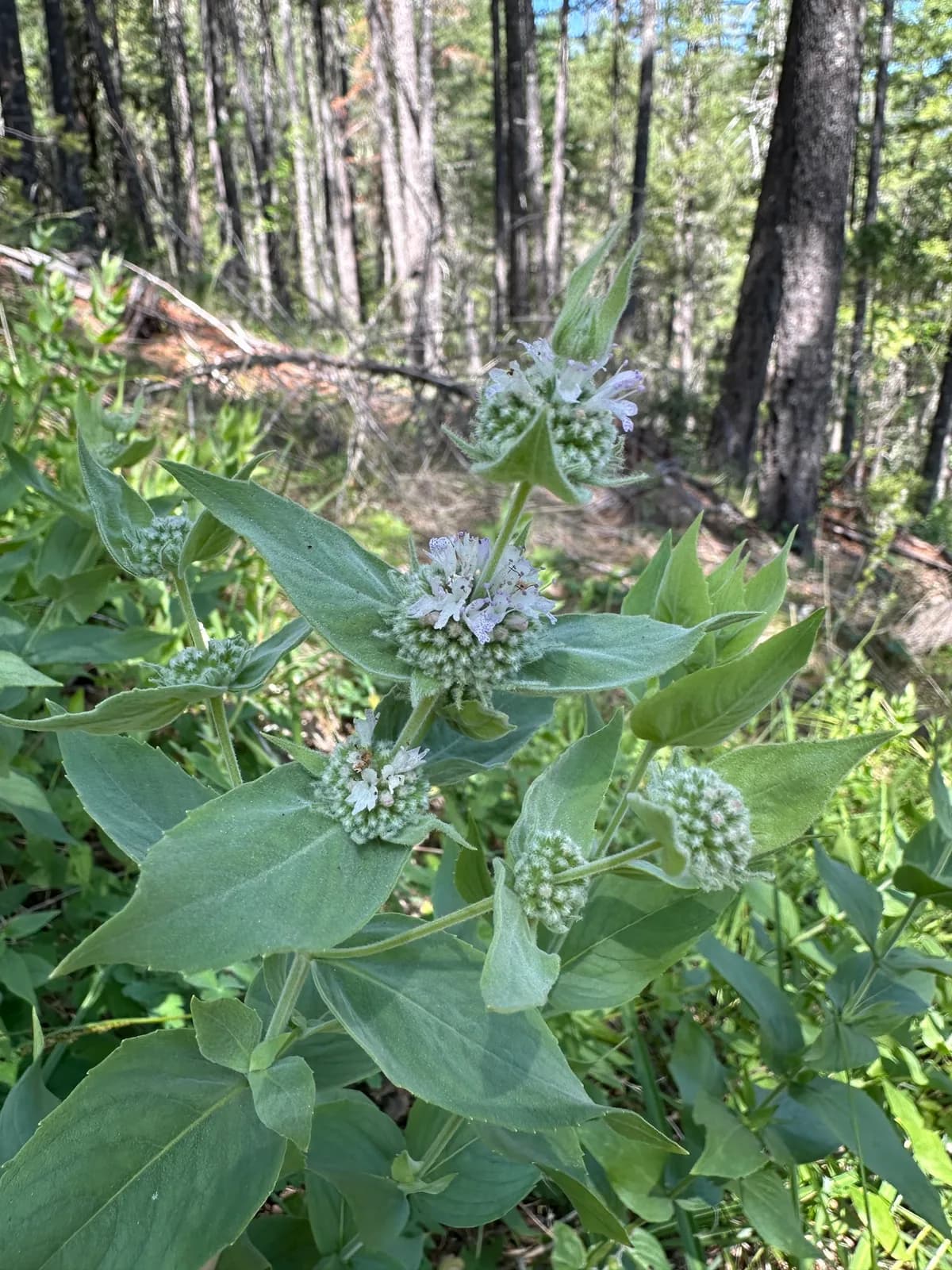
An upright, minty-scented perennial with narrow leaves and dense flat-topped clusters of small white flowers in summer. Spreads slowly by rhizomes to form colonies in moist meadows and streambanks.
Growing Mountain mint
Grow Mountain mint in full sun and medium water. Mature plants reach 18 to 36 inches tall and spread 18 to 30 inches wide.
How to care for Mountain mint, by region
How to care for Mountain mint where it is actually grown: year-round basics plus what to do each season, region by region, with the sources for each.
Care guidance last updated: September 2026
Southeastern Plains (includes Tallahassee, FL)
Year-round
Pycnanthemum californicum, also called Sierra mint or California mountain mint, is a California native perennial in the mint family. It is not native to the Tallahassee area, but as a plant you already own it can still do well in a north Florida garden if you match it to moist, well drained soil and give it some relief from full afternoon sun.
- This plant is native to California, found wild in the Sierra Nevada, the Klamath and Coast Ranges, and southern California's Transverse and Peninsular Ranges. It is not native to Florida or the Southeast, so grow it as a garden perennial rather than a local wildlife-habitat pick.
- Give it part sun to full sun. Some afternoon shade helps it cope with Tallahassee's hotter, more humid summers than it sees in its native California mountains.
- Keep the soil consistently moist but well drained. In the wild it grows in moist mountain sites, so it does not like to dry out completely, but soggy soil that never drains can rot the roots.
- It grows roughly 2 to 4 feet tall and spreads by rhizomes like other mints. A border edge, buried barrier, or large container keeps it from wandering into nearby beds.
- Mountain mints are strong pollinator plants. This species is recorded supporting a wide range of native bees, butterflies, and moths.
- It is not on the ASPCA's toxic plant list for dogs or cats. The ASPCA does separately list common garden mint (Mentha) as toxic, so that is a different plant, but it is still worth watching a pet that likes to chew on new growth.
By late summer the spreading, minty growth can look a little loose. Keeping it edged or in a contained bed keeps the look HOA-conscious without losing the pollinator value.
Fall
Fall in Tallahassee is milder and drier than summer, with the first frost typically arriving in early to mid November, giving this plant a slow wind down toward dormancy.
- Once flowering tapers off in early fall, leave the seed heads standing for a few weeks. They keep drawing in late-season pollinators and look better left alone than cut hard right away.
- Stop feeding the plant by early fall so it is not pushing soft new growth right before the first frost.
- The Tallahassee area's first frost typically lands in early to mid November. Foliage will likely start to brown and die back not long after.
- Fall is a decent second window for dividing or transplanting, now that the worst summer heat has passed.
Winter
Tallahassee sits in USDA hardiness zone 9a with a mild winter for a plant that is used to cold at elevation in the California mountains, so expect this Sierra mint to die back to the ground after a freeze and come back in spring.
- Tallahassee is in USDA hardiness zone 9a. The first freeze typically lands in late November and the first hard freeze near the end of December.
- After a freeze browns the top growth, cut the dead stems back close to the ground. New shoots return from the base in spring.
- Keep winter soil on the well drained side. Cool, wet soil that does not drain is a bigger risk to the roots over winter than our mild cold snaps.
- No pruning is needed mid-winter beyond clearing dead stems. Wait for spring growth to show before shaping the plant further.
Spring
Spring in Tallahassee runs from around mid-March, when frost risk ends, into a warm and increasingly humid start to summer. This is when Sierra mint comes back from its winter dieback.
- Frost advisories in the Tallahassee area typically end around mid-March, so wait until then before counting on new growth to stay undamaged.
- Cut back any dead winter stems down to the fresh green shoots at the base. This tidies the plant and gives new growth room to fill in.
- Spring is a good window to divide a crowded clump or move new starts, before the heavier heat of late spring and summer sets in.
- Check soil moisture as temperatures climb. North Florida spring rain can be uneven, so make sure the ground is not drying out around new shoots.
Summer
Tallahassee summers are hot, humid, and rainy, and June through September is also this plant's bloom window, so its main show lines up with our heaviest afternoon storms.
- Expect white flowers with purple-spotted lower lips from June into September.
- Regular Tallahassee summer rain usually covers this plant's need for steady moisture. Water by hand only during a dry stretch of a week or more.
- High humidity raises the risk of powdery mildew on mountain mints. Give plants room to breathe and water the soil instead of the leaves to cut that risk down.
- Removing spent flower clusters can encourage more blooms and keeps the plant looking tidier through the season.
Sources: Lady Bird Johnson Wildflower Center, Pycnanthemum californicum profile, Calscape (California Native Plant Society), Pycnanthemum californicum, Theodore Payne Foundation Native Plant Database, Pycnanthemum californicum, ASPCA Toxic and Non-Toxic Plant List, Dogs, National Weather Service Tallahassee, Frost and Freeze Information, First report of powdery mildew on mountain mints (Pycnanthemum spp.), Plant Disease journal
Wildlife value
The flat flower clusters are extremely attractive to a wide range of native bees, wasps, and butterflies during peak summer bloom.
Common questions
- How much sun does Mountain mint need?
- Mountain mint grows best in full sun conditions.
- When does Mountain mint bloom?
- Mountain mint blooms in June, July, and August.
- Where is Mountain mint native?
- Mountain mint (Pycnanthemum californicum) is native to CA, per vouchered herbarium specimen records and regional native plant society lists.
- What pollinators does Mountain mint attract?
- Mountain mint draws bees, butterflies, and flies.
Native range data from vouchered herbarium specimen records and regional native plant society lists. Pollinator and host plant associations compiled from GBIF, iNaturalist, and published ecological literature.
If something looks wrong
Common plant problems, and what to check first
These come up on almost any plant. Each guide lists the likely causes in the order they are worth ruling out, with one thing to check before you act on any of them, and links to the source it came from.
- It is dying right after planting
- Leaves turning yellow
- Wilting even though I watered it
- Brown crispy leaf tips
- Bugs on the plant
Ready to grow Mountain mint? Add it to your garden in Pollinator Patch to track it and get season-by-season care guidance.