Ozark calamint
Clinopodium glabellum
Last reviewed: October 2026
Toxicity unknown
Ozark calamint (Clinopodium glabellum) is not listed by the ASPCA Animal Poison Control Center (opens in new tab) or the other sources we check, so we have no verdict for it either way. Absence from those lists is not a clearance. If your pet shows symptoms after eating any plant, call the ASPCA at (888) 426-4435.
Light
full sun
Water
medium
Size
4"–10" H × 6"–12" W
Bloom
May, Jun
Native to
AL, AR, KY, TN
Pollinators
bees
Before you buy
Your city may pay you to plant this
Cities and water utilities offer rebates for replacing lawn with native and water-wise plants. We track 459 programs across 44 states, each with a link to the provider and the date we last checked it.
Find rebates in your areaPicture natives in your own yard
Upload a photo of your yard and Patch Vision shows a rendering of it planted with natives for your region, like Ozark calamint.


Browse plants for this ecoregion
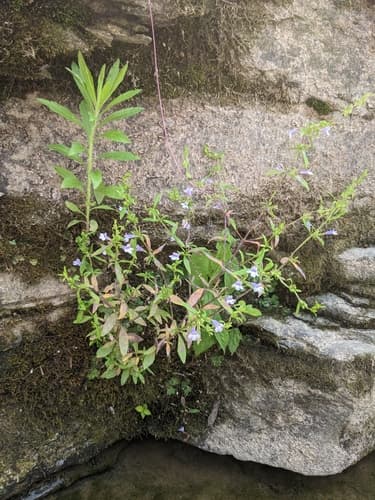
A small perennial mint-family wildflower restricted to wet limestone cedar glades and creekside seeps within a narrow range, with pale pink tubular flowers blooming in late spring. A vulnerable species with very specific habitat needs, most often found colonizing thin, mineral soils over exposed limestone.
How to care for Ozark calamint, by region
How to care for Ozark calamint where it is actually grown: year-round basics plus what to do each season, region by region, with the sources for each.
Care guidance last updated: September 2026
Ouachita Mountains (includes Hot Springs, AR)
Year-round
Ozark calamint is a small perennial mint-family wildflower native to limestone cedar glades and creekside seeps in a narrow range outside this region (the Nashville Basin, Kentucky's Bluegrass Region, and northern Alabama), with pale pink tubular flowers in late spring.
- It is naturally adapted to thin, mineral soil over exposed limestone that stays consistently damp from seeps, which is harder to replicate in a typical yard.
- Give it full sun to light shade and a spot that does not dry out completely between waterings.
- It is a vulnerable species with a very narrow native range, so treat it as a specialty planting rather than a general-purpose groundcover.
- Keep it out of standing water; the habitat is consistently moist, not waterlogged.
Grown low and mounding in a defined bed or rock garden, it reads as a tidy, intentional groundcover.
Fall
Growth slows as temperatures cool; fall is a reasonable time to establish new plantings before winter.
- Keep new plantings watered through fall until they are established.
- Clear fallen leaves off the low mound so it isn't smothered.
- No pruning is needed beyond removing spent growth.
Winter
The plant goes dormant over winter in its native cool-season glade habitat.
- Keep the site from drying out completely even in dormancy; it is not adapted to prolonged winter drought.
- No mulch beyond what naturally falls is typically needed.
- Avoid disturbing the crown until new growth resumes in spring.
Spring
Spring brings new growth and the late-spring bloom of small pink tubular flowers.
- Keep soil consistently moist as new growth emerges; this species does not tolerate drying out.
- No feeding is needed; it grows naturally in thin, mineral soil rather than rich garden beds.
- Watch for flowering to begin in May as temperatures warm.
Summer
Summer heat is the main risk period; the plant needs steady moisture even as temperatures climb.
- Water during dry spells rather than letting the soil dry out completely, mimicking its natural seep habitat.
- Light afternoon shade can help it through the hottest stretch of summer if grown outside a naturally cool glade setting.
- Trim lightly after bloom fades to keep the mound tidy.
Sources: U.S. Fish & Wildlife Service, Ozark Calamint (Clinopodium glabellum), Flora of the Southeastern United States (FSUS)
In an HOA neighborhood
Ozark calamint is an HOA-friendly choice. Maintenance level: low. Tidiness: 4 out of 5.
Works well in: rock garden, groundcover.
- Naturally adapted to wet limestone glade conditions and may be difficult to establish in typical garden soil
Wildlife value
The small pink tubular flowers draw bees and other small pollinating insects for nectar during the late spring bloom.
Common questions
- How much sun does Ozark calamint need?
- Ozark calamint grows best in full sun conditions.
- When does Ozark calamint bloom?
- Ozark calamint blooms in May and June.
- Where is Ozark calamint native?
- Ozark calamint (Clinopodium glabellum) is native to AL, AR, KY, TN, per NatureServe Explorer.
- What pollinators does Ozark calamint attract?
- Ozark calamint draws bees.
- Is Ozark calamint HOA-friendly?
- Ozark calamint is generally an HOA-friendly choice in the right placement, with low maintenance.
Native range data from NatureServe Explorer. Pollinator and host plant associations compiled from GBIF, iNaturalist, and published ecological literature.
If something looks wrong
Common plant problems, and what to check first
These come up on almost any plant. Each guide lists the likely causes in the order they are worth ruling out, with one thing to check before you act on any of them, and links to the source it came from.
- It is dying right after planting
- Leaves turning yellow
- Wilting even though I watered it
- Brown crispy leaf tips
- Bugs on the plant
Ready to grow Ozark calamint? Add it to your garden in Pollinator Patch to track it and get season-by-season care guidance.