Pacific Blackberry
Rubus ursinus
Last reviewed: September 2026
Pacific blackberry is a trailing, thorny vine common along coastal bluffs, forest edges and stream banks in the Pacific Northwest and California, blooming from May through July.
Toxicity unknown
Pacific Blackberry (Rubus ursinus) is not listed by the ASPCA Animal Poison Control Center (opens in new tab) or the other sources we check, so we have no verdict for it either way. Absence from those lists is not a clearance. If your pet shows symptoms after eating any plant, call the ASPCA at (888) 426-4435.
The USDA PLANTS Database (opens in new tab) does not flag Pacific Blackberry as toxic to livestock.
Light
part sun
Water
medium
Size
24"–120" H × 36"–240" W
Bloom
May, Jun, Jul
Native to
CA, ID, MT, OR and 1 more states
Pollinators
bees, beetles
Before you buy
Your city may pay you to plant this
Cities and water utilities offer rebates for replacing lawn with native and water-wise plants. We track 459 programs across 44 states, each with a link to the provider and the date we last checked it.
Find rebates in your areaPicture natives in your own yard
Upload a photo of your yard and Patch Vision shows a rendering of it planted with natives for your region, like Pacific Blackberry.


Browse plants for this ecoregion
Pacific blackberry is a sprawling native vine that produces white to pink flowers in late spring and summer, followed by edible dark berries. This vigorous grower can spread extensively through underground runners and forms dense thickets over time. The thorny canes die back in winter but return each spring.
Growing Pacific Blackberry
Grow Pacific Blackberry in part sun and medium water. Mature plants reach 24 to 120 inches tall and spread 36 to 240 inches wide. Expect high maintenance to keep it looking intentional in a front yard.
How to care for Pacific Blackberry, by region
How to care for Pacific Blackberry where it is actually grown: year-round basics plus what to do each season, region by region, with the sources for each.
Care guidance last updated: September 2026
Piedmont (includes Atlanta, GA)
Year-round
Pacific blackberry (Rubus ursinus) is a trailing bramble from the Pacific Northwest and California coast, not native to Georgia, so in Atlanta it needs a support structure, room to run, and closer disease watching than it gets at home. It sprawls along the ground or a trellis rather than growing upright, which sets its care apart from upright black raspberry canes.
- This bramble is native to California, Idaho, Montana, Oregon, and Washington, not the Southeast, so in an Atlanta garden it is grown as an out-of-range plant rather than a regional native.
- Give the trailing stems something to climb. Canes can run 10 to 20 feet and root wherever a node touches soil, so a trellis or fence keeps the plant contained instead of spreading into the lawn.
- Plant in full sun to part shade in loamy sand, sandy loam, or clay loam with a pH around 6.0 to 6.5, spacing plants about 10 feet apart.
- Atlanta's humid summers favor fungal problems this plant rarely faces on the West Coast, so plan on checking canes each spring for the purple, gray-centered spots of anthracnose.
- Blackberry (Rubus) is not on the ASPCA's toxic plant list for dogs or cats, so the fruit and canes are not a pet-toxicity concern here, though the thorns can still scratch a curious nose or paw.
A trellis or fence line keeps the trailing canes off the ground and out of the lawn, which reads as a tended planting rather than a bramble patch creeping toward a neighbor's yard.
Fall
Fall is cleanup season: cut out the canes that already fruited and finish training the rest onto the trellis before winter dormancy sets in.
- After harvest, remove the old canes that already fruited. Trailing blackberries flower and fruit on their second-year canes, so those canes will not fruit again and should come out.
- Train the remaining new canes onto the trellis in a fan pattern, shortening side shoots to about 10 to 20 inches if they are getting unruly.
- Clear fallen leaves and old cane debris from around the base. Removing that material cuts down on the anthracnose spores that overwinter on old canes.
- Atlanta's fall is milder and less humid than its summer, which makes it a better window for this kind of hands-on pruning without pushing tender new growth into disease-favoring wet heat.
Cutting out spent canes and tying the rest neatly to the trellis right after harvest keeps the bed looking maintained instead of an overgrown thicket heading into fall.
Winter
The plant is dormant through Atlanta's winter, a quiet stretch for the plant itself and a good time to finish training canes and tidy the support structure before spring growth starts.
- Keep training loose canes into a fan pattern away from the crown on the trellis through winter, while the plant is dormant and easy to handle.
- This species is hardy to USDA zone 3, so Atlanta's winter cold is not a concern the way it might be for less cold-hardy garden plants.
- Prune out any remaining dead or spent canes while the plant is bare and easy to see into, clearing the way for clean spring growth.
- Wait until new growth resumes in early spring before the first fertilizer round. UGA recommends the first 10-10-10 application in February or early March for established plantings.
Bare canes neatly tied to a trellis over winter keep the planting looking intentional and tended, rather than an untrimmed thicket, through the dormant months when curb appeal matters most.
Spring
Spring is the main training-and-watching season, when new canes take off and last year's canes finish blooming, right as Atlanta's wet spring weather gives disease its best foothold.
- Tie new canes to the trellis as they grow and tip them about 6 inches above the top wire to encourage branching, the training UGA recommends for trailing types in Georgia.
- Check new shoots for small purple spots with gray centers, the first sign of anthracnose, which spreads fastest during Atlanta's wet spring weeks.
- Hold off on heavy nitrogen fertilizer this early. Lush new growth pushed by too much nitrogen is more prone to that same anthracnose.
- Keep the base weeded and thin crowded canes so air moves through the planting, since Atlanta's spring humidity runs higher than this plant's home range.
Summer
Summer brings ripening fruit alongside the peak of Atlanta's heat and humidity, both harder on this cool-coast species than on blackberry varieties bred for the Southeast.
- Water deeply during dry stretches so moisture reaches 8 to 10 inches down, rather than light frequent sprinkling, following UGA's home bramble guidance.
- Keep mulch around the base to hold soil moisture and cut down on weeds competing for water through Atlanta's hot summer stretch.
- Pick berries once they lose their glossy shine and turn a duller black, harvesting in late morning after the dew has dried, the same timing UGA gives for trailing blackberries in Georgia.
- If leaves develop small spots with light gray centers and purple margins, that is anthracnose. Remove infected canes and leaves promptly, since Atlanta's humid summers keep the disease active longer than it would stay in cooler Pacific climates.
Sources: Lady Bird Johnson Wildflower Center: Rubus ursinus (California blackberry), Oregon State University Landscape Plants: Rubus ursinus, UGA Extension C766: Home Garden Raspberries and Blackberries, Ohio State University Extension: Anthracnose of Raspberry and Blackberry, ASPCA Toxic and Non-Toxic Plants, Letter B
In an HOA neighborhood
Pacific Blackberry takes more care to keep looking intentional in a front yard. Maintenance level: high. Consider it for backyard or mid-zone beds rather than the street edge.
Works well in: backyard only.
- Aggressive spreading habit difficult to control
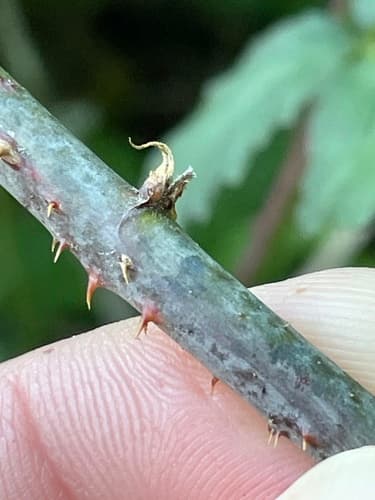
- Thorny canes create maintenance and safety concerns
- Can appear very wild and unkempt
Wildlife value
Host plant for western tiger swallowtail.
The flowers attract native bees and beetles during the growing season. Birds and small mammals rely heavily on the nutritious berries in late summer.
Common questions
- How much light does Pacific blackberry need?
- Pacific blackberry does best in part sun but is adaptable, growing in everything from open full sun clearings to the shaded edges of coniferous forests.
- How much water does Pacific blackberry require?
- This vine prefers medium moisture but tolerates both wetter streamside conditions and drier slopes once it is established.
- When does Pacific blackberry flower?
- Pacific blackberry blooms from May through July, producing small white flowers along its trailing canes.
- What pollinates Pacific blackberry?
- Bees and beetles are the main visitors to the flowers, moving pollen between blossoms as they feed.
- Is Pacific blackberry evergreen or deciduous?
- Pacific blackberry is deciduous, dropping its leaves in fall after fruiting and regrowing new canes each spring.
- Is Pacific Blackberry toxic to livestock?
- The USDA PLANTS Database does not flag Pacific Blackberry as toxic to livestock.
- Is Pacific Blackberry HOA-friendly?
- Pacific Blackberry takes more care to look intentional in a front yard. Consider it for backyard or mid-zone beds rather than the street edge.
These answers were drafted with an AI model from this plant's data. Verify care details with a local expert.
Native range data from vouchered herbarium specimen records and regional native plant society lists. Pollinator and host plant associations compiled from GBIF, iNaturalist, and published ecological literature.
If something looks wrong
Common plant problems, and what to check first
These come up on almost any plant. Each guide lists the likely causes in the order they are worth ruling out, with one thing to check before you act on any of them, and links to the source it came from.
- It is dying right after planting
- Leaves turning yellow
- Wilting even though I watered it
- Brown crispy leaf tips
- Bugs on the plant
Ready to grow Pacific Blackberry? Add it to your garden in Pollinator Patch to track it and get season-by-season care guidance.