Santa Cruz cypress
Hesperocyparis abramsiana
Last reviewed: September 2026
Toxicity unknown
Santa Cruz cypress (Hesperocyparis abramsiana) is not listed by the ASPCA Animal Poison Control Center (opens in new tab) or the other sources we check, so we have no verdict for it either way. Absence from those lists is not a clearance. If your pet shows symptoms after eating any plant, call the ASPCA at (888) 426-4435.
Light
full sun
Water
low
Size
240"–600" H × 96"–240" W
Bloom
Feb, Mar
Native to
CA
Before you buy
Your city may pay you to plant this
Cities and water utilities offer rebates for replacing lawn with native and water-wise plants. We track 452 programs across 44 states, each with a link to the provider and the date we last checked it.
Find rebates in your areaBrowse plants for this ecoregion
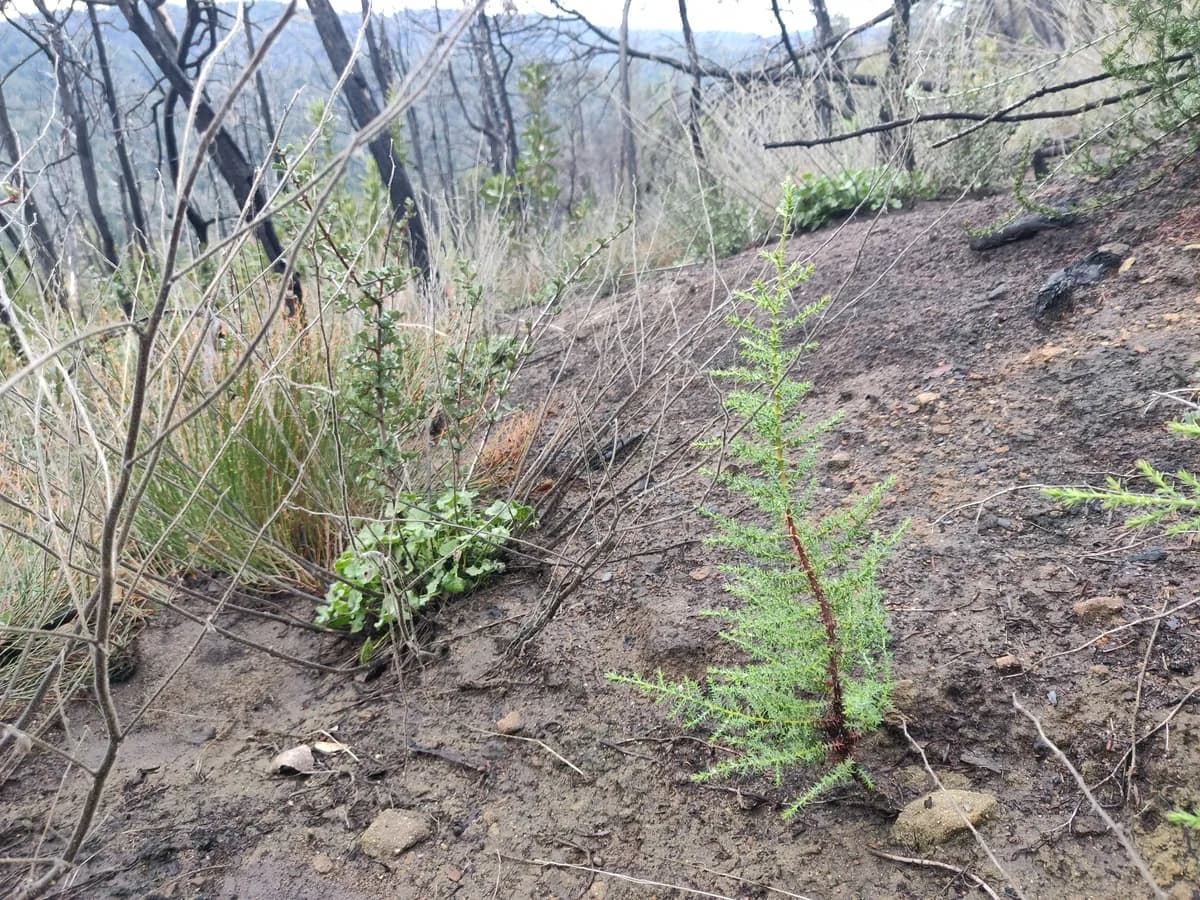
Narrow, conical evergreen conifer with dense scale-like blue-green foliage and small woody cones that remain closed on the tree for years, opening after fire. A rare, narrowly distributed species restricted to a few sandstone ridges.
Wildlife value
Dense evergreen canopy provides year-round nesting cover for birds. Closed cones represent a long-term seed bank that opens after fire to regenerate the stand.
Common questions
- How much sun does Santa Cruz cypress need?
- Santa Cruz cypress grows best in full sun conditions.
- When does Santa Cruz cypress bloom?
- Santa Cruz cypress blooms in February and March.
- Where is Santa Cruz cypress native?
- Santa Cruz cypress (Hesperocyparis abramsiana) is native to CA, per the World Checklist of Vascular Plants (Kew).
Native range data from the World Checklist of Vascular Plants (Kew). Pollinator and host plant associations compiled from GBIF, iNaturalist, and published ecological literature.
If something looks wrong
Common plant problems, and what to check first
These come up on almost any plant. Each guide lists the likely causes in the order they are worth ruling out, with one thing to check before you act on any of them, and links to the source it came from.
- It is dying right after planting
- Leaves turning yellow
- Wilting even though I watered it
- Brown crispy leaf tips
- Bugs on the plant
Ready to grow Santa Cruz cypress? Add it to your garden in Pollinator Patch to track it and get season-by-season care guidance.
Planning a bed around it? Start a free plan with this plant
Not sure where to start? Take the 2-minute yard quiz