Shooting star
Dodecatheon meadia
Last reviewed: September 2026
Shooting star sends up nodding pink and white blooms from March through May, growing well in part shade with medium moisture in woodlands, meadows, and prairies before going dormant in summer heat.
Toxicity unknown
Shooting star (Dodecatheon meadia) is not listed by the ASPCA Animal Poison Control Center (opens in new tab) or the other sources we check, so we have no verdict for it either way. Absence from those lists is not a clearance. If your pet shows symptoms after eating any plant, call the ASPCA at (888) 426-4435.
Light
part shade
Water
medium
Size
8"–18" H × 8"–12" W
Bloom
Mar, Apr, May
Native to
AL, AR, FL, GA and 24 more states
Pollinators
bees
Before you buy
Your city may pay you to plant this
Cities and water utilities offer rebates for replacing lawn with native and water-wise plants. We track 459 programs across 44 states, each with a link to the provider and the date we last checked it.
Find rebates in your areaPicture natives in your own yard
Upload a photo of your yard and Patch Vision shows a rendering of it planted with natives for your region, like Shooting star.


Browse plants for this ecoregion
Woodland perennial with a basal rosette of smooth leaves and a slender leafless stalk bearing nodding, swept-back pink flowers with prominent yellow centers. Goes fully dormant by midsummer.
Growing Shooting star
Grow Shooting star in part shade and medium water. Mature plants reach 8 to 18 inches tall and spread 8 to 12 inches wide. Expect low maintenance to keep it looking intentional in a front yard.
How to care for Shooting star, by region
How to care for Shooting star where it is actually grown: year-round basics plus what to do each season, region by region, with the sources for each.
Care guidance last updated: September 2026
Edwards Plateau (includes San Antonio, TX)
Year-round
Shooting star is a spring wildflower that likes shaded woodland gardens with organic, evenly moist soil, then rests after flowering. San Antonio's long hot summers and dry alkaline soil make this a poor climate match, so treat it as a careful cultivation-only plant.
- Plant in part to full shade with rich, organic soil.
- Keep soil evenly moist during the growing season.
- Expect it to die back after spring bloom.
- Ask a specialist nursery for plants, since seed is hard.
Fall
Fall is the time to plant or add compost. Cooler weather lets you prepare the shady bed for spring.
- Plant from a specialist nursery in fall.
- Add leaf mulch and compost to the bed.
- Water lightly if the fall is dry.
- Do not plant deeper than the nursery advises.
Winter
The plant needs a cool rest in winter and should stay underground until spring.
- Leave the bed undisturbed.
- Keep leaf mulch in place.
- Water only during long dry spells.
- Watch for new leaves as days lengthen.
Spring
Spring is the whole show. Leaves and flowers appear in mid to late spring, and the plant needs steady moisture.
- Water regularly so the soil stays moist.
- Enjoy the backswept flowers in mid to late spring.
- Keep it shaded from strong afternoon sun.
- Let the leaves yellow naturally after bloom.
Summer
The plant dies back after flowering and stays dormant through the San Antonio summer. There will be nothing to see, and that is normal.
- Do not dig or disturb the spot.
- Avoid heavy summer watering on the dormant roots.
- Mark the location so you remember it.
- Plant something shallow rooted around it if you want cover.
A bare patch shows up in summer, so plant a low companion nearby if it faces the street.
Southeastern Wisconsin Till Plains (includes Milwaukee, WI)
Year-round
Eastern shooting star (Dodecatheon meadia) is native to Wisconsin, part of a range that runs from Wisconsin and Pennsylvania south to Texas and Georgia, according to the Lady Bird Johnson Wildflower Center. It is a spring ephemeral, meaning it grows, blooms, and goes dormant within a few months, then disappears until the following spring.
- Choose a spot with part shade to dappled sun and soil that holds spring moisture, ideally with added organic matter.
- Soil should drain well. It tolerates some clay but prefers loam with rocky or sandy texture.
- Expect the leaves to yellow and vanish by early summer. That disappearance is the plant's normal yearly cycle, not decline.
- Pair it with a later-emerging perennial or groundcover that can fill in visually once it goes dormant.
- Divide overcrowded clumps in fall while the plant is dormant if you want to expand the planting.
Fall
Fall is a quiet, mostly hands-off season for eastern shooting star since the plant is already dormant underground. It is the best time to divide and transplant mature clumps if you want to spread the colony.
- The plant is dormant below ground, so there is no foliage to care for in fall.
- If dividing, dig mature crowns once the ground has cooled but before it freezes, then divide and replant right away.
- If you are not dividing, simply leave the area undisturbed since there is no foliage present to manage.
- A layer of fall leaf litter over the dormant crown is fine and mimics its natural woodland or prairie habitat.
- Avoid piling thick mulch directly on the crown. A light covering is enough.
No fall cutback is needed here since the leaves already dropped back in early summer, so this spot needs no extra tidying for curb appeal.
Winter
Eastern shooting star overwinters as a dormant rootstock and is reliably hardy through Milwaukee winters, needing no special winter protection.
- The plant is hardy in USDA zones 4 through 8, well within Milwaukee's typical zone range, so no winter digging or moving is needed.
- No cutback is needed in winter since the foliage already died back months earlier.
- A natural layer of fallen leaves over the bed helps insulate the dormant crown, similar to its native woodland and prairie settings.
- Avoid walking on or compacting the soil where the dormant crown sits.
- New leaves will emerge on their own in early spring. There is nothing to plant or water over winter.
Spring
Spring is the only season this plant is actively growing, and it is when it does all of its blooming, sending up leafless flower stalks with nodding pink to white flowers above a low rosette of leaves.
- Keep the soil consistently moist while the plant is actively growing and flowering, its only real growing season.
- Full sun works in cool spring weather, with light shade appreciated once nearby trees leaf out.
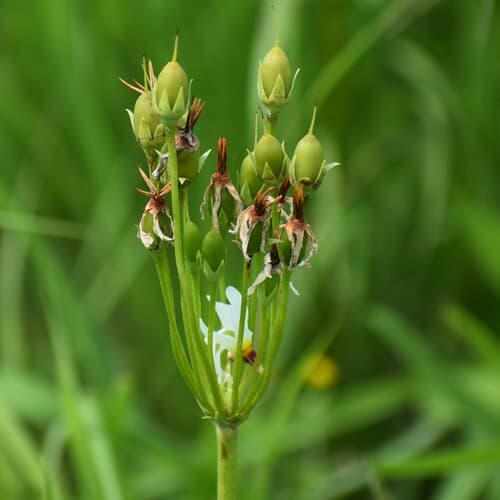
- Deadheading spent flower stalks is optional since the seed pods are not particularly showy.
- Bumblebees are the main pollinators here, shaking pollen loose from the flower in a motion called buzz pollination, so avoid spraying pesticides nearby during bloom.
- Weed carefully around the low basal rosette since the foliage is easy to damage while small.
- Small transplants can be slow to establish. Give them consistent moisture and time before judging whether they took.
Deadheading spent flower stalks after bloom keeps a front-yard bed looking tidy while the plant is still visible before it goes dormant.
Summer
By early summer the plant has finished blooming and its leaves die back completely as it enters dormancy for the rest of the year. This is a normal part of its life cycle as a spring ephemeral, not a sign of a problem.
- Expect the foliage to yellow and disappear completely by early to mid summer. There is nothing to treat or water at this point.
- Mark the spot, with a small tag or a note on a garden map, so you do not accidentally dig into the dormant crown later in the season.
- Skip summer watering and fertilizer. The plant does not need either once it has gone dormant.
- Let a later-emerging companion plant or a groundcover spread over the spot as the shooting star fades.
- Avoid foot traffic or heavy digging over the dormant crown.
A light mulch or companion plant over the spot after die back keeps a front-yard bed looking intentional instead of bare.
Sources: Lady Bird Johnson Wildflower Center, Dodecatheon meadia (Eastern shooting star), UW-Madison Division of Extension, Shooting Star (Dodecatheon meadia), Illinois Wildflowers, Shooting Star (Dodecatheon meadia) (community tip)
In an HOA neighborhood
Shooting star is an HOA-friendly choice. Maintenance level: low. Tidiness: 3 out of 5.
Works well in: front yard, mid zone.
- foliage dies back completely by summer, leaving a bare gap in the bed
Wildlife value
Distinctive nodding flowers are buzz-pollinated by native bees in early spring.
Common questions
- When does shooting star bloom?
- Shooting star typically flowers in spring, from March through May, with clusters of nodding pink to white blossoms on leafless stalks.
- What pollinates shooting star flowers?
- Bees are the main pollinators, using a buzzing motion to release pollen from the flower's downward facing anthers.
- What growing conditions does shooting star need?
- It does best in part shade with medium, well drained soil, and it also tolerates full sun in early spring before nearby trees leaf out.
- Does shooting star stay visible all year?
- No. After it finishes blooming in late spring, the foliage yellows and the plant goes dormant underground for the rest of the summer.
- Is Shooting star HOA-friendly?
- Shooting star is generally an HOA-friendly choice in the right placement, with low maintenance.
These answers were drafted with an AI model from this plant's data. Verify care details with a local expert.
Native range data from the World Checklist of Vascular Plants (Kew). Pollinator and host plant associations compiled from GBIF, iNaturalist, and published ecological literature.
If something looks wrong
Common plant problems, and what to check first
These come up on almost any plant. Each guide lists the likely causes in the order they are worth ruling out, with one thing to check before you act on any of them, and links to the source it came from.
- It is dying right after planting
- Leaves turning yellow
- Wilting even though I watered it
- Brown crispy leaf tips
- Bugs on the plant
Ready to grow Shooting star? Add it to your garden in Pollinator Patch to track it and get season-by-season care guidance.