Common Buckeye
Junonia coenia
Last reviewed: September 2026
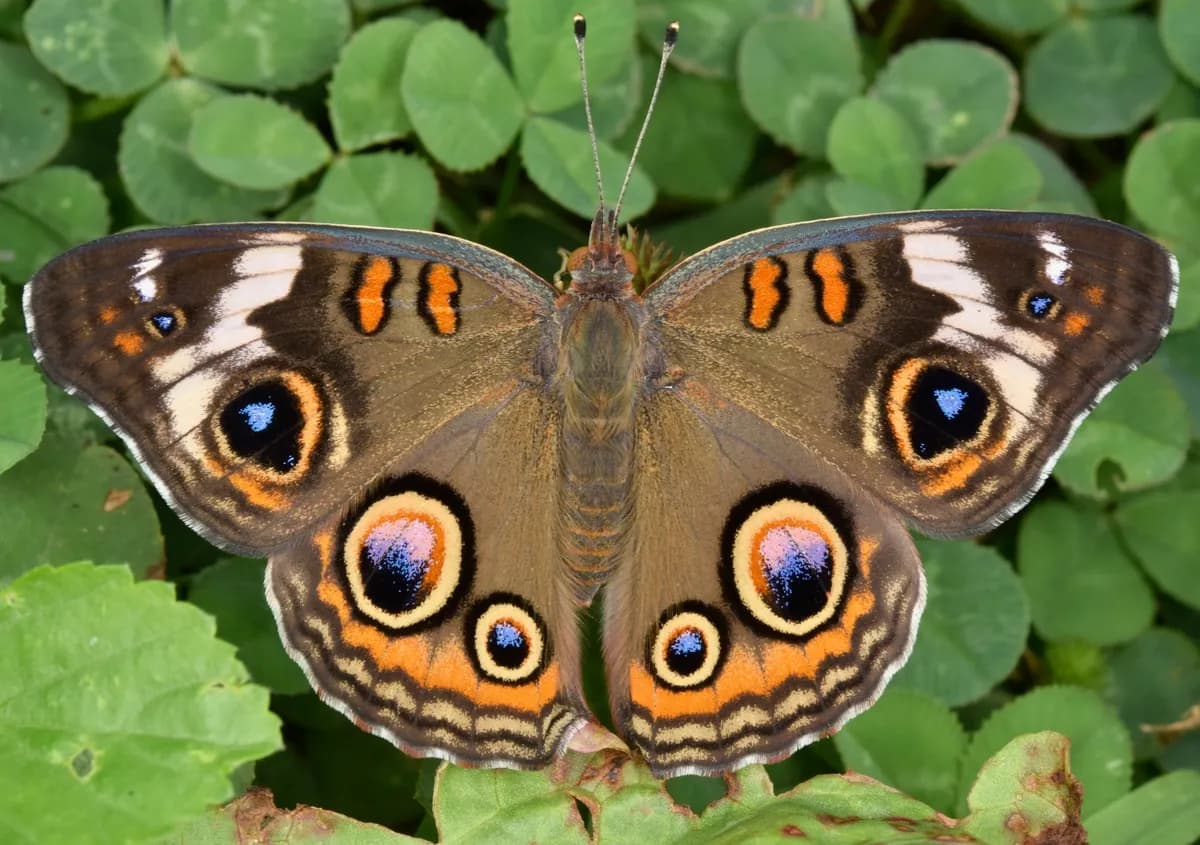
Common Buckeye is known for its prominent black eyespots on brown wings.
Host plants
Common Buckeye caterpillars can only develop on their larval host plants. Plant one of these natives and you can host the full life cycle in your own yard (host plant associations per the Xerces Society (opens in new tab)).
- Common Plantain (Plantago major)
- Plantago lanceolata — see Heartleaf Plantain (same genus)
- Linaria canadensis
- Fringe-leaf Ruellia (Ruellia humilis)
- Wild Petunia (Ruellia nudiflora)
- Carolina Wild Petunia (Ruellia caroliniensis)
- Prairie False Foxglove (Agalinis heterophylla)
- Texas Verbena (Verbena halei)
Want Common Buckeye in your yard? Open Common Plantain in Pollinator Patch and plan an HOA-friendly garden around it for your region.
Family
Nymphalidae
Wingspan
44–64 mm
Active
March through October
Range
TX, AL, AR, CT and 35 more states
How to identify it
Look for large brown wings with prominent black and orange eyespots and a distinctive zigzag wing pattern.
Good to know
- Caterpillars are dark with spiny projections and resemble bird droppings for camouflage
- Adults have distinctive large eyespots on their wings that may startle predators
Common questions
- What do Common Buckeye caterpillars eat?
- Common Buckeye caterpillars feed on Plantago major, Plantago lanceolata, Linaria canadensis, Ruellia humilis, Ruellia nudiflora, Ruellia caroliniensis, Agalinis heterophylla, and Verbena halei. These are the larval host plants the caterpillars must have to develop, per the Xerces Society and host plant records compiled from GBIF and iNaturalist.
- Where do Common Buckeye live?
- Common Buckeye is found across TX, AL, AR, CT and 35 more states.
- When are Common Buckeye active?
- Adult Common Buckeye are typically on the wing from March through October.
Range and life-history data compiled from iNaturalist, GBIF, and the Xerces Society. Photo licensed cc-by.