American Solomon's-seal
Polygonatum biflorum
Last reviewed: August 2026
American Solomon's-seal is a woodland forb with small bell-shaped greenish white flowers that open in May and June, thriving in part shade with medium moisture soil across much of the eastern and central United States.
Toxicity unknown
American Solomon's-seal (Polygonatum biflorum) is not listed by the ASPCA Animal Poison Control Center (opens in new tab) or the other sources we check, so we have no verdict for it either way. Absence from those lists is not a clearance. If your pet shows symptoms after eating any plant, call the ASPCA at (888) 426-4435.
Light
part shade
Water
medium
Size
12"–48" H × 12"–24" W
Bloom
May, Jun
Native to
AL, AR, AZ, CT and 36 more states
Pollinators
bees, flies
Before you buy
Your city may pay you to plant this
Cities and water utilities offer rebates for replacing lawn with native and water-wise plants. We track 459 programs across 44 states, each with a link to the provider and the date we last checked it.
Find rebates in your areaPicture natives in your own yard
Upload a photo of your yard and Patch Vision shows a rendering of it planted with natives for your region, like American Solomon's-seal.


Browse plants for this ecoregion
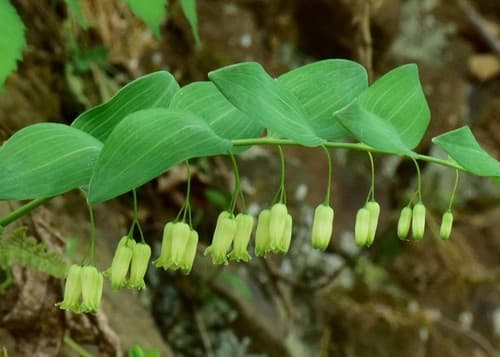
American solomon's-seal is a graceful woodland perennial with arching stems and oval leaves arranged in neat rows. Small white bell-shaped flowers dangle beneath the stems in late spring, followed by dark blue berries in fall.
Growing American Solomon's-seal
Grow American Solomon's-seal in part shade and medium water. Mature plants reach 12 to 48 inches tall and spread 12 to 24 inches wide. Expect low maintenance to keep it looking intentional in a front yard.
How to care for American Solomon's-seal, by region
How to care for American Solomon's-seal where it is actually grown: year-round basics plus what to do each season, region by region, with the sources for each.
Care guidance last updated: October 2026
Central Corn Belt Plains (includes Chicago, IL)
Year-round
Solomon's seal is an easy shade plant for Chicago-area yards. It sends up arching stems with paired bell flowers under trees, then goes quiet and dies back by late summer. Give it shade and steady moisture the first year and it mostly takes care of itself after that.
- Plant it in part to full shade in soil that stays a little moist. It is happiest on the north or east side of the house or under trees where afternoon sun does not hit it.
- Water it deeply once a week the first summer while roots settle in. After the first year it handles normal Chicago rainfall and only needs help during a long dry stretch.
- Keep a two to three inch layer of shredded leaves or bark over the roots and just leave fallen tree leaves in place, since this plant naturally feeds on leaf litter.
- You do not need to prune it. The one common mistake is planting it in a hot, sunny front bed where the leaves scorch, so match it to a shady spot instead.
Fall
In fall the foliage turns soft yellow and then browns as the plant goes dormant for the year. This is a natural fade, not a problem, and it is a fine time to tidy the bed or divide clumps.
- Once the stems have yellowed and flopped, you can cut them back to the ground or simply let them collapse and break down on their own. Both are fine for the plant.
- Let fallen tree leaves stay over the roots as a natural blanket, or add a few inches of shredded leaves, which mimics the woodland floor this plant comes from.
- Fall is a second good window to divide an overgrown clump if you missed spring, as long as you get it in the ground a few weeks before hard freezes.
In a visible front bed the yellowed, flopping stems can read as neglect to an HOA. Cutting the faded foliage back once it has browned keeps the spot looking intentional and tidy and avoids drawing a violation letter.
Winter
Solomon's seal spends a Chicago winter fully dormant underground. There is nothing above ground to protect and the rhizomes are cold-hardy well past local winter lows, so this is a hands-off season.
- Leave a layer of shredded leaves or bark over the root zone through winter to buffer the freeze-thaw swings common around Chicago. Fallen tree leaves do the same job for free.
- Do not water dormant plants. The rhizomes rest through the cold and will send up fresh stems on their own in spring.
- Mark the spot with a small stake or plant tag if the bed is bare, so you do not accidentally dig into the resting rhizomes during winter cleanup or spring planting.
Spring
Spring is when Solomon's seal wakes up and does its best work. New stems push up and unfurl into the arching, flowering foliage. This is also the window to divide a clump if you want more.
- Once the ground thaws in April, pull back any winter mulch cover so the new shoots can push through easily, then refresh it to a two to three inch layer around the emerging stems.
- If a clump has gotten crowded, dig and divide the rhizomes in early spring before growth takes off, and replant the pieces at the same depth in another shady spot.
- Water new spring plantings and fresh divisions well so they settle in before the drier weeks of summer arrive.
Summer
Through a Chicago summer Solomon's seal holds its arching green foliage in the shade, and small blue-black berries form where the flowers were. By late summer the leaves often start to yellow and fade as the plant heads toward dormancy.
- Keep the soil lightly moist during hot, dry July and August weeks, since this is a woodland plant that dislikes baking out. A deep soak once a week in a dry spell is plenty.
- Check for slugs, which are the main pest that chews the leaves in damp shade. Hand-pick them or set a simple trap rather than reaching for anything harsh.
- The berries and the underground rhizome contain saponins that can cause stomach upset if a child or pet eats them, so point them out to family and do not let kids nibble the berries (Illinois Wildflowers).
Sources: Morton Arboretum Solomon's Seal growing guide, Illinois Wildflowers Solomon's Seal
Ridge and Valley (includes Harrisburg, PA)
Year-round
Solomon's seal is a easygoing shade plant that wants rich, evenly moist soil and then mostly looks after itself.
- Give it part to full shade and soil rich in leaf mold or compost.
- Keep soil moist but well drained. It forgives a short dry spell once settled.
- Leave the root clump alone. It slowly spreads without taking over.
- The berries are poisonous in small amounts and can upset the stomach, so keep them away from kids.
Fall
Fall brings yellow leaves, and it is the other good window for dividing and planting.
- Enjoy the yellow to gold foliage before it fades.
- Plant or divide in fall while the plant is dormant, then water in well.
- Sow collected seed in September if you want more plants. It needs cold to sprout.
- Keep watering until the ground freezes if fall is dry.
Yellowing stems can look tired in late fall. Cut them down once they brown to keep the bed tidy.
Winter
Winter needs almost nothing. The roots sleep underground and handle cold well.
- Do not water or fertilize. The plant is dormant.
- Leave a layer of fallen leaves on the bed as free mulch.
- Mark the spot so you do not dig it up by accident.
- Hardy through zones 3 to 9, which covers Harrisburg winters.
Spring
Spring is when arching stems rise and flowers dangle, so focus on moisture and mulch.
- Top up the bed with a thin layer of shredded leaves or compost.
- Water if rain stalls for a week or more, since new shoots like steady moisture.
- This is a good time to divide clumps. Set pieces about 1 inch deep, buds up.
- Watch for slugs on tender new leaves.
Summer
Summer is about keeping roots cool and damp while the shade does the heavy lifting.
- Water deeply once a week in dry stretches, more often for new plants.
- Keep mulch in place to hold moisture.
- Leaves may brown at the edges in hot, dry spells. Extra water and more shade help.
- Blue-black berries form late in the season. They are poisonous, so keep them away from kids.
Sources: Lady Bird Johnson Wildflower Center - Polygonatum biflorum, NC State Extension Plant Toolbox - Polygonatum biflorum
In an HOA neighborhood
American Solomon's-seal is an HOA-friendly choice. Maintenance level: low. Tidiness: 4 out of 5.
Works well in: front yard, foundation, mid zone.
- Dies back completely in winter leaving bare ground
Wildlife value
The flowers attract bees and flies for pollination. Birds enjoy the berries in late summer and fall.
Common questions
- When does American Solomon's-seal bloom?
- American Solomon's-seal typically flowers in May and June, with pairs of small bell-shaped blossoms hanging along the arching stem.
- What pollinators visit American Solomon's-seal?
- Bees and flies are the main visitors, drawn to the drooping tubular flowers that line the stem in late spring.
- How much light does American Solomon's-seal need?
- It grows best in part shade but tolerates conditions ranging from dappled part sun to fuller shade beneath a woodland canopy.
- How much water does American Solomon's-seal need?
- Medium, consistent soil moisture suits it best, though established plants can handle drier stretches once their root system matures.
- Is American Solomon's-seal deciduous or evergreen?
- It is deciduous, dying back to the rootstock each fall and sending up new arching stems again in spring.
- Is American Solomon's-seal HOA-friendly?
- American Solomon's-seal is generally an HOA-friendly choice in the right placement, with low maintenance.
These answers were drafted with an AI model from this plant's data. Verify care details with a local expert.
Native range data from the World Checklist of Vascular Plants (Kew). Pollinator and host plant associations compiled from GBIF, iNaturalist, and published ecological literature.
If something looks wrong
Common plant problems, and what to check first
These come up on almost any plant. Each guide lists the likely causes in the order they are worth ruling out, with one thing to check before you act on any of them, and links to the source it came from.
- It is dying right after planting
- Leaves turning yellow
- Wilting even though I watered it
- Brown crispy leaf tips
- Bugs on the plant
Ready to grow American Solomon's-seal? Add it to your garden in Pollinator Patch to track it and get season-by-season care guidance.