Bird's-eyes
Gilia tricolor
Last reviewed: August 2026
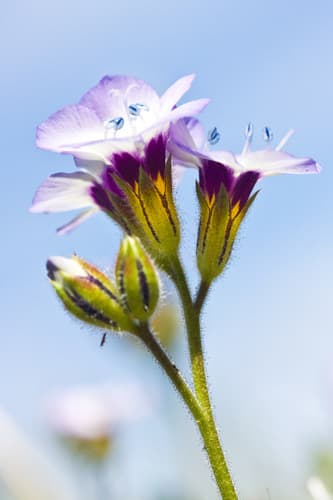
Gilia tricolor, known as Bird's-eyes, is a low-water annual forb that produces lavender-purple flowers with a yellow throat from April through June in full sun. It grows well in open grasslands and dry, sunny sites in California.
Bird's-eyes (Gilia tricolor) is not flagged as toxic to dogs or cats by Plants For A Future (PFAF) (opens in new tab) (last reviewed 2026-05-21). This verdict does not come from the ASPCA. If your pet shows symptoms after eating any plant, call the ASPCA at (888) 426-4435.
Light
full sun
Water
low
Size
6"–24" H × 6"–12" W
Bloom
Apr, May, Jun
Native to
CA
Pollinators
bees, butterflies
Before you buy
Your city may pay you to plant this
Cities and water utilities offer rebates for replacing lawn with native and water-wise plants. We track 459 programs across 44 states, each with a link to the provider and the date we last checked it.
Find rebates in your areaPicture natives in your own yard
Upload a photo of your yard and Patch Vision shows a rendering of it planted with natives for your region, like Bird's-eyes.


Browse plants for this ecoregion
Bird's-eyes is a charming native annual wildflower with delicate lavender to pale purple blooms featuring distinctive yellow and purple centers. It grows in a neat, compact form and produces abundant flowers from spring into early summer. This low-water plant adds soft color and texture to garden beds.
Growing Bird's-eyes
Grow Bird's-eyes in full sun and low water. Mature plants reach 6 to 24 inches tall and spread 6 to 12 inches wide. Expect moderate maintenance to keep it looking intentional in a front yard.
How to care for Bird's-eyes, by region
How to care for Bird's-eyes where it is actually grown: year-round basics plus what to do each season, region by region, with the sources for each.
Care guidance last updated: July 2026
Central California Valley (includes Sacramento, CA)
Year-round
Bird's-eye Gilia is a low, cool-season annual wildflower for full sun. In the Sacramento Valley it grows through the wet winter, blooms blue-violet in spring, then dries to seed and disappears for the hot summer.
- Sow seed in fall, October into November, right before or with the first rains so winter moisture does the germinating for you.
- Give it full sun and lean, well-drained ground. On Sacramento's heavy clay, scatter seed on a slight raised bed or mound so water never pools around the little rosettes.
- Let winter rain do the watering. Once it is up and growing you rarely need to add water, and by summer you add none at all.
- Leave the dry seed stalks in place after bloom so it drops seed and comes back on its own next fall.
Fall
Fall is the prime planting window. When the first rains arrive in October and November, sow Bird's-eye Gilia seed so it germinates with the cool wet weather.
- Sow seed October into November, timed to the first real rains. Fall sowing lets winter moisture handle germination with no irrigation from you.
- Rake the seed into loose surface soil in full sun and press it in for good contact. Do not bury it deep, these seeds want light and shallow cover.
- On heavy Sacramento clay, sow on a slight mound or a well-drained strip so seed and seedlings never sit in standing water.
- If the rains are late, a single light watering to trigger germination is fine, then let winter rain take over.
Freshly sown bare soil can look unfinished from the curb. Define the bed with a clean edge and a light natural mulch on the surrounding ground so the fall planting reads as intentional preparation, keeping the front yard tidy while you wait for germination.
Winter
Winter is the quiet growing season. Cool, foggy, rainy weather sprouts the seed and the young plants grow as small green rosettes, getting ready to bloom in spring.
- Let the winter rain do the watering. In a normal Sacramento winter you add no supplemental water at all.
- Look for small green rosettes coming up through December, January, and February. That flat green growth is exactly what you want.
- Light frost and Tule fog do not hurt this native. No cover or protection is needed.
- Pull nearby winter weeds by hand while young so they do not crowd out the gilia seedlings, and avoid disturbing the seedlings themselves.
The low green rosette stage can look like a weedy patch to an HOA over winter. Keep the bed edges defined and the surrounding walk swept so the growing seedlings read as an intentional planting rather than a neglected corner.
Spring
Spring is peak bloom. The plants you sowed in fall open their pale blue-violet, three-color flowers now while the soil is still damp from winter rain.
- Expect flowers from about April into June in the Sacramento Valley. Enjoy the show and do not fertilize, these wildflowers like lean soil.
- As the days warm and dry through May, taper off any hand watering. The soil is still holding winter moisture and the plants are finishing their life cycle.
- Watch for bees and small butterflies working the flowers. Skip insecticides so the pollinators stay safe.
- Do not pull plants early even as they start to yellow. They are setting the seed that becomes next year's patch.
A tidy spring bloom reads as intentional to an HOA. Keep a clean, defined edge along the bed and the walkway so the low wildflower drift looks planted and cared for rather than weedy, which keeps you clear of a violation letter.
Summer
By summer Bird's-eye Gilia has finished. It dies back to seed and the ground where it grew goes dry and bare through the hot months. This is normal, not a dead garden.
- Do not water the spot over summer. Extra summer water on this bone-dry ground invites weeds and rot in nearby natives, and the gilia is already done.
- Once the seed has dropped, usually by June or early July, you can cut and clear the dry stalks or leave a few to self-sow.
- If you want it back next year, do nothing to disturb the soil where seed fell. Fresh mulch or digging can bury or remove the seed bank.
- Sacramento's number one native-garden mistake is summer irrigation. Keep the hose off this bed and save water for containers instead.
A spent annual patch can look brown and messy to an HOA. Cut back the dried stalks after seed drops and keep the bed edge crisp so the resting summer ground reads as intentional cleanup rather than neglect, which avoids a violation letter.
Sources: Calscape, California Native Plant Society, Gilia tricolor Bird's-eye Gilia, Las Pilitas Nursery, Gilia tricolor horticultural notes, Xerces Society, native annual wildflowers for pollinators, UC Master Gardeners, seasonal care for California native gardens, UC Davis Arboretum, fall planting for California native gardens, UC Master Gardeners, watering California native plants in summer
In an HOA neighborhood
Bird's-eyes is an HOA-friendly choice in the right placement. Maintenance level: moderate. Tidiness: 3 out of 5.
Works well in: front yard, foundation, mid zone.
- Annual lifecycle means seasonal replanting or reseeding
- May look untidy after blooming period
- Best when planted in groups or borders with other complementary plants
Wildlife value
Bird's-eyes is highly attractive to native bees and butterflies, providing valuable spring nectar and pollen when many pollinators are active and foraging.
Common questions
- When does Gilia tricolor bloom?
- Gilia tricolor typically flowers from April through June, producing small lavender-purple blooms with distinctive dark spots and a yellow center.
- What growing conditions does Bird's-eyes need?
- This annual forb does best in full sun with low water once established. It suits dry, open sites and well-drained soil, mimicking the grassland and coastal sage conditions it grows in across California.
- What pollinators visit Gilia tricolor?
- Bees and butterflies are the main visitors to Gilia tricolor flowers, drawn to the blooms during the spring flowering period.
- How much water does Bird's-eyes need?
- Gilia tricolor is a low-water plant. It grows best with minimal irrigation and can struggle if soil stays consistently wet.
- Is Gilia tricolor a perennial?
- No, Gilia tricolor is an annual forb. It completes its life cycle in one growing season, germinating, flowering between April and June, then setting seed.
- Is Bird's-eyes toxic to dogs?
- Bird's-eyes is not flagged as toxic to dogs by Plants For A Future (PFAF). This verdict does not come from the ASPCA.
- Is Bird's-eyes toxic to cats?
- Bird's-eyes is not flagged as toxic to cats by Plants For A Future (PFAF). This verdict does not come from the ASPCA.
- Is Bird's-eyes HOA-friendly?
- Bird's-eyes is generally an HOA-friendly choice in the right placement, with moderate maintenance.
These answers were drafted with an AI model from this plant's data. Verify care details with a local expert.
Native range data from vouchered herbarium specimen records and regional native plant society lists. Pollinator and host plant associations compiled from GBIF, iNaturalist, and published ecological literature.
If something looks wrong
Common plant problems, and what to check first
These come up on almost any plant. Each guide lists the likely causes in the order they are worth ruling out, with one thing to check before you act on any of them, and links to the source it came from.
- It is dying right after planting
- Leaves turning yellow
- Wilting even though I watered it
- Brown crispy leaf tips
- Bugs on the plant
Ready to grow Bird's-eyes? Add it to your garden in Pollinator Patch to track it and get season-by-season care guidance.