Desert Willow
Chilopsis linearis
/images/plants/desert-willow/attribution.json.Light
full sun
Water
low
Size
180"–360" H × 120"–240" W
Bloom
May, Jun, Jul, Aug, Sep
Native to
Edwards Plateau, South Texas Plains, Trans-Pecos, Rolling Plains
Pollinators
hummingbirds, bees, butterflies
Browse plants for this ecoregion
Desert Willow is a perennial tree native to Edwards Plateau, South Texas Plains, Trans-Pecos, Rolling Plains. It grows best in full sun with low water needs.
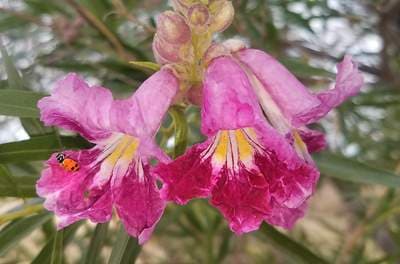
Desert Willow (Chilopsis linearis) is a small native tree with showy pink, lavender, or white trumpet-shaped flowers that bloom from May through September. It is dog-safe (Desert Willow is not on the ASPCA Animal Poison Control Center toxic plant list for dogs, cats, or horses) and is the standard recommended swap for Oleander in Texas yards.
Despite the name, it is not a true willow; it is in the bignonia family alongside Crossvine. Hummingbirds visit the flowers heavily, especially Black-chinned and Ruby-throated species during migration. The seeds form long bean-like pods that birds eat in fall. Mature size is 15-30 feet tall and 10-20 feet wide.
Ecoregion notes for Texas. In the Trans-Pecos and South Texas Plains (alkaline rocky desert and brush country, less than 20 inches of rain): native and at home. Plant in full sun, water once a week the first summer, then leave it. In the Edwards Plateau and Hill Country (alkaline limestone): also native; it is one of the most reliable small flowering trees for that region. In the Blackland Prairie (DFW-Austin-San Antonio corridor, heavy clay): plant on a raised berm or amend the planting hole with decomposed granite to prevent root rot. In the Pineywoods: not recommended; too humid and too acidic.
Desert Willow is the swap to make if you have Oleander in a yard with pets. Mature size is similar (a substantial flowering shrub-tree), summer bloom season overlaps, and drought tolerance is comparable. Avoid heavy fertilizer; native woody plants bloom less when overfed. For HOA contexts, prune in late winter to maintain a single-trunk tree form rather than a multi-stem shrub if your community prefers a tidier look.
Bee species data compiled from GBIF, iNaturalist, Discover Life, and the USGS Native Bee Inventory and Monitoring Lab. Plant-pollinator associations informed by published ecological literature.
How to care for Desert Willow, by region
How to care for Desert Willow where it is actually grown: year-round basics plus what to do each season, region by region, with the sources for each.
Care guidance last updated: August 2026
Cross Timbers (includes Fort Worth, TX)
Year-round
Desert willow is a low-water, sun-loving small tree that mostly takes care of itself once its roots are down. In the Fort Worth area the main jobs are getting it established, keeping water low, and a light shape-up each winter.
- Establishment: water a young plant deeply once a week for the first summer so roots go down, then taper off. After the first full year it can lean on rainfall most of the time.
- Watering once established: let the soil dry out between soakings. The Lady Bird Johnson Wildflower Center notes that drying out between waterings actually pushes more waves of blooms, and too much water means fast leggy growth with fewer flowers.
- Mulch: a 2 to 3 inch ring of mulch kept a few inches off the trunk holds moisture and keeps mowers away, but do not pile it against the bark.
- Common mistake: overwatering and overfeeding. Skip the fertilizer and heavy irrigation, or you get a floppy tree that blooms less.
Fall
Fall is wind-down time in the Fort Worth area. Bloom slows, leaves start to drop, and seed pods hang on into winter if you leave them.
- Do a light deadhead and pull remaining seed pods before they dry and scatter, so you get fewer volunteer seedlings next year.
- Ease off water as the weather cools. The tree is heading toward dormancy and does not need much.
- Refresh the mulch ring going into winter to protect the base, keeping it off the trunk.
Clearing the hanging brown seed pods in fall keeps the tree looking tidy and deliberate as it goes bare, which reads as intentional to neighbors and an HOA.
Winter
Winter is the main pruning window in the Fort Worth area. The tree is bare and dormant, so it is easy to see the frame and make cuts.
- During dormancy, cut the plant back by up to a third to encourage branching and heavier bloom next year. The Wildflower Center recommends this winter cutback.
- It is cold hardy here and survives down to about 10 degrees F, so Fort Worth winters rarely bother it, but a mulch ring at the base is cheap insurance in a hard freeze.
- Leave the shaping cuts clean and remove any crossing or dead branches while you can see them.
A clean winter cutback gives the bare tree a deliberate silhouette instead of a tangle of twigs, which reads as intentional from the curb and helps avoid a violation letter.
Spring
Spring is cleanup and shaping time in the Fort Worth area. Once the tree leafs out you can see what made it through winter and tidy the frame.
- Wait until the tree has leafed out, usually March to April here, then prune out any dead or frost-nipped twig tips back to live wood.
- On a young tree, thin to one or a few main trunks now to build a clean shape. This is the easiest time to see the branch structure.
- Hold off on fertilizer. A spring feeding just triggers fast weak growth and fewer flowers.
Summer
Summer is peak bloom in the Fort Worth area. The plant flowers heaviest in late spring then keeps going in flushes after rain through the warm months.
- Snip off spent flowers and the long seed pods as they form. The Wildflower Center says removing spent flowers and pods keeps new blooms coming.
- Water only during a long dry stretch, and let it dry out in between. A deep soak every couple of weeks in a real drought is plenty.
- Pulling the pods also cuts down on stray seedlings popping up in beds later.
Snipping spent flowers and dangling seed pods keeps the tree reading as intentional and cared for from the curb, which helps avoid a violation letter over a scraggly look.
Sources: Lady Bird Johnson Wildflower Center Chilopsis linearis, Desert willow is not on the ASPCA toxic plant list, USDA Forest Service Fire Effects Information System Chilopsis linearis
Edwards Plateau (includes San Antonio, TX)
Year-round
Desert willow is a small, fast growing native flowering tree well suited to San Antonio's Edwards Plateau climate. It wants full sun, alkaline well drained soil like the area's limestone based ground, and infrequent deep watering once established.
- Give it 6 or more hours of direct sun a day and well drained, alkaline soil. It tolerates San Antonio's limestone based soils without amendment.
- Water deeply but infrequently. Letting the soil dry between waterings encourages more blooms and a stronger, less leggy plant.
- Desert willow is native to south central Texas, including the Edwards Plateau region around San Antonio, per the Lady Bird Johnson Wildflower Center.
- It naturally grows 15 to 40 feet as a small tree or large shrub. Prune to a single or multi trunk tree form to keep it tidy.
- Not on the ASPCA toxic plant list for dogs, cats, or horses.
Pruned to a small single or multi trunk tree, desert willow keeps a tidy, intentional silhouette that reads as HOA-friendly front yard planting rather than untamed brush.
Fall
Fall stays warm well into November in San Antonio, so desert willow often keeps blooming until the first freeze. Mild fall weather also makes this a good second planting window.
- Blooms can continue into October or later since San Antonio's average first freeze does not arrive until late November to early December.
- Fall is a good second planting window here, similar to spring, because roots can establish in mild weather before either summer heat or a hard freeze hits.
- Taper watering as temperatures drop and rainfall typically picks up in early fall.
- Leaves drop with the season's first hard freeze, since desert willow is deciduous.
Winter
Desert willow is dormant and leafless through San Antonio's mild winter. Established trees tolerate the area's typical freezes, but a young tree needs extra protection during a hard freeze event.
- Desert willow tolerates temperatures down to roughly 10 to 20 degrees Fahrenheit once established, which covers most San Antonio winters (the area sits in USDA zone 8b to 9a).
- During a rare multi day hard freeze, wrap or otherwise protect a young or newly planted tree.
- The tree is leafless and dormant this time of year. Hold off on fertilizing and cut watering back significantly.
- Winter, while the tree is dormant, is the best time for structural pruning to shape the canopy.
Spring
Spring is when desert willow leafs out and starts its long bloom season in San Antonio. There is still a chance of a late cold snap into late February or early March before growth kicks in hard.
- New leaves emerge as nights warm in March. San Antonio's average last freeze falls in late February to early March, so hold off on heavy pruning or fertilizing until that risk has passed.
- Bloom typically begins in April and continues through the growing season.
- Spring is one of the best times to plant a new desert willow here, giving roots the cooler months to establish before summer heat arrives.
- Water new plantings two to three times a week during establishment. Established trees need far less.
Summer
Desert willow is built for San Antonio's hot, dry summers. It keeps blooming through the heat and needs very little supplemental water once it is established.
- This is peak bloom season. Desert willow flowers heaviest from late spring through summer heat into early fall.
- Once established, let the soil dry between waterings. Overwatering during summer heat is the main cause of root rot and weak, floppy growth.
- A newly planted or first year tree still needs regular deep watering through San Antonio's hottest, driest stretch, typically July and August.
- Mulch around the root zone to conserve moisture, keeping mulch a few inches back from the trunk.
Sources: Lady Bird Johnson Wildflower Center - Chilopsis linearis, USDA NRCS Plant Guide - Desert Willow, ASPCA Toxic and Non-Toxic Plant List - Dogs, Frost Dates for San Antonio, TX - Almanac.com (community tip)
Northeastern Coastal Zone (includes New York, NY)
Year-round
Desert willow is a warm-climate tree, so in the New York area the whole game is keeping it happy through cold, wet winters. Give it the sunniest, best-drained spot you have, keep water low, and expect some winter twig dieback you clean up in spring.
- Establishment: plant in the sunniest, sharpest-draining spot you have, ideally against a warm south-facing wall. Soggy winter soil is the real killer here, so avoid low wet corners.
- Watering once established: keep it on the dry side and let the soil dry between soakings. It handles drought far better than wet feet, and overwatering plus this climate invites rot.
- Mulch: pile a thick 3 to 4 inch mulch ring over the root zone before winter for cold protection, then pull it back a bit in spring. Young trees especially need this base protection.
- Common mistake: expecting a tidy tree every winter. It is only marginally hardy this far north, survives to roughly 10 degrees F, and often dies back at the tips or to the ground in a hard winter, then resprouts. Plan on it behaving more like a cut-back shrub than a clean tree.
Fall
Fall in the New York area is about prepping for a winter this tree is not built for. The goal is to get it ready to survive, not to push new growth.
- Stop any extra watering and do not fertilize. You want the wood to harden off, not to put out tender new shoots heading into cold.
- After the first hard frost drops the leaves, mound a thick 3 to 4 inch mulch ring over the root zone for winter protection, kept off the trunk.
- Leave the main pruning for spring. Cutting now removes wood that can help shield the plant and you cannot yet tell what winter will take.
Tidying dropped leaves and raking the bed as the tree goes bare keeps the spot looking maintained through winter, which reads as intentional to neighbors and an HOA.
Winter
Winter is the risky stretch in the New York area. Desert willow is only marginally hardy here and just tries to ride it out under mulch.
- Leave it alone under its mulch. It survives to about 10 degrees F, and a cold New York winter can push it to its limit, so any cutting now just removes protective wood.
- Expect tip dieback, or even dieback to the ground, in a hard winter. That is normal for this tree this far north, and it often resprouts from the base in spring.
- If a deep freeze is coming and the plant is small, an extra layer of mulch or a loose burlap wrap over the base gives it a better chance.
Keeping the winter mulch ring neat and contained rather than a loose pile keeps the bare plant looking deliberately tended, which reads as intentional from the curb and helps avoid a violation letter.
Spring
Spring is recovery time in the New York area. Desert willow leafs out late, so you wait to see what survived before cutting anything.
- Be patient. It leafs out late, often not until May here, so do not assume a bare branch is dead. Scratch the bark to check for green underneath before cutting.
- Once you see live growth, prune out all the winter-killed twigs and dead tips back to living wood. After a hard winter this can be a heavy cutback, and that is normal.
- Pull the winter mulch mound back down to a thin layer once the freeze risk passes so the base is not sitting wet.
- Skip fertilizer. Let it recover on its own rather than forcing weak fast growth.
Cleaning out the dead winter twigs once it leafs out turns a bare stick into a deliberate shaped plant, which reads as intentional and cared for and helps avoid a violation letter.
Summer
Summer is when it finally performs in the New York area. Warm months bring the trumpet flowers, though the season is shorter than out west.
- Remove spent flowers and seed pods through the summer to keep new blooms coming, the way the Wildflower Center recommends.
- Water only in a real dry spell and let it dry out between times. Our summer rain usually covers most of its needs, and it prefers dry over soggy.
- Give it every hour of sun you can. In a cooler shorter season, a shady spot means few or no flowers.
Deadheading spent blooms and pods keeps the plant looking tended through its short show season, which reads as intentional from the curb and helps avoid a violation letter.
Sources: Lady Bird Johnson Wildflower Center Chilopsis linearis, Desert willow is not on the ASPCA toxic plant list, Missouri Botanical Garden Chilopsis linearis, USDA Forest Service Fire Effects Information System Chilopsis linearis
Southern California/Northern Baja Coast (includes Los Angeles, CA)
Year-round
Desert willow is a small flowering tree native to the deserts of Arizona, New Mexico, Nevada, Oklahoma, Texas, Utah, and California's inland desert regions. Los Angeles sits in the coastal chaparral zone, not the desert, so this is a garden ornamental here rather than a native pick. The main thing to get right is drainage. In the wild this tree grows in sandy washes that flood briefly and then dry out fast, so it does not like sitting in wet soil the way LA's heavier yard soils can hold water. Give it full sun, fast draining soil, and less water than you think it needs.
- Plant in full sun with soil that drains fast, add sand or grit to heavier LA clay soils if needed
- Water deeply but not often, this tree handles drought far better than it handles wet feet
- Yellowing leaves usually mean too much water or slow drainage, not a fertilizer problem
- Desert willow is not on the ASPCA toxic plant list for dogs, cats, or horses
Fall
Bloom slows down in fall as temperatures cool, and the tree starts forming long seed pods. This is a good time to start easing off summer watering since the tree is heading toward dormancy. Dropped pods and leaves can build up under the canopy, so a fall cleanup keeps the yard tidy.
- Reduce watering frequency as blooms taper off and cooler weather sets in
- Rake up fallen seed pods and leaves under the canopy to keep the area tidy
- Fall is fine for minor shaping, save any hard pruning for winter dormancy
Clearing dropped pods and leaf litter under the tree keeps the yard looking cared for, an easy win for HOA-friendly curb appeal.
Winter
Desert willow is deciduous and drops its leaves in winter, showing bare branches until spring. This is the dormant season, so the tree needs very little water, and LA's winter rains are usually enough on their own. Winter is also the best time for structural pruning since the branch shape is easy to see with no leaves in the way.
- Cut back watering to a minimum, or skip it entirely if winter rain is regular
- Do any structural pruning for shape while the tree is bare and dormant
- Bare winter branches are normal for this species, not a sign of a problem
A quick winter pruning keeps the bare branch structure looking intentional rather than overgrown, which reads better to an HOA-conscious eye than an unshaped tangle.
Spring
Spring is when desert willow starts its long bloom season, with orchid-like flowers that keep going into fall. In LA's Mediterranean climate spring often still brings rain, so hold off on extra watering until the rainy season lets up. Adding irrigation on top of already wet soil is the fastest way to stress this tree's roots.
- Skip supplemental watering while spring rain is keeping the soil moist
- Once the ground starts drying out between storms, resume deep, infrequent watering
- Light shaping after the last frost can encourage a fuller bloom, save heavy pruning for another season
The spring flower show is a nice curb-appeal feature for a street-facing yard, and a lighter watering routine keeps the blooms coming without a soggy look at the base of the tree.
Summer
Summer is peak bloom and peak heat for desert willow. Established trees handle LA's dry summer stretch well and can get by on occasional deep watering once they are settled in. Newly planted trees need more frequent water while roots establish, but the same drainage rule applies, water thoroughly and then let the soil dry out before watering again.
- Established trees usually only need water every 2 to 4 weeks in summer, check that the soil has dried out first
- Newly planted trees need more frequent water for the first one to two summers while roots establish
- A few inches of mulch pulled back from the trunk helps hold moisture without keeping the base of the trunk wet
Sources: Calscape, Desert Willow (Chilopsis linearis), ASPCA Toxic and Non-Toxic Plant List (Dogs), LADWP WaterSmart Gardening, Chilopsis linearis
Texas Blackland Prairies (includes Dallas, TX)
Year-round
Desert willow is a desert and West Texas plant, so the hardest part of keeping it happy in the Dallas area is the heavy black clay. It is native to Texas per USDA PLANTS, but its natural home is the Trans-Pecos and Hill Country, not the Blackland Prairies around Dallas. The number one thing that kills it here is wet feet, so plant it high on a mound or berm and give it sharp drainage. Once it is established it shrugs off long 100 degree summers and needs very little water. Its flowers feed bees, butterflies, moths, and hummingbirds, and it is not on the ASPCA toxic plant list.
- Plant high on a raised mound or berm so the crown never sits in soggy clay
- Mix coarse sand or gravel into the planting area for sharp drainage
- Water only to get it established, then back off to occasional deep soaks
- Give it full sun and room for a 15 to 25 foot multi-trunk tree
- Skip rich soil and heavy fertilizer, which this lean-soil plant does not want
Site this as an intentional specimen tree, not a foundation-bed shrub. At 15 to 25 feet with a somewhat open, twiggy winter frame, it reads best as a chosen focal point with a mulched base and clean edges. Training it to a single trunk or a few clean trunks keeps it looking like a cared-for ornamental rather than a scraggly volunteer.
Fall
Fall is a second good planting window in the Dallas area, since the soil is still warm but the worst heat has passed. Blooming winds down and long, thin seed pods hang on the branches. You can leave the pods for winter texture or clip them off if you prefer a tidier look. This is also a fine time for light shaping while you can still see the leafy structure. Ease off watering as the tree heads toward dormancy.
- Plant in early fall so roots can settle before winter cold
- Leave the seed pods for texture or trim them for a neater look
- Make a few light shaping cuts to guide the branch structure
- Cut back on watering as growth slows for the season
- Keep a gritty, well-drained mound for any new fall plantings
Long seed pods and loose new growth can start to look messy from the street. Clipping the pods and making a few clean shaping cuts keeps it reading as a tended ornamental. Save the heavier structural pruning for winter dormancy.
Winter
Desert willow is deciduous, so around Dallas it drops its leaves and stands bare through winter. Mild winters are fine, and once established it handles the occasional hard freeze into the low 20s. The open, twiggy winter frame is normal and not a sign of trouble. Late winter, while it is still leafless, is the best time for structural pruning to a single trunk or a few clean trunks. Water is rarely needed while it is dormant.
- Expect a bare, twiggy silhouette all winter, this is normal for the plant
- Do structural pruning in late winter before new growth starts
- Train to one trunk or a few clean trunks for a strong shape
- Remove dead, crossing, or weak twigs while the frame is easy to see
- Hold off watering a dormant tree unless the soil is bone dry in a warm spell
The bare winter frame can look scraggly to neighbors and HOA reviewers. A late-winter cleanup to one or a few clean trunks, with dead twigs removed, keeps it reading as an intentional specimen rather than an unkempt volunteer.
Spring
Spring is the best time to plant desert willow around Dallas, once the hard freezes are done and the soil is warming. Set the root ball high in a mound of gritty, well-drained soil so spring rains cannot pool around the crown. This is when the first flowers open, and they start pulling in bees and hummingbirds. Keep new plants watered just enough to root in, but never let the heavy clay stay soggy. Growth wakes up fast as the days warm.
- Plant after the last hard freeze, setting the root ball slightly above grade
- Blend gravel or coarse sand into the backfill for sharp drainage
- Water new plants deeply but let the soil dry out between waterings
- Check for pooling after spring storms and build up the mound if needed
- Enjoy the first blooms and the early bees and hummingbirds they bring
Summer
Dallas summers run 95 to 105 degrees from June into September, and an established desert willow loves that heat. This is peak bloom, with trumpet flowers feeding bees, butterflies, moths, and hummingbirds right through the hottest weeks. The big mistake now is overwatering. In heavy clay, frequent summer watering rots the roots faster than drought ever would. Give an established tree only an occasional deep soak in a long dry spell, and let the clay dry out fully in between.
- Let established trees lean on rainfall through most of the summer
- Give only occasional deep soaks during long, truly dry stretches
- Never water on a fixed schedule in clay, confirm the soil is dry first
- Trim spent flower clusters if you want to nudge another flush of bloom
- Watch new or potted plants more closely so they do not dry out fully
Sources: USDA PLANTS Database, Chilopsis linearis, Lady Bird Johnson Wildflower Center, Chilopsis linearis, Xerces Society, pollinator-friendly plant lists, ASPCA Animal Poison Control, toxic and non-toxic plants, Texas A&M AgriLife Extension, Aggie Horticulture
Want these tasks as reminders timed to your yard? Pollinator Patch turns this guidance into a season-by-season care plan for the plants you actually grow.
Before you buy
Your city may pay you to plant this
Cities and water utilities offer rebates for replacing lawn with native and water-wise plants. We track 452 programs across 44 states, each with a link to the provider and the date we last checked it.
Find rebates in your areaIf something looks wrong
Common plant problems, and what to check first
These come up on almost any plant. Each guide lists the likely causes in the order they are worth ruling out, with one thing to check before you act on any of them, and links to the source it came from.
- It is dying right after planting
- Leaves turning yellow
- Wilting even though I watered it
- Brown crispy leaf tips
- Bugs on the plant
Ready to grow Desert Willow? Add it to your garden in Pollinator Patch to track it and get season-by-season care guidance.
Planning a bed around it? Start a free plan with this plant
Not sure where to start? Take the 2-minute yard quiz