Lanceleaf Greenbrier
Smilax smallii
Last reviewed: August 2026
Lanceleaf Greenbrier (Smilax smallii) is not on the ASPCA Animal Poison Control Center toxic plant list for dogs or cats (aspca.org (opens in new tab), last reviewed 2026-05-21). If your pet shows symptoms after eating any plant, call the ASPCA at (888) 426-4435.
The USDA PLANTS Database (opens in new tab) does not flag Lanceleaf Greenbrier as toxic to livestock.
Light
part shade
Water
medium
Size
36"–240" H × 24"–120" W
Bloom
Apr, May
Native to
AL, AR, DE, FL and 8 more states
Pollinators
bees, beetles
Before you buy
Your city may pay you to plant this
Cities and water utilities offer rebates for replacing lawn with native and water-wise plants. We track 452 programs across 44 states, each with a link to the provider and the date we last checked it.
Find rebates in your areaBrowse plants for this ecoregion
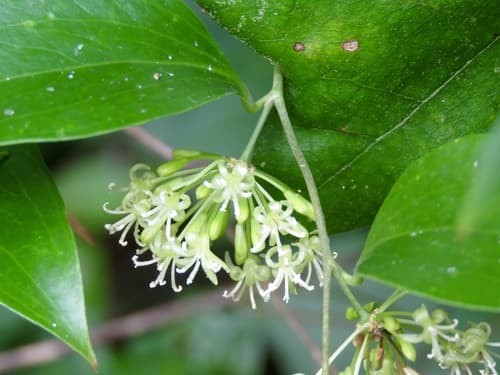
Lanceleaf greenbrier is a native evergreen vine that can climb or sprawl extensively, reaching up to 20 feet in height and 10 feet in spread. It produces small greenish flowers in spring and develops blue-black berries that persist into winter. The thorny stems and vigorous growth habit make it better suited for naturalized areas than formal landscapes.
In an HOA neighborhood
Lanceleaf Greenbrier takes more care to keep looking intentional in a front yard. Maintenance level: high. Consider it for backyard or mid-zone beds rather than the street edge.
Works well in: backyard only.
- Thorny stems present safety concerns
- Aggressive spreading growth can appear uncontrolled
- May climb and damage structures or other plants
Wildlife value
The spring flowers attract bees and beetles for pollination. Birds feed on the blue-black berries, and the dense growth provides nesting habitat and shelter for various wildlife species.
Common questions
- How much sun does Lanceleaf Greenbrier need?
- Lanceleaf Greenbrier grows best in part shade conditions.
- When does Lanceleaf Greenbrier bloom?
- Lanceleaf Greenbrier blooms in April and May.
- Where is Lanceleaf Greenbrier native?
- Lanceleaf Greenbrier (Smilax smallii) is native to AL, AR, DE, FL and 8 more states, per the World Checklist of Vascular Plants (Kew).
- Is Lanceleaf Greenbrier toxic to dogs?
- Lanceleaf Greenbrier is not on the ASPCA Animal Poison Control Center toxic plant list for dogs (aspca.org).
- Is Lanceleaf Greenbrier toxic to cats?
- Lanceleaf Greenbrier is not on the ASPCA Animal Poison Control Center toxic plant list for cats (aspca.org).
- Is Lanceleaf Greenbrier toxic to livestock?
- The USDA PLANTS Database does not flag Lanceleaf Greenbrier as toxic to livestock.
- What pollinators does Lanceleaf Greenbrier attract?
- Lanceleaf Greenbrier draws bees and beetles.
- Is Lanceleaf Greenbrier HOA-friendly?
- Lanceleaf Greenbrier takes more care to look intentional in a front yard. Consider it for backyard or mid-zone beds rather than the street edge.
Native range data from the World Checklist of Vascular Plants (Kew). Pollinator and host plant associations compiled from GBIF, iNaturalist, and published ecological literature.
If something looks wrong
Common plant problems, and what to check first
These come up on almost any plant. Each guide lists the likely causes in the order they are worth ruling out, with one thing to check before you act on any of them, and links to the source it came from.
- It is dying right after planting
- Leaves turning yellow
- Wilting even though I watered it
- Brown crispy leaf tips
- Bugs on the plant
Ready to grow Lanceleaf Greenbrier? Add it to your garden in Pollinator Patch to track it and get season-by-season care guidance.
Planning a bed around it? Start a free plan with this plant
Not sure where to start? Take the 2-minute yard quiz