Marsh daisy
Armeria maritima
Last reviewed: September 2026
Toxicity unknown
Marsh daisy (Armeria maritima) is not listed by the ASPCA Animal Poison Control Center (opens in new tab) or the other sources we check, so we have no verdict for it either way. Absence from those lists is not a clearance. If your pet shows symptoms after eating any plant, call the ASPCA at (888) 426-4435.
Light
full sun
Water
low
Size
6"–12" H × 8"–14" W
Bloom
Apr, May, Jun, Jul
Native to
CA, CO, OR, WA
Pollinators
native bees, butterflies
Before you buy
Your city may pay you to plant this
Cities and water utilities offer rebates for replacing lawn with native and water-wise plants. We track 452 programs across 44 states, each with a link to the provider and the date we last checked it.
Find rebates in your areaBrowse plants for this ecoregion
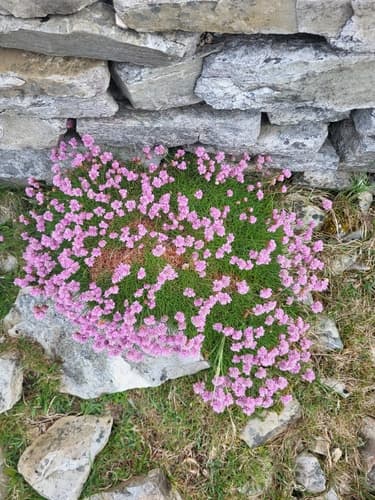
A tidy, tuft-forming perennial with fine, grass-like evergreen foliage and round clusters of pink flowers held on slender stalks. It grows in dense mounds on coastal bluffs and rocky ground, staying neat year-round.
How to care for Marsh daisy, by region
How to care for Marsh daisy where it is actually grown: year-round basics plus what to do each season, region by region, with the sources for each.
Care guidance last updated: September 2026
Western Corn Belt Plains (includes Des Moines, IA)
Year-round
Sea thrift is not native to Iowa. The Lady Bird Johnson Wildflower Center lists its native range as the Pacific coast, Alaska, Colorado, and circumpolar tundra, not the Midwest, so this is a garden perennial here, not a native planting. It can still do well in a Des Moines bed if the soil drains sharply, since heavy clay and wet weather, not cold, are what actually kill it in this climate.
- Choose the driest, sunniest spot in the bed. Full sun is required for good growth.
- Work coarse grit, sand, or perlite into clay soil before planting, or use a raised or mounded bed instead.
- Keep the soil lean. Skip fertilizer and rich compost, both encourage the crown rot that kills this plant in the Midwest.
- Give plants room to breathe. Crowding raises humidity around the crown and invites rot.
Fall
Do not cut sea thrift back to the ground this fall the way you might with many other perennials. University of Wisconsin Extension notes that cutting the evergreen foliage back in fall reduces next spring's bloom. Fall is also the riskiest stretch of the year for this plant in Iowa, since a wet, cool fall followed by clay that will not drain is a leading cause of the crown rot that kills it here.
- Leave the evergreen foliage tufts in place. Remove only leaf blades that are fully brown or dead.
- Recheck drainage before the ground freezes. A wet fall in clay soil is the top risk to this plant over winter.
- Skip fall fertilizing.
- A light trim of just the dead flower stems keeps the clump looking tended without cutting the plant back.
Leaving the evergreen foliage up through fall, instead of cutting the whole plant to the ground, reads as intentional bed structure rather than neglect, and a light trim of just the dead flower stems keeps the edge looking tended.
Winter
Sea thrift keeps its low, grassy evergreen mounds through an Iowa winter. University of Wisconsin Extension lists it hardy to zone 4a, well past what Des Moines winters require, so cold is not the risk here. What actually threatens it is a soggy crown sitting under melting snow or ice in a low spot, which is why the fall drainage check matters more than any winter covering.
- No winter mulch or wrapping is needed. This plant is hardy well beyond typical Des Moines winters.
- Do not pile shoveled snow onto the clump. Extra meltwater at the crown is the real winter hazard.
- The low evergreen tufts stay visibly green through winter rather than dying back to bare dirt.
- Skip winter watering. A dormant plant wants dry conditions, not wet ones.
Spring
Sea thrift blooms in mid to late spring here, pushing up round pink, white, or lavender flower heads on bare stems above its grassy evergreen tufts, per University of Wisconsin Extension. Spring is also when Iowa clay tends to hold the most water from snowmelt and rain, so this is the season to check that the crown is not sitting in standing water.
- Expect bloom sometime in April or May, depending on the spring.
- Check the bed right after snowmelt for standing water at the base of the plant.
- Do not fertilize at spring green up. This plant wants lean soil, not rich soil.
- Deadhead spent flower stems back to the foliage to encourage more blooms later in the season.
Summer
Keep deadheading through summer since sea thrift reblooms sporadically on new stems, per University of Wisconsin Extension. Once established it is drought tolerant, so water only during a real dry stretch, and water at the soil line rather than overhead, since humid air plus wet foliage is what invites rust spotting and crown rot in an Iowa summer.
- Deadhead spent stems through the season to keep new blooms coming.
- Water only during extended dry spells. Established plants prefer dry conditions.
- Water at the base, not with an overhead sprinkler.
- Skip heavy mulch against the crown. It traps moisture in humid weather.
Sources: Lady Bird Johnson Wildflower Center: Armeria maritima (Thrift Seapink), native range and habitat, University of Wisconsin Extension: Sea thrift, Armeria maritima
Want these tasks as reminders timed to your yard? Pollinator Patch turns this guidance into a season-by-season care plan for the plants you actually grow.
Wildlife value
Its long bloom period offers a steady nectar source for native bees and small butterflies.
Common questions
- How much sun does Marsh daisy need?
- Marsh daisy grows best in full sun conditions.
- When does Marsh daisy bloom?
- Marsh daisy blooms in April, May, June, and July.
- Where is Marsh daisy native?
- Marsh daisy (Armeria maritima) is native to CA, CO, OR, WA, per the World Checklist of Vascular Plants (Kew).
- What pollinators does Marsh daisy attract?
- Marsh daisy draws native bees and butterflies.
Native range data from the World Checklist of Vascular Plants (Kew). Pollinator and host plant associations compiled from GBIF, iNaturalist, and published ecological literature.
If something looks wrong
Common plant problems, and what to check first
These come up on almost any plant. Each guide lists the likely causes in the order they are worth ruling out, with one thing to check before you act on any of them, and links to the source it came from.
- It is dying right after planting
- Leaves turning yellow
- Wilting even though I watered it
- Brown crispy leaf tips
- Bugs on the plant
Ready to grow Marsh daisy? Add it to your garden in Pollinator Patch to track it and get season-by-season care guidance.
Planning a bed around it? Start a free plan with this plant
Not sure where to start? Take the 2-minute yard quiz