Naked Buckwheat
Eriogonum nudum
Last reviewed: September 2026
Eriogonum nudum is a drought tolerant forb that blooms from June through September, doing best in full sun on dry, open slopes and rocky ground in western states like California, Nevada, Oregon and Washington.
Naked Buckwheat (Eriogonum nudum) is not flagged as toxic to dogs or cats by Plants For A Future (PFAF) (opens in new tab) (last reviewed 2026-05-21). This verdict does not come from the ASPCA. If your pet shows symptoms after eating any plant, call the ASPCA at (888) 426-4435.
Light
full sun
Water
low
Size
12"–48" H × 12"–24" W
Bloom
Jun, Jul, Aug, Sep
Native to
CA, NV, OR, WA
Pollinators
bees, butterflies, beetles
Before you buy
Your city may pay you to plant this
Cities and water utilities offer rebates for replacing lawn with native and water-wise plants. We track 459 programs across 44 states, each with a link to the provider and the date we last checked it.
Find rebates in your areaPicture natives in your own yard
Upload a photo of your yard and Patch Vision shows a rendering of it planted with natives for your region, like Naked Buckwheat.


Browse plants for this ecoregion
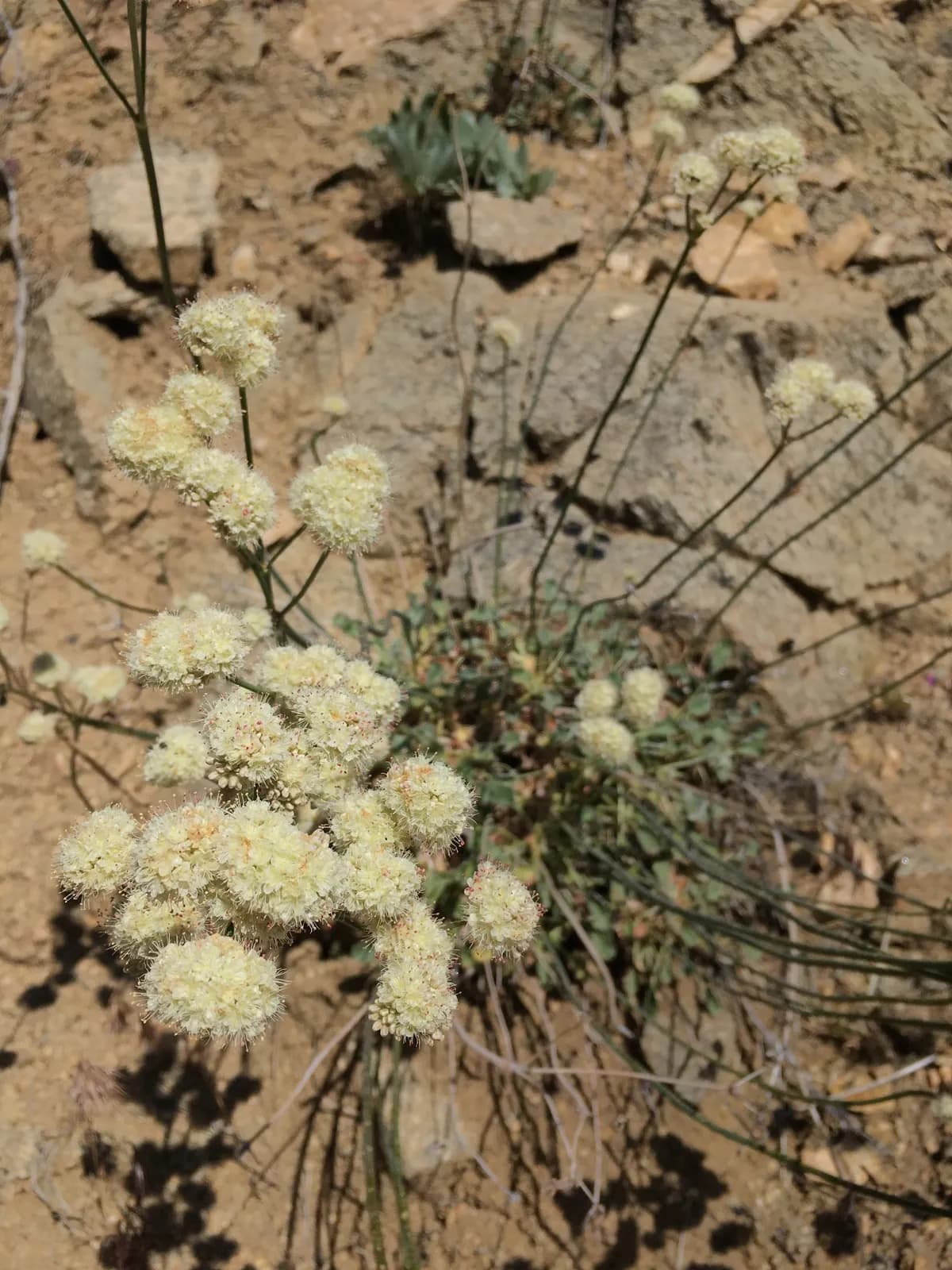
Naked buckwheat is an elegant native perennial with slender, leafless stems that rise above a rosette of oval basal leaves. It produces clusters of small white to pinkish flowers on branched stalks from summer through early fall. The airy, architectural form adds height and texture to drought-tolerant gardens.
Growing Naked Buckwheat
Grow Naked Buckwheat in full sun and low water. Mature plants reach 12 to 48 inches tall and spread 12 to 24 inches wide. Expect low maintenance to keep it looking intentional in a front yard.
How to care for Naked Buckwheat, by region
How to care for Naked Buckwheat where it is actually grown: year-round basics plus what to do each season, region by region, with the sources for each.
Care guidance last updated: October 2026
Central California Foothills and Coastal Mountains (includes San Francisco, CA)
Year-round
Naked buckwheat is an easygoing California native that forms a low mound of gray green leaves with tall, mostly bare flower stalks rising above it. It wants full sun to very light shade and soil that drains fast, and once it settles in it needs very little extra water in the San Francisco area.
- Plant in full sun to very light shade in fast draining soil. Avoid spots that stay soggy over winter.
- Once established it is drought tolerant and usually needs little to no extra water thanks to San Francisco's cool, foggy climate.
- Grows about one to three feet tall and half a foot to two feet wide, with a basal rosette of leaves and slender, mostly leafless flower stems.
- Flowers open in rounded pom pom clusters that start white, pale pink, or yellow and fade to tan, rust, and caramel tones as they age.
- Bees, butterflies, and other pollinators use the flowers, and this plant is a larval host for the Acmon Blue butterfly. It is generally left alone by deer.
- This species is native to California and has documented wild occurrences right in San Francisco County, so it fits naturally into the local landscape here.
Fall
Fall is the best time to plant or transplant naked buckwheat in San Francisco, right as the rains return, and it is also when this year's flowers finish fading.
- As the rainy season begins, this is the ideal window to put new plants in the ground so roots can establish before next summer's dry stretch.
- Flower clusters fade from white, pale pink, or yellow through tan, beige, and rust red tones as the bloom season winds down.
- Spent flower stalks can be left standing for winter structure and dried arrangement interest, or cut back now if a tidier look is wanted.
- Watch drainage as rain returns. This plant does not like sitting in soggy soil over winter.
Cutting the spent flower stalks back to the basal rosette in fall gives a clean, tidy silhouette heading into winter, which reads as intentional care and helps avoid a violation letter over stems that otherwise look dead.
Winter
Winter in San Francisco is mild and wet, and naked buckwheat mostly just sits as a low basal rosette waiting for spring, with little frost risk to worry about.
- San Francisco rarely sees hard freezes, so this plant typically needs no frost protection here.
- Keep an eye on drainage during the rainy months. Soggy, waterlogged spots are the main risk to the plant this time of year, not cold.
- If stalks were left standing in fall, this is a good time to cut them back to the basal rosette for a cleaner winter look.
- No supplemental water is usually needed since San Francisco's rain typically covers the plant's needs through winter.
A late winter cutback to the basal rosette keeps the front yard looking deliberately maintained through the quiet season rather than like an abandoned bed.
Spring
Spring in San Francisco is still cool and often the tail end of the rainy season, so this is mostly a light tidy up month for naked buckwheat rather than a heavy work month.
- Clear away any dead stalks left over from last year so new basal growth has room, then let the season's remaining rain handle watering into April.
- New flower stems begin to lengthen out of the basal rosette as days warm, with the first blooms usually opening late in the spring.
- If soil stayed soggy over winter, check drainage now and hold off on extra water until the ground has dried out some.
- Spring nursery starts can go in now, though San Francisco's fall planting window usually gives roots more time to establish before the dry summer stretch.
Cutting back last year's dry stalks now keeps the bed reading as an intentional wildflower planting rather than leftover weeds, right as the neighborhood comes out of winter.
Summer
Summer is peak bloom season for naked buckwheat in San Francisco, and the city's marine fog usually does most of the watering for you.
- Flowering peaks now, with the rounded flower clusters at their best from June through August before starting to fade toward fall.
- Established plants usually need little to no supplemental water thanks to summer fog. In a sunnier, fog free yard, an occasional deep watering can keep the foliage looking fresher.
- Bees and butterflies are most active on the flowers now, including the Acmon Blue butterfly, which uses this plant to raise its caterpillars.
- There is no frost risk this time of year, so the main task is just watching soil moisture in warmer microclimates.
The tall flower stalks read as an intentional pollinator planting rather than an overgrown patch, especially with a clean mulched edge around the base.
Sources: Calscape - Eriogonum nudum (Nude Buckwheat), CNPS, Lady Bird Johnson Wildflower Center - Eriogonum nudum, UC Master Gardener Program of Sonoma County - Eriogonum (Buckwheat), Calflora - Eriogonum nudum occurrence map
Northern Basin and Range (includes Twin Falls, ID)
Year-round
Year-round care for naked buckwheat around Twin Falls, ID: full sun and well-drained soil with very little water.
- It needs full sun.
- Calscape lists it as adaptable to soil type and to slow, medium, or fast drainage.
- Water needs are very low to low. Once established, summer water is capped at about once a month.
- It forms a low mound of flat green leaves 6 to 12 inches tall, with tall bare flower stems rising above.
- Calscape says it tolerates cold to about -15 to -10 degrees F.
- Flowers open from June through September. Control weeds carefully in the first year.
A neat low mound of leaves with slim flower stems above it reads as a tidy, planned planting when the bed edge is kept clean.
Sources: Calscape: Eriogonum nudum, Lady Bird Johnson Wildflower Center: Eriogonum nudum
Willamette Valley (includes Portland, OR)
Year-round
Naked buckwheat is a low evergreen rosette of flat leaves that sends up tall bare flower stalks in summer. In the Portland area its biggest problem is not cold, it is water sitting around the roots all winter. Our winters drop most of the year's rain on heavy silt and clay, and this plant comes from dry, sharply drained ground. Put it in full sun on a slope, a berm, or a raised mound so rain drains away from the center of the plant. Then give it real water during the July through September dry stretch for its first two summers, even though it is sold as drought tolerant. After that it mostly wants to be left alone.
- Give it at least 6 hours of direct sun, with no shade from the house or a fence.
- Plant it high, on a mound or a slope, so winter rain runs away from the base.
- Mix coarse grit or pumice into heavy clay before planting, and top with gravel instead of bark.
- Water deeply every 2 to 3 weeks from July through September for the first two summers.
- Skip fertilizer and skip rich compost piled against the base, both push soft growth and rot.
For most of the year this reads as a neat low green cushion, with thin flower stalks rising above it in summer, which is an HOA-friendly look. Keeping a clean bed edge and cutting the spent stalks in late winter is what keeps it looking intentional rather than weedy.
Fall
Fall is the best time to get this plant into the ground around Portland. From mid September through mid November the soil is still warm and the air is cool, which is exactly when plants put their energy into roots. The rain that starts up in November then waters the plant for you all winter, for free. Set it on a raised mound roughly 8 to 10 inches high, or on a slope, so the center of the plant sits above the wet line once the ground saturates. Water it in well at planting and keep watering about once a week until steady rain takes over, usually sometime in October. First frost lands around mid November and is not a problem here, the plant simply goes quiet.
- Plant new ones between mid September and mid November rather than waiting for spring.
- Build a mound 8 to 10 inches high in clay so the base stays above soggy ground.
- Water in deeply at planting, then once a week until the fall rains start.
- Top the soil with gravel or coarse grit, not bark or compost.
- Stop watering entirely once steady rain begins, usually late October or November.
Winter
Winter here is wet rather than brutally cold, and zone 8b cold is not what threatens this plant. Soggy ground is. That makes your whole winter job keeping water moving away from the roots. Do not water it at all between November and March, and after the big storms walk out and make sure no puddle is sitting over the base. Clear away wet leaves and bark that have washed up against the rosette, since a soaked mat of debris on the crown is how these plants rot. Late winter, just before new growth starts, is the moment to cut last year's bare flower stalks back down to the leaves.
- Turn off all irrigation to this plant from November through March.
- Check after storms for standing water and open a path for it to drain away.
- Rake soggy leaves and bark off the center of the plant so it can dry out.
- Cut last year's flower stalks off at the base in late February, before new growth starts.
- Do not fertilize or spread compost now, wet rich soil is what rots the roots.
Tan flower stalks left standing all winter can read as neglect from the sidewalk. Trimming them down at the base in late winter is the one change that keeps the bed looking HOA-friendly through the gray months.
Spring
Spring in the Willamette Valley is still wet, with rain running through April. Your buckwheat pushes fresh leaves out of the center rosette as the soil warms up. You do not need to water it at all this season, the rain is already doing more than the plant wants. Your real spring job is drainage and weeding, so walk out after a heavy rain and look for water standing near the base. Last frost lands around mid April, so that is the window if you are adding more plants, but plan to hand water anything new all the way through the coming dry summer.
- Do not water in March or April, valley rain is more than this plant wants.
- Check the base after a hard rain and fix any spot where water puddles and sits.
- Pull weeds and grass out of the rosette before they shade the leaves.
- Rake bark or leaf litter back a few inches so the center of the plant stays open and dry.
- If you add new plants after mid April, commit to watering them through September.
Summer
July through September is the hard part around Portland, often under an inch of rain a month. Naked buckwheat blooms right through it, roughly June into September, with round cream to pink flower clusters held up on bare stalks. In its first two summers it needs real water even though it is listed as drought tolerant, because our clay bakes into a hard crust and sheds a quick sprinkle before it soaks in. Water slowly, about a foot out from the center rather than straight onto the crown, and let the top few inches of soil dry out completely before the next soak. A settled plant in a well drained spot can often ride out the dry months with no help at all. The flowers are a strong late summer nectar source for bees, and this species is a larval host plant for the Acmon Blue butterfly.
- Soak deeply every 2 to 3 weeks in years one and two, then taper off.
- Water early in the morning and slowly, so it sinks in instead of running off baked clay.
- Aim the hose or drip emitter about a foot out from the center, not at the crown.
- Let the top few inches of soil dry out fully between waterings.
- Leave the flowers standing, they are the main nectar supply in the yard right now.
Sources: Lady Bird Johnson Wildflower Center, Eriogonum nudum (Naked buckwheat), The Watershed Nursery, Eriogonum nudum plant finder entry, UC IPM, Phytophthora Root and Crown Rot in home and landscape, California Flora Nursery, Eriogonum nudum, OSU Extension fall planting guidance for Oregon, reported by The Corvallis Advocate (community tip), Washington Native Plant Society, growing buckwheat in the garden (community tip)
In an HOA neighborhood
Naked Buckwheat is an HOA-friendly choice in the right placement. Maintenance level: low. Tidiness: 3 out of 5.
Works well in: mid zone, street edge.
- Can appear sparse or minimal compared to traditional ornamentals
- Winter appearance may be perceived as untidy
- Best incorporated within designed planting schemes rather than as standalone specimens
Wildlife value
Highly attractive to native bees, butterflies, and beneficial beetles. The flowers provide nectar during summer months when many other natives have finished blooming.
Common questions
- When does Eriogonum nudum bloom?
- Eriogonum nudum typically flowers from June into September, with blooms often lasting through late summer depending on elevation and site conditions.
- What pollinators does Eriogonum nudum attract?
- Bees, butterflies, and beetles are commonly seen visiting the small clustered flowers of Eriogonum nudum, which provide nectar and pollen through the summer months.
- How much water does Eriogonum nudum need once established?
- This forb prefers low water and tolerates dry, well drained soil, making it a good fit for sites that are not regularly irrigated.
- What light conditions suit Eriogonum nudum best?
- Full sun is best for Eriogonum nudum, matching the open, exposed slopes and flats where it typically grows.
- What kind of plant is Eriogonum nudum?
- Eriogonum nudum is a forb, an herbaceous flowering plant, known for its leafless flowering stalks rising above a basal rosette of leaves.
- Is Naked Buckwheat toxic to dogs?
- Naked Buckwheat is not flagged as toxic to dogs by Plants For A Future (PFAF). This verdict does not come from the ASPCA.
- Is Naked Buckwheat toxic to cats?
- Naked Buckwheat is not flagged as toxic to cats by Plants For A Future (PFAF). This verdict does not come from the ASPCA.
- Is Naked Buckwheat HOA-friendly?
- Naked Buckwheat is generally an HOA-friendly choice in the right placement, with low maintenance.
These answers were drafted with an AI model from this plant's data. Verify care details with a local expert.
Native range data from vouchered herbarium specimen records and regional native plant society lists. Pollinator and host plant associations compiled from GBIF, iNaturalist, and published ecological literature.
If something looks wrong
Common plant problems, and what to check first
These come up on almost any plant. Each guide lists the likely causes in the order they are worth ruling out, with one thing to check before you act on any of them, and links to the source it came from.
- It is dying right after planting
- Leaves turning yellow
- Wilting even though I watered it
- Brown crispy leaf tips
- Bugs on the plant
Ready to grow Naked Buckwheat? Add it to your garden in Pollinator Patch to track it and get season-by-season care guidance.