Narrow-leaf baccharis
Baccharis angustifolia
Last reviewed: October 2026
Narrow-leaf baccharis (Baccharis angustifolia) is a perennial shrub native to AL, FL, GA, LA and 3 more states. It blooms in August, September, October, and November. The flowers draw bees, wasps, and butterflies. It reads as an intentional, HOA-friendly planting in the right spot.
Toxicity unknown
Narrow-leaf baccharis (Baccharis angustifolia) is not listed by the ASPCA Animal Poison Control Center (opens in new tab) or the other sources we check, so we have no verdict for it either way. Absence from those lists is not a clearance. If your pet shows symptoms after eating any plant, call the ASPCA at (888) 426-4435.
Light
full sun
Water
low
Size
72"–156" H × 36"–60" W
Bloom
Aug, Sep, Oct, Nov
Native to
AL, FL, GA, LA and 3 more states
Pollinators
bees, wasps, butterflies
Before you buy
Your city may pay you to plant this
Cities and water utilities offer rebates for replacing lawn with native and water-wise plants. We track 459 programs across 44 states, each with a link to the provider and the date we last checked it.
Find rebates in your areaPicture natives in your own yard
Upload a photo of your yard and Patch Vision shows a rendering of it planted with natives for your region, like Narrow-leaf baccharis.


Browse plants for this ecoregion
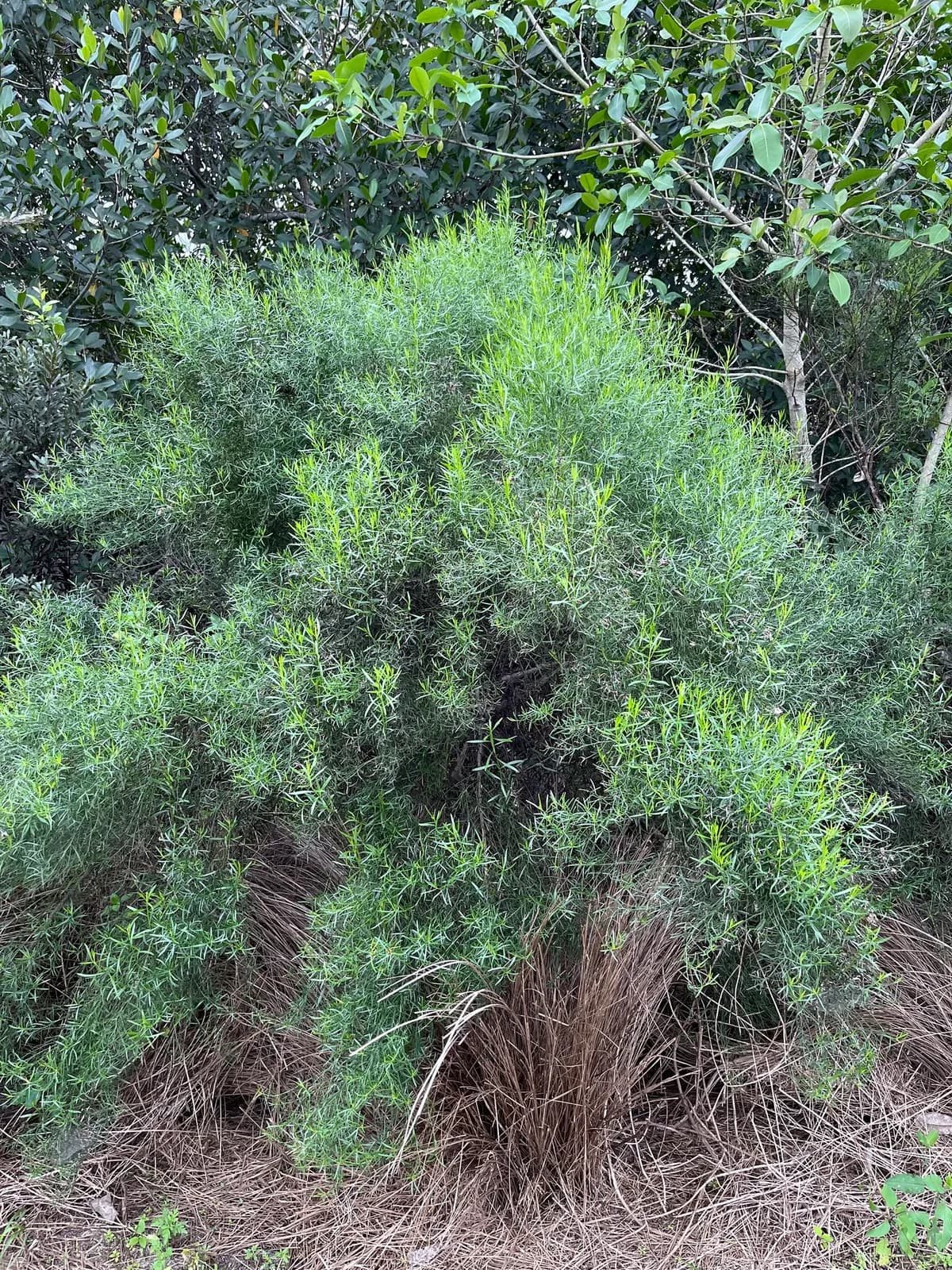
A salt-tolerant, evergreen to semi-evergreen shrub with narrow, willow-like leaves adapted to coastal wetland edges. Female plants produce fluffy, cream-white seed heads in fall that persist for weeks, while male plants bear smaller, less showy flower heads. Naturally colonizes marsh margins and disturbed coastal soils.
Growing Narrow-leaf baccharis
Grow Narrow-leaf baccharis in full sun and low water. Mature plants reach 72 to 156 inches tall and spread 36 to 60 inches wide. Expect low maintenance to keep it looking intentional in a front yard.
How to care for Narrow-leaf baccharis, by region
How to care for Narrow-leaf baccharis where it is actually grown: year-round basics plus what to do each season, region by region, with the sources for each.
Care guidance last updated: August 2026
Middle Atlantic Coastal Plain (includes Philadelphia)
Year-round
This ecoregion is at the far northern edge of saltwater false willow's documented range and well outside its typical Gulf and southern Atlantic coastal habitat; treat any planting here as experimental.
- If planted, give it full sun and a wet-to-dry site similar to a coastal marsh edge or rain garden.
- Winter cold in this region is a real risk to a plant adapted to warm coastal climates, and severe dieback or loss should be expected in a cold winter.
- Check with a local native-plant nursery on whether this species, versus a locally native alternative, is the better fit before planting.
- Confidence in these care notes is low because reliable growing guidance specific to this climate is not available.
Given the uncertain winter performance this far north, a locally native substitute may be the more HOA-friendly, lower-maintenance choice.
Fall
A surviving, established plant may bloom in fall, but flowering this far outside its normal range should be considered a bonus rather than an expectation.
- If it blooms, expect it sometime between August and the first hard frost.
- Avoid pruning during any bloom period.
- Use this season to decide whether the planting is worth protecting through another winter.
Winter
Winter is the biggest risk this far north, and significant dieback or total loss is a realistic outcome.
- A thick mulch layer over the root zone offers the plant its best chance of the crown surviving a hard freeze.
- Leave frost-killed top growth in place until spring rather than pruning it back in fall.
- If it does not return in spring, that reflects the climate mismatch rather than a care error.
Winter dieback here can look unkempt for months; consider a spring-only planting timeline if HOA appearance standards are strict.
Spring
Spring shows whether the plant survived winter; wait for new growth before doing anything else.
- Do not prune until you see where new growth is emerging from.
- Remove any wood that failed to resprout after the last frost has passed.
- Water consistently while the plant tries to re-establish.
Summer
Summer is the growing window if the plant survived winter, though performance this far from its coastal range is unproven.
- Water during dry spells; do not rely on drought tolerance ratings from its native coastal habitat.
- Light shaping can help it fill in, but keep expectations modest for a first-year planting.
- Track how the plant handles the local growing season to decide whether to keep it long term.
Sources: Lady Bird Johnson Wildflower Center
Mississippi Alluvial Plain (includes Memphis)
Year-round
This ecoregion sits well inland of saltwater false willow's core Gulf and Atlantic coastal range; it can be grown in wetland-edge or rain-garden settings, but reliable local growing information for this area is limited.
- Give it full sun and a spot that tolerates both wet and dry soil, mimicking its native marsh-edge habitat.
- Real winter cold here is more of a factor than in its coastal home range, and it should be expected to die back partially in a hard freeze.
- Treat it as an experimental planting in this region rather than a proven landscape staple.
- Confirm availability and cold performance with a local native-plant nursery before committing to a large planting.
Because winter dieback is likely here, plan for an early-season cleanup to keep beds looking maintained.
Fall
If the plant is established, fall should bring its characteristic cottony white seed heads, though bloom may be lighter than in its coastal range.
- Expect flowering, if it occurs, sometime between August and November.
- Hold off on major pruning so any bloom is not cut away.
- Use this season to gauge how well the planting has performed before deciding whether to expand it.
Winter
Winter is the main risk period this far from the plant's coastal home range; expect meaningful cold dieback in a typical year.
- A layer of mulch over the root zone can help protect the crown through hard freezes.
- Do not prune frost-damaged growth until spring, since it can insulate the crown beneath it.
- If the plant fails to resprout in spring, treat it as a planting that did not suit this climate rather than a care mistake.
Winter-browned growth can look untidy; a note on the bed explaining it is a native planting can help, alongside a spring cleanup.
Spring
Spring is the recovery window after winter dieback, and the time to see how much of the plant survived.
- Wait for new growth before pruning, then cut back any wood that did not resprout.
- Water regularly while the plant re-establishes.
- Do not expect full bloom performance the first year in this cooler climate.
Summer
Summer heat and humidity favor active growth; this is when the plant does most of its rebuilding after any winter loss.
- Water during dry spells; it prefers not to fully dry out despite its drought tolerance in warmer climates.
- Light shaping now helps it fill in before fall bloom.
- Monitor for how well it tolerates the local humidity and soil compared with its native coastal marshes.
Sources: Lady Bird Johnson Wildflower Center
Southern Coastal Plain (includes Orlando)
Year-round
In Central Florida's mild climate, saltwater false willow grows as a fast, low-care evergreen to semi-evergreen shrub tolerant of both salty and wet soils.
- Full sun gives the fullest form and the best fall bloom.
- It handles both standing water and dry spells once roots are established, making it a fit for pond edges and rain gardens.
- Expect it to reach 6 to 13 feet tall; prune yearly to keep it to a manageable size.
- Occasional light freezes are typical here and rarely cause more than minor tip dieback.
An annual shaping keeps this naturally loose shrub reading as a tidy hedge or screen planting.
Fall
Fall brings the plant's main bloom, with female shrubs covered in cottony white seed heads that draw pollinators through November.
- Flowers run from August into November; hold off pruning during this window.
- Deadhead spent seed heads if you want to limit self-seeding nearby.
- This is peak nectar season for bees, wasps, and migrating butterflies.
The fall seed-head display reads as a wildlife feature, not clutter, when the shrub's form is kept shaped.
Winter
Winters are mild, with only occasional light frost; the shrub stays mostly evergreen and needs little care.
- A light frost may brown some leaf tips; this is minor and grows out in spring.
- No routine cold protection is needed.
- Keep watering minimal through the cooler, drier months.
Spring
Spring is the main growth push after any light winter dieback, and the best window to prune and shape the plant.
- Cut back any tip dieback from winter cold snaps once new growth resumes.
- Shape the plant now, well before its fall bloom.
- Water new plantings regularly; established shrubs need little extra.
Summer
Summer rain and heat drive strong growth; the shrub needs little beyond keeping its size in check.
- Rely on rainfall for watering; supplement only in an unusually dry stretch.
- A mid-summer trim keeps growth dense ahead of the fall bloom.
- Watch nearby beds for volunteer seedlings, since it self-seeds readily.
Sources: Lady Bird Johnson Wildflower Center
Southern Florida Coastal Plain (includes Miami)
Year-round
Saltwater false willow is a coastal shrub that thrives in full sun and salty, wet-to-dry soils, and in this warm, frost-free climate it stays evergreen and can grow tall over a few seasons.
- Plant in full sun; it flowers thinly and grows leggy with too much shade.
- It tolerates both salt spray and standing water, so it is a strong pick near ponds, swales, or brackish edges.
- Once established it needs little supplemental water outside of extended dry stretches.
- It can reach 6 to 13 feet tall, so give it room or plan on periodic pruning to keep its size in check.
Left unpruned it can look loose and shrubby; an annual shaping cut keeps it reading as an intentional coastal hedge or screen.
Fall
Fall is bloom season; female plants cover themselves in fluffy white seed heads that draw late-season pollinators.
- Expect small white and yellow flower clusters from August into November.
- Skip pruning during bloom so you do not cut off the seed-head display.
- The cottony seed heads can drift and self-seed nearby, so deadhead if you want to limit spread.
The fluffy fall seed heads read as a natural, wildlife-friendly feature rather than an untidy one when the shrub is otherwise kept shaped.
Winter
Winters here are effectively frost-free, so the shrub stays evergreen and needs only routine upkeep.
- No cold protection is needed in this climate.
- This is a good time for a light shaping cut once fall bloom has finished.
- Keep watering minimal; the plant is dormant-adjacent and drought tolerant through the dry season.
Spring
New growth flushes out through spring; this is the best window to shape the plant before the fall bloom.
- Prune to control height and density now, well ahead of the fall flowering push.
- Water new transplants regularly until roots establish; older plants need little extra water.
- No fertilizer is typically needed in average coastal soil.
Summer
Summer heat and rain are no problem; the plant grows steadily and needs little attention beyond keeping it in bounds.
- Let seasonal rain handle watering; step in only during an unusually dry stretch.
- A mid-summer trim keeps the plant dense heading into its fall bloom.
- Watch for stray seedlings nearby, since it self-seeds readily in favorable coastal soil.
Sources: Lady Bird Johnson Wildflower Center
In an HOA neighborhood
Narrow-leaf baccharis is an HOA-friendly choice. Maintenance level: low. Tidiness: 3 out of 5.
Works well in: coastal buffer plantings, rain gardens, pollinator borders.
- Self-seeds readily in favorable coastal conditions
- Female plants can look ragged during seed dispersal
Wildlife value
A valuable late-season nectar source for bees, wasps, and migrating butterflies when few other plants are in bloom. The fluffy seed heads also provide material some birds use for nest building.
Common questions
- How much sun does Narrow-leaf baccharis need?
- Narrow-leaf baccharis grows best in full sun conditions.
- When does Narrow-leaf baccharis bloom?
- Narrow-leaf baccharis blooms in August, September, October, and November.
- Where is Narrow-leaf baccharis native?
- Narrow-leaf baccharis (Baccharis angustifolia) is native to AL, FL, GA, LA and 3 more states, per the World Checklist of Vascular Plants (Kew).
- What pollinators does Narrow-leaf baccharis attract?
- Narrow-leaf baccharis draws bees, wasps, and butterflies.
- Is Narrow-leaf baccharis HOA-friendly?
- Narrow-leaf baccharis is generally an HOA-friendly choice in the right placement, with low maintenance.
Native range data from the World Checklist of Vascular Plants (Kew). Pollinator and host plant associations compiled from GBIF, iNaturalist, and published ecological literature.
If something looks wrong
Common plant problems, and what to check first
These come up on almost any plant. Each guide lists the likely causes in the order they are worth ruling out, with one thing to check before you act on any of them, and links to the source it came from.
- It is dying right after planting
- Leaves turning yellow
- Wilting even though I watered it
- Brown crispy leaf tips
- Bugs on the plant
Ready to grow Narrow-leaf baccharis? Add it to your garden in Pollinator Patch to track it and get season-by-season care guidance.