Pine Grass
Calamagrostis rubescens
Last reviewed: September 2026
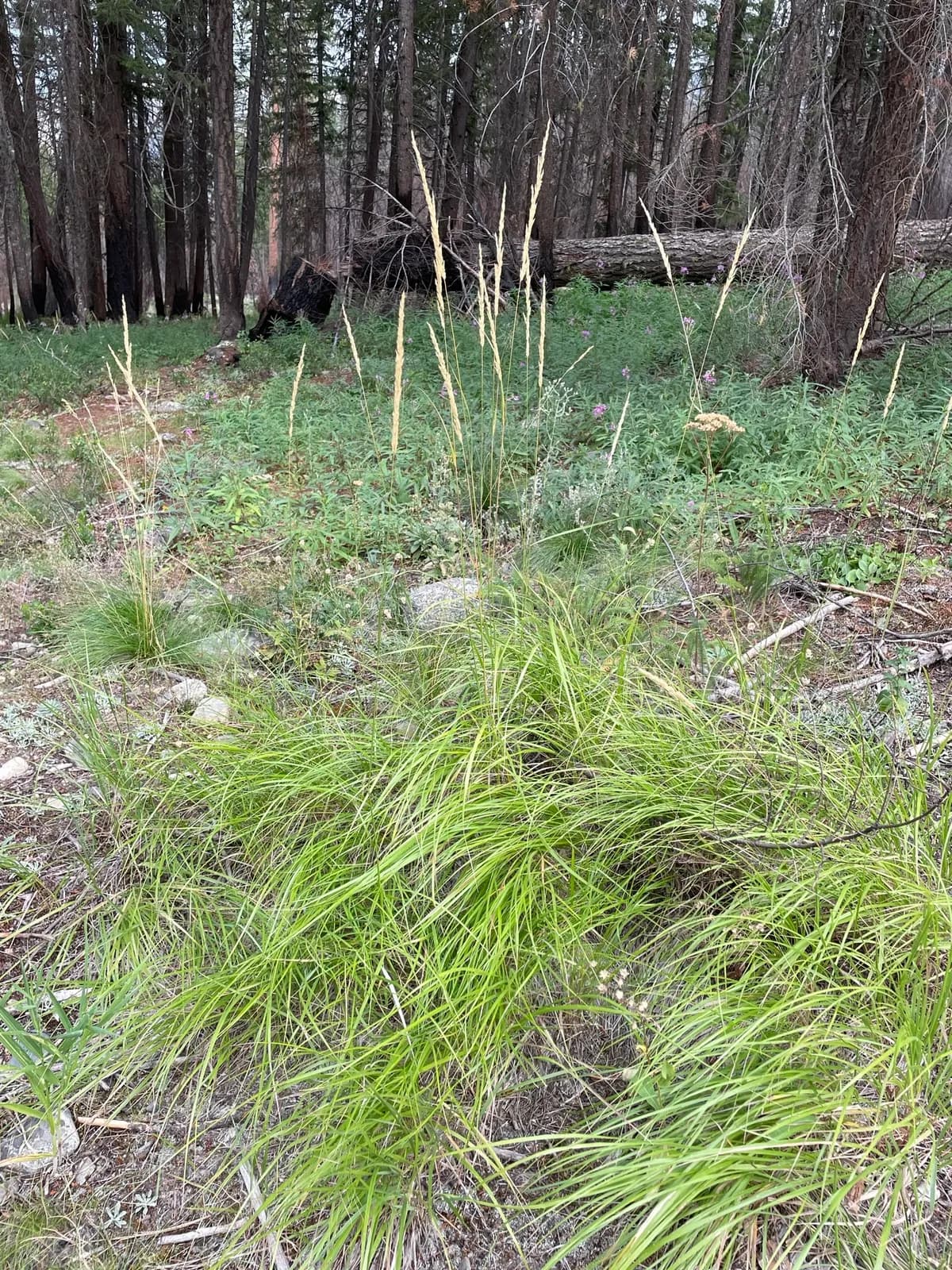
Pine grass is a low-growing bunchgrass common in dry coniferous forest understories across the Rocky Mountains and Pacific Northwest, blooming from June through August and thriving in full sun to shaded, low water sites.
Toxicity unknown
Pine Grass (Calamagrostis rubescens) is not listed by the ASPCA Animal Poison Control Center (opens in new tab) or the other sources we check, so we have no verdict for it either way. Absence from those lists is not a clearance. If your pet shows symptoms after eating any plant, call the ASPCA at (888) 426-4435.
The USDA PLANTS Database (opens in new tab) does not flag Pine Grass as toxic to livestock.
Light
full sun
Water
low
Size
12"–36" H × 6"–18" W
Bloom
Jun, Jul, Aug
Native to
CA, CO, ID, MT and 5 more states
Pollinators
bees, beetles
Before you buy
Your city may pay you to plant this
Cities and water utilities offer rebates for replacing lawn with native and water-wise plants. We track 459 programs across 44 states, each with a link to the provider and the date we last checked it.
Find rebates in your areaPicture natives in your own yard
Upload a photo of your yard and Patch Vision shows a rendering of it planted with natives for your region, like Pine Grass.


Browse plants for this ecoregion
Calamagrostis rubescens is a native bunchgrass that forms neat, upright clumps with fine-textured foliage. This drought-tolerant perennial produces delicate flower plumes in summer and maintains its evergreen appearance year-round. It's an excellent low-maintenance choice for adding natural texture to landscapes while requiring minimal water once established.
Growing Pine Grass
Grow Pine Grass in full sun and low water. Mature plants reach 12 to 36 inches tall and spread 6 to 18 inches wide. Expect low maintenance to keep it looking intentional in a front yard.
How to care for Pine Grass, by region
How to care for Pine Grass where it is actually grown: year-round basics plus what to do each season, region by region, with the sources for each.
Care guidance last updated: October 2026
Canadian Rockies (includes Columbia Falls, MT)
Year-round
Year-round care for pine grass around Columbia Falls, MT: sun or shade, loamy or clay soil, and medium to dry moisture.
- It grows in full sun or part shade and is shade tolerant, so it works under trees.
- It rarely flowers in shade. Expect seed heads only where it gets open sun.
- It prefers loamy or clay soil and grows poorly in sandy soil.
- It handles medium to dry ground. Give it moderate water while it settles in.
- It is a slow grower that forms a sod over time.
- It usually grows 1 to 2 feet tall and can reach about 3 feet.
Used as a cover under trees, it reads as a soft, even carpet rather than a bare patch.
Sources: USDA Forest Service Fire Effects Information System: Calamagrostis rubescens, Calscape (CNPS): Pine Grass (Calamagrostis rubescens), Lady Bird Johnson Wildflower Center: Calamagrostis rubescens
Central California Foothills and Coastal Mountains (includes San Francisco, CA)
Year-round
Pine grass is a shade loving cool season bunchgrass whose real home is high mountain conifer forest, and in the Bay Area it only shows up naturally in shaded forest patches in the hills, not in open coastal or urban yards.
- This is a spreading, rhizomatous grass that naturally forms a groundcover under conifers and oaks, from the Sierra Nevada and Cascades down through California's Coast Ranges (USDA Forest Service Fire Effects Information System, Calscape).
- Calflora and Calscape both show growing records for pine grass in shaded forest on Bay Area hillsides, including Marin's Mount Tamalpais and the Santa Cruz Mountains, but not in the flatter, more open, or coastal parts of San Francisco itself, so do not treat it as native to a typical city lot here.
- Give it the closest match to its native forest floor conditions: dappled to part shade, loamy or clay soil, and steady moisture. It grows poorly in sandy soil (Calscape).
- It spreads slowly to form a dense, low patch, so it works best as a shaded groundcover planting rather than a full sun lawn substitute.
Fall
Fall rain restarts active growth, making it a good season for light cleanup and for getting new plantings established before winter.
- As fall rains return, pine grass comes out of summer dormancy and resumes active cool season growth (USDA Forest Service Fire Effects Information System, California Flora Nursery).
- This is a good time to plant new starts or divide clumps, since the rhizomes can establish through the wetter months ahead.
- Trim off any dry, tan summer blades to freshen the look and make room for new growth.
- No need for fall fertilizing. Established pine grass does fine on rainfall and lean soil alone.
Trimming back dry summer blades in fall keeps a front bed clump looking neat as new green growth comes in.
Winter
Winter is pine grass's easiest season in a mild Bay Area climate. It stays green with rain and needs almost no maintenance.
- In mild coastal winters, pine grass tends to stay evergreen to semi evergreen rather than dying back the way it can in its snowier mountain range (California Flora Nursery).
- No cutback is needed. Unlike many ornamental grasses, pine grass does not require a hard winter or early spring haircut to look good.
- Well drained loamy or clay soil still matters. Soggy, waterlogged spots through a wet Bay Area winter can work against a plant adapted to forest floor drainage, not standing water (Calscape).
- This is a low maintenance season. Rain typically covers its water needs on its own.
Because it stays evergreen and needs no winter cutback, a pine grass planting keeps a tidy, low look through the winter without extra work.
Spring
Spring is when pine grass puts on its main growth and flowers, making it the best window to plant or divide it.
- New leaf growth picks up with spring rain and cooler temperatures, matching its cool season growth habit (California Flora Nursery).
- Small flower spikes typically show through spring into early summer in a mild coastal climate (Calscape).
- Spring is the best time to divide crowded clumps or plant new starts, while soil is still moist from winter rain.
- Skip fertilizer. Pine grass is adapted to lean forest floor soil and does not need feeding to grow well.
Summer
Summer is the riskiest season for pine grass in San Francisco, because its native forest floor stays cooler and moister than a typical open Bay Area yard in the dry season.
- Without supplemental water, pine grass naturally goes summer dormant and turns tan, a pattern from its native mountain forest shade and residual soil moisture, not from open sun exposed sites (USDA Forest Service Fire Effects Information System).
- An occasional deep watering through the dry months keeps it green instead of dormant, without needing a daily or even weekly schedule (California Flora Nursery).
- Keep it out of full, reflected summer sun. Part shade under trees or on a north or east facing bed is the closer match to how it actually grows.
- Watch for dry, sandy planting spots. Pine grass performs poorly in sandy soil, and a fast draining summer bed can stress it further (Calscape).
If a front yard patch is going summer dormant and turning tan, an occasional deep watering keeps it looking green and tidy from the street instead of patchy.
Sources: Calscape: Pine Grass (Calamagrostis rubescens), Calflora: Calamagrostis rubescens observation records, USDA Forest Service Fire Effects Information System: Calamagrostis rubescens, California Flora Nursery: Calamagrostis rubescens
Columbia Plateau (includes Yakima, WA)
Year-round
Year-round care for pine grass around Yakima, WA: sun or shade, loamy or clay soil, and medium to dry moisture.
- It grows in full sun or part shade and is shade tolerant, so it works under trees.
- It rarely flowers in shade. Expect seed heads only where it gets open sun.
- It prefers loamy or clay soil and grows poorly in sandy soil.
- It handles medium to dry ground. Give it moderate water while it settles in.
- It is a slow grower that forms a sod over time.
- It usually grows 1 to 2 feet tall and can reach about 3 feet.
Used as a cover under trees, it reads as a soft, even carpet rather than a bare patch.
Sources: USDA Forest Service Fire Effects Information System: Calamagrostis rubescens, Calscape (CNPS): Pine Grass (Calamagrostis rubescens), Lady Bird Johnson Wildflower Center: Calamagrostis rubescens
North Cascades (includes Leavenworth, WA)
Year-round
Year-round care for pine grass around Leavenworth, WA: sun or shade, loamy or clay soil, and medium to dry moisture.
- It grows in full sun or part shade and is shade tolerant, so it works under trees.
- It rarely flowers in shade. Expect seed heads only where it gets open sun.
- It prefers loamy or clay soil and grows poorly in sandy soil.
- It handles medium to dry ground. Give it moderate water while it settles in.
- It is a slow grower that forms a sod over time.
- It usually grows 1 to 2 feet tall and can reach about 3 feet.
Used as a cover under trees, it reads as a soft, even carpet rather than a bare patch.
Sources: USDA Forest Service Fire Effects Information System: Calamagrostis rubescens, Calscape (CNPS): Pine Grass (Calamagrostis rubescens), Lady Bird Johnson Wildflower Center: Calamagrostis rubescens
Northern Rockies (includes Coeur d'Alene, ID)
Year-round
Pine grass is a native bunching grass that grows wild under the pine and fir forests around Coeur d'Alene, Idaho. It spreads slowly by shallow underground stems and forms a soft green patch in the shade of your trees. Once it settles in, it needs almost no care and holds up well through dry summers and snowy winters.
- This grass is native to the forests of North Idaho and the Northern Rockies, so it already fits your soil and climate.
- It spreads by shallow underground stems that stay in the top two inches of soil, so it forms a slow, tidy patch rather than taking over a bed.
- It tolerates shade well and is often found growing right under pine and fir trees, which makes it a good fit if your yard has tree cover.
- Established plants handle dry summer stretches once their roots settle in, so you will not need to water often after the first year.
Fall
Pine grass greens back up in late summer and early fall once the weather cools off. Around Coeur d'Alene this second active growth window is a low-effort stretch before winter sets in.
- New growth picks back up in late August or early September as the days cool, so do not be surprised to see the patch green up again after its summer rest.
- This is a good time to leave fallen pine needles and leaf litter in place over it. It grows naturally in that kind of forest floor and does not need it cleared away.
- No mowing or cutting is needed in fall. Let the grass keep its natural low, arching shape into winter.
- This grass spreads on its own through shallow underground stems, so over a few years it will slowly fill in bare patches nearby without you needing to replant it.
Winter
Winter in Coeur d'Alene means real snow and cold, and pine grass takes it in stride because it comes from cold Northern Rockies forests to begin with. It stays low and dormant under the snow until spring.
- This grass is built for cold winters. Its native range reaches north into British Columbia and Alberta, so Coeur d'Alene's snow and hard freezes are well within what it naturally handles.
- No watering is needed in winter under normal snow cover. The plant is dormant and does not need garden attention during the coldest months.
- You do not need to cut it back or clean it up before winter. Leaving the dried blades in place is how it grows in the wild and helps protect the crown from freezing.
- Heavy snow will flatten the blades, but that is normal. It springs back and greens up on its own once the snow melts.
Its flattened, dormant look under snow is normal winter dieback for a native grass, not something that needs replacing to stay HOA-friendly.
Spring
Spring is when pine grass wakes up and does most of its growing for the year. In Coeur d'Alene, expect new green blades to show up in late April and May as the snow clears from under the trees.
- New growth starts in late April to May once the ground thaws, so this is when you will first see fresh green blades each year.
- The plant does almost all of its new stem growth by mid-May, so spring is a good time to let it grow undisturbed rather than cutting it back hard.
- It uses more water in spring than in any other season, so during a dry spring stretch a light watering under the trees can help it along.
- No fertilizer is needed. This grass is used to plain forest soil and does best left alone.
Summer
Summer is a quiet stretch for pine grass. Growth stops by July as things dry out around Coeur d'Alene's forested lots, and the patch may look less lush in the summer heat before it greens back up in fall.
- Growth stops by July most years, so do not expect much new green in the height of summer. This is a normal pause, not a sign of a problem.
- This is when the grass handles drought best, since its roots can keep drawing moisture even from dry soil, so you can skip watering it once established.
- If a summer dry spell runs longer than a few weeks and the grass looks stressed, one deep watering under the tree canopy is enough. It does not need regular watering like a lawn.
- This grass can flower in July and August in sunnier spots, with small, subtle seed heads rather than a showy bloom.
Its dry, quieter summer look is normal rest for a native grass, not dead turf, which keeps it reading as HOA-friendly ground cover even in the driest weeks.
Sources: Calamagrostis rubescens, pinegrass - Fire Effects Information System (US Forest Service), Calamagrostis rubescens (Pinegrass) - Native Plant Database, Lady Bird Johnson Wildflower Center
Southern California/Northern Baja Coast (includes Los Angeles, CA)
Year-round
Pine grass is a slow spreading, shade tolerant bunchgrass that naturally rests through hot dry stretches and regrows once cooler, wetter weather returns.
- It spreads slowly from underground rhizomes and forms a loose, sod like patch rather than a single tight clump.
- Give it part shade, especially afternoon shade, since it evolved growing under trees and struggles with all day sun and heat.
- Loamy or clay soil with decent drainage works best. Fast draining sandy soil is a poor match for this plant.
- It naturally goes dormant through the hottest, driest stretch of the year, so tan or resting blades in that window are normal, not a sign the plant is dying.
- Deer tend to leave it alone, and it grows slowly, so plan on a couple of seasons before it fills in a patch.
Fall
Fall is a good window to tidy up dried summer growth and get pine grass ready to green back up once the rainy season starts.
- Cut back the dried, tan blades left over from summer dormancy. This keeps the patch looking tidy and is the main upkeep task for this plant during the year.
- Los Angeles area rain often does not arrive until November or later, so a deep watering in October can help the plant start regreening rather than waiting on rain that may be late.
- This is also a reasonable time to divide or transplant an established patch if you want to spread it to a new shady spot.
A fall cutback of the dried summer blades is the one task that keeps this grass looking neat from the street. A front facing patch reads as intentional and HOA-friendly when this is done before the rainy season starts.
Winter
Winter is the wet season in Los Angeles and the closest match to the cool, moist conditions pine grass is used to, so this is typically its best looking, most actively growing time of year.
- Let winter rain do the watering. Extra irrigation is rarely needed during the rainy months.
- Check drainage after heavy rain, especially in clay soil. Standing water around the base for more than a day or two can lead to rot.
- Frost is uncommon across most of the Los Angeles area, but a light frost in a colder pocket or higher elevation yard will not damage an established plant.
- No pruning needed. Let it fill out through winter and save any cleanup for fall or very early spring.
Spring
Spring is when pine grass wakes up and pushes new blades, right as the Los Angeles area's rainy season tapers off.
- New growth typically starts around April, so this is a good time to check that part shade and soil moisture are in place before summer heat arrives.
- If spring turns dry early, which happens often in the Los Angeles area, a deep watering every couple of weeks helps new growth get established before the dry season sets in.
- Skip fertilizer. This grass is adapted to lean native soils and does not need feeding to perform well.
- This is a good window to clear out any winter weeds growing in around the base before they compete with new blades.
Summer
Los Angeles summers are hot and essentially rainless, and pine grass responds by resting rather than pushing new growth.
- Expect it to slow down and look tan or dormant by mid to late summer. That is its normal response to dry heat, not a problem that needs fixing.
- A deep, infrequent watering every few weeks keeps it from looking too rough, but this plant does not want or need frequent watering the way a lawn does.
- Afternoon shade matters most in summer. Los Angeles heat, especially inland, runs hotter than the forest understories this grass grows in naturally, so full sun exposure in July and August can scorch it.
- Hold off on cutting it back now. Let it ride out the dry season and clean it up once cooler weather returns.
Sources: Calscape (California Native Plant Society) - Pine Grass plant profile, USDA Forest Service FEIS - Calamagrostis rubescens species review
In an HOA neighborhood
Pine Grass is an HOA-friendly choice. Maintenance level: low. Tidiness: 4 out of 5.
Works well in: front yard, foundation, street edge, mid zone.
Wildlife value
The summer blooms attract bees and beetles, while the seed heads provide food for birds. The dense clumping habit also offers nesting sites and shelter for small wildlife.
Common questions
- When does pine grass bloom?
- Pine grass typically flowers from June through August, producing narrow, slightly reddish-tinged seed heads above its grassy foliage.
- How much light does pine grass need?
- It grows well in full sun but is also common under open forest canopies, tolerating part sun, part shade, and even fairly deep shade beneath pines and firs.
- Does pine grass need much water once established?
- No. Pine grass is adapted to dry forest floors and rocky slopes, so it generally needs only low to moderate water once it is established.
- What pollinators visit pine grass?
- As a wind-pollinated grass, pine grass is not a major nectar source, but bees and beetles can be found foraging or sheltering around its flowering stems and foliage.
- Is Pine Grass toxic to livestock?
- The USDA PLANTS Database does not flag Pine Grass as toxic to livestock.
- Is Pine Grass HOA-friendly?
- Pine Grass is generally an HOA-friendly choice in the right placement, with low maintenance.
These answers were drafted with an AI model from this plant's data. Verify care details with a local expert.
Native range data from the World Checklist of Vascular Plants (Kew). Pollinator and host plant associations compiled from GBIF, iNaturalist, and published ecological literature.
If something looks wrong
Common plant problems, and what to check first
These come up on almost any plant. Each guide lists the likely causes in the order they are worth ruling out, with one thing to check before you act on any of them, and links to the source it came from.
- It is dying right after planting
- Leaves turning yellow
- Wilting even though I watered it
- Brown crispy leaf tips
- Bugs on the plant
Ready to grow Pine Grass? Add it to your garden in Pollinator Patch to track it and get season-by-season care guidance.