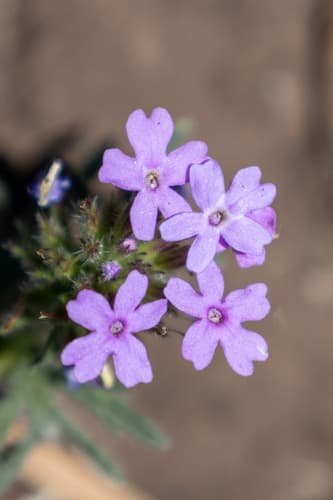
Prairie Verbena
Glandularia bipinnatifida
Light
full sun
Water
low
Size
6"–12" H × 12"–24" W
Bloom
Mar, Apr, May, Jun, Jul, Aug, Sep, Oct, Nov
Native to
Edwards Plateau, South Texas Plains, Trans-Pecos, Blackland Prairie
Pollinators
butterflies, bees
Picture natives in your own yard
Upload a photo of your yard and Patch Vision shows a rendering of it planted with natives for your region, like Prairie Verbena.


Browse plants for this ecoregion
Prairie Verbena is a perennial forb native to Edwards Plateau, South Texas Plains, Trans-Pecos, Blackland Prairie. It grows best in full sun with low water needs.
Prairie Verbena (Glandularia bipinnatifida) forms low spreading mats of finely cut foliage covered in purple flower clusters from March through November. It stays under 12 inches tall while spreading 1-2 feet wide, making it one of the best native ground covers for sunny, dry spots in Texas. Butterflies, especially painted ladies and skippers, use the flowers constantly.
Prairie Verbena is not on the ASPCA Animal Poison Control Center toxic plant list for dogs or cats. The low spreading habit means it functions as a ground cover or front-of-bed edging plant. In HOA neighborhoods, the fine-textured foliage and non-stop bloom read as intentional and well-maintained even without any pruning.
Ecoregion notes for Texas. In the Edwards Plateau and South Texas Plains (alkaline rocky caliche, 18-35 inches of rain): native and ideal. Plant in full sun and lean soil, skip irrigation after the first year. It self-seeds freely and fills gaps. In the Trans-Pecos (Chihuahuan Desert margin, driest and hottest): native; give it well-drained alkaline soil and it asks for nothing. In the Blackland Prairie (DFW, Austin, heavy clay): native; plant on a raised berm or the top of a slope to improve drainage, as it will rot in standing water. In the Pineywoods: not recommended.
Prairie Verbena pairs with Blackfoot Daisy and Prairie Phlox for a dense, weed-suppressing front-of-bed combination that requires almost no maintenance. Leave the spent seed heads in place; they attract small finches. For HOA contexts, this is one of the safest choices for street-edge and driveway beds because the low profile and long bloom season are universally legible as intentional.
Bee species data compiled from GBIF, iNaturalist, Discover Life, and the USGS Native Bee Inventory and Monitoring Lab. Plant-pollinator associations informed by published ecological literature.
How to care for Prairie Verbena, by region
How to care for Prairie Verbena where it is actually grown: year-round basics plus what to do each season, region by region, with the sources for each.
Care guidance last updated: October 2026
Cross Timbers (includes Fort Worth, TX)
Year-round
Prairie verbena is a low, spreading native wildflower for North Texas that stays under a foot tall and blooms for most of the growing season once it settles in. It wants full sun and dry to average soil, and it does not like wet feet.
- Plant in full sun (6 or more hours a day); it gets leggy and blooms less in shade.
- Give it well drained soil. In the sandier loam soils around the western part of North Texas it drains naturally, so avoid low spots that hold water after rain.
- Space new plants 12 to 18 inches apart since it spreads into a low mat as it matures.
- Skip regular fertilizer. Rich soil pushes leafy growth over flowers.
- Water it in at planting, then let it establish on rainfall except during extended dry spells.
Its low, mounding habit under 12 inches reads as a tidy, intentional groundcover rather than a wild patch, which fits a front bed without looking overgrown.
Fall
Fall brings a second strong bloom flush as heat breaks, and it is a good season to tidy the plant up before winter.
- Expect a fresh round of blooms in September and October as temperatures drop from summer highs.
- Deadhead spent blooms through October to keep the plant flowering into November.
- If it has sprawled past its bed edge, trim the outer stems back to the planting line; it fills back in from the center.
- Hold off on planting new woody companions nearby until the plant has finished its fall flush so you are not disturbing its roots.
A fall trim to the bed line keeps the mat inside its planted footprint, which matters if a neighbor or HOA walk-through happens in October or November.
Winter
Prairie verbena is semi-evergreen in a mild North Texas winter but will brown back after a hard freeze; leave it alone until new growth starts in spring.
- Do not cut it back in winter. The existing foliage protects the crown through short hard freezes and the occasional severe Arctic outbreak.
- If foliage browns after a freeze, leave the dead growth in place rather than pulling the plant, it is very likely to resprout from the base.
- Wait until you see new green growth at the base in March before doing any cleanup cut.
- Skip winter watering unless the ground has been dry for several weeks with no rain.
Freeze-browned foliage over winter can look neglected to a passerby; a short note or a small marker stake can signal it is dormant, not dead, until spring cleanup.
Spring
Spring is prairie verbena's showiest stretch and the best time to plant it, once the mid March frost date has passed.
- Plant new starts anytime from mid March through May, after the last frost, so roots have time to establish before summer heat.
- Water new plantings two to three times a week for the first three to four weeks, then taper off as roots take hold.
- Pinch or lightly shear spent flower clusters through spring to keep new blooms coming.
- Watch for the first flush of purple blooms as early as late March in a mild year.
The dense spring flower flush reads as a maintained flower bed rather than an unmowed area, which is the season it does the most visual work for curb appeal.
Summer
Once established, prairie verbena tolerates North Texas summer heat and drought well, but a plant in its first summer still needs help getting through the 100F stretch.
- First-summer plants need a deep soak once a week during weeks with no rain, more often in the sandier soils west of the metro where water drains through faster.
- Established plants (a full year or more in the ground) can usually go on rainfall alone except during extended drought.
- If bloom slows in the hardest heat of July and August, shear the plant back by about a third; it typically reblooms within a few weeks as temperatures ease.
- Do not fertilize during the hottest weeks; it stresses the plant without helping bloom.
Sources: Lady Bird Johnson Wildflower Center: Glandularia bipinnatifida
Edwards Plateau (includes San Antonio, TX)
Year-round
Prairie Verbena (Glandularia bipinnatifida) is a low, spreading wildflower native to Texas, including the Edwards Plateau region around San Antonio. It handles full sun, poor rocky or clay soil, and long dry stretches once established, and it blooms nearly year-round in San Antonio's mild climate.
- Confirmed native to Texas, including the Edwards Plateau area around San Antonio, by the Lady Bird Johnson Wildflower Center and the Native Plant Society of Texas.
- Give it full sun to part shade and well-drained soil. It tolerates San Antonio's typical caliche, limestone-based, and clay soils.
- Low water needs once established. It handles dry spells well and does not like soggy, poorly drained spots.
- Blooms from spring through fall, with the heaviest flush in spring, and can flower into early winter in a mild San Antonio year.
- Not on the ASPCA toxic plant list for dogs.
It stays low and spreading, usually under 6 inches tall, so a periodic trim keeps front-bed edges tidy and HOA-friendly.
Fall
Fall in San Antonio (roughly October through November) usually brings a second strong bloom flush as the heat breaks, before the first freeze risk starts late in the season.
- A mid-summer trim typically pays off in fall with a fresh flush of blooms once temperatures cool.
- San Antonio's average first fall freeze lands somewhere between mid-November and late November depending on the data source, so watch nightly lows once November begins.
- Leaving some spent flower heads through fall gives seed-eating birds a food source.
- Keep watering light. Cooler fall weather means the plant needs even less supplemental water than in summer.
Winter
San Antonio winters are mild for a Zone 8b to 9a climate, with occasional freezes rather than sustained cold. Prairie Verbena can die back in a hard freeze but usually resprouts from the base once temperatures warm.
- San Antonio sits in USDA Hardiness Zone 8b to 9a, with average winter lows that rarely fall below the low 20s Fahrenheit.
- The main freeze-risk window runs roughly mid-November through early March, so hold off on hard pruning until after that window closes.
- Foliage can die back or look ragged after a hard freeze. Established plants typically resprout from the base once it warms up.
- Skip supplemental watering in winter unless the season is unusually dry. Dormant or slow-growing plants need very little.
Spring
Spring (roughly March through May) is Prairie Verbena's strongest bloom period in San Antonio, right after the average last freeze passes.
- Spring is the heaviest bloom period for this plant, with flowering starting as early as March.
- San Antonio's average last spring freeze falls around late February to early March, so that date marks a good, low-stress window to plant, divide, or do major cleanup.
- Deadhead spent blooms to keep new flowers coming, but leave a few seed heads if you want it to self-sow into a wider patch.
- Water lightly during dry spring stretches until plants are established. Mature plants need very little extra water even in spring.
Summer
San Antonio summers are hot and dry, with July and August highs commonly near 95 to 100 degrees. Prairie Verbena tolerates the heat well once established but looks and blooms best with a mid-summer trim.
- July and August average highs run about 96 to 100 degrees in San Antonio, with heat index values that can climb well past 100.
- Established plants need little supplemental water. Deep, infrequent watering during the driest stretches is enough.
- Trim the plant back by about a third in mid-summer. This keeps it tidy and helps push a stronger bloom flush once fall temperatures arrive.
- A spot with some afternoon shade can help it hold up better during the hottest weeks, especially near pavement or a south-facing wall.
Sources: Lady Bird Johnson Wildflower Center - NPIN Plant Database, Glandularia bipinnatifida var. bipinnatifida (Prairie Verbena), ASPCA Toxic and Non-Toxic Plant List, Dogs, Native Plant Society of Texas, Glandularia bipinnatifida, ThriveoGarden, San Antonio Planting Zone (USDA Hardiness Zone 8b) (community tip), Almanac.com, Frost Dates for San Antonio, TX (community tip), weather-us.com, August Climate and Weather for San Antonio, TX (community tip)
Sonoran Basin and Range (includes Palm Springs, CA)
Year-round
Prairie verbena is a low, spreading wildflower built for dry heat and does not ask for much once it settles in.
- Give it full sun to light afternoon shade. In low desert heat, a little afternoon shade can keep it blooming longer instead of shutting down.
- Plant it in fast draining soil. Sand, gravel, or rocky ground all work, it does not want rich or soggy soil.
- Water it deeply but not often while it gets established, then back off. Once rooted in it handles long dry stretches without help.
- It stays low and spreading, usually under 16 inches tall, so it works well as a groundcover or border filler rather than a tall accent plant.
- Pet toxicity is undetermined for this exact plant. It does not appear on the ASPCA toxic or non-toxic plant list, so if a pet eats a large amount call your vet or ASPCA Animal Poison Control rather than assuming either way.
- The flowers are a nectar source that draws butterflies and other pollinators.
Fall
Fall often brings a second wave of blooms, especially if you trimmed the plant back in summer.
- Expect renewed flowering into fall, prairie verbena is one of the last bloomers to get knocked back by cold.
- Trim any leggy or sprawling stems now for a cleaner shape heading into winter.
- Cut back on watering as temperatures drop. This plant does not want to sit wet in cooler weather.
- Fall is also a fine time to overseed the patch if you want it to fill in denser by next spring.
A fall cutback keeps the planting looking tended instead of straggly heading into the cooler months.
Winter
Winter is mostly a rest period. The plant tends to look sparse but comes back fine once it warms up.
- Low desert winters are mild, so this plant may hold onto some green growth and even a few stray blooms.
- Hold off on extra water. It shrugs off cold snaps and light frost fine without added moisture.
- Leave winter growth in place rather than cutting it hard, it helps protect the crown through cold nights.
- If a hard freeze is forecast, a light frost cloth is an easy precaution, though it is usually not needed in this area.
Leaving some winter structure instead of cutting it to the ground keeps the bed looking tidy rather than bare.
Spring
Spring is when prairie verbena wakes up and puts on its best show of pink to purple blooms.
- Flowering typically starts as early as March and runs heavy through spring.
- Skip the fertilizer. Poor, lean soil is fine and even preferred by this plant.
- If you just planted it, water deeply every week or two until you see new growth, then taper off toward a dry routine.
- Fast top growth after winter is normal, do not worry if it looks like it doubled in size in a few weeks.
Summer
Summer heat is when this plant needs a trim to stay tidy and keep blooming instead of going leggy.
- In peak low desert heat it may slow down and bloom less for a few weeks, that is normal, not a sign of trouble.
- Cut it back by about half in mid summer. This keeps the mat neat and sets up a second round of flowers in fall.
- Water established plants only during long heat waves. A deep soak once in a while beats frequent shallow watering.
- Afternoon shade helps it keep flowering through the hottest stretch instead of stalling out.
A mid summer trim keeps the bed looking neat along the front yard instead of sprawling and bare in the middle.
Sources: Santa Fe Extension Master Gardeners, Prairie Verbena, Lady Bird Johnson Wildflower Center, Glandularia bipinnatifida, ASPCA Toxic and Non-Toxic Plants (checked, no entry for this species), High Plains Gardening, Glandularia (Verbena) bipinnatifida (community tip)
Southern Texas Plains (includes McAllen)
Year-round
Year-round care for prairie verbena around McAllen: full sun to part shade, well-drained soil, little water.
- It grows in full sun or part shade, with afternoon shade helping in hot summers.
- It does well in well-drained sand, loam, clay, caliche, or limestone, and does best in poor soil.
- Water needs are low to medium.
- It stays low, about 8 to 16 inches tall, and can spread about 24 inches wide.
- Trimming in midsummer improves its look and its fall blooms.
Planted in a defined bed with a crisp edge and trimmed in midsummer, it reads as a tidy groundcover.
Sources: Lady Bird Johnson Wildflower Center: Glandularia bipinnatifida, Santa Fe Extension Master Gardeners: Prairie Verbena
Texas Blackland Prairies (includes Dallas, TX)
Year-round
Prairie verbena is a tough, low, spreading groundcover that is native to Texas and blooms purple for months, and its main need in Dallas clay is to be left a little dry.
- This plant is native to Texas and the Blackland Prairies, so it is built for local heat and heavy black clay.
- It grows only 6 to 12 inches tall and spreads sideways by stems that root where they touch the ground.
- The clusters of purple flowers are a favorite nectar stop for butterflies from spring into fall.
- Give it full sun. It will get thin and floppy in shade.
- The number one way to kill it here is too much water in slow draining clay, so water deeply and only once in a while.
- No fertilizer needed. Rich soil makes it leggy and short lived.
To read as an intentional planting and not a weed, plant it in a defined bed or along a walkway with a crisp cut edge, and pull any stray runners that creep into the lawn so the front yard stays tidy and avoids a violation letter.
Fall
Fall is the best time to plant prairie natives here and a second strong bloom, so add plants now and let roots settle in over the mild winter.
- September through November is the ideal planting window so roots establish before summer heat returns.
- Cooler weather and fall rain usually bring another round of purple flowers.
- Water new fall plantings enough to settle them, then back off as the weather cools and the soil holds moisture longer.
- This is a good time to lift and move rooted runners to fill gaps or start a new patch.
- Leave some late flowers standing for butterflies still feeding before winter.
When you add fall plants, keep them inside a clean bed line and off the lawn edge so the groundcover still reads as a deliberate design rather than something that wandered in.
Winter
Dallas winters are mild, so this plant mostly just slows down and needs almost nothing from you.
- The plant slows or goes semi dormant in winter and may look flat and thin. It usually greens back up in spring.
- It shrugs off the occasional hard freeze into the 20s that Dallas gets.
- Water rarely, only during a long dry warm spell, since cold wet clay is the bigger risk.
- Hold off on a hard cutback until late winter, then trim dead stems to make room for new spring growth.
- Do not fertilize or heavily mulch over the crown, which can trap moisture and rot it.
A tidy late winter trim of the dead stems keeps the dormant patch looking cared for instead of dead, which reads as intentional to neighbors and an HOA during the bare months.
Spring
Spring is prime growing time, so plant, tidy, and let the flowers take off, but hold back on water once the plant is going.
- March through May is a strong window to set out new plants while the soil is warm and rains are common.
- Space plants about 18 inches apart and they will knit together into a low mat over the season.
- Water a new plant in well, then let the clay dry out on top before watering again.
- Snip off any winter dead ends to push fresh growth and more flowers.
- Skip the fertilizer. Spring rain and sun are all it needs to bloom heavily.
A quick spring edge and a light cleanup keep the young groundcover looking placed on purpose from the curb, which sets the tidy tone for the rest of the season.
Summer
In the long Dallas summer this plant handles the heat fine, so your main job is to resist overwatering and let it rest.
- During the July and August dry stretch, water deeply once every week or two at most, and only if the plant looks stressed.
- Let the top of the clay dry and even crack a bit between waterings. Soggy clay rots the roots.
- Growth and bloom may slow in the worst heat. This is normal, not a problem.
- A light shearing of spent flowers can bring a fresh flush once the worst heat eases.
- Do not fertilize in summer. It stresses a plant that is trying to coast through the heat.
Sources: USDA PLANTS: Glandularia bipinnatifida (GLBI2), Lady Bird Johnson Wildflower Center: Glandularia bipinnatifida, Native Plant Society of Texas: Prairie Verbena, Xerces Society: Pollinator nectar plants
Before you buy
Your city may pay you to plant this
Cities and water utilities offer rebates for replacing lawn with native and water-wise plants. We track 459 programs across 44 states, each with a link to the provider and the date we last checked it.
Find rebates in your areaIf something looks wrong
Common plant problems, and what to check first
These come up on almost any plant. Each guide lists the likely causes in the order they are worth ruling out, with one thing to check before you act on any of them, and links to the source it came from.
- It is dying right after planting
- Leaves turning yellow
- Wilting even though I watered it
- Brown crispy leaf tips
- Bugs on the plant
Ready to grow Prairie Verbena? Add it to your garden in Pollinator Patch to track it and get season-by-season care guidance.