Showy Penstemon
Penstemon spectabilis
Last reviewed: September 2026
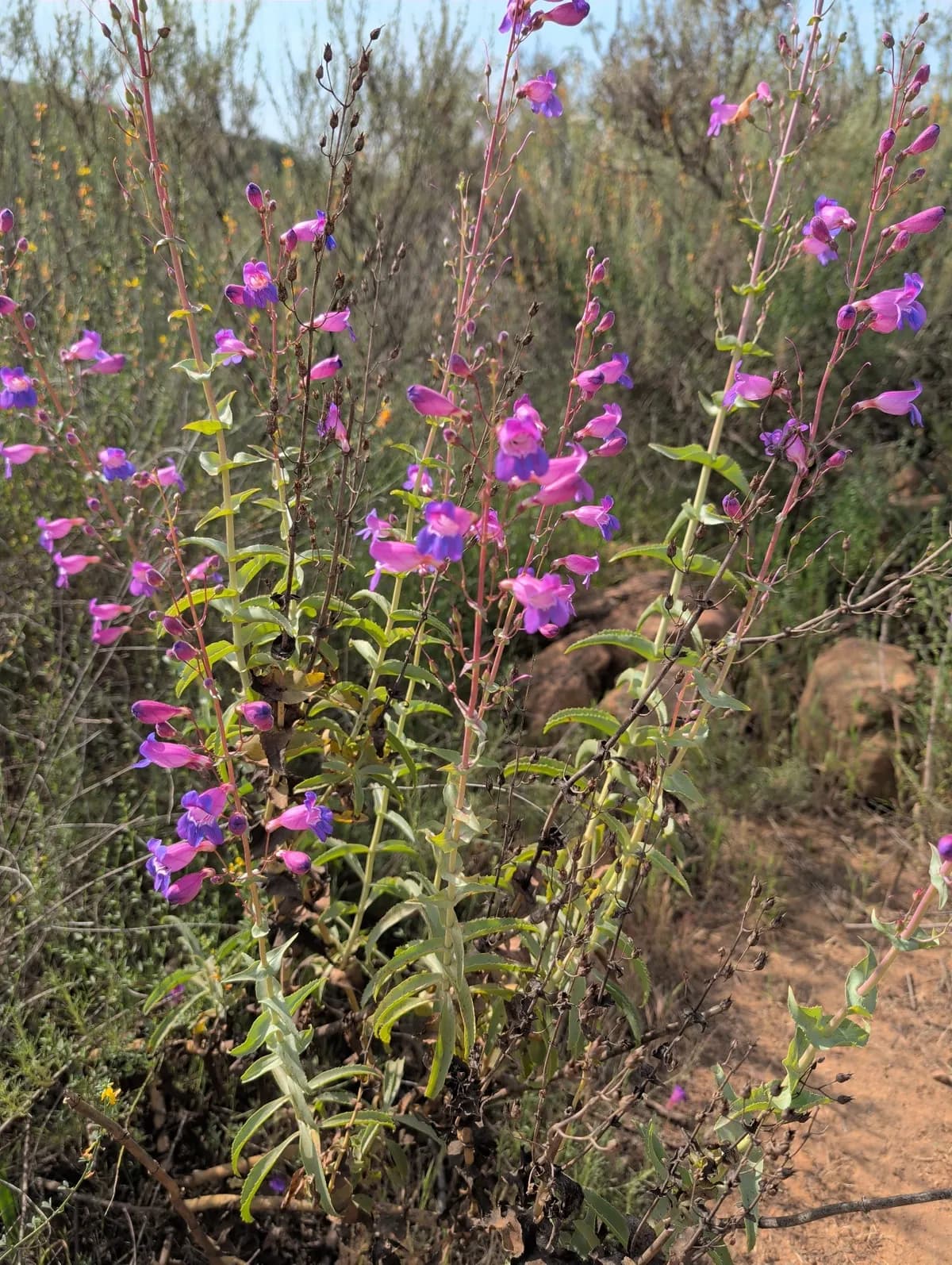
Penstemon spectabilis, or Showy Penstemon, sends up tall spikes of blue-lavender to pink flowers from April through June and thrives in dry, sunny chaparral and coastal sage scrub settings, attracting bees and hummingbirds.
Showy Penstemon (Penstemon spectabilis) is not flagged as toxic to dogs or cats by Plants For A Future (PFAF) (opens in new tab) (last reviewed 2026-05-21). This verdict does not come from the ASPCA. If your pet shows symptoms after eating any plant, call the ASPCA at (888) 426-4435.
Light
full sun
Water
low
Size
12"–36" H × 12"–24" W
Bloom
Apr, May, Jun
Native to
CA
Pollinators
bees, hummingbirds
Before you buy
Your city may pay you to plant this
Cities and water utilities offer rebates for replacing lawn with native and water-wise plants. We track 459 programs across 44 states, each with a link to the provider and the date we last checked it.
Find rebates in your areaPicture natives in your own yard
Upload a photo of your yard and Patch Vision shows a rendering of it planted with natives for your region, like Showy Penstemon.


Browse plants for this ecoregion
Showy penstemon features striking stalks of purple-blue flowers that rise above attractive gray-green foliage. This native species blooms profusely in spring and early summer, creating vertical interest in water-wise gardens. It remains evergreen year-round with minimal maintenance.
Growing Showy Penstemon
Grow Showy Penstemon in full sun and low water. Mature plants reach 12 to 36 inches tall and spread 12 to 24 inches wide. Expect low maintenance to keep it looking intentional in a front yard.
How to care for Showy Penstemon, by region
How to care for Showy Penstemon where it is actually grown: year-round basics plus what to do each season, region by region, with the sources for each.
Care guidance last updated: August 2026
Sonoran Basin and Range (includes Phoenix, AZ)
Year-round
Showy penstemon comes from chaparral and coastal sage scrub slopes in California, where summer days get hot but nights cool off. In the low desert you are asking it to hold on through 105 to 115 F afternoons with nights that stay above 85 F, and that heat, not winter, is what decides whether it lives. Give it morning sun with shade in the afternoon, and keep it well away from west-facing walls, driveways and open gravel that throw reflected heat back at it. Plant it between October and February so the roots are established before the first real heat wave. Water deeply but rarely, and never let water sit around the crown, because rot kills more penstemon here than drought does. Treat it as a short-lived perennial that may give you two or three good years and reseed itself rather than a permanent shrub.
- Site it for morning sun and shade after about 2 pm.
- Keep it several feet back from west-facing walls and paved surfaces.
- Plant October through February, never in spring or summer.
- Dig a test hole two feet deep and break through any caliche layer first.
- Mound the crown an inch or two above grade and add coarse gravel to the backfill.
- Skip fertilizer entirely, it pushes soft growth that burns.
- Let a few seed heads ripen each year so volunteers can replace the parent plant.
Fall
October and November are the real gardening months here and the best time to put a new plant in the ground. Nights finally drop, and an established clump will push fresh leaves from the base after its summer sulk. If you are adding one, plant it now so the roots have four months to spread before heat returns. Work on drainage rather than richness, mixing coarse gravel or decomposed granite into the backfill and setting the crown slightly above grade. Water a new plant twice a week for the first three or four weeks, then stretch out to about every 10 days. Once fresh basal growth appears, clean off the dead summer foliage, and scatter any seed you saved right on the soil surface so winter chill can break its dormancy.
- Plant new ones October through November for the strongest root start.
- Mix coarse gravel or decomposed granite into the backfill and set the crown high.
- Water new plants twice weekly for 3 to 4 weeks, then every 10 days.
- Remove dead summer leaves only after fresh basal growth shows.
- Sow saved seed on the surface in fall and let winter chilling break dormancy.
- Still no fertilizer, drainage matters far more than feeding here.
Clearing the dead summer foliage and re-cutting the bed edge in fall is what keeps the front yard reading as tended going into winter, which is usually enough to keep a violation letter away.
Winter
Winter is the easy part of the year for this plant. The gentle rain that falls from December through March usually covers what it needs, so check the soil before you water at all and skip irrigation in any week that brought real rain. Last frost lands somewhere between late January and late February, and some winters bring none, so you do not need frost cloth for a light low desert freeze. This penstemon is often described as evergreen, and in a mild winter it holds a low rosette of leaves, though a plant that took a beating in summer may look thin instead. Do not shear it to the ground. If a cold night burns a few leaf tips, leave them until spring growth starts, then trim. Late winter is when the first flower buds form, so give it one deep soak in February if the winter has been dry.
- Water only when the top 2 inches of soil are dry, roughly monthly.
- Skip watering in any week that brought real rain.
- No frost cloth needed for a light low desert freeze.
- Leave the low winter rosette intact, do not shear it.
- Give one deep soak in February if winter rain has been thin.
- Watch for the first flower buds in late winter and stop disturbing the crown.
Spring
Spring is the payoff season. Expect the tall spikes of wide-mouthed violet blue flowers from roughly February into May in the low desert, running earlier than the April to June window the plant keeps in cooler California hills. Hummingbirds and small native bees work the tubular flowers, often within days of the first ones opening. Water deeply once every week or two while it is blooming, soaking the whole root zone and then letting the top few inches dry out before the next round. Water at the soil, not over the leaves, since wet foliage in warming weather invites rot. When a heat spike arrives in May the flowering shuts down quickly, so enjoy the show early rather than waiting for it to get bigger. Cut the finished spikes back to the low leafy rosette as they brown.
- Look for bloom from roughly February through May here.
- Water deeply every 7 to 14 days during bloom, then let the surface dry.
- Water at the soil line and keep the foliage dry.
- Cut spent flower spikes back to the basal rosette.
- Leave two or three spikes to ripen if you want volunteer seedlings.
- Hummingbirds and small native bees feed at the tubular flowers.
- Pull winter weeds now before they crowd the crown.
Taking the browning flower spikes down as they finish keeps the planting reading as intentional rather than as a dead patch out front, which is the kind of thing that draws a letter.
Summer
This is the season that decides things, and it is worth being straight with you. From June through August the low desert runs 105 to 115 F with nights above 85 F, and this plant grew up where nights cool down, so it will look rough no matter how well you tend it. Expect crisped leaf edges, stalled growth and a plant that mostly sulks until fall. Water deeply about every 10 to 14 days, tightening toward every 7 in a brutal stretch, but always let the top of the soil dry between waterings. Once the monsoon rain starts, somewhere around mid July, turn your irrigation off completely, because warm standing moisture around the crown is what rots penstemon. Do not cut it back hard now and do not fertilize, since both push tender new growth straight into the worst heat.
- Water deeply every 10 to 14 days, tightening to 7 in a 115 F stretch.
- Shut off irrigation once monsoon rain begins, roughly mid July.
- Keep water off the crown and off the leaves.
- Use gravel mulch rather than bark, pulled back an inch from the stems.
- Hang 30 to 40 percent shade cloth for July and August if afternoon sun reaches it.
- Hold off on pruning and fertilizer until temperatures drop.
- Crisped leaf edges and paused growth are normal here, not a watering mistake.
A heat stressed clump can read as neglect from the sidewalk, so pick off only the fully dead leaves and keep the bed edge crisp so the planting still looks deliberate.
Sources: Calscape (California Native Plant Society): Penstemon spectabilis, Showy Penstemon, University of Arizona Cooperative Extension, Backyard Gardener #72: Penstemons
Southern California/Northern Baja Coast (includes Los Angeles, CA)
Year-round
Showy Penstemon is native to the coastal and inland mountains of Southern California, including the Los Angeles area, where it grows on rocky slopes in chaparral and coastal sage scrub. In gardens it stays compact, about 12 to 36 inches tall, and wants full sun with low water once it's established.
- This plant is native to Southern California's Transverse and Peninsular mountain ranges, the same region that includes the Los Angeles basin.
- It wants full sun and low water. Once it's established it does not need regular irrigation.
- No authority list, including the ASPCA, has an entry evaluating Penstemon spectabilis for pet toxicity. The wider Penstemon genus is documented to take up selenium from the soil it grows in, which is not good for pets in excess, so it's a reasonable precaution to keep dogs and cats from chewing on it.
Its tidy size and tubular purple flowers read as an intentional planting rather than overgrowth, which helps in HOA-conscious front yards.
Fall
Fall is a good time to cut the spent flower stalks back to the base. This species is fairly short lived and often reseeds on its own.
- Cut spent flower stalks back to the base in fall to tidy the plant and encourage new basal growth for next year.
- This plant usually lives 5 to 10 years and often self-seeds, so a few volunteer seedlings nearby are normal, not a problem.
Cutting the spent stalks back in fall keeps the bed looking maintained through the dormant months.
Winter
Winter is the dormant season for this plant. It needs little to no water and has shown strong cold tolerance for a Southern California plant.
- Little to no supplemental water is needed during the winter dormant period.
- It has been recorded surviving nights down to 0 degrees Fahrenheit, well beyond what most Los Angeles area winters bring.
Spring
Spring is peak bloom for Showy Penstemon, with tubular purple flowers opening from late winter into early summer depending on the year.
- Flowers typically open between April and June, sometimes starting as early as late winter.
- Hummingbirds and bees visit the blooms regularly during this window.
The purple flower spikes read as a deliberate flower bed during bloom, which is a good look for street-facing beds.
Summer
By summer this plant wants very little water. Established plants can go a month or more between waterings and may look dry or dormant in high heat, which is normal for this species.
- Water established plants at most once a month through summer.
- It's normal for the foliage to look dry or dormant in summer heat. That is not a sign the plant is dying.
Dormant summer foliage can look untended to a neighbor. Planting it among low shrubs or bunch grasses helps it blend in during its off months.
Sources: Calscape: Penstemon spectabilis (Showy Penstemon), Lady Bird Johnson Wildflower Center (NPIN): Is Penstemon Poisonous to Dogs?, Chino Basin Water Conservation District, Waterwise Garden Planner: Showy Penstemon, American Penstemon Society: Pruning (community tip), Las Pilitas Nursery: Penstemon spectabilis
In an HOA neighborhood
Showy Penstemon is an HOA-friendly choice. Maintenance level: low. Tidiness: 4 out of 5.
Works well in: front yard, foundation, street edge, mid zone.
- May look slightly sparse when not in bloom
- Could require staking in windy areas
Wildlife value
Showy penstemon is highly attractive to native bees and a favorite of hummingbirds. The tubular flowers provide an excellent nectar source during its bloom period.
Common questions
- How much water does Penstemon spectabilis need?
- This penstemon does best with low water once established. Infrequent, deep watering that mimics dry chaparral conditions works better than frequent shallow irrigation.
- When does Showy Penstemon bloom?
- Showy Penstemon typically flowers from April through June, sending up tall spikes topped with blue to lavender-pink blossoms.
- What pollinators visit Penstemon spectabilis?
- The tubular flowers attract bees and hummingbirds, both of which feed on the nectar and help move pollen between plants.
- How much sun does Penstemon spectabilis need?
- This plant grows best in full sun, though it can tolerate a bit of afternoon part sun in hotter inland gardens.
- Is Showy Penstemon toxic to dogs?
- Showy Penstemon is not flagged as toxic to dogs by Plants For A Future (PFAF). This verdict does not come from the ASPCA.
- Is Showy Penstemon toxic to cats?
- Showy Penstemon is not flagged as toxic to cats by Plants For A Future (PFAF). This verdict does not come from the ASPCA.
- Is Showy Penstemon HOA-friendly?
- Showy Penstemon is generally an HOA-friendly choice in the right placement, with low maintenance.
These answers were drafted with an AI model from this plant's data. Verify care details with a local expert.
Native range data from vouchered herbarium specimen records and regional native plant society lists. Pollinator and host plant associations compiled from GBIF, iNaturalist, and published ecological literature.
If something looks wrong
Common plant problems, and what to check first
These come up on almost any plant. Each guide lists the likely causes in the order they are worth ruling out, with one thing to check before you act on any of them, and links to the source it came from.
- It is dying right after planting
- Leaves turning yellow
- Wilting even though I watered it
- Brown crispy leaf tips
- Bugs on the plant
Ready to grow Showy Penstemon? Add it to your garden in Pollinator Patch to track it and get season-by-season care guidance.