Copper iris
Iris fulva
Last reviewed: September 2026
Iris fulva, or copper iris, thrives in wet ditches, swamps, and bottomland woodlands of the lower Mississippi River Valley and Gulf Coast, blooming April through May with copper-red flowers that draw hummingbirds.
Copper iris is toxic to dogs and cats.
Listed as toxic by the ASPCA Animal Poison Control Center (opens in new tab) (last reviewed 2026-08-15). If your pet has been exposed, call the ASPCA Animal Poison Control Center at (888) 426-4435 and your veterinarian's emergency line.
Pollinator Patch flags toxic plants so you can choose a pet-safe native alternative for your yard.
Light
part sun
Water
high
Size
24"–36" H × 18"–24" W
Bloom
Apr, May
Native to
AL, AR, IL, KY and 4 more states
Pollinators
hummingbirds, bumble bees
Before you buy
Your city may pay you to plant this
Cities and water utilities offer rebates for replacing lawn with native and water-wise plants. We track 458 programs across 44 states, each with a link to the provider and the date we last checked it.
Find rebates in your areaBrowse plants for this ecoregion
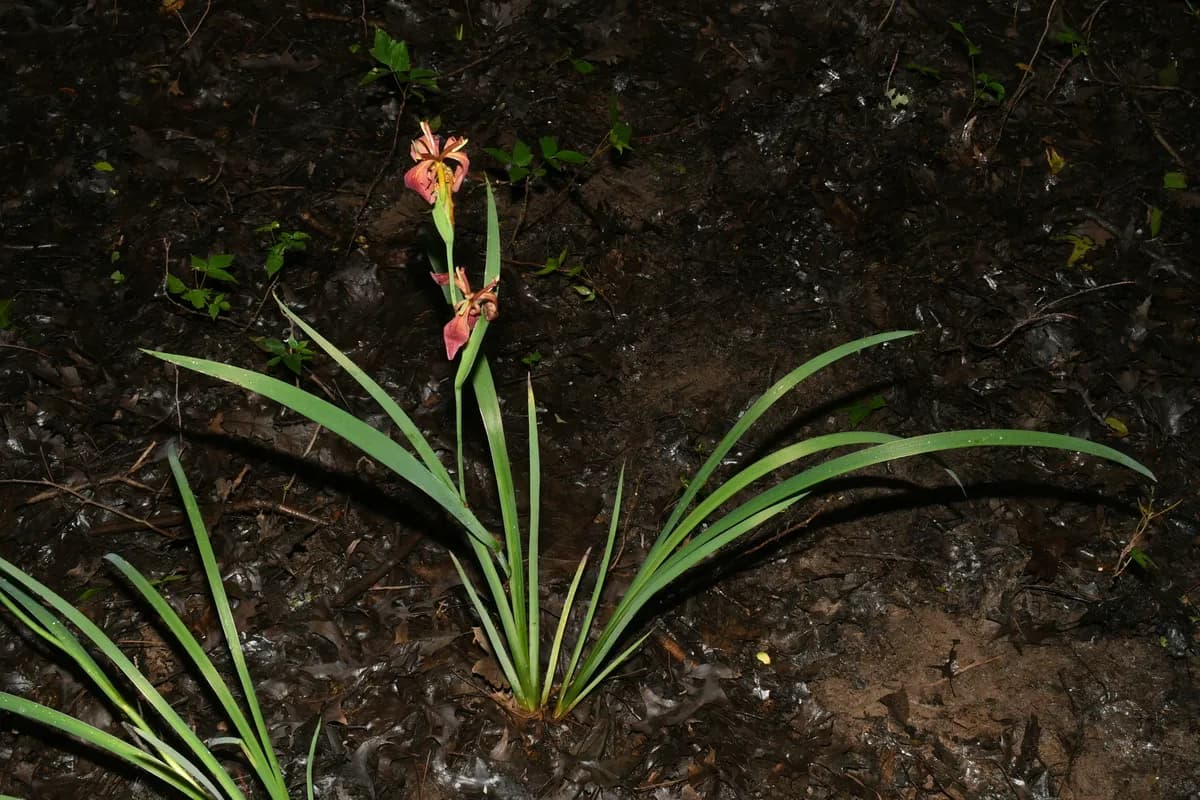
A wetland iris with unusual coppery-orange to brick-red flowers whose falls droop rather than flare. It grows from spreading rhizomes in mucky soil and shallow standing water in part shade.
Growing Copper iris
Grow Copper iris in part sun and high water. Mature plants reach 24 to 36 inches tall and spread 18 to 24 inches wide.
Wildlife value
The rare true-orange flower color and tubular form make it a hummingbird favorite in wet ground.
Common questions
- When does copper iris bloom?
- Iris fulva blooms in April and May, sending up copper-red to brick-orange flowers on tall, slender stems.
- What growing conditions suit Iris fulva best?
- This iris does best in consistently wet to moist soil with part sun, similar to the ditches, swamp edges, and bottomland sites where it is commonly found growing.
- What pollinates copper iris flowers?
- The tubular, copper-red flowers attract hummingbirds and bumble bees, which are drawn to the color and shape of the blooms.
- Does Iris fulva stay green year round?
- No. Copper iris is deciduous, dying back after the growing season and resprouting from its rhizomes the following spring.
- Is Copper iris toxic to dogs?
- Yes. Copper iris is listed as toxic to dogs by the ASPCA Animal Poison Control Center (aspca.org). If your pet has been exposed, call the ASPCA Animal Poison Control Center at (888) 426-4435.
- Is Copper iris toxic to cats?
- Yes. Copper iris is listed as toxic to cats by the ASPCA Animal Poison Control Center (aspca.org). If your cat has been exposed, call the ASPCA Animal Poison Control Center at (888) 426-4435.
These answers were drafted with an AI model from this plant's data. Verify care details with a local expert.
Native range data from the World Checklist of Vascular Plants (Kew). Pollinator and host plant associations compiled from GBIF, iNaturalist, and published ecological literature.
If something looks wrong
Common plant problems, and what to check first
These come up on almost any plant. Each guide lists the likely causes in the order they are worth ruling out, with one thing to check before you act on any of them, and links to the source it came from.
- It is dying right after planting
- Leaves turning yellow
- Wilting even though I watered it
- Brown crispy leaf tips
- Bugs on the plant
Pollinator Patch flags toxic plants like Copper iris and shows pet-safe natives for your ecoregion instead.