Frogfruit
Phyla nodiflora

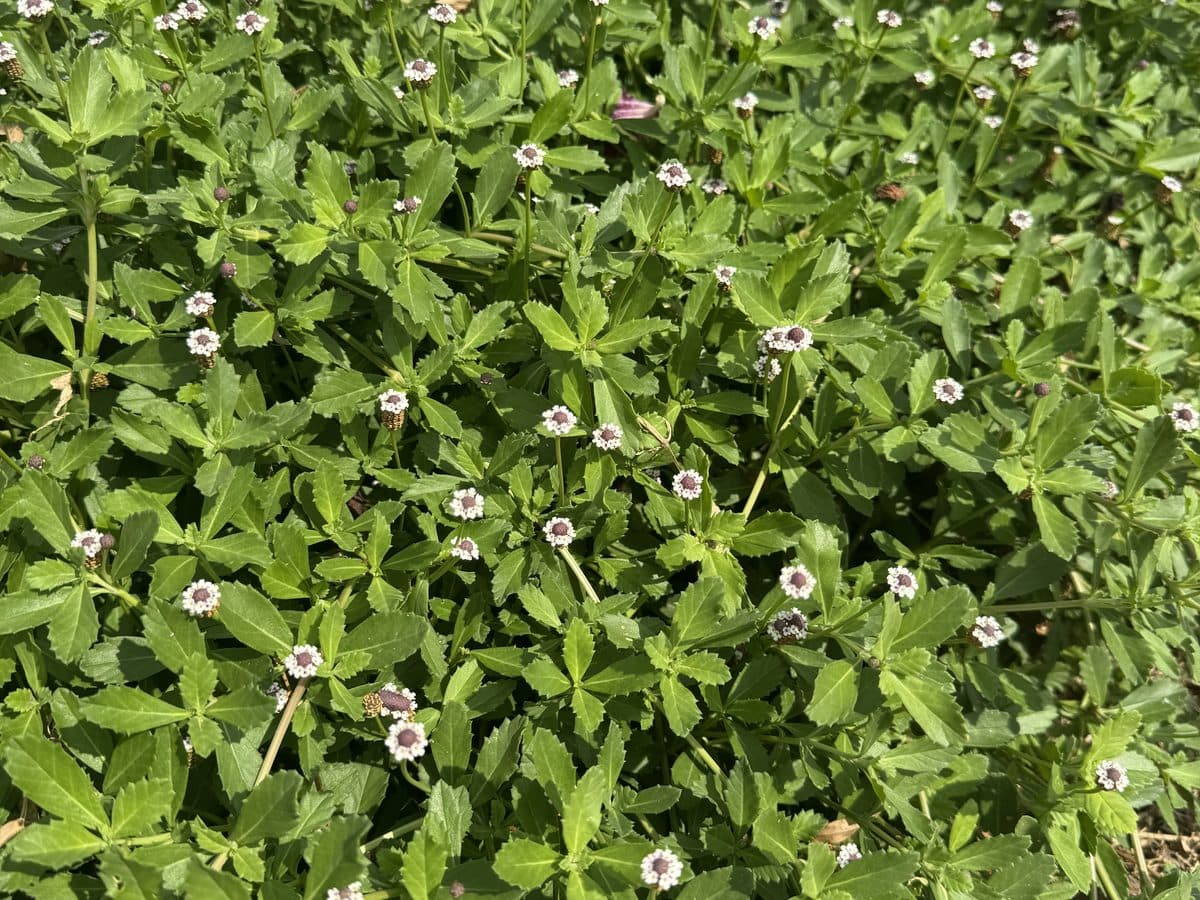
Light
full sun
Water
low
Size
2"–6" H × 24"–48" W
Bloom
Apr, May, Jun, Jul, Aug, Sep, Oct
Native to
Edwards Plateau, South Texas Plains, Blackland Prairie, Coastal Prairies, Post Oak Savannah
Pollinators
bees, butterflies, Phaon Crescent, Common Buckeye
Picture natives in your own yard
Upload a photo of your yard and Patch Vision shows a rendering of it planted with natives for your region, like Frogfruit.


Browse plants for this ecoregion
Frogfruit is a perennial forb native to Edwards Plateau, South Texas Plains, Blackland Prairie, Coastal Prairies, Post Oak Savannah. It grows best in full sun with low water needs.
Frogfruit (Phyla nodiflora) is a low, mat-forming native ground cover that takes foot traffic better than St. Augustine grass and uses a fraction of the water. Tiny white flowers with purple or pink centers bloom from April through October. It hugs the ground at 2-6 inches tall and spreads 2-4 feet by runners.
Frogfruit is not listed as toxic to dogs or cats by the ASPCA Animal Poison Control Center plant database (aspca.org). It is the host plant for the Phaon Crescent butterfly and supports many native bees. Texas water utilities increasingly cite it in approved-plant lists for turf-conversion rebates because of its drought tolerance and pollinator value.
Ecoregion notes for Texas. In the Edwards Plateau and South Texas Plains (alkaline, rocky, hot summers): native and ideal. Plant 12-18 inches apart in spring; it fills in within one season. Water once a week the first summer, then almost never. In the Blackland Prairie (DFW-Austin metros, heavy clay): native; tolerates clay better than most ground covers but spreads slower than in lighter soils. In the Coastal Prairies (Houston, Corpus Christi, sandy loam, humid): native and aggressive; easy to establish, may need edge containment. In the Post Oak Savannah (transitional Central Texas): native; performs well with light mulch the first season.
Frogfruit pairs well with Horseherb in shade and with Blackfoot Daisy or Damianita in sun for a low-water mosaic ground cover. For HOA contexts, mow once a month at 3 inches for a tighter look, or leave unmowed for a meadow effect; the unmowed look reads better in mid-zone than at the street edge. Frogfruit goes semi-dormant in hard freezes and greens up quickly in spring.
Bee species data compiled from GBIF, iNaturalist, Discover Life, and the USGS Native Bee Inventory and Monitoring Lab. Plant-pollinator associations informed by published ecological literature.
How to care for Frogfruit, by region
How to care for Frogfruit where it is actually grown: year-round basics plus what to do each season, region by region, with the sources for each.
Care guidance last updated: October 2026
Central California Valley (includes Sacramento, CA)
Year-round
Frogfruit is a low, spreading groundcover that likes sun and needs little water once settled.
- Full sun, and it spreads by trailing runners to make a mat 1 to 6 inches tall.
- Drought tolerant and adapts to sand, loam and clay.
- Water deeply about every two weeks in summer per Calscape, more often in dry seasons per the Wildflower Center.
It is low and tidy, which suits a front yard, but it spreads, so keep edges trimmed near lawn and walkways.
Fall
Blooms continue into fall, so there is little to do.
- Flowers can last through November.
- Water during dry periods to keep the cover solid.
Winter
In mild winters it stays green and in hard frosts it can go dormant.
- It is semi-evergreen and may go dormant in a hard winter.
- Leaves may turn reddish or purplish in cold weather.
Spring
Spring is a good time to let it fill in and to edge it where it runs.
- It spreads vigorously by runners.
- Small white to pink flowers can start as early as May.
Summer
Give an occasional deep soak in summer and skip mowing while it blooms.
- Deep water about every two weeks in the dry season.
- Avoid mowing while it blooms, since recovery can take years.
Sources: Calscape: Phyla nodiflora, Lady Bird Johnson Wildflower Center: Phyla nodiflora
Cross Timbers (includes Fort Worth, TX)
Year-round
Frogfruit is a tough, low creeping groundcover that forms a dense green mat only a few inches tall. Around Fort Worth it handles heat, poor soil, and drought once it has settled in, so most of the work is edging it back and letting it fill in.
- Establishment: water new plugs two or three times a week for the first month so the runners root at the nodes, then taper off as it knits together.
- Once established: it is drought tolerant, so a deep soak every week or two in a dry spell is plenty. Overwatering makes it grow taller and floppier.
- Containment: it spreads by runners and will crawl into beds and walkways. Edge it, pull stray runners, or run a string trimmer along the border to hold the line.
- Common mistake: mowing while it is in bloom. It can take a long time to bounce back, so mow only when flowering has paused.
To keep a front-yard patch reading as intentional rather than as a weedy sprawl that draws a violation letter, edge the mat cleanly along walks and beds so the boundary looks deliberate.
Fall
As nights cool around Fort Worth, blooming winds down and growth slows. This is a good window to reset the edges and do any needed cutback once flowers fade.
- Once flowering has clearly stopped, you can mow or trim the mat to tidy it for the season.
- Re-cut the edges along walks and beds so the planting holds a clean line going into winter.
- Skip heavy fertilizing. Frogfruit does fine in lean soil and stays denser without a growth push.
A fall edge-and-trim once blooms fade keeps the front-yard mat looking cared-for through the off season, which reads as intentional and helps avoid an unkempt-yard notice.
Winter
In Fort Worth winters frogfruit slows down and can brown or take on a reddish tinge during cold snaps. It usually stays put and greens back up in spring with little help.
- Leave it be. The mat protects itself, and it recovers quickly once warmth returns.
- A light mulch over the crowns can guard the roots through a hard freeze if your yard runs cold.
- Avoid hard pruning now, since cutting in fall or winter can leave it more exposed to cold damage.
A little winter browning is normal and reads as a dormant groundcover, not neglect, so a clean edge from the fall trim is enough to keep the front yard looking intentional.
Spring
Spring is when frogfruit wakes up and starts running. This is the time to divide, plug gaps, and give it one clean cutback before it hits full bloom.
- Do any rejuvenation trimming or mowing now, before flowering starts, since cutting during bloom sets it back badly.
- Fill bare spots by tucking rooted runners into the soil. In warm Fort Worth springs a few pieces spread fast.
- Ease off water as the weather warms so the mat stays low and tight instead of tall and loose.
Summer
Summer is frogfruit's strong season. It blooms through the heat and feeds bees and butterflies, so the main job is to leave it alone and only water in real drought.
- Hold off on mowing while it is flowering. Cutting a blooming mat can cost you years of recovery.
- Water deeply only when it looks stressed in a long dry stretch. It shrugs off Fort Worth heat once established.
- Trim runners escaping into paths or beds by hand instead of shearing the whole planting during bloom.
Sources: Native Plant Society of Texas frogfruit profile, Lady Bird Johnson Wildflower Center Texas frogfruit, Dallas County Master Gardeners frogfruit, Gardenia frogfruit grow and care guide (community tip)
Edwards Plateau (includes San Antonio, TX)
Year-round
Frogfruit is a low, spreading groundcover that handles the Edwards Plateau's rocky limestone soil and heat well, and it feeds several butterfly caterpillars.
- It hugs the ground at about 4 to 8 inches tall and spreads out to roughly 4 feet wide, so give it room to run.
- It grows in nearly any soil found around San Antonio, including clay, caliche, and limestone, and it handles both dry spells and soggy patches once established.
- Full sun gives the fullest bloom, but it also does fine in part shade or dappled shade.
- It is a larval host plant for the Common Buckeye, Phaon Crescent, and White Peacock butterflies, so a patch of it feeds more than just the adult pollinators visiting the flowers.
- It is not on the ASPCA toxic plant list for dogs or cats.
- The Native Plant Society of Texas includes the Edwards Plateau, which covers the Hill Country and San Antonio area, in this plant's native ecoregion range.
Fall
Fall bloom keeps going into November in the Edwards Plateau, so this is a good season to let the plant keep spreading before winter slows it down.
- Bloom continues from summer into November according to the Native Plant Society of Texas, so pollinators still have flowers into late fall.
- Keep watering established patches through any dry fall stretches, though needs are lower than in summer.
- Keep avoiding a cutback while flowers are still present, since an untimely mow can take years to grow back from, the same warning that applies in summer.
- Fall's cooler weather is a good time to plant new plugs or move runners, since roots get a chance to settle in before next summer's heat.
Leaving the fall bloom in place instead of a fall cutback keeps nectar available late in the season, but mowing a clean edge around the bed keeps the overall look tidy for the street.
Winter
Winter in the Edwards Plateau is when frogfruit slows down, usually staying evergreen in mild years and only going dormant after a hard freeze.
- In San Antonio's mild winters frogfruit usually stays evergreen and just takes on a reddish or purplish tinge in the cold, per the Lady Bird Johnson Wildflower Center.
- A hard freeze can knock the foliage back into dormancy, and the plant typically comes back from the roots once warm weather returns.
- Watering needs drop to little or none in winter unless the season turns unusually dry.
- Leave any frost bitten leaves in place through winter rather than cutting the patch back, since it regrows more easily from the roots when left undisturbed.
If frost turns the patch brown, a light trim of the dead top growth once new leaves appear in spring keeps the bed looking intentional rather than neglected.
Spring
Spring is when frogfruit wakes up from winter and starts putting out new growth and its first flowers of the year.
- New growth picks up as nights warm, and bloom generally starts in March in the San Antonio area and continues into fall.
- Water new plantings often enough to keep the soil from drying out completely while the roots are still spreading.
- Established patches usually need little extra water in spring if rainfall is close to normal for the season.
- If winter left any frost damaged leaves behind, a light trim before new growth fills in keeps the patch looking tidy.
A light spring tidy up of any frost damaged leaves before new growth fills in keeps the bed looking neat from the street.
Summer
Summer is frogfruit's peak bloom season in the Edwards Plateau heat, and an established patch carries through drought with only occasional deep watering.
- Established frogfruit tolerates San Antonio summer heat and dry stretches well, though it fills in fuller with an occasional deep watering during long dry spells.
- Do not mow or cut back the patch while it is blooming. Rainbow Gardens, a San Antonio nursery, warns that mowing a blooming patch can set it back for years before it recovers.
- The small white to pink flowers keep drawing butterflies and other pollinators through the hottest months.
- New plugs or transplants still need regular watering through summer heat until their roots are established.
Skipping a mow while it blooms can look at odds with a trimmed lawn look, so consider mowing a clean edge or path around the patch instead of the whole area.
Sources: Phyla nodiflora (Texas frogfruit) - Native Plant Information Network, Lady Bird Johnson Wildflower Center, Phyla nodiflora - Native Plant Society of Texas, Toxic and Non-Toxic Plant List - Dogs, ASPCA, Frog Fruit Groundcover - San Antonio Plants, Rainbow Gardens
Northeastern Coastal Zone (includes New York, NY)
Year-round
In the New York City area frogfruit works as a warm-season, mat-forming groundcover. It sits at the cold edge of its comfort range here, so plan on it browning in winter and rebounding in late spring, with edging as the main chore.
- Establishment: water new plugs two or three times a week the first month so runners root before the first fall. Plant in spring so it has a full warm season to settle in.
- Once established: it is drought tolerant. A deep weekly soak in a dry stretch is plenty, and too much water makes it grow tall and loose.
- Containment: it spreads by rooting runners. Edge it and pull strays so it does not wander into beds or lawn.
- Common mistake: expecting it to stay evergreen. This far north it browns back in winter, which is normal, not a sign it died.
To keep a front-yard patch reading as intentional and not as a scrappy weed, hold a clean edge along the walk so the planting looks deliberate through the year.
Fall
Fall cools fast around New York, and frogfruit will start to fade toward dormancy. Tidy the edges after bloom, but go easy so it heads into a hard winter with its crowns protected.
- Once flowering has clearly ended, do a light trim and re-edge, not a hard cutback.
- Leave a bit of top growth in place rather than shearing low, since the mat helps shield the roots from cold.
- Add a light mulch over the planting before the first hard frost to help the roots through winter.
A light fall trim and clean edge keeps the front-yard mat looking cared-for as it goes dormant, which reads as intentional and helps avoid an unkempt-yard notice.
Winter
New York winters sit at the cold limit for frogfruit. It goes dormant and browns fully, and a light protective layer improves its odds of coming back in spring.
- Expect it to be brown and dormant all winter. That is normal here, not a dead planting.
- Keep a light mulch over the crowns through the coldest months to protect the roots from freeze damage.
- Do not prune now. A fresh cut going into a hard freeze can leave it more exposed to cold.
A fully brown, dormant mat can look bare in winter, so the mulch layer and the clean edge from your fall trim are what keep the front yard reading as intentional rather than neglected.
Spring
Spring comes late here, and frogfruit is slow to wake. Give it time before assuming winter took it, then shape it once new growth shows.
- Be patient. In the New York area it can stay brown well into spring and still push fresh growth once soil warms.
- Once you see green, do any trimming or dividing now, before bloom starts, since cutting during bloom sets it back.
- This is the best planting window locally, so add plugs in spring to give them a full season to root.
Summer
Summer is frogfruit's window to shine in the New York area. Warm weather brings the low mat and its tiny blooms, and the plant asks for very little.
- Do not mow while it is flowering. A blooming mat recovers very slowly from a cutback.
- Water deeply only during a real dry spell. Once rooted it handles heat and lean soil well.
- Trim escaping runners by hand to keep it out of beds and walkways instead of shearing during bloom.
Sources: Gardenia frogfruit grow and care guide (community tip), Emory Knoll Farms Phyla nodiflora, Lady Bird Johnson Wildflower Center Texas frogfruit
Texas Blackland Prairies (includes Dallas, TX)
Year-round
Frogfruit is a fast, mat-forming groundcover that stays only a few inches tall and takes the heavy clay soils common around Dallas in stride. Most of the upkeep is edging and pulling runners so it stays where you want it.
- Establishment: keep new plugs watered two or three times a week for the first few weeks so runners root, then cut back as the mat closes in.
- Once established: it is drought tolerant and does well in Dallas clay. A deep soak now and then in a dry spell is enough, and too much water makes it grow tall.
- Containment: it runs vigorously in rich, moist ground. Manage it with edging, an occasional mow, or pulling stray runners, which come up easily.
- Common mistake: mowing during bloom. It recovers slowly from that, so time any cutback for when it is not flowering.
To keep a front-yard planting reading as intentional and not as a weed patch that invites a violation letter, keep a crisp mowed or edged border between the mat and the walkway.
Fall
Cooler fall nights slow the mat and end the bloom. Once flowers fade, tidy the edges and do any cutback you have been holding off on.
- After flowering stops for good, mow or trim to neaten the planting for the season.
- Re-edge along walks and beds so the mat carries a clean line into winter.
- Hold the fertilizer. Frogfruit stays tighter and healthier in the lean clay soils around Dallas.
A fall trim and re-edge once blooms fade keeps the front yard looking deliberately maintained through the quiet season, which reads as intentional and heads off an unkempt-yard notice.
Winter
Dallas winters push frogfruit into a slow, semi-dormant state, and cold snaps can brown the leaves or turn them reddish. It usually holds through and greens up again in spring.
- Leave it undisturbed. It protects its own crowns and rebounds fast in spring.
- A thin mulch over the roots helps in a hard freeze if your yard sits in a cold pocket.
- Do not do heavy pruning now, since a fresh cut going into cold can leave it more vulnerable.
Winter browning on frogfruit reads as normal dormancy rather than a dead lawn, so the clean edge left from your fall trim is what keeps the front yard looking intentional.
Spring
Spring green-up is the moment to shape frogfruit for the year. Do your cutback and any dividing now, before the bloom season starts around Dallas.
- Mow or trim to rejuvenate a thick mat now, while it is still out of bloom.
- Plug bare patches with rooted runners. They take fast in warm spring soil.
- Start tapering water as it warms so the planting stays low and dense rather than leggy.
Summer
Through the Dallas summer frogfruit blooms hard and pulls in pollinators. Leave the mower parked and water only when a real dry spell sets in.
- Do not mow while it is flowering. A blooming mat cut back now can take years to fully recover.
- Water deeply only in extended drought. Established frogfruit handles Dallas heat and clay without much help.
- Hand-pull or spot-trim runners heading into beds and paths instead of shearing the whole planting.
Sources: Dallas County Master Gardeners frogfruit, Native Plant Society of Texas frogfruit profile, Lady Bird Johnson Wildflower Center Texas frogfruit, Gardenia frogfruit grow and care guide (community tip)
Before you buy
Your city may pay you to plant this
Cities and water utilities offer rebates for replacing lawn with native and water-wise plants. We track 459 programs across 44 states, each with a link to the provider and the date we last checked it.
Find rebates in your areaIf something looks wrong
Common plant problems, and what to check first
These come up on almost any plant. Each guide lists the likely causes in the order they are worth ruling out, with one thing to check before you act on any of them, and links to the source it came from.
- It is dying right after planting
- Leaves turning yellow
- Wilting even though I watered it
- Brown crispy leaf tips
- Bugs on the plant
Ready to grow Frogfruit? Add it to your garden in Pollinator Patch to track it and get season-by-season care guidance.