Goldenball Leadtree
Leucaena retusa
Last reviewed: September 2026
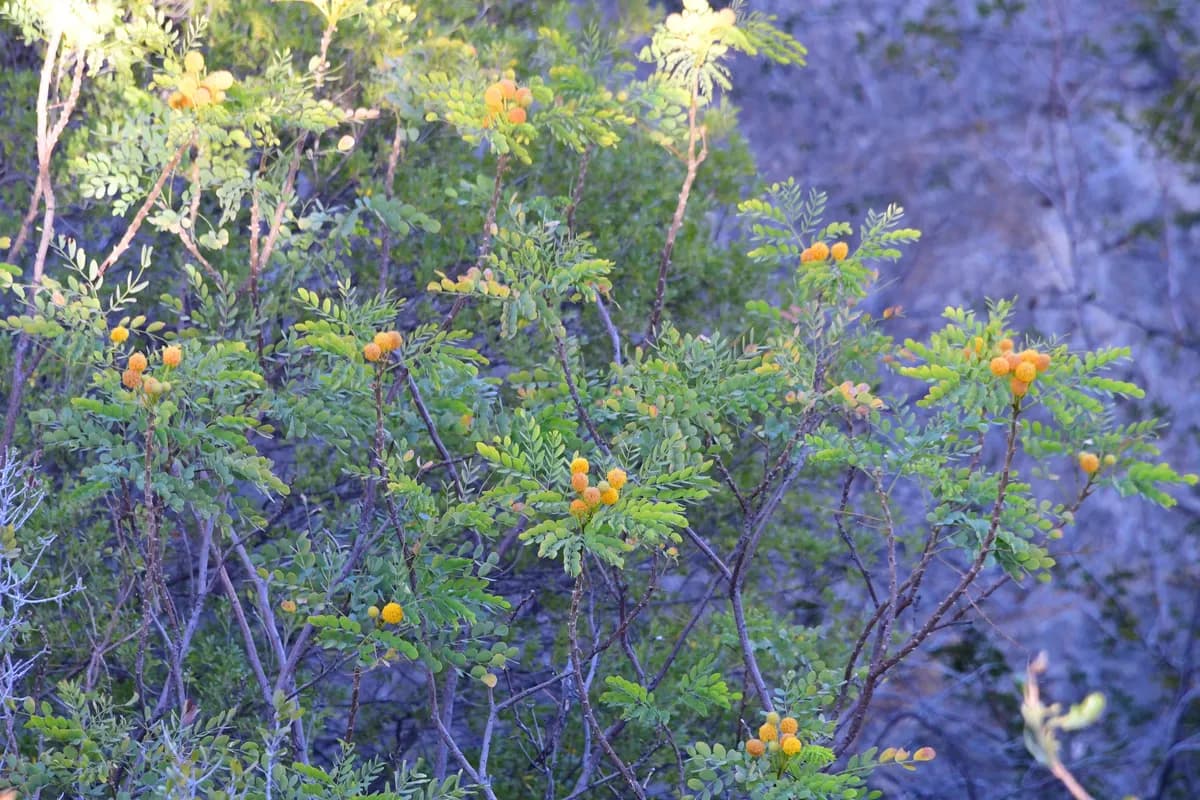
Leucaena retusa is a small deciduous tree with fragrant, golden puffball flowers that bloom from March through November, tolerating low water and full to part sun in dry, well-drained sites typical of Texas and New Mexico landscapes.
Toxicity unknown
Goldenball Leadtree (Leucaena retusa) is not listed by the ASPCA Animal Poison Control Center (opens in new tab) or the other sources we check, so we have no verdict for it either way. Absence from those lists is not a clearance. If your pet shows symptoms after eating any plant, call the ASPCA at (888) 426-4435.
The USDA PLANTS Database (opens in new tab) does not flag Goldenball Leadtree as toxic to livestock.
Light
part sun
Water
low
Size
144"–240" H × 144"–180" W
Bloom
Mar, Apr, May, Jun, Jul, Aug, Sep, Oct, Nov
Native to
NM, TX
Pollinators
nectar insects
Before you buy
Your city may pay you to plant this
Cities and water utilities offer rebates for replacing lawn with native and water-wise plants. We track 452 programs across 44 states, each with a link to the provider and the date we last checked it.
Find rebates in your areaBrowse plants for this ecoregion
Goldenball Leadtree is a small native Texas tree that produces clusters of bright yellow, ball-shaped flowers from spring through fall. This drought-tolerant tree grows 12-20 feet tall with a rounded canopy and delicate, feathery foliage that drops in winter.
Growing Goldenball Leadtree
Grow Goldenball Leadtree in part sun and low water. Mature plants reach 144 to 240 inches tall and spread 144 to 180 inches wide. Expect moderate maintenance to keep it looking intentional in a front yard.
How to care for Goldenball Leadtree, by region
How to care for Goldenball Leadtree where it is actually grown: year-round basics plus what to do each season, region by region, with the sources for each.
Care guidance last updated: September 2026
Cross Timbers (includes Fort Worth, TX)
Year-round
Goldenball leadtree, also called littleleaf leadtree or lemonball, is a small Texas native tree that thrives on heat and neglect once it settles into your yard, then rewards you with round, fragrant gold flower puffs most of the growing season.
- Give it full sun to part shade. It flowers best with at least a half day of direct sun, but it also does fine in the light, dappled shade under taller trees.
- Skip amending the soil. This tree grows in Cross Timbers sand, Blackland Prairie clay, caliche, and straight rock alike, as long as water drains through instead of pooling around the roots.
- Water it deeply but rarely. After the first one to two growing seasons in the ground, it wants very little supplemental water and can go weeks between soakings in normal weather.
- Plant it somewhere sheltered from strong wind, such as near the house or a patio. The wood is soft and brittle, and limbs can snap in storms.
Fall
Fall still brings blooms most years, and it's a solid window for planting before winter dormancy sets in.
- Flowering often continues into October in the Fort Worth and Dallas area, so don't assume the show is over once summer ends.
- Early fall, before the first hard freeze, is a good time to plant a new tree from a nursery container so roots get a head start before winter.
- Leaves yellow and thin as nights cool. That's normal seasonal shutdown, not disease or a pest problem.
- Hold off on major pruning now. Wait until after the coldest stretch of winter passes so you can see exactly which wood actually survived.
Winter
Winter usually knocks this tree back hard, and that bare, twiggy look is normal, not a dead tree.
- A hard freeze strips the leaves and, in a cold winter, can kill branches back close to the ground in Fort Worth and Dallas's colder snaps.
- The tree regrows from surviving wood or from the base once nights stay reliably above freezing in spring. A bare skeleton in January is expected, not a failure.
- Leave the bare branches alone through winter. Wait until you see new growth in spring before cutting anything back, so you don't remove wood that was actually still alive.
- If a neighbor asks about the bare branches, it's temporary. This tree is used to freezing back and starting over every year.
A freeze-cut-back leadtree can look neglected to a passerby in winter. A tidy mulch ring at the base of the trunk helps it read as an intentional planting rather than an abandoned one.
Spring
Spring is the tree's big show: new leaves come first, then round gold flower puffs cover the branches.
- New leaves push out in late winter to early spring, quickly followed by the first flush of fragrant, ball-shaped gold blooms, usually peaking March into May in the Fort Worth and Dallas area.
- Bees notice fast. It's listed as a nectar source for insects, and gardeners commonly see carpenter bees and honeybees working the flowers.
- If winter killed back any branches, wait until you see live buds pushing out before you prune. Cutting too early risks removing wood that would have leafed out on its own.
- A late cold snap can nip the first round of blooms or new leaves. The tree typically pushes a second flush and recovers within a few weeks.
Summer
Summer is mostly hands-off: water only in real drought, and let the tree keep flowering into fall.
- Once established, most summers need little supplemental water beyond an occasional slow, deep soak during extended drought or stretches of extreme heat.
- Blooming continues in flushes right through summer, often picking back up after a good rain.
- Flat seed pods follow the flowers and drop through late summer. That's normal pod-drop, not a sign the tree is struggling.
- Skip fertilizer. A burst of feeding mostly produces fast, weak growth that snaps in summer storms, since this tree already grows well in poor soil.
Sources: Leucaena retusa - Lady Bird Johnson Wildflower Center, Leucaena retusa - Native Plant Society of Texas, Goldenball Leadtree - City of Austin Watershed Protection Plant Guide, Goldenball Lead Tree - Central Texas Gardener (community tip), A Seasonal Look: Goldenball Leadtree - My Gardener Says (community tip)
Texas Blackland Prairies (includes Dallas, TX)
Year-round
Goldenball leadtree, also called littleleaf leadtree or lemonball, is a small Texas native tree that thrives on heat and neglect once it settles into your yard, then rewards you with round, fragrant gold flower puffs most of the growing season.
- Give it full sun to part shade. It flowers best with at least a half day of direct sun, but it also does fine in the light, dappled shade under taller trees.
- Skip amending the soil. This tree grows in Cross Timbers sand, Blackland Prairie clay, caliche, and straight rock alike, as long as water drains through instead of pooling around the roots.
- Water it deeply but rarely. After the first one to two growing seasons in the ground, it wants very little supplemental water and can go weeks between soakings in normal weather.
- Plant it somewhere sheltered from strong wind, such as near the house or a patio. The wood is soft and brittle, and limbs can snap in storms.
Fall
Fall still brings blooms most years, and it's a solid window for planting before winter dormancy sets in.
- Flowering often continues into October in the Fort Worth and Dallas area, so don't assume the show is over once summer ends.
- Early fall, before the first hard freeze, is a good time to plant a new tree from a nursery container so roots get a head start before winter.
- Leaves yellow and thin as nights cool. That's normal seasonal shutdown, not disease or a pest problem.
- Hold off on major pruning now. Wait until after the coldest stretch of winter passes so you can see exactly which wood actually survived.
Winter
Winter usually knocks this tree back hard, and that bare, twiggy look is normal, not a dead tree.
- A hard freeze strips the leaves and, in a cold winter, can kill branches back close to the ground in Fort Worth and Dallas's colder snaps.
- The tree regrows from surviving wood or from the base once nights stay reliably above freezing in spring. A bare skeleton in January is expected, not a failure.
- Leave the bare branches alone through winter. Wait until you see new growth in spring before cutting anything back, so you don't remove wood that was actually still alive.
- If a neighbor asks about the bare branches, it's temporary. This tree is used to freezing back and starting over every year.
A freeze-cut-back leadtree can look neglected to a passerby in winter. A tidy mulch ring at the base of the trunk helps it read as an intentional planting rather than an abandoned one.
Spring
Spring is the tree's big show: new leaves come first, then round gold flower puffs cover the branches.
- New leaves push out in late winter to early spring, quickly followed by the first flush of fragrant, ball-shaped gold blooms, usually peaking March into May in the Fort Worth and Dallas area.
- Bees notice fast. It's listed as a nectar source for insects, and gardeners commonly see carpenter bees and honeybees working the flowers.
- If winter killed back any branches, wait until you see live buds pushing out before you prune. Cutting too early risks removing wood that would have leafed out on its own.
- A late cold snap can nip the first round of blooms or new leaves. The tree typically pushes a second flush and recovers within a few weeks.
Summer
Summer is mostly hands-off: water only in real drought, and let the tree keep flowering into fall.
- Once established, most summers need little supplemental water beyond an occasional slow, deep soak during extended drought or stretches of extreme heat.
- Blooming continues in flushes right through summer, often picking back up after a good rain.
- Flat seed pods follow the flowers and drop through late summer. That's normal pod-drop, not a sign the tree is struggling.
- Skip fertilizer. A burst of feeding mostly produces fast, weak growth that snaps in summer storms, since this tree already grows well in poor soil.
Sources: Leucaena retusa - Lady Bird Johnson Wildflower Center, Leucaena retusa - Native Plant Society of Texas, Goldenball Leadtree - City of Austin Watershed Protection Plant Guide, Goldenball Lead Tree - Central Texas Gardener (community tip), A Seasonal Look: Goldenball Leadtree - My Gardener Says (community tip)
Want these tasks as reminders timed to your yard? Pollinator Patch turns this guidance into a season-by-season care plan for the plants you actually grow.
In an HOA neighborhood
Goldenball Leadtree is an HOA-friendly choice in the right placement. Maintenance level: moderate. Tidiness: 3 out of 5.
Works well in: front yard, mid zone.
- Trees often require HOA/ARC approval even when allowed.
- Verify setbacks from sidewalks, driveways, utilities, and structures.
- Confirm mature height/canopy limits and sightline rules for corners.
Wildlife value
The abundant nectar-rich flowers attract butterflies, bees, and other beneficial insects throughout the growing season. Seeds provide food for birds and small wildlife.
Common questions
- When does Goldenball Leadtree bloom?
- Leucaena retusa produces its golden, fragrant puffball flowers over a long season, from March through November, with the heaviest flowering usually in the warmer months.
- How much water does Leucaena retusa need?
- Once established, this tree handles low water well and prefers well-drained soil, making it a good fit for dry landscapes and xeric plantings.
- What light conditions suit Goldenball Leadtree best?
- It grows best with full sun to part sun exposure, reflecting the open, dry, rocky habitats where it is commonly found.
- What insects are attracted to Leucaena retusa flowers?
- The golden ball-shaped flowers draw nectar-seeking insects, including various bees, which visit them throughout the long bloom period.
- Is Goldenball Leadtree toxic to livestock?
- The USDA PLANTS Database does not flag Goldenball Leadtree as toxic to livestock.
- Is Goldenball Leadtree HOA-friendly?
- Goldenball Leadtree is generally an HOA-friendly choice in the right placement, with moderate maintenance.
These answers were drafted with an AI model from this plant's data. Verify care details with a local expert.
Native range data from vouchered herbarium specimen records and regional native plant society lists. Pollinator and host plant associations compiled from GBIF, iNaturalist, and published ecological literature.
If something looks wrong
Common plant problems, and what to check first
These come up on almost any plant. Each guide lists the likely causes in the order they are worth ruling out, with one thing to check before you act on any of them, and links to the source it came from.
- It is dying right after planting
- Leaves turning yellow
- Wilting even though I watered it
- Brown crispy leaf tips
- Bugs on the plant
Ready to grow Goldenball Leadtree? Add it to your garden in Pollinator Patch to track it and get season-by-season care guidance.
Planning a bed around it? Start a free plan with this plant
Not sure where to start? Take the 2-minute yard quiz