Leavenworth's sedge
Carex leavenworthii
Last reviewed: September 2026
Carex leavenworthii is a fine-textured, clumping sedge that grows well in part shade with medium moisture and is often used as a low-mow lawn alternative or woodland groundcover.
Toxicity unknown
Leavenworth's sedge (Carex leavenworthii) is not listed by the ASPCA Animal Poison Control Center (opens in new tab) or the other sources we check, so we have no verdict for it either way. Absence from those lists is not a clearance. If your pet shows symptoms after eating any plant, call the ASPCA at (888) 426-4435.
Light
part shade
Water
medium
Size
4"–8" H × 8"–12" W
Bloom
N/A
Native to
AL, AR, FL, GA and 23 more states
Before you buy
Your city may pay you to plant this
Cities and water utilities offer rebates for replacing lawn with native and water-wise plants. We track 459 programs across 44 states, each with a link to the provider and the date we last checked it.
Find rebates in your areaPicture natives in your own yard
Upload a photo of your yard and Patch Vision shows a rendering of it planted with natives for your region, like Leavenworth's sedge.


Browse plants for this ecoregion
Fine, low-growing, turf-forming sedge with soft narrow blades that spreads by rhizomes to create a dense lawn-alternative groundcover. Tolerates light foot traffic.
Growing Leavenworth's sedge
Grow Leavenworth's sedge in part shade and medium water. Mature plants reach 4 to 8 inches tall and spread 8 to 12 inches wide. Expect low maintenance to keep it looking intentional in a front yard.
How to care for Leavenworth's sedge, by region
How to care for Leavenworth's sedge where it is actually grown: year-round basics plus what to do each season, region by region, with the sources for each.
Care guidance last updated: August 2026
Cross Timbers (includes Fort Worth, TX)
Year-round
Leavenworth's sedge is a sedge, not a grass, and that difference changes how you treat it. Sedge stems are triangular, so if you roll one between your fingers you feel three flat sides instead of a round stalk. This one grows as a tight tufted clump, roughly 6 to 12 inches of leaves, with thin flower stems rising above that in spring. It is a cool season plant, which means it does most of its growing in the mild weeks of spring and fall and mostly idles through the worst of a Dallas Fort Worth summer. It holds green leaves through most winters here, which is the main reason to put it in a front yard.
- Do not care for this the way you would care for a lawn grass. It sits in the sedge family, Cyperaceae, and the North Texas rule of thumb is triangular sedge stems versus round grass stems (Native Plant Society of Texas).
- It does not creep. Botanists describe the plant as densely tufted with no conspicuous rhizomes, so one plant stays a clump and a planting thickens by seedlings rather than by runners (Flora of North America via SEINet).
- If you were told it spreads underground to form solid turf, adjust that expectation now. Growers who sell it are plain about the fact that it does not spread from rhizomes and moves only by seed (The Pollen Nation).
- Expect a leafy mound about 6 to 12 inches tall and about as wide, set 12 to 18 inches apart so the clumps eventually meet (North Creek Nurseries).
- Whether your yard is Cross Timbers sand or Blackland clay, it will take it. Growers list it for sandy, clay, seasonally wet, and alkaline soils alike (North Creek Nurseries).
- It handles full sun through full shade, which makes it one of the very few fine textured lawn substitutes that still works under a shade tree (Native Plant Society of Texas).
- It is native to Texas, and Texas sits inside a documented range running from Ontario and New York south to the Florida Panhandle (Lady Bird Johnson Wildflower Center).
- Treat it as a look rather than a play surface. Because it only moves around by seed, a worn path through it does not close back up the way a running turf does (The Pollen Nation).
A clumping sedge held at an even low height reads as a deliberate planted groundcover rather than a lawn somebody stopped mowing, and that is what keeps it HOA-friendly. It also tolerates mowing, so if your rules set a height limit you can hold it there with one pass on the highest setting.
Fall
Fall is the second half of this plant's growing year. When nights cool and the autumn rain returns, it picks up where spring left off and pushes fresh green growth. In north Texas fall is the stronger of the two planting windows, because new roots get months of mild weather before the next summer arrives. It is also the last easy chance to divide crowded clumps until spring comes back around.
- Fall is one of the two windows for dividing clumps, and it also works for sowing untreated seed straight into the ground (Native Plant Society of Texas).
- Set new plugs 12 to 18 inches apart so they have all winter and spring to knit together before the heat returns (North Creek Nurseries).
- Watch for volunteer seedlings around established clumps. This plant does not spread from rhizomes and moves only by seed, so those seedlings are how a planting actually thickens (The Pollen Nation).
- Skip the fall lawn fertilizer. Its wild habitat is dry forest and sandy ground rather than fed soil, and it is not looking for a feeding program (Flora of the Southeastern United States).
- Let the autumn rain do most of the watering. Established North Texas sedges need minimal irrigation, so only step in during a genuinely dry fall (Native Plant Society of Texas).
Fall is the right time to re-cut the bed edge before winter. A clean edge is most of what separates a planted sedge groundcover from a lawn that stopped being mowed, and it is the cheapest thing you can do to keep the yard reading as intentional.
Winter
Winter is when this plant earns its place in a Dallas Fort Worth front yard. It keeps green leaves through the cold months while the Bermuda and St. Augustine lawns around it sit tan. Listed hardiness runs through zone 6, and DFW is zone 8a to 8b, so even a hard freeze week is inside what it handles. There is close to nothing to do for it between December and February.
- It is evergreen here. The foliage persists through the winter months instead of browning off and vanishing (North Creek Nurseries).
- Most North Texas native sedges hold green foliage year round, which is exactly why they get planted for winter interest (Native Plant Society of Texas).
- Listed hardiness is zone 6 through 9. DFW sits at 8a to 8b, so a February freeze week is comfortably inside its range (The Pollen Nation).
- Skip the winter haircut. Growers cut this plant back in late summer, not in the cold months, so leave the leaves alone in December and January (North Creek Nurseries).
- Winter is a good time to study spacing, while nothing else in the bed is pulling your eye. Clumps only reach about 6 to 12 inches across, so any gap wider than 18 inches is still a gap next year unless you add plants (North Creek Nurseries).
January is when a native front yard draws the most attention, because every lawn on the street has gone dormant tan. An evergreen sedge is one of the few native groundcovers that still looks deliberately maintained in midwinter, which is worth pointing at if a board member ever asks.
Spring
Spring is this plant's main season. It greens up and puts on most of its new growth while nights are still cool, and the flower heads arrive in April and May. Do not expect a show. The flowers are small pale knots at the top of thin stems, and nobody plants this sedge for the bloom. Spring is also a good window to get new plants in the ground in Dallas Fort Worth, as long as you finish well before the first run of 100 degree days in late June.
- Seed heads typically form in April, which makes this an early plant. The native grasses in North Texas mostly wait until fall to bloom (Native Plant Society of Texas).
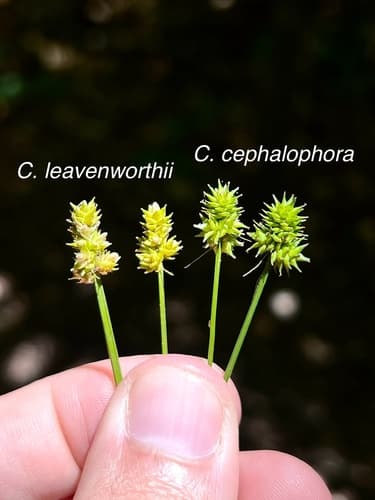
- The flowers are dense little heads of three to eight spikes, well under an inch long and pale green to brown, so treat any bloom as a bonus rather than the point (Flora of North America via SEINet).
- Bloom is logged for May in shades of white, green, and brown, and the fruit that follows is a small dry achene (Lady Bird Johnson Wildflower Center).
- Spring is one of the two windows for dividing an established clump. Dig it, pull it apart with roots attached, and replant the same day (Native Plant Society of Texas).
- You can also start it from seed by sowing untreated seed straight into the ground instead of fussing with trays indoors (Native Plant Society of Texas).
- New plants want regular water through their first spring. After the first year, minimal watering is the norm for North Texas sedges (Native Plant Society of Texas).
April and May are the one stretch when this planting looks slightly shaggy from the sidewalk, because the seed heads add a few inches of tan above the green. A single pass with the mower on its highest setting once those heads brown will reset the even look.
Summer
Summer is the season this sedge simply gets through. It is a cool season plant, so from late June into September it makes very little new growth and mostly holds steady. Established clumps are rated drought and heat tolerant, which means the standard lawn sprinkler schedule is more water than they actually want. First year plants are the exception and will take a deep soak during a long dry stretch.
- A summer slowdown is not failure. This is a cool season sedge, so easing off in the heat is normal and it picks back up when nights cool (Native Plant Society of Texas).
- Once established it is listed as drought and heat tolerant, and North Texas sedges in general need minimal watering after the first year (Native Plant Society of Texas).
- In the wild it turns up on dry grasslands, roadsides, open forests, forest edges, and even in mown lawns, so lean and dry ground is what it is built for (Flora of North America via SEINet).
- Keep the mower high. Mature leaf height is only about 6 to 12 inches, so a normal turf setting would shear off most of the plant (North Creek Nurseries).
- If it looks tired by late summer, that is the point in the year growers cut it back, and it answers with a flush of fresh growth (North Creek Nurseries).
- Deer and other herbivores find it unpalatable, and it is described as pest resistant, so summer browsing is rarely the reason a clump looks thin (Native Plant Society of Texas).
Late summer is when front yards look most tired to neighbors. This sedge holds its low even height without weekly mowing, so in August it usually reads as better maintained than the thirsty turf beside it.
Sources: Lady Bird Johnson Wildflower Center: Carex leavenworthii, Leavenworth's Sedge, Native Plant Society of Texas: Carex leavenworthii, Native Plant Society of Texas: Hardy and Humble Gems of North Texas, Native Sedges, SEINet: Carex leavenworthii, Flora of North America treatment, North Creek Nurseries: Carex leavenworthii, The Pollen Nation: Carex leavenworthii, lawn sedge
Texas Blackland Prairies (includes Dallas, TX)
Year-round
Leavenworth's sedge is a sedge, not a grass, and that difference changes how you treat it. Sedge stems are triangular, so if you roll one between your fingers you feel three flat sides instead of a round stalk. This one grows as a tight tufted clump, roughly 6 to 12 inches of leaves, with thin flower stems rising above that in spring. It is a cool season plant, which means it does most of its growing in the mild weeks of spring and fall and mostly idles through the worst of a Dallas Fort Worth summer. It holds green leaves through most winters here, which is the main reason to put it in a front yard.
- Do not care for this the way you would care for a lawn grass. It sits in the sedge family, Cyperaceae, and the North Texas rule of thumb is triangular sedge stems versus round grass stems (Native Plant Society of Texas).
- It does not creep. Botanists describe the plant as densely tufted with no conspicuous rhizomes, so one plant stays a clump and a planting thickens by seedlings rather than by runners (Flora of North America via SEINet).
- If you were told it spreads underground to form solid turf, adjust that expectation now. Growers who sell it are plain about the fact that it does not spread from rhizomes and moves only by seed (The Pollen Nation).
- Expect a leafy mound about 6 to 12 inches tall and about as wide, set 12 to 18 inches apart so the clumps eventually meet (North Creek Nurseries).
- Whether your yard is Cross Timbers sand or Blackland clay, it will take it. Growers list it for sandy, clay, seasonally wet, and alkaline soils alike (North Creek Nurseries).
- It handles full sun through full shade, which makes it one of the very few fine textured lawn substitutes that still works under a shade tree (Native Plant Society of Texas).
- It is native to Texas, and Texas sits inside a documented range running from Ontario and New York south to the Florida Panhandle (Lady Bird Johnson Wildflower Center).
- Treat it as a look rather than a play surface. Because it only moves around by seed, a worn path through it does not close back up the way a running turf does (The Pollen Nation).
A clumping sedge held at an even low height reads as a deliberate planted groundcover rather than a lawn somebody stopped mowing, and that is what keeps it HOA-friendly. It also tolerates mowing, so if your rules set a height limit you can hold it there with one pass on the highest setting.
Fall
Fall is the second half of this plant's growing year. When nights cool and the autumn rain returns, it picks up where spring left off and pushes fresh green growth. In north Texas fall is the stronger of the two planting windows, because new roots get months of mild weather before the next summer arrives. It is also the last easy chance to divide crowded clumps until spring comes back around.
- Fall is one of the two windows for dividing clumps, and it also works for sowing untreated seed straight into the ground (Native Plant Society of Texas).
- Set new plugs 12 to 18 inches apart so they have all winter and spring to knit together before the heat returns (North Creek Nurseries).
- Watch for volunteer seedlings around established clumps. This plant does not spread from rhizomes and moves only by seed, so those seedlings are how a planting actually thickens (The Pollen Nation).
- Skip the fall lawn fertilizer. Its wild habitat is dry forest and sandy ground rather than fed soil, and it is not looking for a feeding program (Flora of the Southeastern United States).
- Let the autumn rain do most of the watering. Established North Texas sedges need minimal irrigation, so only step in during a genuinely dry fall (Native Plant Society of Texas).
Fall is the right time to re-cut the bed edge before winter. A clean edge is most of what separates a planted sedge groundcover from a lawn that stopped being mowed, and it is the cheapest thing you can do to keep the yard reading as intentional.
Winter
Winter is when this plant earns its place in a Dallas Fort Worth front yard. It keeps green leaves through the cold months while the Bermuda and St. Augustine lawns around it sit tan. Listed hardiness runs through zone 6, and DFW is zone 8a to 8b, so even a hard freeze week is inside what it handles. There is close to nothing to do for it between December and February.
- It is evergreen here. The foliage persists through the winter months instead of browning off and vanishing (North Creek Nurseries).
- Most North Texas native sedges hold green foliage year round, which is exactly why they get planted for winter interest (Native Plant Society of Texas).
- Listed hardiness is zone 6 through 9. DFW sits at 8a to 8b, so a February freeze week is comfortably inside its range (The Pollen Nation).
- Skip the winter haircut. Growers cut this plant back in late summer, not in the cold months, so leave the leaves alone in December and January (North Creek Nurseries).
- Winter is a good time to study spacing, while nothing else in the bed is pulling your eye. Clumps only reach about 6 to 12 inches across, so any gap wider than 18 inches is still a gap next year unless you add plants (North Creek Nurseries).
January is when a native front yard draws the most attention, because every lawn on the street has gone dormant tan. An evergreen sedge is one of the few native groundcovers that still looks deliberately maintained in midwinter, which is worth pointing at if a board member ever asks.
Spring
Spring is this plant's main season. It greens up and puts on most of its new growth while nights are still cool, and the flower heads arrive in April and May. Do not expect a show. The flowers are small pale knots at the top of thin stems, and nobody plants this sedge for the bloom. Spring is also a good window to get new plants in the ground in Dallas Fort Worth, as long as you finish well before the first run of 100 degree days in late June.
- Seed heads typically form in April, which makes this an early plant. The native grasses in North Texas mostly wait until fall to bloom (Native Plant Society of Texas).
- The flowers are dense little heads of three to eight spikes, well under an inch long and pale green to brown, so treat any bloom as a bonus rather than the point (Flora of North America via SEINet).
- Bloom is logged for May in shades of white, green, and brown, and the fruit that follows is a small dry achene (Lady Bird Johnson Wildflower Center).
- Spring is one of the two windows for dividing an established clump. Dig it, pull it apart with roots attached, and replant the same day (Native Plant Society of Texas).
- You can also start it from seed by sowing untreated seed straight into the ground instead of fussing with trays indoors (Native Plant Society of Texas).
- New plants want regular water through their first spring. After the first year, minimal watering is the norm for North Texas sedges (Native Plant Society of Texas).
April and May are the one stretch when this planting looks slightly shaggy from the sidewalk, because the seed heads add a few inches of tan above the green. A single pass with the mower on its highest setting once those heads brown will reset the even look.
Summer
Summer is the season this sedge simply gets through. It is a cool season plant, so from late June into September it makes very little new growth and mostly holds steady. Established clumps are rated drought and heat tolerant, which means the standard lawn sprinkler schedule is more water than they actually want. First year plants are the exception and will take a deep soak during a long dry stretch.
- A summer slowdown is not failure. This is a cool season sedge, so easing off in the heat is normal and it picks back up when nights cool (Native Plant Society of Texas).
- Once established it is listed as drought and heat tolerant, and North Texas sedges in general need minimal watering after the first year (Native Plant Society of Texas).
- In the wild it turns up on dry grasslands, roadsides, open forests, forest edges, and even in mown lawns, so lean and dry ground is what it is built for (Flora of North America via SEINet).
- Keep the mower high. Mature leaf height is only about 6 to 12 inches, so a normal turf setting would shear off most of the plant (North Creek Nurseries).
- If it looks tired by late summer, that is the point in the year growers cut it back, and it answers with a flush of fresh growth (North Creek Nurseries).
- Deer and other herbivores find it unpalatable, and it is described as pest resistant, so summer browsing is rarely the reason a clump looks thin (Native Plant Society of Texas).
Late summer is when front yards look most tired to neighbors. This sedge holds its low even height without weekly mowing, so in August it usually reads as better maintained than the thirsty turf beside it.
Sources: Lady Bird Johnson Wildflower Center: Carex leavenworthii, Leavenworth's Sedge, Native Plant Society of Texas: Carex leavenworthii, Native Plant Society of Texas: Hardy and Humble Gems of North Texas, Native Sedges, SEINet: Carex leavenworthii, Flora of North America treatment, North Creek Nurseries: Carex leavenworthii, The Pollen Nation: Carex leavenworthii, lawn sedge
In an HOA neighborhood
Leavenworth's sedge is an HOA-friendly choice. Maintenance level: low. Tidiness: 5 out of 5.
Works well in: front yard, foundation, street edge, mid zone.
Wildlife value
Host plant for little wood satyr.
Dense foliage shelters small wildlife and serves as a larval host for woodland butterflies.
Common questions
- When does Leavenworth's sedge bloom?
- Leavenworth's sedge produces small, inconspicuous flower spikes in spring, generally from April into May, well before many surrounding woodland plants leaf out fully.
- What growing conditions suit Leavenworth's sedge best?
- It grows best in part shade with medium soil moisture, though established plants can handle drier spells once their root systems are settled.
- How is Leavenworth's sedge typically used in landscaping?
- Because of its fine, grass-like texture and tolerance for foot traffic and mowing, it is commonly planted as a no-mow lawn substitute or as a groundcover beneath trees and shrubs.
- What does Leavenworth's sedge look like?
- It forms low, dense clumps of narrow green blades that stay soft-textured through the growing season, giving it a lawn-like or turf-like appearance in garden beds.
- Is Leavenworth's sedge HOA-friendly?
- Leavenworth's sedge is generally an HOA-friendly choice in the right placement, with low maintenance.
These answers were drafted with an AI model from this plant's data. Verify care details with a local expert.
Native range data from the World Checklist of Vascular Plants (Kew). Pollinator and host plant associations compiled from GBIF, iNaturalist, and published ecological literature.
If something looks wrong
Common plant problems, and what to check first
These come up on almost any plant. Each guide lists the likely causes in the order they are worth ruling out, with one thing to check before you act on any of them, and links to the source it came from.
- It is dying right after planting
- Leaves turning yellow
- Wilting even though I watered it
- Brown crispy leaf tips
- Bugs on the plant
Ready to grow Leavenworth's sedge? Add it to your garden in Pollinator Patch to track it and get season-by-season care guidance.