Toyon
Heteromeles arbutifolia
Last reviewed: September 2026
Toyon is an evergreen shrub found in chaparral and woodland edges across California, with clusters of small white flowers in summer and bright red berries that persist into winter.
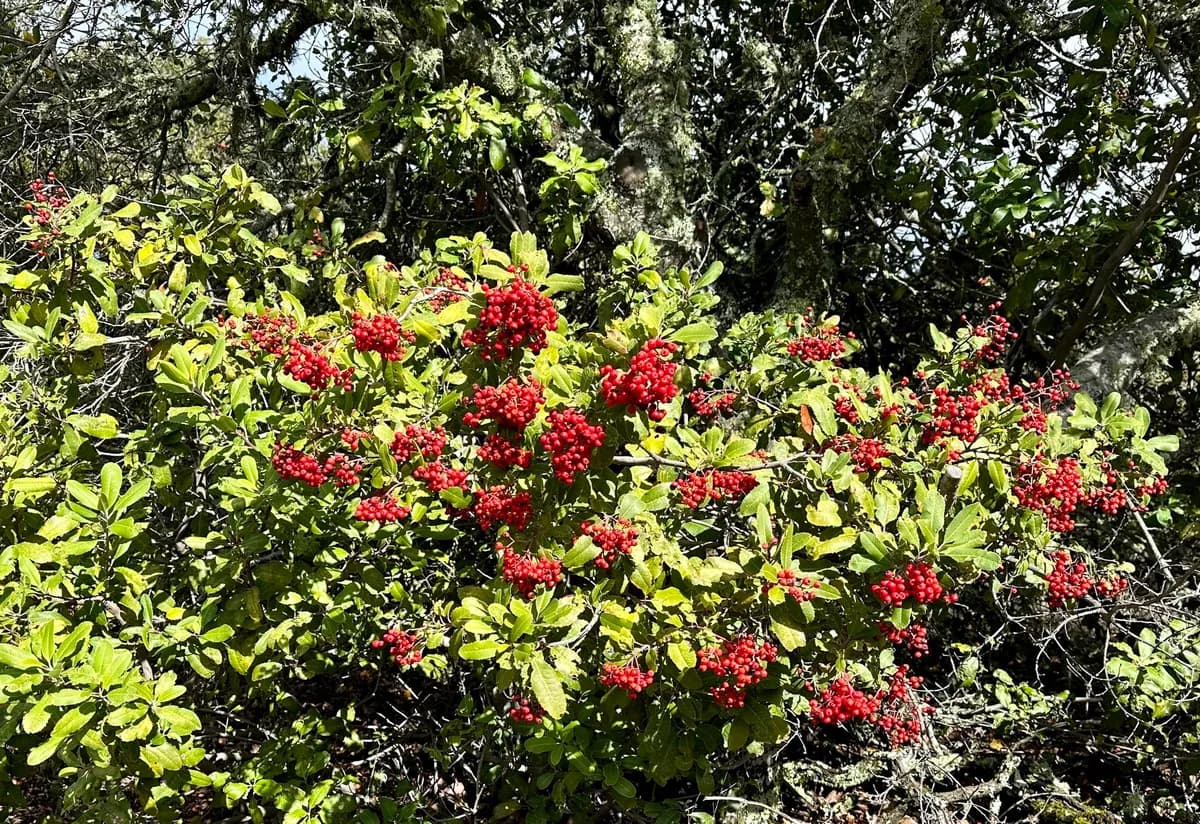
Toyon (Heteromeles arbutifolia) is not flagged as toxic to dogs or cats by Plants For A Future (PFAF) (opens in new tab) (last reviewed 2026-05-21). This verdict does not come from the ASPCA. If your pet shows symptoms after eating any plant, call the ASPCA at (888) 426-4435.
Light
full sun
Water
low
Size
72"–240" H × 72"–240" W
Bloom
Jun, Jul, Aug
Native to
CA
Pollinators
bees, butterflies, hummingbirds, beetles
Before you buy
Your city may pay you to plant this
Cities and water utilities offer rebates for replacing lawn with native and water-wise plants. We track 459 programs across 44 states, each with a link to the provider and the date we last checked it.
Find rebates in your areaPicture natives in your own yard
Upload a photo of your yard and Patch Vision shows a rendering of it planted with natives for your region, like Toyon.


Browse plants for this ecoregion
Heteromeles arbutifolia (Toyon) is a large native evergreen shrub with glossy dark green leaves and clusters of small white flowers in summer. In winter, it produces bright red berries that add vibrant color to the landscape. Toyon is drought tolerant once established and can grow into a small tree over time.
Growing Toyon
Grow Toyon in full sun and low water. Mature plants reach 72 to 240 inches tall and spread 72 to 240 inches wide. Expect low maintenance to keep it looking intentional in a front yard.
How to care for Toyon, by region
How to care for Toyon where it is actually grown: year-round basics plus what to do each season, region by region, with the sources for each.
Care guidance last updated: August 2026
Southern California/Northern Baja Coast (includes Los Angeles, CA)
Year-round
Toyon is a California native shrub that does well in Los Angeles yards. It wants full sun, very little water once it settles in, and tolerates poor, rocky soil. Left alone it grows into a large shrub or small tree, but regular light pruning keeps it a manageable size near a front yard.
- Give it full sun to light part shade. It handles Los Angeles heat and dry summers well.
- Once established (after the first year or two), water only occasionally, maybe once or twice a month during the driest stretch of summer. Too much water on a mature toyon can cause root problems.
- It tolerates clay, sandy, and rocky soil as long as drainage is reasonable.
- Left unpruned it can reach 8 to 12 feet tall and 4 to 6 feet wide. Starting light, regular pruning while it's young keeps it a manageable hedge size.
- Toyon does not appear on the ASPCA toxic plant list for dogs or cats, but unripe or raw berries do contain small amounts of cyanogenic compounds, so it's good practice to keep pets and kids from snacking on them.
- This is a California native shrub and its range includes the Los Angeles area, so it's a genuinely good ecological fit here, not just a tough plant that happens to survive.
Fall
Fall is when toyon's berries turn from green to the bright red that gives it the nickname Christmas berry. It's also a good season to plant a new toyon in Los Angeles.
- Leave the berries alone. Birds like mockingbirds, robins, and cedar waxwings depend on them through fall and winter.
- Fall is one of the best times to plant new California natives here, since cooler weather helps roots settle in before summer heat returns.
- Keep any newly planted toyon watered every week or two until the rainy season arrives.
- Hold off on pruning. Wait until the berries are mostly eaten or it's deep winter.
Winter
Winter is the best time to prune toyon, once most of the berries are gone and before spring growth kicks in.
- Prune for shape and size now, including pinching or thinning it into a denser hedge if you want a neater look near the front yard.
- Sterilize pruning shears between cuts (diluted bleach or rubbing alcohol works) since toyon can carry fire blight.
- Don't cut it all the way to the ground repeatedly. Toyon can resprout from the base once, but doing that every year or every few years weakens it and can eventually kill it.
- Los Angeles winters (zone 10b) are mild enough that toyon needs no frost protection. It tolerates cold well below anything LA sees.
Winter pruning that keeps toyon shaped and tidy is an HOA-friendly way to maintain a clean front-yard silhouette while it's dormant.
Spring
Spring is when toyon pushes new growth ahead of its summer bloom. It's also the riskiest time of year for fire blight, a bacterial disease that can turn young shoot tips black and droopy.
- Watch new shoot tips for a sudden black, wilted, hooked look. That's the sign of fire blight, which is worse in wet spring weather.
- If you spot it, cut the diseased branch back well below the damaged wood and wipe your pruning shears with diluted bleach or rubbing alcohol between cuts so you don't spread it to healthy growth.
- Skip fertilizer. California natives like toyon generally do worse with rich feeding, not better.
- Keep watering light. Established plants barely need supplemental water even in spring.
Summer
Summer is toyon's bloom season. Clusters of small creamy white flowers cover the shrub and draw in pollinators, then turn into green berries that will ripen to red later in the year.
- An established toyon needs little to no extra water in summer. Los Angeles's dry summers match its natural habitat.
- If it was planted in the last year or two, give it a deep soak every few weeks during the hottest stretch.
- Water at the base rather than overhead. Wet foliage in summer heat invites fungal problems.
- No pruning needed now. Save shaping cuts for winter, once it's dormant.
Sources: ASPCA Toxic and Non-Toxic Plant List - Dogs, Calscape: Heteromeles arbutifolia (Toyon), UC IPM: Fire Blight (Home and Landscape)
In an HOA neighborhood
Toyon is an HOA-friendly choice. Maintenance level: low. Tidiness: 4 out of 5.
Works well in: front yard, foundation, street edge, mid zone.
- Can grow quite large without regular pruning
- Berry drop may create temporary mess on hardscapes
Wildlife value
Toyon is excellent for wildlife, attracting numerous pollinators including native bees, butterflies, and beetles when in bloom. Birds eagerly feed on the bright red winter berries.
Common questions
- How much sun does Toyon need?
- Toyon grows well in full sun and also tolerates part sun to part shade, making it adaptable to open slopes as well as the edges of oak woodlands.
- When does Toyon bloom?
- Toyon typically flowers from June through August, producing flat clusters of small white blooms at the branch tips.
- How much water does Toyon need?
- Once established, Toyon is a low water shrub that handles dry summers well, though it can also take occasional moderate irrigation in garden settings.
- What pollinators visit Toyon flowers?
- Toyon's summer flower clusters draw bees, butterflies, hummingbirds, and beetles, making it a useful nectar source in dry season landscapes.
- Is Toyon evergreen or deciduous?
- Toyon keeps its leathery, dark green leaves year round, so it is considered an evergreen shrub.
- Is Toyon toxic to dogs?
- Toyon is not flagged as toxic to dogs by Plants For A Future (PFAF). This verdict does not come from the ASPCA.
- Is Toyon toxic to cats?
- Toyon is not flagged as toxic to cats by Plants For A Future (PFAF). This verdict does not come from the ASPCA.
- Is Toyon HOA-friendly?
- Toyon is generally an HOA-friendly choice in the right placement, with low maintenance.
These answers were drafted with an AI model from this plant's data. Verify care details with a local expert.
Native range data from vouchered herbarium specimen records and regional native plant society lists. Pollinator and host plant associations compiled from GBIF, iNaturalist, and published ecological literature.
If something looks wrong
Common plant problems, and what to check first
These come up on almost any plant. Each guide lists the likely causes in the order they are worth ruling out, with one thing to check before you act on any of them, and links to the source it came from.
- It is dying right after planting
- Leaves turning yellow
- Wilting even though I watered it
- Brown crispy leaf tips
- Bugs on the plant
Ready to grow Toyon? Add it to your garden in Pollinator Patch to track it and get season-by-season care guidance.