Rebates Guide
Stormwater fee credits: how native plants lower your utility bill
Many cities charge a stormwater fee on your utility bill, and a lot of them will discount it, every billing cycle, if you manage runoff with a rain garden or similar landscaping. It is one of the few ways native plants pay you back on a recurring basis.
Last updated: September 2026 · 44 programs tracked across 16 states
The quick version
- A stormwater fee credit is a recurring discount on the stormwater charge on your utility bill, not a one-time rebate.
- You earn it by managing runoff on your property, most often with a rain garden, which is a natural fit for deep-rooted native plants.
- Credits are usually a percentage off the stormwater fee, commonly 10 to 60 percent, and they keep applying for as long as the practice works and you stay enrolled.
What is a stormwater fee credit?
Many cities run a stormwater utility and bill you a stormwater fee, sometimes called a drainage charge or impervious area charge. The fee is usually based on how much hard surface your property has, since roofs, driveways, and patios send rainwater rushing into the storm system instead of soaking into the ground. The fee funds the pipes, basins, and treatment that handle that runoff (US Environmental Protection Agency, National Pollutant Discharge Elimination System stormwater program).
A stormwater fee credit lowers that charge when you keep some of your runoff on site. If you slow the water down and let it soak in, you are doing part of the city's job, so the city discounts your share. The discount repeats on every bill for as long as the practice keeps working, which is what makes it different from a rebate.
How do native plants and rain gardens earn one?
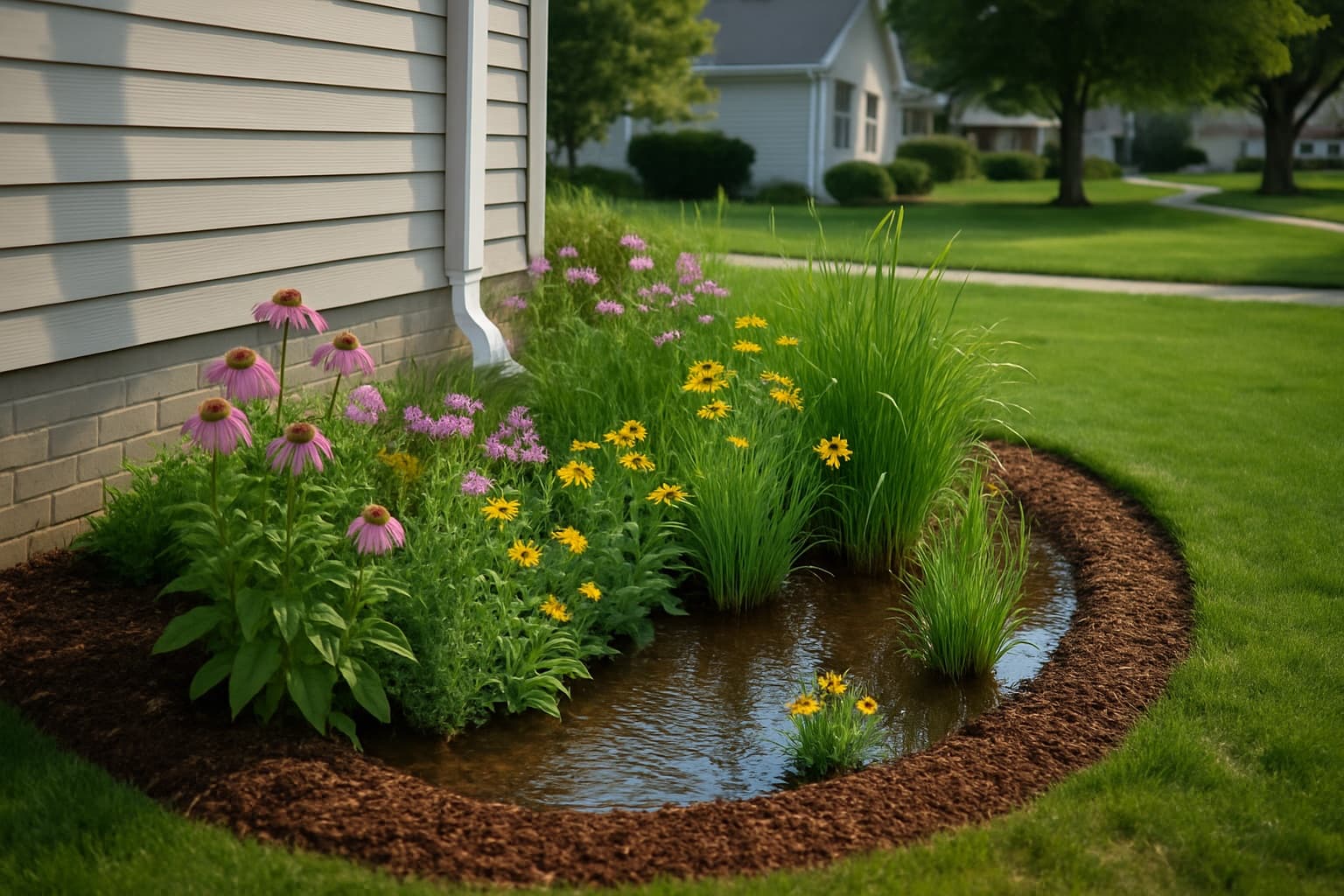
The most common qualifying practice is a rain garden, a shallow planted basin set where runoff collects. Water pools there briefly after a storm and soaks into the soil over a day or two instead of running to the curb. Deep-rooted native plants suit a rain garden well because their roots open up the soil for drainage and they handle both the wet spells and the dry ones. Most programs also accept practices like permeable pavement, disconnected downspouts routed to a planted area, dry wells, or green roofs.
The credit is tied to the practice managing runoff, so the native planting is part of qualifying rather than the qualifier on its own. If you are picking plants for a rain garden, you can browse native plants by region and group the ones that take occasional standing water.
How much can you save?
Savings depend on your city and how much impervious area your practice handles. Most credits are a percentage off the stormwater portion of the bill, and across the programs we track that runs from about 10 percent to 60 percent. A few cities use a flat dollar amount per quarter instead. Because the discount applies every billing cycle, a modest percentage adds up over the years the rain garden is in place. The table below lists the current amount for each program with the date we last checked it.
Is a fee credit the same as a rebate?
They are different, and some cities offer both. A rebate is a one-time payment after you finish a project, often a set amount per square foot of lawn you replace. A stormwater fee credit is a recurring discount on a bill you already pay. A rebate helps with the upfront cost of putting the garden in. A fee credit keeps paying you back for keeping it. If your city offers both, you can usually pursue the rebate first and then enroll the finished practice for the ongoing credit.
Can you earn one and keep your HOA happy?
Usually, yes, if the rain garden is designed to look intentional. The thing that makes an HOA-conscious homeowner nervous is a planting that reads as unkempt. A rain garden with a clean edge, a defined shape, and a plant palette chosen to look deliberate tends to pass the same eye test as a regular bed. In Texas, Property Code section 202.007 limits how far an HOA can restrict water-conserving landscaping, though an HOA can still apply reasonable aesthetic standards. Rules vary by state, so read your own governing documents before you start.
Pollinator Patch can show you a render of a rain garden in your own yard before you commit, so you can judge how it reads from the street. Find rebates in your area
Which cities offer stormwater fee credits?
Here are the residential stormwater fee credit programs we currently track, with the amount and the date we last verified each against its official source. Each program links to a full guide. Confirm the current terms with the provider before you apply, since program rules can change.
| Program | Where | Credit | Verified |
|---|---|---|---|
| RiverSmart Rewards Stormwater Fee DiscountDC Dept. of Energy & Environment (DOEE) + DC Water | Washington, District of Columbia | Up to 55% off the DOEE stormwater fee + up to 20% off the DC Water Clean Rivers charge | Jun 2026 |
| Stormwater Credit (Residential Environmental Technologies)City of Roswell Environmental Public Works | Roswell, Georgia | 100% off the stormwater fee in year 1, then 20% for years 2-3 (3-year renewable term) | Jul 2026 |
| Stormwater Fee CreditMacon Water Authority | Macon, Georgia | Up to 50% off the stormwater fee | Jun 2026 |
| Stormwater Fee Credit (Rain Garden)Gwinnett County Department of Water Resources | Lawrenceville, Georgia | Up to 10% off the stormwater fee (40% total cap) | Jun 2026 |
| Stormwater Fee Credit (Rain Garden)Rockdale County Stormwater Management | Conyers, Georgia | Up to 10% off the stormwater fee (40% total cap across all credit categories) | Jul 2026 |
| Stormwater Utility Fee CreditCity of Powder Springs | Powder Springs, Georgia | 10-20% off the stormwater fee | Jun 2026 |
| Stormwater Utility User Fee Credit (Residential GI/LID)City of Savannah Water Resources | Savannah, Georgia | 20% off the stormwater user fee for 3 years | Aug 2026 |
| Individual Residential Stormwater CreditCity of Decatur, Illinois | Decatur, Illinois | 10-20% off the stormwater fee (10% per practice) | Jun 2026 |
| Stormwater Volume Reduction CreditCity of Peoria, Illinois | Peoria, Illinois | 15% (1.0in) or 30% (1.6in stored) off the stormwater fee | Jun 2026 |
| Stormwater User Fee Credit (Individual Residential)City of Indianapolis Department of Public Works | Indianapolis, Indiana | Ongoing stormwater bill credit: flat 25% off the stormwater user fee | Jun 2026 |
| Stormwater Abatement CreditCity of Takoma Park | Takoma Park, Maryland | Up to 50% off the stormwater utility fee | Jun 2026 |
| Stormwater Remediation Fee CreditCharles County (Watershed Protection and Restoration Fund) | Waldorf, Maryland | Ongoing stormwater bill credit: up to 50% off the Stormwater Remediation Fee (FY2026 fee = $162/improved property) | Jun 2026 |
| Stormwater Utility Fee CreditCity of Annapolis | Annapolis, Maryland | Up to 50% off the stormwater utility fee | Jun 2026 |
| Stormwater Utility Fee CreditCity of Hagerstown | Hagerstown, Maryland | Up to 60% off the stormwater utility fee | Jun 2026 |
| WPRF Stormwater Fee CreditAnne Arundel County (Watershed Protection & Restoration) | Annapolis, Maryland | Up to 50% of the Watershed Protection & Restoration Fee | Jun 2026 |
| Stormwater Fee Abatement (Infiltration)Town of Reading (Storm Water Enterprise Fund) | Reading, Massachusetts | Up to 50% abatement of the stormwater assessment | Jun 2026 |
| Stormwater Fee Credit (Rain Garden)City of Northampton (Stormwater & Flood Control Utility) | Northampton, Massachusetts | Up to 25% off the stormwater fee per rain garden (50% total cap) | Jun 2026 |
| Stormwater Fee Credit (Small Residential)Town of Milton (Stormwater Enterprise) | Milton, Massachusetts | Ongoing stormwater bill credit: 25% off the stormwater fee (single-family up to 4 units) | Jun 2026 |
| Stormwater Utility Fee Credit (Dry Well BMPs)City of Newton, Department of Public Works | Newton, Massachusetts | Up to 75% off the $200/year flat residential stormwater fee (50% roof dry well + 25% driveway dry well) | Jul 2026 |
| Stormwater Utility Fee Credit (Small Residential)Town of Concord (Stormwater Utility) | Concord, Massachusetts | Ongoing stormwater bill credit: up to 25% off the stormwater fee (1-3 family homes) | Jun 2026 |
| Stormwater Utility Small User CreditTown of Franklin, Department of Public Works | Franklin, Massachusetts | Up to 50% combined off the stormwater utility fee (25% quantity control + 25% quality control) | Jul 2026 |
| Rain Garden Stormwater Utility CreditCity of Ann Arbor | Ann Arbor, Michigan | $8.34 per quarter (about $33/year) for a rain garden | Jun 2026 |
| Environmental Utility Fee CreditCity of Maplewood, Minnesota | Maplewood, Minnesota | 30% per month off the environmental utility fee | Jun 2026 |
| Residential Stormwater CreditCity of Minneapolis Stormwater Utility | Minneapolis, Minnesota | Up to 45% (Green Zone) / 35% (elsewhere) off the monthly stormwater fee | Jun 2026 |
| Stormwater Fee Credit for Lawn to Native Forest ConversionTownship of Maplewood | Maplewood, New Jersey | 10% off the stormwater fee for every 2,000 sq ft of lawn converted to native forest, up to 40% (about $28 a year at the $70 per unit base rate) | Aug 2026 |
| Individual Residential Property CreditNortheast Ohio Regional Sewer District (NEORSD) | Cleveland, Ohio | Flat 25% off the stormwater fee | Jun 2026 |
| Residential Stormwater CreditCity of Springfield, Ohio | Springfield, Ohio | Up to 10% off the stormwater fee | Jun 2026 |
| Clean River Rewards Stormwater DiscountCity of Portland Bureau of Environmental Services | Portland, Oregon | Ongoing stormwater bill credit: up to 35% off the stormwater fee | Jun 2026 |
| Stormwater Management Fee Credit Program (Single Family)City of Newberg Public Works Department | Newberg, Oregon | Up to 35% off the single-family stormwater fee (25% for a rain garden, 10% for a vegetated swale or infiltration planter, 10% for qualified shade trees) | Jul 2026 |
| Residential Stormwater Fee CreditPittsburgh Water and Sewer Authority (PWSA) | Pittsburgh, Pennsylvania | 50% off the stormwater charge | Jun 2026 |
| Single-Family Stormwater Fee CreditHampton Township (Allegheny County) | Hampton Township, Pennsylvania | Up to 25% off the annual stormwater fee (single-family) | Jun 2026 |
| Stormwater Fee CreditCity of Erie | Erie, Pennsylvania | Up to 45% off the stormwater management fee | Aug 2026 |
| Stormwater Management Fee CreditCity of Lancaster | Lancaster, Pennsylvania | Up to 50% off the stormwater management fee | Jun 2026 |
| Stream Protection Fee CreditWest Chester Borough | West Chester, Pennsylvania | Ongoing bill credit on the Stream Protection Fee (amount not currently published) | Sep 2026 |
| RainSmart Yards Stormwater Fee DiscountCity of Chattanooga (WaterWays) | Chattanooga, Tennessee | 25% / 50% / 75% off the water quality fee (Bronze/Silver/Gold) | Jun 2026 |
| Stormwater Management DiscountCity of Austin Watershed Protection | Austin, Texas | Up to 50% off the drainage charge (impervious offset) | Jun 2026 |
| Residential Stormwater Fee CreditCity of Alexandria | Alexandria, Virginia | Up to 50% off the stormwater utility fee | Jun 2026 |
| Residential Stormwater Fee CreditCity of Harrisonburg | Harrisonburg, Virginia | Up to 50% off the stormwater fee | Jun 2026 |
| Residential Stormwater Fee CreditCity of Roanoke | Roanoke, Virginia | Up to 50% off the stormwater utility fee | Aug 2026 |
| Single-Family Residential Stormwater Utility Fee CreditCity of Waynesboro Department of Public Works | Waynesboro, Virginia | Up to 50% off the annual stormwater fee (10% per Level 1 practice, 20% per Level 2 practice) | Jul 2026 |
| Single-Family Stormwater Fee CreditCity of Richmond (DPU) | Richmond, Virginia | Up to 50% off the stormwater fee (20% per practice) | Jun 2026 |
| Stormwater Utility Fee Credit (Voluntary Actions)Arlington County Department of Environmental Services | Arlington, Virginia | Fixed tiers up to 35% total (10% rain garden, 5% conservation/native landscaping, 5% tree planting annual, 10% permeable driveway/patio) | Jul 2026 |
| Residential Stormwater Credit (Rain Garden)City of La Crosse Stormwater Utility | La Crosse, Wisconsin | Up to 80% off the stormwater fee (80% for a rain garden of 185+ cubic feet, 60% for 139 to 184, 40% for 92 to 138) | Jul 2026 |
| Stormwater Utility Credit (Rain Garden)City of Appleton Department of Public Works | Appleton, Wisconsin | $25 a year off the stormwater utility bill | Jul 2026 |
Common questions
Is a stormwater fee credit the same as a rebate?+
No. A rebate is a one-time payment after you finish a project. A stormwater fee credit is a recurring discount on the stormwater charge on your utility bill that stays in place as long as your rain garden or other practice keeps working and you stay enrolled. Some cities offer both.
How do native plants earn a stormwater fee credit?+
Most credits reward a practice that captures and slowly releases runoff, such as a rain garden. A rain garden is a shallow planted basin, and deep-rooted native plants are well suited to it because they handle both wet and dry spells and hold the soil. The credit is tied to the practice managing runoff, so the planting is part of qualifying, not the qualifier on its own.
How much can a stormwater fee credit save?+
It depends on the city and your impervious area. Credits are usually a percentage off the stormwater portion of the bill, commonly 10 to 60 percent, and a few cities offer a flat dollar amount per quarter. Because it repeats every billing cycle, the savings add up over the years the practice is in place.
Will a rain garden cause a problem with my HOA?+
A rain garden can be designed to read as intentional and tidy rather than wild, which is what most HOA-conscious homeowners are after. Keep clean edges, a defined shape, and a plant palette that looks deliberate. In Texas, Property Code section 202.007 limits how far an HOA can restrict water-conserving landscaping, though an HOA can still set reasonable aesthetic standards. Rules vary by state, so check your own governing documents.
Do I have to keep the rain garden to keep the credit?+
Yes. The credit is tied to the practice working. If you remove it or let it stop functioning, the city can end the credit. Many cities also ask you to reapply or recertify on a set schedule, often every three to five years.
Get started
See what qualifies in your area
Enter your location to find the rebates and fee credits near you, then design a rain garden that earns them.
Find rebates near youDownload Free
Free on iPhone, Android, and on the web. Upgrade to Pro for more Garden Planner previews, yard-specific plans, and Ask Patch personalized to your garden.
Available on iPhone, Android, and in any browser.
