Broadleaf Stonecrop
Sedum spathulifolium
Last reviewed: September 2026
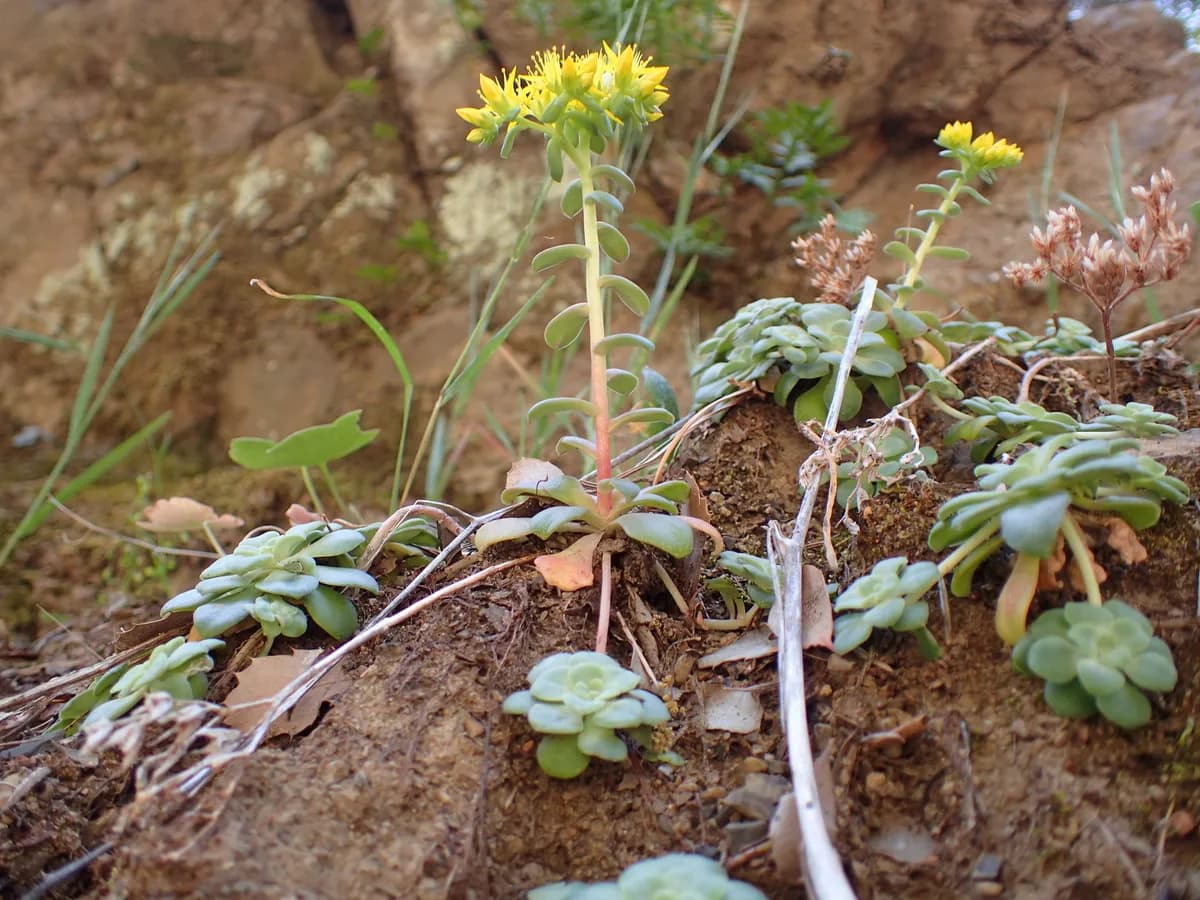
Sedum spathulifolium is a mat-forming succulent with rosettes of blue-green to reddish leaves and yellow star-shaped flowers from May through July. It grows well on rocky outcrops and well-drained slopes along the Pacific coast and needs little water once established.
Broadleaf Stonecrop (Sedum spathulifolium) is not on the ASPCA Animal Poison Control Center toxic plant list for dogs or cats (aspca.org (opens in new tab), last reviewed 2026-05-21). If your pet shows symptoms after eating any plant, call the ASPCA at (888) 426-4435.
Light
part sun
Water
low
Size
2"–6" H × 6"–12" W
Bloom
May, Jun, Jul
Native to
CA, OR, WA
Pollinators
bees, beetles
Before you buy
Your city may pay you to plant this
Cities and water utilities offer rebates for replacing lawn with native and water-wise plants. We track 452 programs across 44 states, each with a link to the provider and the date we last checked it.
Find rebates in your areaBrowse plants for this ecoregion
Sedum spathulifolium is a low-growing native succulent with pretty rosettes of fleshy, spoon-shaped leaves. It produces bright yellow star-shaped flowers in late spring through summer on short stems above the foliage. This drought-tolerant groundcover spreads slowly to form an attractive mat in rock gardens or between stepping stones.
Growing Broadleaf Stonecrop
Grow Broadleaf Stonecrop in part sun and low water. Mature plants reach 2 to 6 inches tall and spread 6 to 12 inches wide. Expect low maintenance to keep it looking intentional in a front yard.
How to care for Broadleaf Stonecrop, by region
How to care for Broadleaf Stonecrop where it is actually grown: year-round basics plus what to do each season, region by region, with the sources for each.
Care guidance last updated: August 2026
Puget Lowland (includes Seattle, WA)
Year-round
Establish it with a little water, then let Seattle's own wet-winter, dry-summer rhythm do the rest. Drainage is what keeps this stonecrop alive here.
- Water new plantings every few days through the first summer while roots establish, then stop supplemental watering.
- Once established, it needs no regular water. Seattle's dry summers and wet winters mirror the rocky slopes it grows on in the wild.
- Use gravel or mineral mulch instead of bark or wood chips. Organic mulch holds moisture against the crown and invites rot in our wet winters.
- Plant on a slight angle or in a raised spot so water runs off the crown rather than pooling.
- The most common mistake is planting it in heavy, unamended clay or a low spot that stays soggy through the rainy season. That's what kills it, not cold or drought.
- It's native along the coast from British Columbia down through California, so it's genuinely at home in Puget Sound gardens.
Its low, tidy mat habit and long bloom season read as neat rather than wild, an HOA-friendly choice for a rock garden edge or border without looking unkempt.
Fall
As the rain returns, cut back spent stems and let the plant settle in for winter.
- Cut spent flowering stems to the ground after bloom finishes, standard fall guidance for maritime Northwest gardens.
- Fall is a good second planting window. Cooler air and returning rain make it easy for new plants to root before winter.
- Check drainage before the rains arrive. Make sure the crown isn't sitting in a spot that will pool water this winter.
- Stop any supplemental watering once fall rain becomes regular, usually by October.
Winter
Winter care here is about drainage, not cold protection. Seattle's mild winters rarely threaten this plant.
- No winter protection needed. Established plants handle Seattle's typical winter lows without covering.
- The real winter risk is standing water from heavy rain, not frost. Confirm the site drains within a few hours after a storm.
- Leave it be. This is a dormant, low-growth period with nothing to prune or fertilize.
- If it's planted in a container, make sure drainage holes aren't blocked. Saturated potting soil is the fastest way to lose it over winter.
Spring
Spring is planting and dividing season, before Seattle's summer dry stretch sets in.
- Plant or divide clumps in March or April, while soil is still workable from winter rain.
- New growth resumes now. Watch for slug and snail damage on the leaves, common in wet Pacific Northwest springs.
- Water new divisions in for the first few weeks if spring rain tapers off early.
- Top-dress with a thin layer of gravel to refresh the mineral mulch after winter settling.
Summer
This is Seattle's dry season, exactly what this plant expects, so it's mostly hands-off.
- No supplemental water needed for established plants during Seattle's dry summer. This is its natural rest period.
- If you're in full sun near pavement or a south-facing wall, an occasional deep watering during a multi-week dry stretch helps color and vigor.
- Full sun brings out the best flowering and leaf color. Part shade is fine but blooms less.
- Leave the flowering stems in place until bloom finishes, usually by August.
Sources: Lady Bird Johnson Wildflower Center - Sedum spathulifolium, Great Plant Picks (Elisabeth C. Miller Botanical Garden) - Sedum spathulifolium
Willamette Valley (includes Portland, OR)
Year-round
Broadleaf stonecrop is a low evergreen succulent that is native right here, and in the Willamette Valley the whole job is keeping it out of soggy winter clay.
- It grows as a tight mat of spoon-shaped rosettes only a few inches tall, with yellow star flowers on short stems from May into August.
- It is native to California, Oregon, and Washington, where it grows naturally on rocky slopes and ledges.
- Full sun to part shade both work, but the soil has to drain fast. Gravel, a slope, a rock crevice, a raised spot, or a container are all good homes for it.
- Heavy valley clay that stays saturated from November through April is what kills this plant, not the rainless summer. It is built for the dry season.
- Set each plant tilted slightly so rain runs off the center of the rosette instead of pooling in it.
- The yellow flowers feed butterflies and native bees, and the leaves are the larval food plant for Moss's elfin butterfly.
Fall
Fall is the season that decides whether this plant survives, because everything you do in October is really about shedding the winter rain.
- Early October is the best planting window. The soil is still warm, roots settle in, and the returning rains do the watering for you.
- Before the rains set in around November, top-dress around the rosettes with a half inch of coarse grit or pea gravel so water drains away from the crowns.
- Keep bark mulch and compost off the plant. Wet organic mulch pressed against the leaves is a direct path to crown rot.
- Sweep or rake fallen maple, oak, and birch leaves off the mat every couple of weeks through October and November. A leaf blanket holds water on the plant all winter.
- Cut and remove the dried flower stems now if you left them up over summer.
- If a spot held standing water last winter, move the plant in October to a slope, a wall top, a rock crevice, or a container. Relocating beats amending in heavy clay.
A raked, gravel-topped patch reads as deliberate groundcover heading into the wet months, which is the look that keeps an HOA-conscious front yard off the complaint list.
Winter
Winter is the dangerous season here, and the plant asks nothing of you except that it not be sitting in water.
- The cold is not the issue. Our 8b to 9a winters are well within what this plant handles, and it stays evergreen straight through.
- Saturated soil is the issue. Months of waterlogged clay will rot the crowns even in a mild, frost-free winter.
- Do not water at all from November through March. The 36 to 43 inches of rain we get, most of it in these months, is already far more than it wants.
- Skip winter covers, fleece, and any mulch laid over the top. Anything that traps moisture against the rosettes makes the problem worse.
- Tip containers slightly or set them on pot feet so drain holes stay clear and the pot never sits in a saucer of rainwater.
- Check the patch in late January. Firm rosettes with red or purple winter tones are healthy. Soft, translucent, or collapsed ones are rot and should be pulled out right away.
Because the rosettes hold their shape and color all winter, the bed keeps a neat, intentional look in the months when most perennial plantings look bare.
Spring
Spring is for cleanup, planting, and dividing, all done early enough that the mat fills back in before the May flowers open.
- In late February, before new growth pushes, pick out any rosettes that went soft, translucent, or brown over the winter. Those are rot and they will not recover.
- Plant or divide from March through April, once the clay crumbles instead of smearing. Broken-off rosettes and rooted sections take hold easily.
- Mix coarse grit or small gravel into the top few inches before planting, or better, plant into a raised gravel pocket, a wall top, or a container.
- Skip fertilizer entirely. This plant evolved on thin, poor, rocky ground and gets loose and floppy in rich soil.
- Water new plantings lightly through April and May until you see fresh growth at the center of each rosette, then taper off.
- Yellow flower stems come up in May. Leave them standing, they feed butterflies and bees through early summer.
Pulling the winter-damaged rosettes in late February keeps the patch reading as intentional planting rather than something that died over the wet season.
Summer
Summer is the easy season, because an established plant can ride out the valley's rainless June through September on almost no water.
- Once established, water once a month at the very most. Many plantings here get through the whole dry stretch on nothing at all.
- First-summer plants are the exception. Give them a slow soak every two or three weeks through July and August while the roots take hold.
- Keep lawn sprinklers and drip lines off this patch. Repeated overhead water in warm weather is the quickest way to lose rosettes.
- Leaves that shrivel slightly or flush red in a heat wave are storing water, not asking for it. Leave them alone.
- When the yellow flowers finish in July or August, snip the spent stems at the base if you want a flat mat, or leave them to set seed.
- On a hot west-facing wall or driveway strip, a little afternoon shade keeps the blue-grey color better. Part shade suits it fine.
Sources: Lady Bird Johnson Wildflower Center, Sedum spathulifolium (Broadleaf stonecrop), Calscape (California Native Plant Society), Sedum spathulifolium, U.S. Fish and Wildlife Service, San Bruno elfin butterfly (Callophrys mossii bayensis), Missouri Botanical Garden Plant Finder, Sedum spathulifolium 'Cape Blanco', King County Native Plant Guide, broad-leaved stonecrop (Sedum spathulifolium), Oregon State University Garden Ecology Lab, Plant of the Week: Broadleaf Stonecrop
Want these tasks as reminders timed to your yard? Pollinator Patch turns this guidance into a season-by-season care plan for the plants you actually grow.
In an HOA neighborhood
Broadleaf Stonecrop is an HOA-friendly choice. Maintenance level: low. Tidiness: 4 out of 5.
Works well in: front yard, foundation, street edge, mid zone.
- May look less tidy if not given enough sun
Wildlife value
The bright yellow flowers attract native bees and beetles as pollinators. Stonecrop provides valuable nectar sources during summer months.
Common questions
- When does Sedum spathulifolium bloom?
- Sedum spathulifolium produces clusters of small yellow star-shaped flowers from May through July, with timing varying by elevation and coastal fog patterns.
- How much water does Sedum spathulifolium need?
- This succulent stores water in its thick leaves and prefers low water once established, doing best in fast-draining, gritty or rocky soil.
- What pollinators visit Sedum spathulifolium flowers?
- Bees and beetles are the main visitors to Sedum spathulifolium flowers, drawn to the flat clusters of small yellow blooms in late spring and summer.
- Does Sedum spathulifolium stay green all year?
- Yes, it keeps its fleshy rosettes year round as an evergreen groundcover, though leaf color can shift to red or purple tones in strong sun or cold weather.
- How much light does Sedum spathulifolium need?
- It grows well in part sun and also tolerates full sun on the coast or part shade further inland, adjusting leaf color depending on light exposure.
- Is Broadleaf Stonecrop toxic to dogs?
- Broadleaf Stonecrop is not on the ASPCA Animal Poison Control Center toxic plant list for dogs (aspca.org).
- Is Broadleaf Stonecrop toxic to cats?
- Broadleaf Stonecrop is not on the ASPCA Animal Poison Control Center toxic plant list for cats (aspca.org).
- Is Broadleaf Stonecrop HOA-friendly?
- Broadleaf Stonecrop is generally an HOA-friendly choice in the right placement, with low maintenance.
These answers were drafted with an AI model from this plant's data. Verify care details with a local expert.
Native range data from vouchered herbarium specimen records and regional native plant society lists. Pollinator and host plant associations compiled from GBIF, iNaturalist, and published ecological literature.
If something looks wrong
Common plant problems, and what to check first
These come up on almost any plant. Each guide lists the likely causes in the order they are worth ruling out, with one thing to check before you act on any of them, and links to the source it came from.
- It is dying right after planting
- Leaves turning yellow
- Wilting even though I watered it
- Brown crispy leaf tips
- Bugs on the plant
Ready to grow Broadleaf Stonecrop? Add it to your garden in Pollinator Patch to track it and get season-by-season care guidance.
Planning a bed around it? Start a free plan with this plant
Not sure where to start? Take the 2-minute yard quiz