Crevice alumroot
Heuchera micrantha
Last reviewed: September 2026
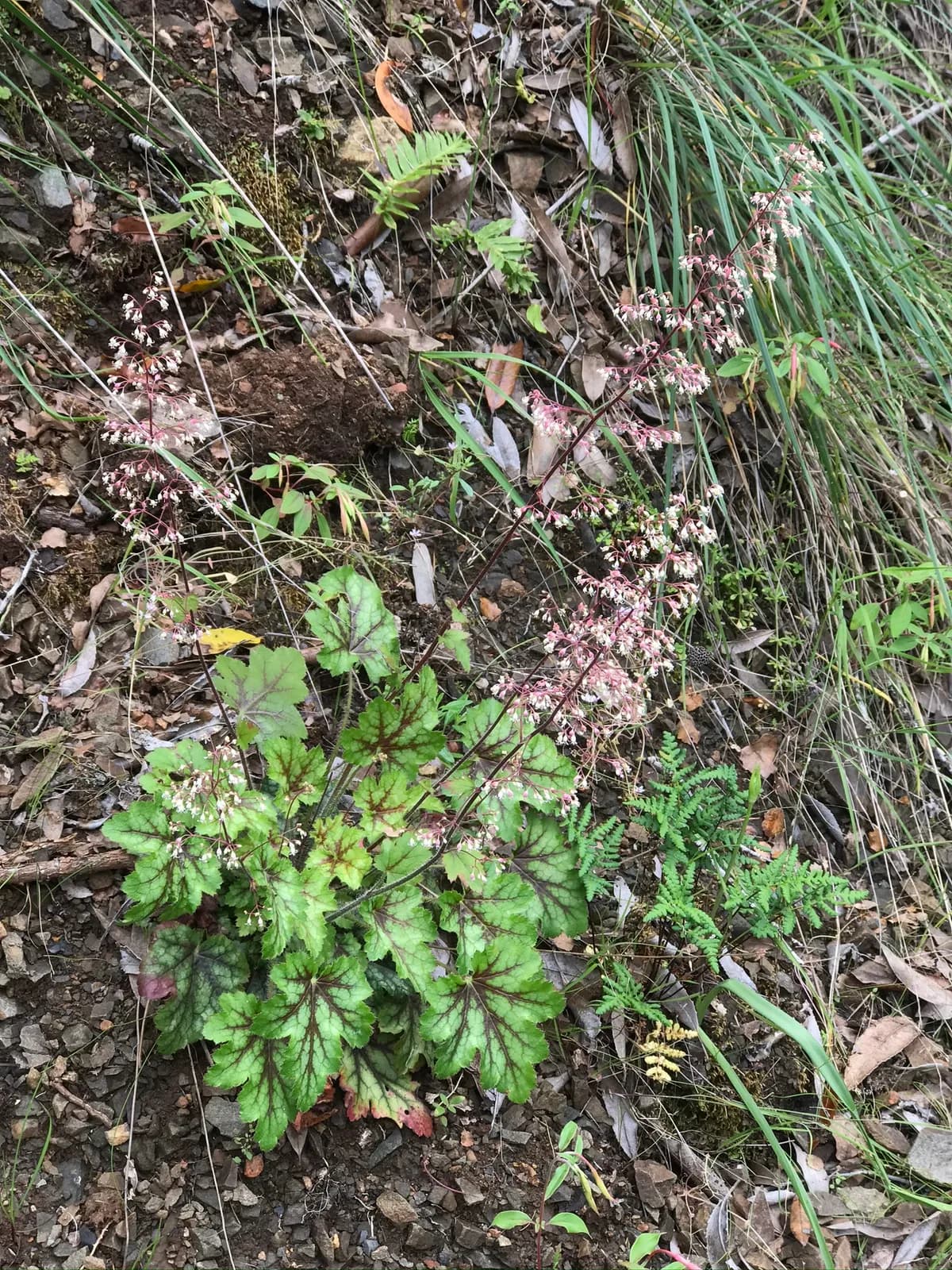
Crevice alumroot is a part-shade forb that sends up airy stalks of small white flowers from April through July, growing well in rocky crevices, streambanks, and moist woodland understories.
Toxicity unknown
Crevice alumroot (Heuchera micrantha) is not listed by the ASPCA Animal Poison Control Center (opens in new tab) or the other sources we check, so we have no verdict for it either way. Absence from those lists is not a clearance. If your pet shows symptoms after eating any plant, call the ASPCA at (888) 426-4435.
Light
part shade
Water
medium
Size
6"–24" H × 12"–18" W
Bloom
Apr, May, Jun, Jul
Native to
CA, OR, WA, ID and 2 more states
Pollinators
bees, hummingbirds
Before you buy
Your city may pay you to plant this
Cities and water utilities offer rebates for replacing lawn with native and water-wise plants. We track 459 programs across 44 states, each with a link to the provider and the date we last checked it.
Find rebates in your areaPicture natives in your own yard
Upload a photo of your yard and Patch Vision shows a rendering of it planted with natives for your region, like Crevice alumroot.


Browse plants for this ecoregion
A low, mounding evergreen perennial forb with rounded, lobed, maple-like leaves often marked with silver or bronze tones. Slender, wiry flower stalks rise above the foliage in late spring bearing airy sprays of tiny white flowers. Prefers partial shade and consistently moist, well-drained soil, especially in rocky or crevice settings.
Growing Crevice alumroot
Grow Crevice alumroot in part shade and medium water. Mature plants reach 6 to 24 inches tall and spread 12 to 18 inches wide. Expect low maintenance to keep it looking intentional in a front yard.
How to care for Crevice alumroot, by region
How to care for Crevice alumroot where it is actually grown: year-round basics plus what to do each season, region by region, with the sources for each.
Care guidance last updated: August 2026
Cross Timbers (includes Fort Worth, TX)
Year-round
Crevice alumroot is a low mound of scalloped leaves, roughly 6 to 24 inches tall, that holds its foliage year round and sends up thin stems of small white bell flowers in late spring. It is native to the Pacific Northwest and California, where it grows in cool, shaded rock crevices and along damp stream banks, and it is not native to Texas or anywhere close to it. That one fact drives everything else on this page, because Dallas and Fort Worth hand it hot nights, a two month stretch above 100 degrees, and ground that is either Cross Timbers sand or heavy Blackland clay. Treat it as an ornamental you are choosing to grow rather than a plant suited to this climate, and give it the shadiest, best drained ground you have. The two ways homeowners lose it are crown rot in soil that stays wet and heat and humidity stress in July and August.
- Give it morning sun and afternoon shade. Coral bells cannot handle full sun in North Texas (Dallas County Master Gardeners).
- Set the plant so the crown, the point where the leaves meet the roots, sits at or slightly above the soil line, because a buried crown rots (Royal Horticultural Society).
- Coral bells do not tolerate heavy, poorly drained soils, so work compost or other organic matter into the bed before planting, whether your yard is Cross Timbers sand or Blackland clay (Clemson Cooperative Extension).
- The ASPCA lists alumroot, also sold as coral bells, under the name Heuchera sanguinea as non-toxic to dogs, non-toxic to cats, and non-toxic to horses. That entry covers a different species in the same genus than the one you bought, so read it as information about a close relative rather than a ruling on this exact plant (ASPCA).
- If your tag reads Heuchera micrantha 'Palace Purple', the name on it is contested. NC State Extension says that plant may be a selection of hairy alumroot, Heuchera villosa, rather than of Heuchera micrantha (NC State Extension).
- That difference matters to you here, because Heuchera villosa is the species that confers heat tolerance in this group, which is why cultivars such as 'Caramel' and 'Citronelle' hold up in Southern gardens (Clemson Cooperative Extension).
- Plan on flowers around May and June in North Texas, ahead of the June to July window listed for cooler regions such as St. Louis (Denton County Master Gardener Association).
As a low evergreen mound it works well as tidy edging along a front walk and stays inside the space you give it, which is an HOA-friendly habit. It only keeps that neat look in shade with real drainage, so put it where you would put a fern and not in an open sunny front bed.
Fall
Fall is the recovery season. Once night temperatures fall, the plant puts out fresh leaves and repairs what summer took out of it. It is also when the risk flips from heat to water, because fall rain lands on ground that has been baked dry all summer, and heavy soil can go from cracked to soggy in a day. Your main job is easing off the hose and making sure water never stands around the crown.
- Cut back on watering as the nights cool. Established plants only need water during long dry spells (Royal Horticultural Society).
- It needs well drained ground that does not stay soggy, and damp conditions lead to rotting. If your bed holds water after a fall storm, move the plant to a raised bed or a container (Royal Horticultural Society).
- Refresh the mulch layer with pine straw, leaves, or shredded bark heading into winter (Clemson Cooperative Extension).
- Trim off the last of the spent flower stems (Missouri Botanical Garden).
- Do not divide now. Division belongs in spring, which gives the pieces a full growing season to root before they face a Texas summer (Missouri Botanical Garden).
Winter
Winter is the low effort season here, and cold is not the threat. This plant is rated hardy from about zone 4 to zone 9, so a normal DFW winter, and even a hard freeze, sits well inside what it can take. What actually hurts it is wet, cold ground sitting around the crown and freeze and thaw cycles that push the roots up out of the soil. The leaves usually stay on through a DFW winter, so leave them alone until spring.
- It is rated for USDA zones 4 through 9, which covers DFW winters with room to spare (Missouri Botanical Garden).
- Leave the winter worn foliage in place until spring, because it shields the crown through cold weather (Royal Horticultural Society).
- Plants can lift out of the ground over winter on heavy clay, so after a hard freeze look at whether the roots are riding above the surface and replant them at the proper depth (Royal Horticultural Society).
- Keep a mulch layer over the root zone through the cold months to cut down on that root heaving (Missouri Botanical Garden).
- Water only if the winter turns genuinely dry. Established plants need water just in long dry spells, and ground that stays wet rots the crown (Royal Horticultural Society).
- The leaves form rosettes that hold through the year in North Texas, so the plant stays visible in the bed all winter (Denton County Master Gardener Association).
Holding its leaves through a DFW winter makes this one of the few things in a shaded front bed that still looks tended in January, which is an HOA-friendly quality when the rest of the yard has gone brown.
Spring
Spring is this plant's best season in Dallas and Fort Worth, and it is the window when nearly all of its care happens. Temperatures are still mild, spring rain does most of the watering, and the plant pushes out fresh leaves and its flower stems. Everything structural belongs in these few weeks, meaning planting, resetting a crown that lifted over winter, dividing, and the one light feeding of the year. Get it done before the first run of 100 degree days, because after that the plant is only trying to hang on.
- Wait until you see new growth in the center before you trim off winter worn leaves, since the old foliage shelters the crown until then (Royal Horticultural Society).
- Check whether winter freezes pushed the roots up above the surface. If they did, dig the plant, work through the roots, and replant it at the proper depth (Dallas County Master Gardeners).
- If the woody stem under the leaves is more than three inches long, pop the rootball out, dig the hole deeper, and reset the plant with about three inches of soil, taking care not to cover the growing tips, which causes rot or death (Elisabeth C. Miller Library).
- Divide the clump every three to four years in spring, or whenever the center has gone woody, to keep it vigorous (Royal Horticultural Society).
- Feed once, lightly, with a half inch of compost or a small amount of slow release fertilizer. Heavy or frequent quick release fertilizer actually holds back flowering (Dallas County Master Gardeners).
- Remove the faded flower stems as they finish to encourage more bloom (Missouri Botanical Garden).
Summer
Summer decides whether this plant lives. It is not native to Texas, it comes from cool, shaded, damp rock crevices out west, and DFW gives it the exact opposite, meaning weeks above 100 degrees and nights that never really cool off. Expect the leaf edges to scorch, growth to stall, and the whole clump to look thinner in August than it did in May. The goal right now is survival, not looks, and the quickest way to lose it is to pour water on a hot, struggling plant until the crown rots.
- Deep afternoon shade is not optional in July and August. Leaf scorch turns up on plants grown in full sun during hot, dry conditions (NC State Extension).
- Water about once a week during hot, dry weather, and mulch with pine straw, leaves, or shredded bark to hold moisture in the ground (Clemson Cooperative Extension).
- Do not overwater. Too much water leads to fungal problems, and the plant rots at the crown in soil that stays soggy (NC State Extension).
- Be ready for losses. Master gardeners in Dallas County say plainly that some coral bells do not make it through the heat, humidity, and winter here (Dallas County Master Gardeners).
- If you replace one, look for cultivars with Heuchera villosa in the background, such as 'Caramel' or 'Citronelle', because that is the species carrying the heat tolerance (Clemson Cooperative Extension).
- Growing it in a large container is a genuine option, and it lets you shift the plant into shade and control drainage in a way a Blackland clay bed never will (Clemson Cooperative Extension).
By late August the leaves can look burned at the edges, and one ragged plant at the front of a bed reads as a neglected yard. The HOA-conscious placement is tucked into shade beside something that still looks full in summer, rather than standing alone next to the sidewalk.
Sources: Lady Bird Johnson Wildflower Center: Heuchera micrantha (Crevice alumroot), ASPCA: Alumroot (Coral Bells, Heuchera), Royal Horticultural Society: How to grow heuchera, Missouri Botanical Garden: Heuchera micrantha var. diversifolia 'Palace Purple', Clemson Cooperative Extension HGIC: Heuchera, Coral Bells, NC State Extension Plant Toolbox: Heuchera 'Palace Purple'
Texas Blackland Prairies (includes Dallas, TX)
Year-round
Crevice alumroot is a low mound of scalloped leaves, roughly 6 to 24 inches tall, that holds its foliage year round and sends up thin stems of small white bell flowers in late spring. It is native to the Pacific Northwest and California, where it grows in cool, shaded rock crevices and along damp stream banks, and it is not native to Texas or anywhere close to it. That one fact drives everything else on this page, because Dallas and Fort Worth hand it hot nights, a two month stretch above 100 degrees, and ground that is either Cross Timbers sand or heavy Blackland clay. Treat it as an ornamental you are choosing to grow rather than a plant suited to this climate, and give it the shadiest, best drained ground you have. The two ways homeowners lose it are crown rot in soil that stays wet and heat and humidity stress in July and August.
- Give it morning sun and afternoon shade. Coral bells cannot handle full sun in North Texas (Dallas County Master Gardeners).
- Set the plant so the crown, the point where the leaves meet the roots, sits at or slightly above the soil line, because a buried crown rots (Royal Horticultural Society).
- Coral bells do not tolerate heavy, poorly drained soils, so work compost or other organic matter into the bed before planting, whether your yard is Cross Timbers sand or Blackland clay (Clemson Cooperative Extension).
- The ASPCA lists alumroot, also sold as coral bells, under the name Heuchera sanguinea as non-toxic to dogs, non-toxic to cats, and non-toxic to horses. That entry covers a different species in the same genus than the one you bought, so read it as information about a close relative rather than a ruling on this exact plant (ASPCA).
- If your tag reads Heuchera micrantha 'Palace Purple', the name on it is contested. NC State Extension says that plant may be a selection of hairy alumroot, Heuchera villosa, rather than of Heuchera micrantha (NC State Extension).
- That difference matters to you here, because Heuchera villosa is the species that confers heat tolerance in this group, which is why cultivars such as 'Caramel' and 'Citronelle' hold up in Southern gardens (Clemson Cooperative Extension).
- Plan on flowers around May and June in North Texas, ahead of the June to July window listed for cooler regions such as St. Louis (Denton County Master Gardener Association).
As a low evergreen mound it works well as tidy edging along a front walk and stays inside the space you give it, which is an HOA-friendly habit. It only keeps that neat look in shade with real drainage, so put it where you would put a fern and not in an open sunny front bed.
Fall
Fall is the recovery season. Once night temperatures fall, the plant puts out fresh leaves and repairs what summer took out of it. It is also when the risk flips from heat to water, because fall rain lands on ground that has been baked dry all summer, and heavy soil can go from cracked to soggy in a day. Your main job is easing off the hose and making sure water never stands around the crown.
- Cut back on watering as the nights cool. Established plants only need water during long dry spells (Royal Horticultural Society).
- It needs well drained ground that does not stay soggy, and damp conditions lead to rotting. If your bed holds water after a fall storm, move the plant to a raised bed or a container (Royal Horticultural Society).
- Refresh the mulch layer with pine straw, leaves, or shredded bark heading into winter (Clemson Cooperative Extension).
- Trim off the last of the spent flower stems (Missouri Botanical Garden).
- Do not divide now. Division belongs in spring, which gives the pieces a full growing season to root before they face a Texas summer (Missouri Botanical Garden).
Winter
Winter is the low effort season here, and cold is not the threat. This plant is rated hardy from about zone 4 to zone 9, so a normal DFW winter, and even a hard freeze, sits well inside what it can take. What actually hurts it is wet, cold ground sitting around the crown and freeze and thaw cycles that push the roots up out of the soil. The leaves usually stay on through a DFW winter, so leave them alone until spring.
- It is rated for USDA zones 4 through 9, which covers DFW winters with room to spare (Missouri Botanical Garden).
- Leave the winter worn foliage in place until spring, because it shields the crown through cold weather (Royal Horticultural Society).
- Plants can lift out of the ground over winter on heavy clay, so after a hard freeze look at whether the roots are riding above the surface and replant them at the proper depth (Royal Horticultural Society).
- Keep a mulch layer over the root zone through the cold months to cut down on that root heaving (Missouri Botanical Garden).
- Water only if the winter turns genuinely dry. Established plants need water just in long dry spells, and ground that stays wet rots the crown (Royal Horticultural Society).
- The leaves form rosettes that hold through the year in North Texas, so the plant stays visible in the bed all winter (Denton County Master Gardener Association).
Holding its leaves through a DFW winter makes this one of the few things in a shaded front bed that still looks tended in January, which is an HOA-friendly quality when the rest of the yard has gone brown.
Spring
Spring is this plant's best season in Dallas and Fort Worth, and it is the window when nearly all of its care happens. Temperatures are still mild, spring rain does most of the watering, and the plant pushes out fresh leaves and its flower stems. Everything structural belongs in these few weeks, meaning planting, resetting a crown that lifted over winter, dividing, and the one light feeding of the year. Get it done before the first run of 100 degree days, because after that the plant is only trying to hang on.
- Wait until you see new growth in the center before you trim off winter worn leaves, since the old foliage shelters the crown until then (Royal Horticultural Society).
- Check whether winter freezes pushed the roots up above the surface. If they did, dig the plant, work through the roots, and replant it at the proper depth (Dallas County Master Gardeners).
- If the woody stem under the leaves is more than three inches long, pop the rootball out, dig the hole deeper, and reset the plant with about three inches of soil, taking care not to cover the growing tips, which causes rot or death (Elisabeth C. Miller Library).
- Divide the clump every three to four years in spring, or whenever the center has gone woody, to keep it vigorous (Royal Horticultural Society).
- Feed once, lightly, with a half inch of compost or a small amount of slow release fertilizer. Heavy or frequent quick release fertilizer actually holds back flowering (Dallas County Master Gardeners).
- Remove the faded flower stems as they finish to encourage more bloom (Missouri Botanical Garden).
Summer
Summer decides whether this plant lives. It is not native to Texas, it comes from cool, shaded, damp rock crevices out west, and DFW gives it the exact opposite, meaning weeks above 100 degrees and nights that never really cool off. Expect the leaf edges to scorch, growth to stall, and the whole clump to look thinner in August than it did in May. The goal right now is survival, not looks, and the quickest way to lose it is to pour water on a hot, struggling plant until the crown rots.
- Deep afternoon shade is not optional in July and August. Leaf scorch turns up on plants grown in full sun during hot, dry conditions (NC State Extension).
- Water about once a week during hot, dry weather, and mulch with pine straw, leaves, or shredded bark to hold moisture in the ground (Clemson Cooperative Extension).
- Do not overwater. Too much water leads to fungal problems, and the plant rots at the crown in soil that stays soggy (NC State Extension).
- Be ready for losses. Master gardeners in Dallas County say plainly that some coral bells do not make it through the heat, humidity, and winter here (Dallas County Master Gardeners).
- If you replace one, look for cultivars with Heuchera villosa in the background, such as 'Caramel' or 'Citronelle', because that is the species carrying the heat tolerance (Clemson Cooperative Extension).
- Growing it in a large container is a genuine option, and it lets you shift the plant into shade and control drainage in a way a Blackland clay bed never will (Clemson Cooperative Extension).
By late August the leaves can look burned at the edges, and one ragged plant at the front of a bed reads as a neglected yard. The HOA-conscious placement is tucked into shade beside something that still looks full in summer, rather than standing alone next to the sidewalk.
Sources: Lady Bird Johnson Wildflower Center: Heuchera micrantha (Crevice alumroot), ASPCA: Alumroot (Coral Bells, Heuchera), Royal Horticultural Society: How to grow heuchera, Missouri Botanical Garden: Heuchera micrantha var. diversifolia 'Palace Purple', Clemson Cooperative Extension HGIC: Heuchera, Coral Bells, NC State Extension Plant Toolbox: Heuchera 'Palace Purple'
In an HOA neighborhood
Crevice alumroot is an HOA-friendly choice. Maintenance level: low. Tidiness: 4 out of 5.
Works well in: foundation, mid zone, front yard.
Wildlife value
Delicate spring flower sprays attract bees and occasionally hummingbirds seeking early-season nectar.
Common questions
- What growing conditions does Heuchera micrantha prefer?
- Crevice alumroot does best in part shade with medium moisture and good drainage, often rooting in rocky crevices, canyon walls, and streambanks.
- When does Heuchera micrantha bloom?
- It flowers from April through July, sending up slender stalks lined with small white to pinkish flowers above its rounded, lobed leaves.
- What pollinators visit Heuchera micrantha?
- Bees and hummingbirds are the main visitors, drawn to the small tubular flowers held above the foliage.
- Does Heuchera micrantha keep its leaves year round?
- Its low mound of lobed, maple-like leaves is semi-evergreen and can persist through mild winters, though it may die back in colder conditions.
- Is Crevice alumroot HOA-friendly?
- Crevice alumroot is generally an HOA-friendly choice in the right placement, with low maintenance.
These answers were drafted with an AI model from this plant's data. Verify care details with a local expert.
Native range data from vouchered herbarium specimen records and regional native plant society lists. Pollinator and host plant associations compiled from GBIF, iNaturalist, and published ecological literature.
If something looks wrong
Common plant problems, and what to check first
These come up on almost any plant. Each guide lists the likely causes in the order they are worth ruling out, with one thing to check before you act on any of them, and links to the source it came from.
- It is dying right after planting
- Leaves turning yellow
- Wilting even though I watered it
- Brown crispy leaf tips
- Bugs on the plant
Ready to grow Crevice alumroot? Add it to your garden in Pollinator Patch to track it and get season-by-season care guidance.