Drummond's Dogwood
Cornus drummondii
Last reviewed: October 2026
Cornus drummondii is a thicket-forming shrub that produces clusters of small white flowers from May through July. It grows well in full sun with medium water needs and adapts to a range of soil moisture conditions.
Toxicity unknown
Drummond's Dogwood (Cornus drummondii) is not listed by the ASPCA Animal Poison Control Center (opens in new tab) or the other sources we check, so we have no verdict for it either way. Absence from those lists is not a clearance. If your pet shows symptoms after eating any plant, call the ASPCA at (888) 426-4435.
The USDA PLANTS Database (opens in new tab) does not flag Drummond's Dogwood as toxic to livestock.
Light
part sun
Water
low
Size
120"–180" H × 120"–192" W
Bloom
May, Jun, Jul
Native to
AL, AR, GA, IA and 18 more states
Pollinators
bees, beetles, flies, butterflies, nectar insects
Before you buy
Your city may pay you to plant this
Cities and water utilities offer rebates for replacing lawn with native and water-wise plants. We track 459 programs across 44 states, each with a link to the provider and the date we last checked it.
Find rebates in your areaPicture natives in your own yard
Upload a photo of your yard and Patch Vision shows a rendering of it planted with natives for your region, like Drummond's Dogwood.


Browse plants for this ecoregion
Drummond's dogwood is a native shrub that forms dense thickets through underground runners. It produces clusters of small white flowers in late spring and summer, followed by white berries that attract birds.
Growing Drummond's Dogwood
Grow Drummond's Dogwood in part sun and low water. Mature plants reach 120 to 180 inches tall and spread 120 to 192 inches wide. Expect high maintenance to keep it looking intentional in a front yard.
How to care for Drummond's Dogwood, by region
How to care for Drummond's Dogwood where it is actually grown: year-round basics plus what to do each season, region by region, with the sources for each.
Care guidance last updated: July 2026
Cross Timbers (includes Fort Worth, TX)
Year-round
Roughleaf dogwood is a native North Texas shrub that grows as a thicket of multiple stems from root suckers rather than a single trunk. It is a high maintenance plant if you want to keep it looking tidy in a front yard.
- It spreads by root suckers into a thicket if left alone, so decide early whether you want a spreading colony or a single small tree, and manage it accordingly.
- In the heavy black clay soils of the Blackland Prairies, plant it slightly mounded or work in coarse compost so roots are not sitting in slow draining clay; in the sandier soils of the Cross Timbers to the west it drains faster but will need more frequent watering through its first summer.
- Mature size runs 6 to 20 feet tall with a similar spread once suckers are allowed to fill in.
- Clusters of small white flowers open May through July, followed by white berry clusters birds eat through late summer and fall.
- To keep it as a single small tree instead of a spreading patch, cut new sucker shoots back to the ground as they appear through the growing season.
Left alone this shrub spreads into a thicket that can read as unmanaged from the street. Removing suckers on a regular schedule keeps it looking like one intentional specimen instead of a spreading patch.
Fall
Fall is a better planting window than spring for a woody shrub like this one, and it is also when the berries and leaf color peak.
- October through November is the best time to plant or transplant it, letting roots establish through the mild North Texas winter before next summer's heat.
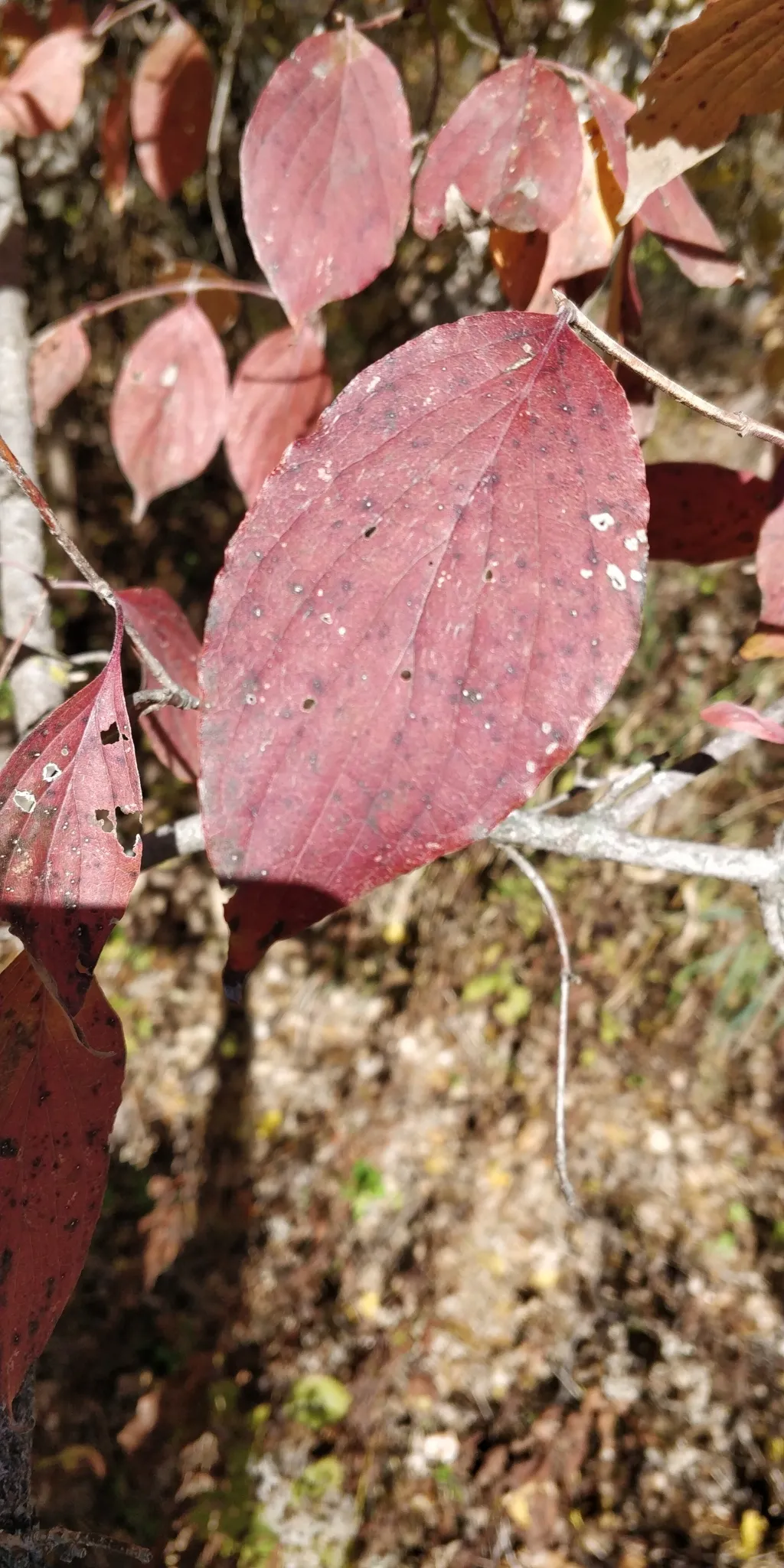
- Leaves turn a reddish purple color in October and November before dropping.
- White berry clusters are fully ripe in fall and are a reliable food source for migrating and wintering birds.
- Cut back any leftover summer sucker growth once leaves drop, before new spring growth starts.
Fall color and ripe white berry clusters display well from the street; cleaning up summer sucker growth first keeps the display looking deliberate rather than overgrown.
Winter
Winter is the dormant season to shape the shrub's structure; North Texas winters are mild with occasional hard freezes it tolerates once established.
- North Texas winters run USDA zone 8a to 8b with short hard freezes and occasional severe Arctic outbreaks; an established roughleaf dogwood tolerates these without protection.
- Use December through February, while the plant is dormant, to prune out dead, crossing, or damaged stems and remove any remaining root suckers at ground level.
- Skip fertilizing in winter; wait until new growth resumes in spring.
- Bare stems look sparse and twiggy in winter; if the thicket habit bothers a front yard view, this is the season to cut it back to fewer main stems.
Bare winter stems can look untidy from the street if suckers were not controlled during the growing season; a winter structural pruning is the fix before spring growth resumes.
Spring
Spring is the planting window for this shrub in North Texas and the season it flowers.
- Plant in March or April while the weather is mild, so roots have time to establish before the first 100 degree afternoons hit.
- Water new plantings deeply once or twice a week through spring while roots are establishing.
- Watch for flat clusters of small white flowers opening in May, drawing bees and butterflies for nectar.
- Start checking the base for new root suckers by April and snip them off at ground level early, before a thicket gets ahead of you.
The May flower clusters are the shrub's most eye-catching moment and read as an intentional flowering feature, especially if suckers are already kept in check.
Summer
July and August heat is the hardest stretch for a newly planted roughleaf dogwood; established plants handle it with little help.
- For a plant in its first summer, water deeply about once a week whenever two weeks pass without rain during 100 degree stretches.
- Once established (in the ground more than one full year), it tolerates North Texas summer heat and short dry spells without regular watering.
- Suckers grow fastest in summer heat and humidity; check the base every two to three weeks and cut new shoots back so the thicket does not spread into the lawn or bed edges.
- White berry clusters begin forming after the spring bloom and ripen through late summer, drawing songbirds to the yard.
Fast summer sucker growth is the main risk to a tidy look this season; staying on top of it every few weeks keeps the shrub from visibly spreading past its bed.
Sources: Lady Bird Johnson Wildflower Center: Cornus drummondii, Missouri Botanical Garden Plant Finder: Cornus drummondii
Texas Blackland Prairies (includes Dallas, TX)
Year-round
Roughleaf dogwood is a native North Texas shrub that grows as a thicket of multiple stems from root suckers rather than a single trunk. It is a high maintenance plant if you want to keep it looking tidy in a front yard.
- It spreads by root suckers into a thicket if left alone, so decide early whether you want a spreading colony or a single small tree, and manage it accordingly.
- In the heavy black clay soils of the Blackland Prairies, plant it slightly mounded or work in coarse compost so roots are not sitting in slow draining clay; in the sandier soils of the Cross Timbers to the west it drains faster but will need more frequent watering through its first summer.
- Mature size runs 6 to 20 feet tall with a similar spread once suckers are allowed to fill in.
- Clusters of small white flowers open May through July, followed by white berry clusters birds eat through late summer and fall.
- To keep it as a single small tree instead of a spreading patch, cut new sucker shoots back to the ground as they appear through the growing season.
Left alone this shrub spreads into a thicket that can read as unmanaged from the street. Removing suckers on a regular schedule keeps it looking like one intentional specimen instead of a spreading patch.
Fall
Fall is a better planting window than spring for a woody shrub like this one, and it is also when the berries and leaf color peak.
- October through November is the best time to plant or transplant it, letting roots establish through the mild North Texas winter before next summer's heat.
- Leaves turn a reddish purple color in October and November before dropping.
- White berry clusters are fully ripe in fall and are a reliable food source for migrating and wintering birds.
- Cut back any leftover summer sucker growth once leaves drop, before new spring growth starts.
Fall color and ripe white berry clusters display well from the street; cleaning up summer sucker growth first keeps the display looking deliberate rather than overgrown.
Winter
Winter is the dormant season to shape the shrub's structure; North Texas winters are mild with occasional hard freezes it tolerates once established.
- North Texas winters run USDA zone 8a to 8b with short hard freezes and occasional severe Arctic outbreaks; an established roughleaf dogwood tolerates these without protection.
- Use December through February, while the plant is dormant, to prune out dead, crossing, or damaged stems and remove any remaining root suckers at ground level.
- Skip fertilizing in winter; wait until new growth resumes in spring.
- Bare stems look sparse and twiggy in winter; if the thicket habit bothers a front yard view, this is the season to cut it back to fewer main stems.
Bare winter stems can look untidy from the street if suckers were not controlled during the growing season; a winter structural pruning is the fix before spring growth resumes.
Spring
Spring is the planting window for this shrub in North Texas and the season it flowers.
- Plant in March or April while the weather is mild, so roots have time to establish before the first 100 degree afternoons hit.
- Water new plantings deeply once or twice a week through spring while roots are establishing.
- Watch for flat clusters of small white flowers opening in May, drawing bees and butterflies for nectar.
- Start checking the base for new root suckers by April and snip them off at ground level early, before a thicket gets ahead of you.
The May flower clusters are the shrub's most eye-catching moment and read as an intentional flowering feature, especially if suckers are already kept in check.
Summer
July and August heat is the hardest stretch for a newly planted roughleaf dogwood; established plants handle it with little help.
- For a plant in its first summer, water deeply about once a week whenever two weeks pass without rain during 100 degree stretches.
- Once established (in the ground more than one full year), it tolerates North Texas summer heat and short dry spells without regular watering.
- Suckers grow fastest in summer heat and humidity; check the base every two to three weeks and cut new shoots back so the thicket does not spread into the lawn or bed edges.
- White berry clusters begin forming after the spring bloom and ripen through late summer, drawing songbirds to the yard.
Fast summer sucker growth is the main risk to a tidy look this season; staying on top of it every few weeks keeps the shrub from visibly spreading past its bed.
Sources: Lady Bird Johnson Wildflower Center: Cornus drummondii, Missouri Botanical Garden Plant Finder: Cornus drummondii
In an HOA neighborhood
Drummond's Dogwood takes more care to keep looking intentional in a front yard. Maintenance level: high. Consider it for backyard or mid-zone beds rather than the street edge.
Works well in: backyard only.
- Spreads aggressively by underground runners
- Can reach 20 feet tall and wide
- Forms wild-looking thickets
Wildlife value
The flowers attract bees, beetles, and flies during the long bloom period from May through July. Birds eagerly consume the white berries in late summer and fall.
Common questions
- When does Drummond's dogwood bloom?
- Cornus drummondii typically blooms from May through July, producing flat clusters of small white flowers.
- What pollinators visit Drummond's dogwood?
- The flowers attract bees, beetles, and flies, which visit for pollen and nectar during the bloom period.
- How much sun does this shrub need?
- It grows best in full sun but tolerates part sun to part shade conditions as well.
- How much water does Cornus drummondii require?
- It prefers medium moisture but can handle both wetter and drier soil conditions once established.
- Is Drummond's dogwood a tree or a shrub?
- It grows as a large, multi-stemmed shrub, often forming dense thickets in open woodlands, fence rows, and old fields.
- Is Drummond's Dogwood toxic to livestock?
- The USDA PLANTS Database does not flag Drummond's Dogwood as toxic to livestock.
- Is Drummond's Dogwood HOA-friendly?
- Drummond's Dogwood takes more care to look intentional in a front yard. Consider it for backyard or mid-zone beds rather than the street edge.
These answers were drafted with an AI model from this plant's data. Verify care details with a local expert.
Native range data from the World Checklist of Vascular Plants (Kew). Pollinator and host plant associations compiled from GBIF, iNaturalist, and published ecological literature.
If something looks wrong
Common plant problems, and what to check first
These come up on almost any plant. Each guide lists the likely causes in the order they are worth ruling out, with one thing to check before you act on any of them, and links to the source it came from.
- It is dying right after planting
- Leaves turning yellow
- Wilting even though I watered it
- Brown crispy leaf tips
- Bugs on the plant
Ready to grow Drummond's Dogwood? Add it to your garden in Pollinator Patch to track it and get season-by-season care guidance.