Beardlip Penstemon
Penstemon barbatus
Last reviewed: September 2026
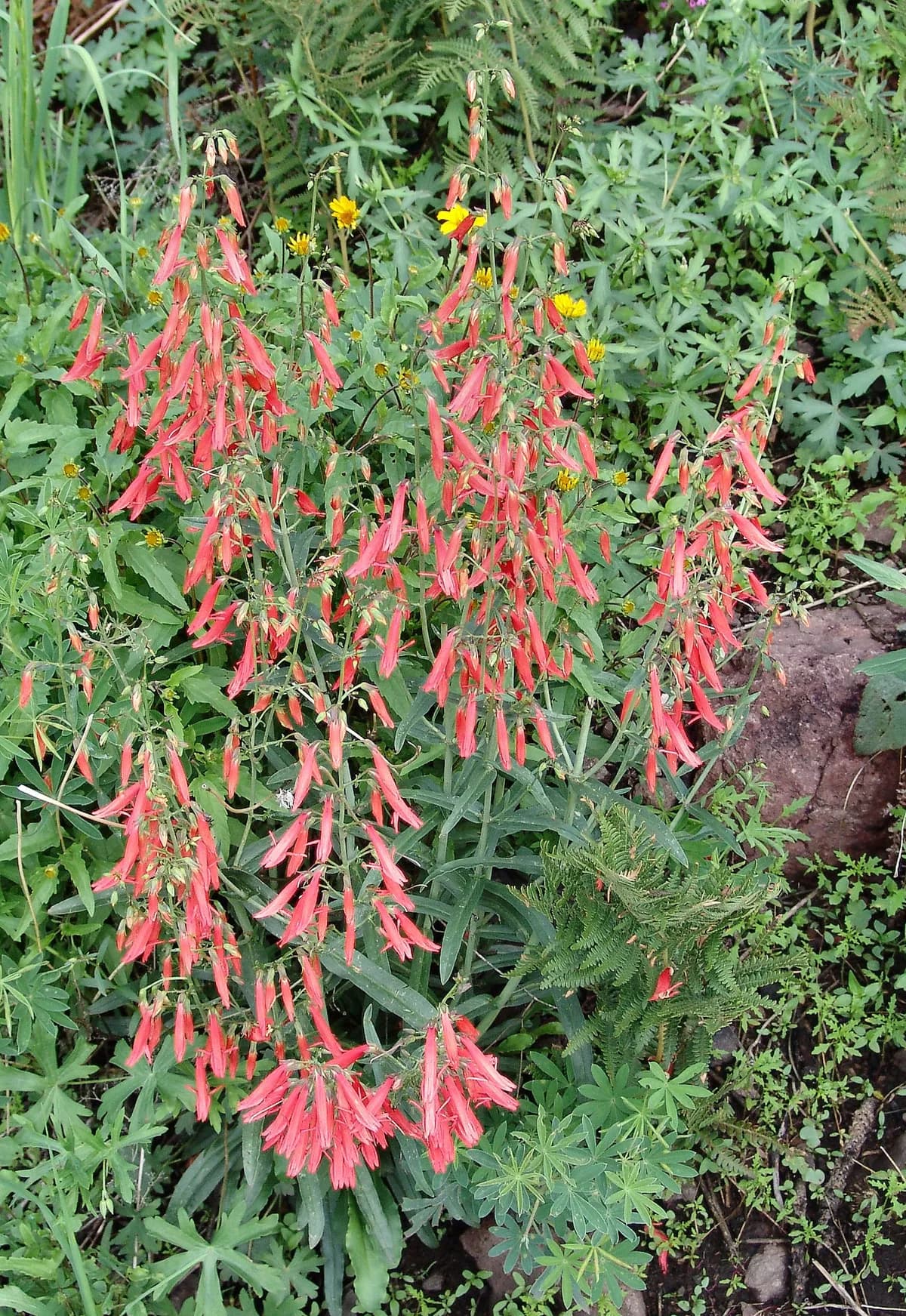
Penstemon barbatus, or Beardlip Penstemon, is a full sun forb with slender red tubular flowers blooming April through July. It tolerates dry, well drained soils and draws hummingbirds and bees to gardens.
Toxicity unknown
Beardlip Penstemon (Penstemon barbatus) is not listed by the ASPCA Animal Poison Control Center (opens in new tab) or the other sources we check, so we have no verdict for it either way. Absence from those lists is not a clearance. If your pet shows symptoms after eating any plant, call the ASPCA at (888) 426-4435.
Light
full sun
Water
low
Size
12"–36" H × 12"–24" W
Bloom
Apr, May, Jun, Jul
Native to
AZ, CA, CO, NM and 2 more states
Pollinators
hummingbirds, bees
Before you buy
Your city may pay you to plant this
Cities and water utilities offer rebates for replacing lawn with native and water-wise plants. We track 459 programs across 44 states, each with a link to the provider and the date we last checked it.
Find rebates in your areaPicture natives in your own yard
Upload a photo of your yard and Patch Vision shows a rendering of it planted with natives for your region, like Beardlip Penstemon.


Browse plants for this ecoregion
Beardlip penstemon is a compact perennial wildflower that produces tubular red to pink flowers on upright stems from spring through summer. This drought-tolerant native maintains evergreen foliage year-round and forms neat clumps that work well in desert gardens.
Growing Beardlip Penstemon
Grow Beardlip Penstemon in full sun and low water. Mature plants reach 12 to 36 inches tall and spread 12 to 24 inches wide. Expect low maintenance to keep it looking intentional in a front yard.
How to care for Beardlip Penstemon, by region
How to care for Beardlip Penstemon where it is actually grown: year-round basics plus what to do each season, region by region, with the sources for each.
Care guidance last updated: October 2026
Colorado Plateaus (includes Grand Junction, CO)
Year-round
Scarlet bugler is a dry-soil penstemon with red flowers all summer. It needs very little water once settled in.
- Water needs are listed as low and soil as dry and rocky.
- Colorado State's very low water garden says its plants can live on rainfall alone after establishment.
- The Wildflower Center lists part shade, and the Colorado State garden is meant for full sun.
- Flowers are red and show from June through October.
Red spikes add steady color from summer into fall.
Fall
Blooms can run into October. Water stays low.
- Flowering can last through October.
- Water needs stay low.
- Seed is propagated by cold-moist stratification, which hints that seed likes a cold spell.
Winter
Winter is a quiet time for this plant.
- Seed needs cold-moist stratification to sprout.
- The plant is listed as native to mesas and mountains from Sonora through Utah and Colorado.
- Keep the site dry and rocky as listed.
Spring
Help new plants settle in, then back off on water.
- Plants in the Colorado State very low water garden survive on rainfall alone only after establishment.
- Plant in rocky, dry soil.
- Bloom starts in June.
Summer
Summer is bloom season. Keep soil on the dry side.
- Red flowers appear from June through October.
- Water needs are low.
- Dry, rocky soil is the listed preference.
Sources: Wildflower Center, Penstemon barbatus, Colorado State Extension, Very Low Water Garden
Sonoran Basin and Range (includes Phoenix, AZ)
Year-round
Scarlet penstemon is a red-flowered desert wildflower that hummingbirds love. In the low desert around Phoenix it does best with full morning sun, a little afternoon shade, and very little water.
- Plant it in fast-draining decomposed-granite or gritty native soil, never in rich amended beds, since desert penstemons resent heavy or fertilized soil.
- Give full sun but pick a spot that gets some afternoon shade in the low desert, because much of the nursery stock comes from higher, cooler Arizona elevations.
- Water deep and infrequent once established, roughly once or twice a month, and top the bed with gravel or decomposed-granite mulch instead of wood bark.
- The single most common local mistake is overwatering, so let the soil dry between soakings and skip fertilizer entirely.
Fall
Fall is the prime season in the low desert and the best time to plant scarlet penstemon. Cooler air lets roots settle in before next summer.
- Plant in October or November so roots establish through the mild winter, which is the single best timing move for this plant in Phoenix.
- Set new plants in fast-draining decomposed-granite soil with no compost or fertilizer, and water in well at planting.
- After the bloom has finished, tidy or lightly cut back spent flower stalks to keep the plant compact.
- Water any new fall plantings a bit more often at first, then stretch to deep and infrequent as they take hold.
A fall cut-back of spent stalks and a clean decomposed-granite bed reads as intentional desert xeriscape, the expected HOA-friendly Phoenix front-yard look, which helps avoid a violation letter.
Winter
Winter in Phoenix is a mild cool-growing season, not a deep freeze. Scarlet penstemon needs very little water now and is hardy through the Phoenix core.
- Water minimally through the gentle winter rains, roughly once a month or less, and let the soil dry well between soakings.
- This penstemon is frost-hardy in the Phoenix low desert, so no cover is needed on all but the rare hard freeze.
- Skip fertilizer and hold off on any hard pruning until after the plant reblooms in spring.
- Keep gravel mulch topped up so the crown stays on dry, fast-draining ground through cool wet spells.
Spring
Spring is when scarlet penstemon puts on its red flower show and feeds hummingbirds. Enjoy the bloom and start easing off water as the heat builds.
- Expect peak red bloom from roughly April into early summer, and leave the flower spikes up while hummingbirds and bees are working them.
- Taper the last of the cool-season waterings as March turns to May so the plant is not sitting wet going into heat.
- If you must add a plant, very early spring is a weaker secondary planting window, but fall is still the better time.
- Refresh thin spots in the decomposed-granite mulch rather than adding compost or fertilizer.
Leaving the red bloom spikes up reads as an intentional, cared-for desert planting rather than a weedy patch, which keeps a tidy front yard and helps avoid a violation letter.
Summer
Summer is the stress season in Phoenix, not the growing peak. This penstemon just needs to survive the heat, and a little afternoon shade plus an occasional deep soak gets it through.
- In the brutal dry June foresummer, give an occasional deep soak, especially in the plant's first one or two summers, since much of this stock came from cooler high country.
- Once monsoon storms start in July, back off irrigation and let the rain do the work, because watering on top of monsoon downpours is the fastest way to rot the roots.
- Keep the plant where it gets afternoon shade so the intense low-desert UV does not scorch the foliage.
- Do not plant new penstemon now, and never plant May through July, because roots cannot establish in that heat.
Sources: University of Arizona Cooperative Extension, Penstemons for Arizona gardens, Lady Bird Johnson Wildflower Center, Penstemon barbatus plant database, Desert Botanical Garden, low-desert planting calendar, Arizona-Sonora Desert Museum, Penstemon and desert wildflower notes
Texas Blackland Prairies (includes Dallas, TX)
Year-round
Beardlip penstemon is native to Texas at the state level, but its natural home is the state's rocky, dry west, not the heavy black clay around Dallas. In this ecoregion the main risk to manage is wet, slow-draining soil, not cold or heat.
- Native plant records list this species in Arizona, New Mexico, Utah, Colorado, and Texas, but within Texas its rocky, low-humidity habitat is out west, not the black clay prairie around Dallas.
- This plant is built for dry, rocky, fast-draining ground. Dallas area clay (locally called gumbo) holds water much longer than that, so drainage is the main thing to manage here, not cold or heat.
- Plant it in a raised bed, berm, or a hole heavily amended with coarse grit, sand, or expanded shale so water moves away from the roots and crown within a few hours of rain.
- Full sun and low water, per this plant's profile, mean infrequent deep watering in soil that drains well, not tolerating standing water.
A small raised bed or berm for this plant reads as an intentional design feature from the street, not a mess, as long as the edge is kept clean.
Fall
Fall is a good, low-stress window to plant, divide, or fix drainage problems, since cooler temperatures reduce transplant stress and give roots time to settle in before next summer's heat.
- If drainage has been a struggle, fall (once summer storms taper off) is a good time to add coarse grit or raise the bed before winter and spring rains arrive.
- Cut back only dead or damaged stems now. Save the full cutback for late winter or very early spring.
- Blackland Prairie clay can stay wet well into early winter, so keep checking the bed for standing water after fall rain.
Winter
Winter is mostly hands-off for this plant, but wet, cold clay is the one combination worth watching, since standing water around the crown in cold weather is more likely to cause rot than a light freeze is to cause cold damage.
- Skip winter watering. Let the plant stay dry and dormant rather than adding moisture.
- If the bed has a history of standing water after winter rain, this is a good time to add drainage or raise the planting area before spring rains return.
- Leave dead top growth in place over winter for some structure and cold protection, then cut it back in late winter before new growth starts.
Spring
Spring is the highest-risk season for this plant in Dallas area clay, since that is usually when Blackland Prairie rainfall is heaviest and the ground drains slowest.
- Hold off on extra watering in spring. Rain alone is usually enough, and adding more raises the odds of crown and root rot in clay soil.
- If the bed still holds standing water more than a few hours after a hard rain, that is a sign to rework the soil or move the plant, not to wait it out.
- For new plantings, set the crown right at soil level, not down in a dip, and skip heavy compost. Coarse grit, sand, or expanded shale help clay drain instead.
- Watch for stems collapsing at the soil line or leaves suddenly wilting and yellowing. Those point to crown rot starting, not underwatering.
A raised planting spot or a clean amended bed edge reads as tidy, intentional structure from the street, especially while the plant is still small in spring.
Summer
Summer heat itself is not the problem for this plant, since it comes from hot, dry parts of the Southwest. The real risk here is only if a summer storm leaves the clay soaked.
- Full sun and low water, per this plant's stored profile, apply in summer too. Let the soil dry out between waterings instead of keeping it consistently moist.
- Avoid running it on the same automatic sprinkler schedule as lawn or bedding annuals. It wants dry stretches, not daily moisture.
- Deadheading spent flower spikes is standard care for this genus and can help extend bloom through the summer.
- After a heavy summer storm, check that water is not pooling around the base of the plant for more than a few hours.
Deadheading through summer keeps the bed looking maintained and full, which reads well from the street.
Sources: Penstemon barbatus, Lady Bird Johnson Wildflower Center Native Plant Database, Growing Penstemons, Colorado State University Extension
Wasatch and Uinta Mountains (includes Logan, UT)
Year-round
Beardlip penstemon is a low-water, low-fuss perennial that likes rocky, well-drained spots.
- It grows 2 to 4 feet tall and about 1 to 1.5 feet wide, and its water needs are rated low.
- In the wild it grows on rocky slopes, meadows and pinyon-juniper woodlands, so give it lean, well-drained soil.
- Its red tube-shaped flowers draw hummingbirds.
Cut spent stalks back to the leafy base after bloom for a tidy front-yard look.
Fall
In fall you choose between a tidy cutback or leaving seed pods for wildlife.
- You can leave stems and seed pods standing for forage through winter.
- Or cut back to the leafy base after flowering to improve the look of the planting.
Winter
Winter is quiet: the plant needs almost nothing from you.
- Maintenance is rated low, so there is no winter chore required.
- Standing seed pods can stay up through winter as forage.
- Seed can be sown outside in midwinter and left to chill naturally.
Spring
Spring is a good time to start new plants from seed or cuttings.
- Seed does best with 8 weeks of cold in the fridge at about 40 F, or sown outside in midwinter.
- Cover the seeds only lightly.
- Seeds sprout in 3 to 9 days once temperatures reach 70 F.
Summer
Summer is bloom time, and a little deadheading keeps flowers coming.
- It blooms from late spring through mid-summer.
- Remove spent flower stalks to prolong bloom.
- Water needs stay low, so skip extra watering once it is settled in.
Sources: Wild Ones Front Range: Penstemon barbatus fact sheet (community tip), University of Arizona Extension Yavapai Plants: Penstemon barbatus
In an HOA neighborhood
Beardlip Penstemon is an HOA-friendly choice. Maintenance level: low. Tidiness: 4 out of 5.
Works well in: front yard, foundation, street edge, mid zone.
Wildlife value
The tubular flowers are magnets for hummingbirds and also attract native bees. This plant provides reliable nectar from April through July.
Common questions
- How much water does Beardlip Penstemon need?
- Once established, Penstemon barbatus does well with low water and prefers soil that drains quickly rather than staying consistently moist.
- What pollinators visit Penstemon barbatus?
- The tubular red flowers are a favorite of hummingbirds, and bees also visit the blooms for nectar and pollen.
- What light conditions does Beardlip Penstemon prefer?
- Full sun is best for strong flowering and compact growth, though it can tolerate some part sun, especially in hotter, drier climates.
- When does Beardlip Penstemon bloom?
- Flowering typically runs from April into July, with plants sending up tall spikes of tubular flowers during this period.
- Is Beardlip Penstemon HOA-friendly?
- Beardlip Penstemon is generally an HOA-friendly choice in the right placement, with low maintenance.
These answers were drafted with an AI model from this plant's data. Verify care details with a local expert.
Native range data from vouchered herbarium specimen records and regional native plant society lists. Pollinator and host plant associations compiled from GBIF, iNaturalist, and published ecological literature.
If something looks wrong
Common plant problems, and what to check first
These come up on almost any plant. Each guide lists the likely causes in the order they are worth ruling out, with one thing to check before you act on any of them, and links to the source it came from.
- It is dying right after planting
- Leaves turning yellow
- Wilting even though I watered it
- Brown crispy leaf tips
- Bugs on the plant
Ready to grow Beardlip Penstemon? Add it to your garden in Pollinator Patch to track it and get season-by-season care guidance.