Bush Sunflower
Simsia calva
Last reviewed: September 2026
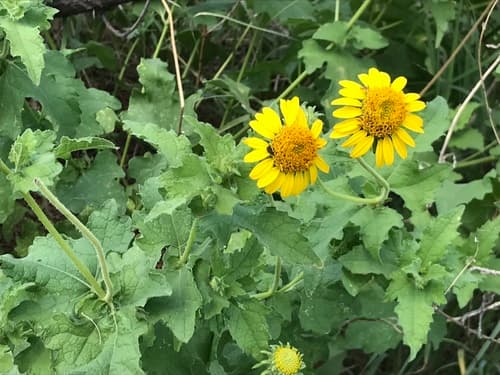
Simsia calva, known as bush sunflower, grows in dry, sunny fields and roadsides across the southwestern United States. It produces yellow blooms from March through November and draws butterflies.
Toxicity unknown
Bush Sunflower (Simsia calva) is not listed by the ASPCA Animal Poison Control Center (opens in new tab) or the other sources we check, so we have no verdict for it either way. Absence from those lists is not a clearance. If your pet shows symptoms after eating any plant, call the ASPCA at (888) 426-4435.
Light
full sun
Water
low
Size
12"–36" H × 12"–36" W
Bloom
Mar, Apr, May, Jun, Jul, Aug, Sep, Oct, Nov
Native to
NM, TX
Pollinators
butterflies
Before you buy
Your city may pay you to plant this
Cities and water utilities offer rebates for replacing lawn with native and water-wise plants. We track 460 programs across 44 states, each with a link to the provider and the date we last checked it.
Find rebates in your areaPicture natives in your own yard
Upload a photo of your yard and Patch Vision shows a rendering of it planted with natives for your region, like Bush Sunflower.


Browse plants for this ecoregion
Bush Sunflower is a compact native perennial that produces cheerful yellow daisy-like blooms from spring through fall. This drought-tolerant plant forms a neat, rounded mound and requires minimal water once established, making it an excellent low-maintenance choice for Texas gardens.
Growing Bush Sunflower
Grow Bush Sunflower in full sun and low water. Mature plants reach 12 to 36 inches tall and spread 12 to 36 inches wide. Expect low maintenance to keep it looking intentional in a front yard.
How to care for Bush Sunflower, by region
How to care for Bush Sunflower where it is actually grown: year-round basics plus what to do each season, region by region, with the sources for each.
Care guidance last updated: September 2026
Texas Blackland Prairies (includes Dallas, TX)
Year-round
Bush Sunflower is a tough, sun loving perennial that needs sharp drainage most of all to do well in the Dallas area.
- Give it full sun, at least six to eight hours a day, for the best bloom and a compact shape.
- Good drainage matters most. The heavy Blackland clay common around Dallas holds water, so plant on a slope, in a raised bed, or work some coarse sand or expanded shale into the soil first.
- It grows a deep taproot and becomes very drought tolerant once established, usually after its first full growing season.
- Water deeply but not often once it is established. Overwatering in clay soil is the most common way people lose this plant.
- Expect a mounding, bushy shape roughly one and a half to three feet tall and wide, with small yellow daisy like flowers.
- Deer tend to leave it alone, which is useful for an unfenced front yard.
Fall
Bush Sunflower keeps blooming into fall in the Dallas area right up until the first hard freeze knocks it back.
- Blooms typically continue into October and sometimes November here, tapering off as nights cool.
- Deadhead spent flowers through October to keep new blooms coming and to limit how much the plant reseeds itself.
- NWS records put the Dallas-Fort Worth average first freeze around November 22. Expect the top growth to blacken and die back around then.
- Cut back watering as growth slows in fall. This is a naturally low water season for the plant here.
- Once frost kills the top growth, it is fine to leave the dead stems standing through fall. Save the hard cutback for late winter.
Deadheading through October keeps the front bed looking cared for while the plant is still blooming.
Winter
The plant goes fully dormant after the first hard freeze and spends winter as a bare crown and root system.
- Top growth dies back to the ground after a hard freeze, typically by late November in the Dallas area.
- Cut the dead stems back to a few inches above the ground in late winter, before new growth starts underneath.
- No need to water a dormant plant unless Dallas goes an unusually long stretch without any rain.
- Good drainage matters in winter too. A taproot sitting in cold, wet Blackland clay is a common way to lose the plant, more so than the cold itself.
- Because it dies back completely, the spot will look bare from the first freeze until new spring growth. Nearby evergreen plants help keep the bed from looking empty.
Cutting the dead stems back in late winter keeps the bed from looking dead once neighbors' spring color starts coming in.
Spring
Spring is when Bush Sunflower wakes back up from winter and starts pushing new growth from its base.
- New growth resumes from the base once nights stay reliably above freezing. NWS records for Dallas-Fort Worth put the average last freeze around March 12.
- If the dead winter stems were not already cut back, trim them down to a few inches before the new shoots get much taller, so growth does not have to push through old dead wood.
- Spring is normally the wettest stretch of the year in Dallas, so hold off on extra watering until the rain slows. Soggy Blackland clay is more likely to rot the taproot than a dry week is to hurt the plant.
- Some early leaf chewing is normal. Bush Sunflower is a documented host plant for the Bordered Patch butterfly, and the plant regrows quickly.
- A light layer of compost or mulch pulled back from the crown can help once new leaves are a few inches long, though it is not required.
Summer
Dallas summer heat and dry spells are exactly the conditions this plant is built for, once it has a season of roots under it.
- Water deeply but infrequently, roughly every 10 to 14 days in a real dry stretch, less if there has been rain.
- By mid to late summer the plant can get leggy and open up in the middle. Cutting it back by about half brings on a fuller, more compact rebloom before fall.
- Skip fertilizer. Rich or overly wet Blackland clay tends to produce a floppy plant with fewer flowers, not a better one.
- Full sun and heat are not a problem for an established plant. Wilting in the hottest part of the afternoon and bouncing back by evening is normal, not a sign it needs more water.
A mid-summer cutback keeps the plant from sprawling over a front walkway or bed edge and gives it a tidier second bloom.
Sources: Lady Bird Johnson Wildflower Center - Simsia calva, Native Plant Society of Texas - Simsia calva, Eco Blossom Nursery - Simsia calva (Bush Sunflower), National Weather Service Fort Worth/Dallas - Normals, Means, and Extremes, Butterflies and Moths of North America - Bordered Patch (Chlosyne lacinia)
In an HOA neighborhood
Bush Sunflower is an HOA-friendly choice. Maintenance level: low. Tidiness: 4 out of 5.
Works well in: front yard, foundation, street edge, mid zone.
Wildlife value
The extended bloom period provides nectar for butterflies and other pollinators from March through November. Its seeds also attract birds during the fall and winter months.
Common questions
- When does Simsia calva bloom?
- Simsia calva blooms over a long season, generally from March through November, with flowering often peaking during the warmer summer months.
- What pollinators visit Simsia calva?
- Butterflies are commonly observed visiting the yellow flower heads of Simsia calva.
- What growing conditions does Simsia calva prefer?
- This forb does best in full sun with low water needs, making it a good fit for dry, well-drained soils in hot, arid to semi-arid climates.
- Is Simsia calva a shrub or a wildflower?
- Despite the common name bush sunflower, Simsia calva grows as an herbaceous forb rather than a woody shrub, dying back at the end of the growing season.
- Is Bush Sunflower HOA-friendly?
- Bush Sunflower is generally an HOA-friendly choice in the right placement, with low maintenance.
These answers were drafted with an AI model from this plant's data. Verify care details with a local expert.
See Bush Sunflower in a real native yard
Bush Sunflower is one of the natives used in these Garden Planner yard designs. Tap any one to see the before and after.
The after image is a Garden Planner preview, generated by an AI image model from the real yard photo. It replants the yard with native plants chosen to fit that yard's ecoregion, sun, and HOA strictness. The finished planting will look different.
Native range data from vouchered herbarium specimen records and regional native plant society lists. Pollinator and host plant associations compiled from GBIF, iNaturalist, and published ecological literature.
If something looks wrong
Common plant problems, and what to check first
These come up on almost any plant. Each guide lists the likely causes in the order they are worth ruling out, with one thing to check before you act on any of them, and links to the source it came from.
- It is dying right after planting
- Leaves turning yellow
- Wilting even though I watered it
- Brown crispy leaf tips
- Bugs on the plant
Ready to grow Bush Sunflower? Add it to your garden in Pollinator Patch to track it and get season-by-season care guidance.