Texas Persimmon
Diospyros texana
Last reviewed: September 2026
Texas persimmon is a small evergreen to semi-evergreen tree that thrives in full sun and dry, well drained soil, blooming with small white flowers from March through May.
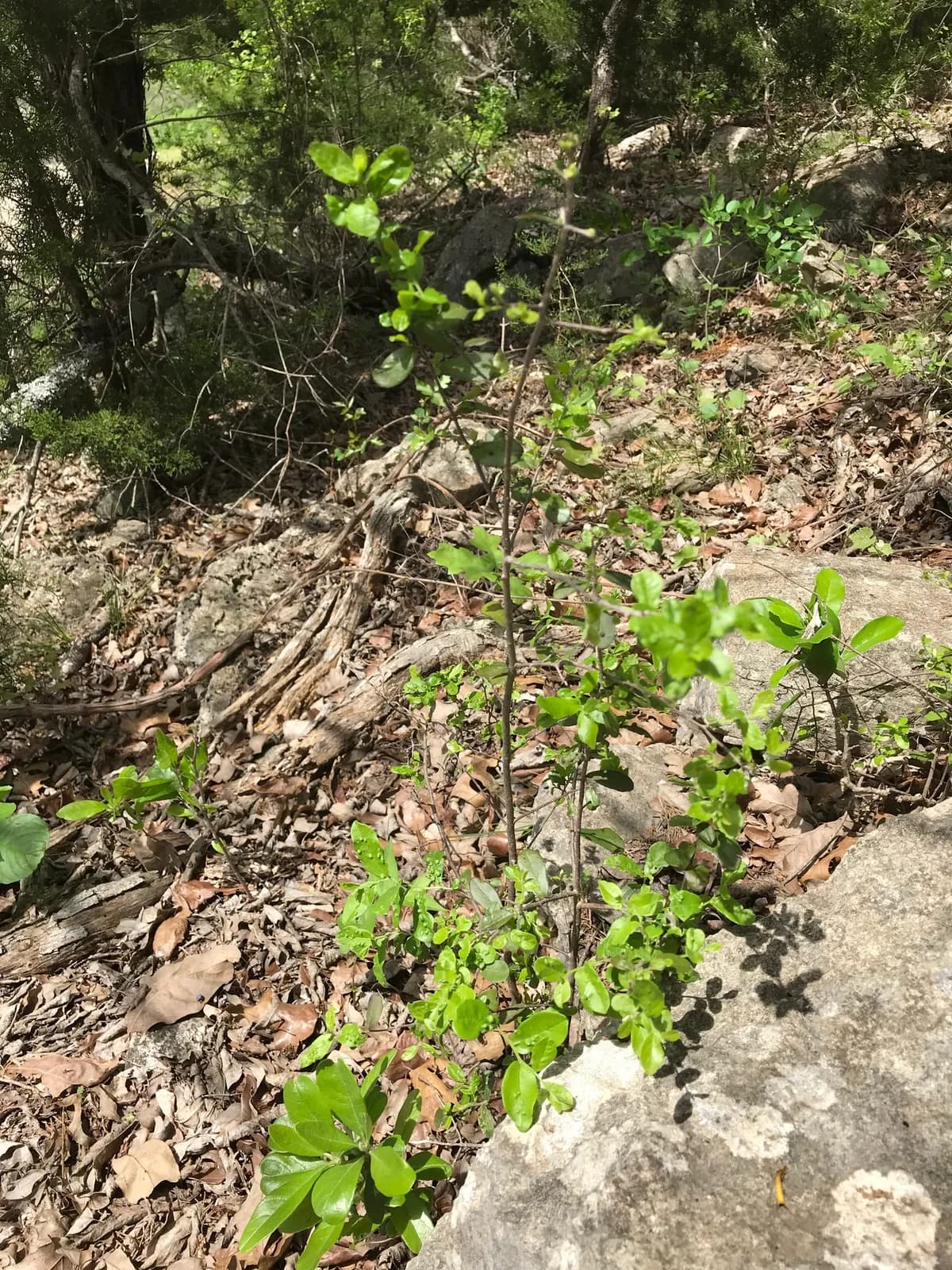
Toxicity unknown
Texas Persimmon (Diospyros texana) is not listed by the ASPCA Animal Poison Control Center (opens in new tab) or the other sources we check, so we have no verdict for it either way. Absence from those lists is not a clearance. If your pet shows symptoms after eating any plant, call the ASPCA at (888) 426-4435.
Light
full sun
Water
low
Size
96"–240" H × 48"–60" W
Bloom
Mar, Apr, May
Native to
TX
Pollinators
butterflies, nectar insects
Before you buy
Your city may pay you to plant this
Cities and water utilities offer rebates for replacing lawn with native and water-wise plants. We track 452 programs across 44 states, each with a link to the provider and the date we last checked it.
Find rebates in your areaBrowse plants for this ecoregion
Texas Persimmon is a small native tree with distinctive smooth, gray bark that exfoliates to reveal white patches underneath. It produces small white flowers in spring followed by black fruits that are prized by wildlife, and its semi-evergreen foliage provides year-round structure.
Growing Texas Persimmon
Grow Texas Persimmon in full sun and low water. Mature plants reach 96 to 240 inches tall and spread 48 to 60 inches wide. Expect moderate maintenance to keep it looking intentional in a front yard.
How to care for Texas Persimmon, by region
How to care for Texas Persimmon where it is actually grown: year-round basics plus what to do each season, region by region, with the sources for each.
Care guidance last updated: September 2026
Cross Timbers (includes Fort Worth, TX)
Year-round
Texas persimmon is a small, slow growing native tree that shrugs off Fort Worth heat and dry spells once its roots settle in.
- Give it full sun to light shade. It flowers and fruits best with several hours of direct sun each day.
- Plant it in soil that drains. It handles both the sandy Cross Timbers ground on Fort Worth's west side and the heavier clay found closer to Dallas, as long as water does not sit around the roots after a hard rain.
- Water it deeply every week or two through the first growing season while roots establish. After that it is drought tolerant and usually gets by on rainfall alone.
- Expect a slow grower that typically reaches 10 to 20 feet here, often as a multi trunked small tree. It can take close to a decade to show off the smooth, pale flaking bark it's known for.
- Its leaves feed caterpillars of the gray hairstreak and Henry's elfin butterflies, so light chewing in spring means the tree is doing its job, not a pest problem.
Fall
Fall is harvest and cleanup season for Texas persimmon, when the fruit on female trees finally turns black and starts dropping.
- Fruit ripens from late summer into fall and turns from green to black when fully soft and ready. Only female trees produce fruit.
- Ripe fruit that falls onto a driveway, patio, or light colored concrete can leave a dark stain, so sweep or hose it off soon after it drops if the tree hangs over hardscape.
- In the Fort Worth area, which sits at the cooler northern edge of this tree's range, expect more leaf drop in fall than a Texas persimmon would show further south, where it often stays semi evergreen.
- Fall is a good time to plant a new Texas persimmon here, since cooler air lets roots establish before next summer's heat.
Rake or hose off any fallen fruit near your driveway, walkway, or patio soon after it drops, since the ripe fruit stains concrete and can look messy if left to sit.
Winter
Winter is dormant pruning season for Texas persimmon, and the tree needs little else from you.
- If the tree needs shaping or a lower limb removed, do it in early winter while it is fully dormant, not in late winter, since flower buds for next spring's bloom start forming on old wood before bud break.
- Established trees handle typical Fort Worth winter cold without protection. A tree planted within the last year benefits from a layer of mulch over the root zone before a hard freeze.
- Bare branches and dropped leaves this time of year are normal here, since this tree is deciduous at the cooler, northern edge of its Texas range. It is not a sign of decline.
- Skip fertilizer in winter. This tree is adapted to lean, well drained soil and rarely needs feeding at all.
Do any structural pruning or trunk revealing cuts in early winter while the tree is bare, so the yard doesn't sit with an obviously freshly cut look heading into spring.
Spring
Spring is bloom time for Texas persimmon, and the biggest care rule is to keep pruning shears away from it.
- Small white to pale green flowers open February through April on wood the tree grew last year, so this is not the time for shaping cuts.
- If you want to prune for shape, wait until right after the blooms fade in spring rather than cutting in late winter, or you will remove next year's flower buds along with this year's.
- Give new spring growth a deep soak if the season turns dry, especially on a tree planted in the last year or two.
- You may see small caterpillars nibbling leaves. These are usually gray hairstreak or Henry's elfin larvae, both of which use Texas persimmon as a host plant, and they clear up on their own.
If you're shaping the tree this spring, cut right after bloom rather than earlier, so you're not left with a bare, freshly hacked look for the rest of the growing season.
Summer
Summer is the low maintenance season for an established Texas persimmon, though young trees still need help through the worst heat.
- A newly planted tree still benefits from a deep watering every one to two weeks during peak summer heat. A tree that has been in the ground more than a couple of years usually only needs supplemental water during an extended dry stretch.
- Keep a two to three inch mulch ring over the root zone to hold moisture, but pull it back a few inches from the trunk itself.
- Fruit begins forming on female trees now and will not fully ripen until late summer into fall, so green berries on the branches this time of year are normal.
- The species handles Texas summer heat well and is not known for serious pest or disease problems in home landscapes.
Sources: Lady Bird Johnson Wildflower Center: Diospyros texana, USDA Forest Service FEIS: Diospyros texana species review, Native Plant Society of Texas: Diospyros texana care notes (community tip)
Edwards Plateau (includes San Antonio, TX)
Year-round
Texas persimmon is a slow to moderate growing native tree that fits San Antonio's limestone soils and needs very little water once it is established.
- Plant in full sun to part shade in well-drained, alkaline, rocky or limestone-based soil, which matches most San Antonio yards.
- Extremely drought tolerant once established, generally two to three years after planting.
- The smooth, peeling gray and pink bark is the tree's main ornamental feature and shows best when lower limbs are lifted to reveal the trunk.
- Trees are dioecious, meaning male and female flowers grow on separate plants; only female trees produce the dark purple to black fruit.
- Leaves are deciduous to semi-evergreen depending on how cold the winter gets.
- In Texas, Texas persimmon leaves serve as a caterpillar host plant for the Henry's Elfin butterfly.
- Native to the Edwards Plateau and Rio Grande Plains of central and south Texas, the region that includes San Antonio.
The tidy multi-trunk form and ornamental bark read as an intentional specimen tree, which is HOA-friendly for a front yard planting.
Fall
Fall brings San Antonio's second seasonal rain peak and is a favored planting window for Texas persimmon, with watering needs tapering off as temperatures cool.
- September and October typically bring a second rain peak to the Edwards Plateau, which helps new plantings establish.
- Fall is a good alternative to spring planting, giving roots time to establish before next summer's heat.
- Taper supplemental watering as daytime highs drop, checking soil moisture rather than watering on a fixed schedule.
- Leaves may begin to yellow and drop in cooler falls, since the species is deciduous to semi-evergreen; in a mild fall it may hold its leaves later into the season.
- Wildlife continue to feed on any fruit still on the tree or ground into early fall.
Winter
Winter in San Antonio, zone 8b to 9a, is generally mild enough for an established Texas persimmon without protection, and it is the best window for structural pruning.
- Texas persimmon is hardy through USDA zones 7 to 9, and San Antonio's zone 8b to 9a winters fall well within that range.
- Late winter, before new spring growth starts, is the recommended time to prune and shape the multi-trunk form and reveal the bark.
- A newly planted or very young tree can still be hurt by a hard freeze; mulch the root zone and consider wrapping the young trunk on nights well below freezing.
- Established trees need little to no supplemental water while dormant.
Spring
Spring is bloom time for Texas persimmon and a good season to plant or keep a young tree watered before San Antonio's summer heat sets in.
- Small, fragrant white to greenish flowers appear February through April.
- Water a newly planted or young tree deeply about once a week if spring rain is light.
- Established trees generally do not need supplemental watering in spring.
- Spring is a workable planting window, since San Antonio's average last frost falls in mid to late February.
- Add a layer of mulch around the base, kept a few inches off the trunk, to hold soil moisture ahead of summer.
Summer
Summer is San Antonio's peak heat stress season, but a well-established Texas persimmon needs little more than occasional deep watering, and this is also when the fruit ripens.
- San Antonio summers regularly reach the upper 90s to low 100s Fahrenheit with dry stretches between rain events.
- Give an establishing tree, roughly its first two to three years, a deep soak every one to two weeks during extended dry heat.
- Mature, established trees can generally go without supplemental water through summer dry spells.
- Avoid frequent shallow watering or poor drainage, since soggy soil around the roots can cause decline.
- Fruit ripens and softens from roughly July through September and is eaten heavily by birds and mammals; sweep dropped fruit off patios and walkways since it can stain surfaces and create a slip hazard.
Sources: Lady Bird Johnson Wildflower Center, Native Plant Database: Diospyros texana, USDA Forest Service, Fire Effects Information System: Diospyros texana, Butterflies and Moths of North America: Henry's Elfin (Callophrys henrici) host plants, Texas A&M AgriLife Extension, Aggie Horticulture: Persimmons
Texas Blackland Prairies (includes Dallas, TX)
Year-round
Texas persimmon is a slow to moderate growing Texas native tree that asks for very little once it is established, mainly full sun and soil that drains.
- It grows wild across much of Texas, including the Blackland Prairies region that surrounds Dallas, so local rainfall and clay or limestone soils are well within what it is already used to.
- Give it full sun to light shade and well drained soil. It tolerates the heavy clay and rocky, alkaline ground common around Dallas once its roots are established.
- This is a dioecious tree, meaning individual plants are either male or female. Only a female tree sets the small black fruit, so a single tree may flower every spring without ever fruiting.
- Water deeply but infrequently once established. It is one of the more drought tolerant native trees for North Texas and does not want regular irrigation or wet feet.
- Growth is slow to moderate, on the order of eight to twelve inches a year for a young tree. It is generally free of serious pests or disease, though aphids occasionally show up on new growth.
Its compact vase shape and smooth, pale gray bark read as a deliberate ornamental choice, which tends to fit HOA-friendly front yard expectations better than a scrappier native shrub.
Fall
Fall is fruit drop season here, and one of the two best windows to plant, right alongside spring.
- Ripe black fruit drops from female trees between roughly September and the first freeze. Sweep or rake fallen fruit off walkways and patios promptly, since it can stain hard surfaces if left to sit.
- October is typically the second wettest month of the year in Dallas, behind only May, so a newly planted tree usually needs less hand watering than it would in summer.
- Fall planting is a good window here. Cooler air lets a new tree put energy into root growth before next year's summer heat arrives.
- Dallas averages a first freeze around November 22. Get any new tree in the ground with several weeks of root establishment time before that date.
- Leaves may thin or drop as the tree eases toward winter dormancy. That is normal and not a sign of a problem.
Prompt fruit cleanup on paved areas keeps the tree from looking neglected, an easy way to stay HOA-friendly without changing anything about the planting itself.
Winter
Winter is dormant season here, and the season for any real pruning, with an occasional hard freeze the main thing to plan around.
- Dallas falls in USDA plant hardiness zone 8a to 8b depending on the neighborhood, per the USDA's Plant Hardiness Zone Map.
- The bigger risk to a young or newly planted tree is an unusual hard freeze event, the kind North Texas sees every several years. Wrap or cover a first or second year tree ahead of any forecast hard freeze. An established, older tree handles a typical Dallas winter without help.
- This is the best season for structural pruning. With the tree bare or thin and dormant, it is easy to see and shape the smooth, pale bark that is its main ornamental feature.
- Some thinning or bare branches through winter is normal dormant behavior for this semi-evergreen to deciduous tree, not a sign of a problem.
- Hold off on fertilizer until spring growth resumes. This tree does not want to be pushed to grow during a cold snap.
Winter structural pruning that keeps the natural vase shape and shows off the bark is a low-effort way to keep the tree looking tended, an HOA-friendly touch through the bare season.
Spring
Spring is bloom time for Texas persimmon, and the point to wait for before planting or doing any real work on one.
- Small, fragrant white to cream flowers open from around February into April, drawing bees and other pollinators even though the blooms are not showy from a distance.
- Dallas averages a last freeze around March 12. Hold off planting or transplanting a young tree until after that date so new growth is not caught by a late cold snap.
- New spring growth is when aphids are most likely to appear. A strong spray of water or insecticidal soap on the new tips clears most outbreaks without reaching for a stronger pesticide.
- Skip supplemental watering for an established tree even in a wet Dallas spring like May. Extra water is really only worth it for a tree planted within the last year.
- If the tree needs shaping, wait until after bloom finishes so pruning does not remove the flowers the summer fruit depends on.
A quick post-bloom shaping keeps the tree's vase form tidy for a street-facing bed, an HOA-friendly look without heavy pruning.
Summer
Summer in Dallas is hot and, most years, the driest stretch, which is exactly the weather this tree is built for.
- Dallas typically logs 40 or more days above 100 degrees Fahrenheit each summer, and July and August are normally the two driest months of the year here.
- An established Texas persimmon needs little to no supplemental water through that dry stretch. It is well suited to exactly this kind of heat and drought.
- A tree still in its first one to two years in the ground is the exception. Give it a deep, slow soak every couple of weeks during the driest weeks rather than frequent shallow watering.
- Female trees begin ripening their round, one-inch fruit from green to black late in this season, running into early fall.
- Avoid pruning in peak summer heat. Save real structural cuts for the dormant winter months so the tree is not managing heat stress and pruning wounds at the same time.
Sources: Lady Bird Johnson Wildflower Center - Diospyros texana, Texas A&M AgriLife - Plants of Texas Rangelands: Texas Persimmon, Texas Master Naturalist Alamo Chapter - Texas Persimmon, USDA Plant Hardiness Zone Map, National Weather Service Fort Worth - DFW Freeze Dates, National Weather Service Fort Worth - DFW Normals, Means, and Extremes
Want these tasks as reminders timed to your yard? Pollinator Patch turns this guidance into a season-by-season care plan for the plants you actually grow.
In an HOA neighborhood
Texas Persimmon is an HOA-friendly choice in the right placement. Maintenance level: moderate. Tidiness: 4 out of 5.
Works well in: front yard, mid zone.
- Trees often require HOA/ARC approval even when allowed.
- Verify setbacks from sidewalks, driveways, utilities, and structures.
- Confirm mature height/canopy limits and sightline rules for corners.
Wildlife value
The spring flowers attract butterflies and other nectar-loving insects. The dark fruits are an important food source for birds and small mammals.
Common questions
- How much water does Texas persimmon need?
- This tree tolerates low water once established and does best in well drained soil that is allowed to dry out between waterings.
- When does Texas persimmon bloom?
- Texas persimmon blooms in March, April and May, producing small white to greenish flowers.
- What pollinators visit Texas persimmon flowers?
- Butterflies and other nectar seeking insects visit the flowers for nectar during the spring bloom period.
- What kind of light does Texas persimmon need to grow well?
- It grows best in full sun but can also handle part sun locations without loss of vigor.
- Is Texas persimmon deciduous or evergreen?
- It is best described as semi-evergreen, holding onto its leaves through mild winters and dropping some or all of them during colder or drier stretches.
- Is Texas Persimmon HOA-friendly?
- Texas Persimmon is generally an HOA-friendly choice in the right placement, with moderate maintenance.
These answers were drafted with an AI model from this plant's data. Verify care details with a local expert.
Native range data from vouchered herbarium specimen records and regional native plant society lists. Pollinator and host plant associations compiled from GBIF, iNaturalist, and published ecological literature.
If something looks wrong
Common plant problems, and what to check first
These come up on almost any plant. Each guide lists the likely causes in the order they are worth ruling out, with one thing to check before you act on any of them, and links to the source it came from.
- It is dying right after planting
- Leaves turning yellow
- Wilting even though I watered it
- Brown crispy leaf tips
- Bugs on the plant
Ready to grow Texas Persimmon? Add it to your garden in Pollinator Patch to track it and get season-by-season care guidance.
Planning a bed around it? Start a free plan with this plant
Not sure where to start? Take the 2-minute yard quiz