Soapweed yucca
Yucca glauca
Last reviewed: September 2026
Yucca glauca is a drought tolerant succulent that thrives in full sun across prairie and plains regions, sending up creamy white flower spikes from May through July that attract moths and bees.
Toxicity unknown
Soapweed yucca (Yucca glauca) is not listed by the ASPCA Animal Poison Control Center (opens in new tab) or the other sources we check, so we have no verdict for it either way. Absence from those lists is not a clearance. If your pet shows symptoms after eating any plant, call the ASPCA at (888) 426-4435.
Light
full sun
Water
low
Size
18"–36" H × 24"–36" W
Bloom
May, Jun, Jul
Native to
CO, IA, KS, MO and 8 more states
Pollinators
moths, bees
Before you buy
Your city may pay you to plant this
Cities and water utilities offer rebates for replacing lawn with native and water-wise plants. We track 459 programs across 44 states, each with a link to the provider and the date we last checked it.
Find rebates in your areaPicture natives in your own yard
Upload a photo of your yard and Patch Vision shows a rendering of it planted with natives for your region, like Soapweed yucca.


Browse plants for this ecoregion
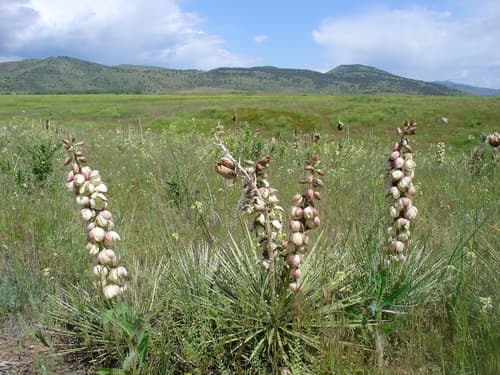
A trunkless, clump-forming succulent with narrow, rigid blue-green leaves and a stout central spike of pale greenish-white bell-shaped flowers in early summer. Extremely cold and drought tolerant once established.
Growing Soapweed yucca
Grow Soapweed yucca in full sun and low water. Mature plants reach 18 to 36 inches tall and spread 24 to 36 inches wide. Expect low maintenance to keep it looking intentional in a front yard.
How to care for Soapweed yucca, by region
How to care for Soapweed yucca where it is actually grown: year-round basics plus what to do each season, region by region, with the sources for each.
Care guidance last updated: October 2026
Flint Hills (includes Manhattan)
Year-round
Year-round care for soapweed yucca around Manhattan: full sun, well-drained soil, little water.
- Plant it in full sun in well-drained soil.
- Water needs are low and it is highly drought tolerant.
- The evergreen leaves form a clump about 3 to 4 feet wide.
- Flower stalks rise up to about 4 and a half feet from June through August.
- Oregon State University lists it as hardy to USDA Zone 3.
Its evergreen clump holds its shape all year, which reads as a tidy specimen plant in a front bed.
Sources: Lady Bird Johnson Wildflower Center: Yucca glauca, Oregon State University Landscape Plants: Yucca glauca
Nebraska Sand Hills (includes Valentine)
Year-round
Year-round care for soapweed yucca around Valentine: full sun, well-drained soil, little water.
- Plant it in full sun in well-drained soil.
- Water needs are low and it is highly drought tolerant.
- The evergreen leaves form a clump about 3 to 4 feet wide.
- Flower stalks rise up to about 4 and a half feet from June through August.
- Oregon State University lists it as hardy to USDA Zone 3.
Its evergreen clump holds its shape all year, which reads as a tidy specimen plant in a front bed.
Sources: Lady Bird Johnson Wildflower Center: Yucca glauca, Oregon State University Landscape Plants: Yucca glauca
Western Corn Belt Plains (includes Des Moines, IA)
Year-round
Soapweed yucca is actually native to Iowa's own Loess Hills in the west of the state, so it is well matched to the freeze and thaw winters and hot summers around Des Moines once it is planted in the right spot.
- Give it full sun and sharp drainage above everything else. Iowa's heavier clay garden soil holds far more water than the sandy loess hills this plant grows in naturally, so plant it on a slope, in a raised bed, or work coarse sand or gravel into the planting hole.
- Once established, usually after its first year or two, it needs very little supplemental water. Wet feet in heavy soil is the most common way this plant is lost here, not cold.
- The leaf tips are stiff and sharp enough to puncture skin, so keep it back from walkways, patios, and any spot where kids or pets brush past.
- ASPCA poison control lists yucca (Yucca spp., which covers this species) as toxic to dogs, cats, and horses. The toxic principle is saponins, and dogs and cats typically get vomiting if they chew on it. Keep pets from chewing the leaves or flower stalk.
Its tidy evergreen rosette and tall summer flower stalk read as an intentional specimen plant, which tends to fit an HOA-conscious front bed better than a loose, informal prairie planting.
Fall
Fall is about letting the plant slow down and dry out before the Des Moines area's first frost, which usually lands sometime in early to mid October.
- Stop supplemental watering by early fall unless conditions are unusually dry. Heading into winter with wet soil around the roots is the main cause of winter dieback in this climate, more than the cold itself.
- Leave this season's leaves in place through fall. Do not cut back green foliage, since it helps protect the crown through winter.
- If seed pods formed after summer bloom, you can leave them on or trim them off. Either way is fine and will not affect the plant.
- This is a good window to improve drainage around an existing planting, such as adding coarse grit or regrading a low spot, before the ground freezes for winter.
Winter
Winter is when soapweed yucca does the least and needs the least. It is rated hardy to USDA zone 3, well beyond what a typical Des Moines area winter asks of it, since the species is native as far north and cold as Iowa's own Loess Hills, North Dakota, and Montana.
- No winter watering or covering is needed for an established plant in well-drained soil. Its cold tolerance comfortably covers a normal Iowa winter.
- Leaves may flatten, curl, or take on a purple or grayish tint in cold weather. That is a normal seasonal look, not damage.
- Heavy wet snow can splay a rosette open. If a storm leaves a plant weighted down, gently brush the snow off rather than letting it sit.
- For a plant still in its first winter after transplant, or one sitting in a spot with slow drainage, a loose layer of mulch kept off the crown over the root zone gives some extra insurance until it is fully established.
Spring
Spring, after the last frost, is the best time to plant or divide soapweed yucca in the Des Moines area so roots have a full season to settle in before summer heat.
- Let the soil dry out from spring snowmelt and rain before planting or digging around an existing plant. Working wet clay soil now compacts it and works against the drainage this plant needs.
- New growth pushes up from the center of the rosette this month. Trim only leaves that are fully brown and dead from last year, and leave anything still green in place.
- If a mature plant sent up a flower stalk last summer, wait until the old stalk is completely dry and brown, then cut it back near the base.
- Skip the fertilizer. This plant is built for lean prairie soil, and feeding it tends to produce floppy leaves and fewer flowers, not a stronger plant.
Summer
Des Moines summers are hot and can get humid, but soapweed yucca is one of the most drought-tolerant plants a home garden here can have, and it mostly takes care of itself.
- Established plants, meaning two or more years in the ground, do not need routine watering through a normal Iowa summer. Only water during a stretch of three or more weeks with no real rain, and let the soil dry out fully between waterings.
- June through August is when the tall flower stalk shows up, sometimes several feet high, covered in creamy white bell shaped flowers. That is normal blooming, not a stress response.
- Humid stretches are a bigger risk here than heat. Good air movement around the base of the plant helps keep the crown from rotting in muggy weeks.
- A newly planted yucca can use a little afternoon shade its first Iowa summer. An established plant takes full sun without any help.
Sources: Lady Bird Johnson Wildflower Center - Yucca glauca native range, ASPCA Toxic and Non-Toxic Plants - Yucca, Oregon State University Landscape Plants - Yucca glauca
In an HOA neighborhood
Soapweed yucca is an HOA-friendly choice. Maintenance level: low. Tidiness: 4 out of 5.
Works well in: front yard, foundation, street edge.
- Sharp leaf tips; site away from walkways and foot traffic
Wildlife value
Host plant for yucca moth.
Flower spikes are pollinated by yucca moths in a specialized mutualism, and the blooms also draw foraging bees.
Common questions
- When does Yucca glauca bloom?
- Yucca glauca generally blooms from May through July, producing a tall central spike of creamy white to pale green flowers above its stiff, narrow leaves.
- What pollinates Yucca glauca?
- Yucca glauca relies heavily on yucca moths for pollination, a specialized mutualism in which the moth lays eggs in the flower while pollinating it. Bees also visit the flowers but are not part of this obligate relationship.
- How much water does Yucca glauca need?
- This yucca is adapted to low water conditions and grows best in well drained, sandy or rocky soil that does not stay wet. Overwatering can cause root rot.
- What kind of light does Yucca glauca need?
- Yucca glauca needs full sun to develop its characteristic rosette form and flower well. It becomes leggy and blooms poorly in shaded conditions.
- Is Soapweed yucca HOA-friendly?
- Soapweed yucca is generally an HOA-friendly choice in the right placement, with low maintenance.
These answers were drafted with an AI model from this plant's data. Verify care details with a local expert.
Native range data from the World Checklist of Vascular Plants (Kew). Pollinator and host plant associations compiled from GBIF, iNaturalist, and published ecological literature.
If something looks wrong
Common plant problems, and what to check first
These come up on almost any plant. Each guide lists the likely causes in the order they are worth ruling out, with one thing to check before you act on any of them, and links to the source it came from.
- It is dying right after planting
- Leaves turning yellow
- Wilting even though I watered it
- Brown crispy leaf tips
- Bugs on the plant
Ready to grow Soapweed yucca? Add it to your garden in Pollinator Patch to track it and get season-by-season care guidance.