American Black Nightshade
Solanum americanum
Last reviewed: July 2026
Solanum americanum is a native annual forb found across the southeastern and western United States. It produces small white flowers from June through November and attracts bees as pollinators.
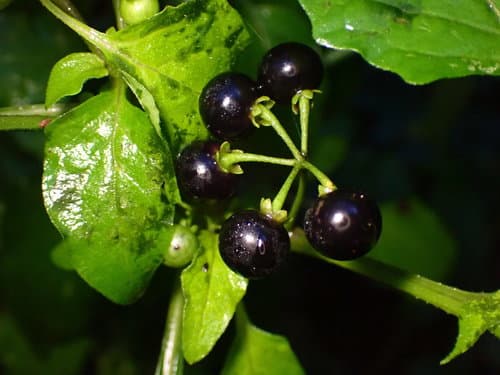
American Black Nightshade is toxic to dogs and cats.
Listed as toxic by the ASPCA Animal Poison Control Center (opens in new tab) (last reviewed 2026-05-21). If your pet has been exposed, call the ASPCA Animal Poison Control Center at (888) 426-4435and your veterinarian's emergency line.
Pollinator Patch flags toxic plants so you can choose a pet-safe native alternative for your yard.
Light
full sun
Water
low
Size
12"–36" H × 6"–18" W
Bloom
Jun, Jul, Aug, Sep, Oct, Nov
Native to
AL, AZ, CA, FL and 8 more states
Pollinators
bees
Before you buy
Your city may pay you to plant this
Cities and water utilities offer rebates for replacing lawn with native and water-wise plants. We track 411 programs across 44 states, each with a link to the provider and the date we last checked it.
Find rebates in your areaBrowse plants for this ecoregion
American Black Nightshade is a small annual forb that produces tiny white flowers followed by dark berries. This native plant blooms from summer through late fall and requires minimal water once established.
Growing American Black Nightshade
Grow American Black Nightshade in full sun and low water. Mature plants reach 12 to 36 inches tall and spread 6 to 18 inches wide. Expect moderate maintenance to keep it looking intentional in a front yard.
In an HOA neighborhood
American Black Nightshade is an HOA-friendly choice in the right placement. Maintenance level: moderate. Tidiness: 2 out of 5.
Works well in: mid zone, backyard only.
- Requires seasonal replanting
- May have messy dieback
Wildlife value
The small white flowers attract bees and other pollinators throughout its extended blooming period. Birds may also consume the berries.
Common questions
- When does American Black Nightshade bloom?
- Solanum americanum typically blooms from June through November, producing small white star-shaped flowers throughout this extended period.
- What pollinators visit American Black Nightshade?
- Bees are the primary pollinators of Solanum americanum, attracted to its small white flowers for nectar and pollen.
- Where is American Black Nightshade native?
- This species is native to multiple states including Alabama, Arizona, California, Florida, Georgia, Louisiana, Mississippi, Oregon, South Carolina, Tennessee, Texas, Utah, and Washington.
- What growing conditions does American Black Nightshade prefer?
- Solanum americanum thrives in full sun to partial sun conditions with low to moderate water requirements, making it well-adapted to various soil conditions.
- Is American Black Nightshade toxic to dogs?
- Yes. American Black Nightshade is listed as toxic to dogs by the ASPCA Animal Poison Control Center (aspca.org). If your pet has been exposed, call the ASPCA Animal Poison Control Center at (888) 426-4435.
- Is American Black Nightshade toxic to cats?
- Yes. American Black Nightshade is listed as toxic to cats by the ASPCA Animal Poison Control Center (aspca.org). If your cat has been exposed, call the ASPCA Animal Poison Control Center at (888) 426-4435.
- Is American Black Nightshade HOA-friendly?
- American Black Nightshade is generally an HOA-friendly choice in the right placement, with moderate maintenance.
Native range data from the USDA PLANTS Database and regional native plant society lists. Pollinator and host plant associations compiled from GBIF, iNaturalist, and published ecological literature.
Pollinator Patch flags toxic plants like American Black Nightshade and shows pet-safe natives for your ecoregion instead.
Not sure where to start? Take the 2-minute yard quiz