Indian Ricegrass
Achnatherum hymenoides
Last reviewed: October 2026
Achnatherum hymenoides, or Indian ricegrass, is a drought tolerant bunchgrass that blooms from May through July and grows best in full sun on dry, sandy or rocky soils.
Toxicity unknown
Indian Ricegrass (Achnatherum hymenoides) is not listed by the ASPCA Animal Poison Control Center (opens in new tab) or the other sources we check, so we have no verdict for it either way. Absence from those lists is not a clearance. If your pet shows symptoms after eating any plant, call the ASPCA at (888) 426-4435.
The USDA PLANTS Database (opens in new tab) does not flag Indian Ricegrass as toxic to livestock.
Light
full sun
Water
low
Size
12"–24" H × 12"–24" W
Bloom
May, Jun, Jul
Native to
AR, AZ, CA, CO and 15 more states
Pollinators
bees, beetles, butterflies
Before you buy
Your city may pay you to plant this
Cities and water utilities offer rebates for replacing lawn with native and water-wise plants. We track 459 programs across 44 states, each with a link to the provider and the date we last checked it.
Find rebates in your areaPicture natives in your own yard
Upload a photo of your yard and Patch Vision shows a rendering of it planted with natives for your region, like Indian Ricegrass.


Browse plants for this ecoregion
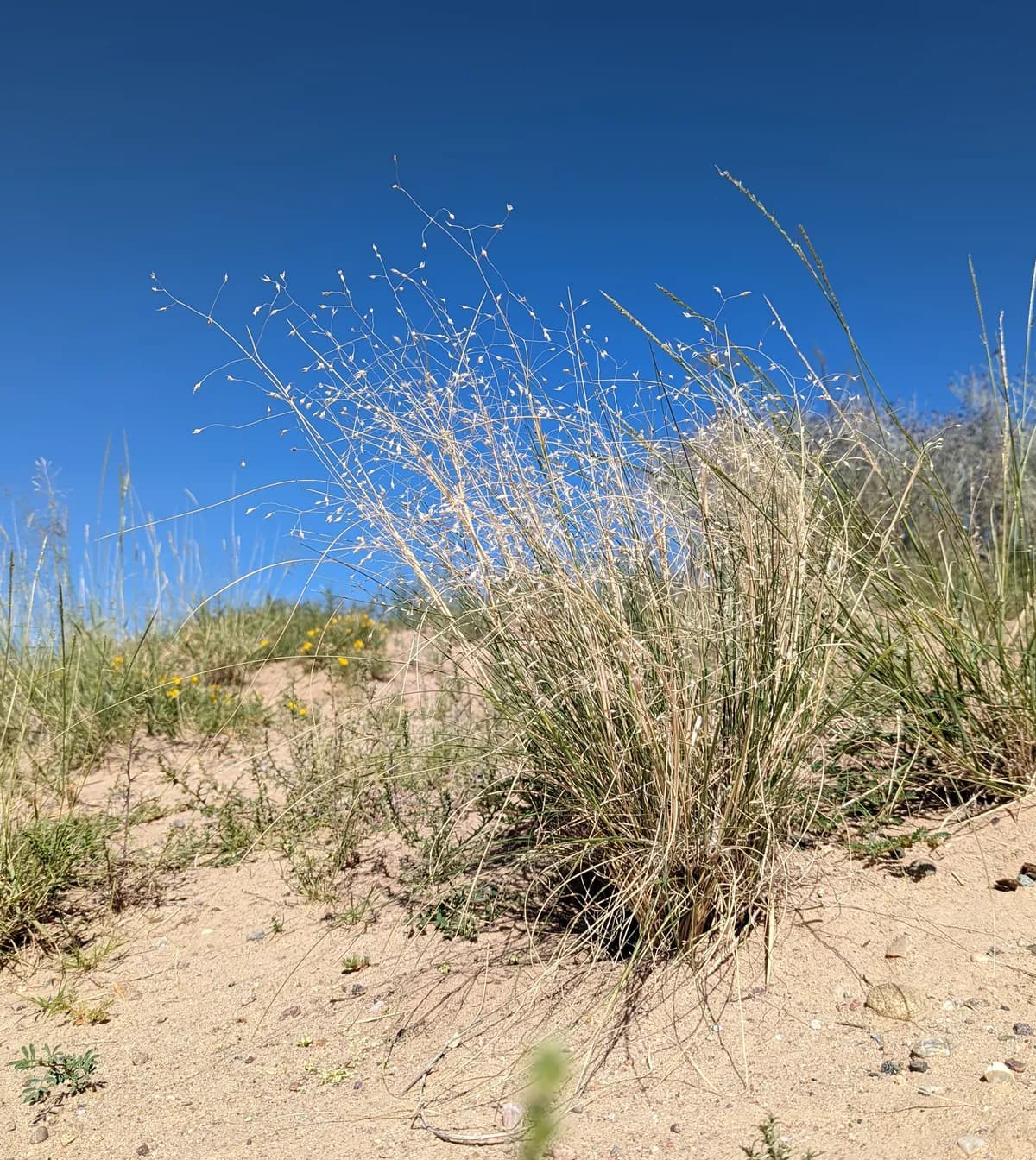
Indian ricegrass is a fine-textured bunch grass native to dry regions. It forms attractive clumps with delicate, airy seed heads that catch the light beautifully in late spring and summer.
Growing Indian Ricegrass
Grow Indian Ricegrass in full sun and low water. Mature plants reach 12 to 24 inches tall and spread 12 to 24 inches wide. Expect low maintenance to keep it looking intentional in a front yard.
How to care for Indian Ricegrass, by region
How to care for Indian Ricegrass where it is actually grown: year-round basics plus what to do each season, region by region, with the sources for each.
Care guidance last updated: October 2026
Mojave Basin and Range (includes Victorville, CA)
Year-round
Indian Ricegrass is a low, airy bunchgrass that already grows wild across the Mojave Basin and Range, the desert region around Victorville. Once it settles into sandy, well-drained soil, it needs very little water or care from you.
- Plant it in loose sandy or rocky, well-drained soil in full sun. It does not tolerate heavy clay or soil that stays wet.
- This grass is genuinely native to the Mojave Basin and Range ecoregion that includes Victorville, not just California in general. Growers at nearby Victor Valley College have grown wild-collected local seed from this same desert successfully.
- Water sparingly. Once established it needs very little supplemental water beyond Victorville's natural rainfall pattern.
- Skip regular fertilizing. It is adapted to low-fertility, sandy desert soils and does not need feeding.
- It is a short-lived bunchgrass, often declining after roughly 3 to 5 years, so plan on it reseeding itself or on adding new plants on that rough cycle rather than expecting one planting to last indefinitely.
- It is a likely larval host plant for several butterflies and moths found in the Mojave, including the Juba skipper and the white-lined sphinx moth, so leaving mature clumps in place rather than clearing them completely helps their caterpillars.
Its low, fine-bladed clumps stay under about 2 feet and read as soft groundcover texture, an HOA-friendly look rather than an unruly ornamental grass, since it typically stays within sightline and height rules.
Fall
Fall is the season to tidy up Indian Ricegrass: cut it back, clear out dead growth, and, if you want more of it, sow seed for a head start over winter.
- Early fall is the natural grooming window. Cut plants back to about 8 inches to clear out old growth before winter.
- At the same time, remove any fully dead, woody clumps so self-sown seedlings nearby have room to fill in.
- If you want to thicken a planting, late fall is the traditional seeding window. Cooling soil breaks the seed's dormancy naturally over winter without needing sandpaper or acid scarification.
- Keep watering minimal. The Mojave Basin and Range stays dry through fall, with most of the region's rain arriving in winter instead.
Cutting the clump back to about 8 inches each fall keeps its look tidy and HOA-friendly instead of letting it collapse into a matted, unkempt patch over winter.
Winter
Winter is actually the wettest and most active growing season for this grass in the Mojave Basin and Range. It is very cold hardy, so Victorville's mild winter frosts will not bother it.
- Winter is naturally the wettest season across the Mojave Basin and Range, so established plants get most of their yearly moisture now with little help from you.
- This is a cool-season grass and is very winter hardy. Victorville's occasional light frosts are well within its tolerance and need no covering or protection.
- If you are direct-sowing seed, late fall through winter dormant planting is the traditional method. Cold, moist soil naturally breaks down the seed's hard coat over the season.
- Expect slow, minimal top growth through the coldest weeks. This species greens up more slowly than most cool-season grasses and will not show much visible change until temperatures warm.
- Skip supplemental water unless the season stays unusually dry. Natural winter rainfall is normally enough.
Spring
Spring is when Indian Ricegrass sends up its wispy seed heads, and it is the best time to add more if you want it. It is a slow starter compared to most grasses, so do not expect fast green growth right away.
- In the Mojave Desert this grass can flower as early as February, though April and May are more typical. Watch for the delicate, hair-like seed panicles, which are its main ornamental feature.
- Spring is the best time to plant new starts or direct-sow seed. Local growers in Victorville have sown seed by hand into sandy furrows about 1 to 2 inches deep in March.
- It greens up more slowly than most cool-season grasses in spring, so a plant that still looks mostly tan while nearby lawns and shrubs have leafed out is not necessarily dead.
- Hold off on heavy watering. A light watering during dry spring stretches is enough on Victorville's sandy soil.
- Skip fertilizer this season too. It is adapted to lean, low-fertility sandy soils.
The airy seed panicles that show up in spring are the plant's main visual payoff, worth pointing out to neighbors as an intentional design feature rather than an overgrown patch.
Summer
Indian Ricegrass handles Victorville's dry, hot summers by drying down to a tan color and mostly resting, which is normal rather than a sign of trouble. It needs only occasional water this time of year.
- By mid-summer the seed heads have matured and the foliage cures to a light tan color. That is this cool-season bunchgrass going dormant in the heat, not dying.
- Established plants need very little water in summer. Most of the Mojave's rainfall arrives in winter, with only a small amount from summer thunderstorms, so occasional watering is enough.
- Do not overwater to try to keep it green through summer. This grass does not tolerate soil that stays wet, and extra moisture in the heat can rot the crown.
- By July or August the seed heads dry to a hard, dark stage. Leaving them in place gives birds and small desert mammals a food source through the hottest part of the year.
- Skip mid-summer fertilizing. It is adapted to low-fertility desert soils and does not need it.
The tan, cured look in mid to late summer can read as dead or neglected at a glance, so keeping the surrounding bed tidy helps it read as an intentional, dormant native grass rather than a patch that needs clearing.
Sources: BLM Mojave Desert Native Plants: Indian Ricegrass, USDA NRCS Plant Guide: Indian Ricegrass, Calscape: Indian Ricegrass (Stipa hymenoides), Lady Bird Johnson Wildflower Center: Achnatherum hymenoides
Northwestern Great Plains (includes Billings)
Year-round
Year-round care for Indian ricegrass around Billings: full sun and dry, deep sandy or rocky soil.
- It wants sun and deep, sandy or rocky soil.
- Water needs are low, and it prefers dry soil.
- Plants reach up to about 2 feet tall.
- Remove old clumps to give self-sown seedlings room to develop.
- It can be mowed to 8 inches in early fall.
- Newly seeded areas can take up to two years to become fully established.
Its fine, airy clumps give a soft look when kept mowed or trimmed at the bed edge.
Sources: Lady Bird Johnson Wildflower Center: Achnatherum hymenoides
Texas Blackland Prairies (includes Dallas, TX)
Year-round
Indian ricegrass is a cool-season clumping grass that likes full sun and fast-draining soil. In the Dallas area the biggest challenge is the heavy Blackland Prairie clay, so give it sharp drainage, water it well only until it roots in, then leave it mostly alone. It is drought tolerant once established and gives you airy seed heads that hold up through winter.
- Establishment: plant into a raised bed or a spot amended with coarse sand or gravel, since this grass rots in soggy clay. Water deeply once or twice a week the first season while roots take hold.
- Watering once established: back off to occasional deep soaks only in long dry spells. It handles drought far better than it handles wet feet.
- Mulch: use a thin gravel or decomposed-granite mulch, not heavy wood mulch, to keep the crown dry and reflect heat.
- Common mistake: overwatering and rich clay soil are what kill it, not neglect. Do not treat it like a thirsty lawn grass.
Fall
Fall is the best window for the yearly cutback in the Dallas area, and it is also when the grass earns its keep. The blades fade to ivory and the airy seed heads catch low autumn light. If you want a tidier look, shear it now.
- For the yearly cutback, mow or shear the clump to about 8 inches in early fall to keep it neat and make room for new growth.
- Remove old, tired clumps to give any self-sown seedlings room to develop if you want the patch to spread.
- If you prefer winter interest instead, you can skip the cutback and leave the ivory seed heads standing until spring.
Cutting the clump back to a tidy 8 inches in fall reads as deliberate seasonal maintenance and keeps the front yard looking cared for through winter, which helps avoid a violation letter.
Winter
In Dallas winters this grass is easygoing. Left uncut, the pale ivory blades and seed heads give real structure to a dormant garden. There is very little to do beyond keeping it dry.
- If you left it standing, enjoy the winter silhouette and hold the cutback until late winter or early spring, just before new green appears.
- Do not water on a schedule in winter. Cold, wet clay is the fastest way to lose the crown.
- Check that winter rain is draining away from the base and pull back any soggy mulch or leaf litter sitting against the crown.
A standing, well-shaped clump of ivory seed heads reads as an intentional winter feature rather than a dead plant, so leaving it up on purpose looks tidy and helps avoid a violation letter.
Spring
Spring is when this cool-season grass does most of its growing in the Dallas area, so this is the time to clean it up and get new plantings in. Do the yearly cutback before fresh green blades push up, and set out any new plants early while the soil is still cool and moist.
- If you did not cut it back in fall, shear the clump to a few inches now before new growth starts, so old tan blades do not mix with the fresh green.
- Plant any new divisions or nursery plants in early spring so roots establish before Dallas summer heat arrives.
- Give new spring plantings a deep weekly soak, but hold off on feeding. This grass wants lean soil, not fertilizer.
Doing the cutback in early spring reads as intentional seasonal tidy-up and keeps the front-yard clump from looking dead or neglected, which helps avoid a violation letter.
Summer
Indian ricegrass often goes semi-dormant and tan in the heat of a Dallas summer, and that is normal, not a sign it is dying. The main job is to resist the urge to water it heavily. Established clumps need very little.
- Let established plants ride out the heat with only an occasional deep soak during extended drought. Frequent watering in hot clay soil invites crown rot.
- Do not fertilize or prune in summer. The plant is conserving energy, so leave the faded seed heads in place.
- Keep the base clear of piled-up wet debris or dense mulch so the crown can breathe in the humidity.
Sources: Lady Bird Johnson Wildflower Center Achnatherum hymenoides, USDA NRCS Indian Ricegrass Plant Guide, ASPCA Toxic and Non-Toxic Plant List Dogs, Native Plant Society of Texas Achnatherum hymenoides, USDA Forest Service Indian Ricegrass, Utah State University Extension Indian Ricegrass
Wyoming Basin (includes Laramie, WY)
Year-round
Year-round care for Indian ricegrass around Laramie, WY: full sun and dry, deep sandy or rocky soil.
- It wants sun and deep, sandy or rocky soil.
- Water needs are low, and it prefers dry soil.
- Plants reach up to about 2 feet tall.
- Remove old clumps to give self-sown seedlings room to develop.
- It can be mowed to 8 inches in early fall.
- Newly seeded areas can take up to two years to become fully established.
Its fine, airy clumps give a soft look when kept mowed or trimmed at the bed edge.
Sources: Lady Bird Johnson Wildflower Center: Achnatherum hymenoides
In an HOA neighborhood
Indian Ricegrass is an HOA-friendly choice. Maintenance level: low. Tidiness: 4 out of 5.
Works well in: front yard, foundation, street edge, mid zone.
Wildlife value
This grass provides seeds for birds and small mammals while supporting native bees and beetles with its flowers. It's especially valuable as habitat for ground-nesting birds.
Common questions
- When does Indian ricegrass bloom?
- Indian ricegrass generally flowers from May through July, sending up slender stems topped with airy, open seed heads.
- What pollinators visit Indian ricegrass?
- Bees and beetles are the main visitors to Indian ricegrass flowers, drawn to the plant during its late spring and early summer bloom period.
- How much water does Indian ricegrass need?
- Indian ricegrass is adapted to low water conditions and handles extended dry spells once established, making it a good fit for arid and semi arid gardens.
- What light conditions suit Indian ricegrass best?
- Full sun is ideal for Indian ricegrass. It can tolerate some light afternoon shade but flowers and grows most vigorously in open, sunny sites.
- What does Indian ricegrass look like when it is not blooming?
- Outside of its May to July bloom window, Indian ricegrass forms a low, fine textured tuft of narrow green blades typical of a bunchgrass growth habit.
- Is Indian Ricegrass toxic to livestock?
- The USDA PLANTS Database does not flag Indian Ricegrass as toxic to livestock.
- Is Indian Ricegrass HOA-friendly?
- Indian Ricegrass is generally an HOA-friendly choice in the right placement, with low maintenance.
These answers were drafted with an AI model from this plant's data. Verify care details with a local expert.
Native range data from the World Checklist of Vascular Plants (Kew). Pollinator and host plant associations compiled from GBIF, iNaturalist, and published ecological literature.
If something looks wrong
Common plant problems, and what to check first
These come up on almost any plant. Each guide lists the likely causes in the order they are worth ruling out, with one thing to check before you act on any of them, and links to the source it came from.
- It is dying right after planting
- Leaves turning yellow
- Wilting even though I watered it
- Brown crispy leaf tips
- Bugs on the plant
Ready to grow Indian Ricegrass? Add it to your garden in Pollinator Patch to track it and get season-by-season care guidance.