Maryland Senna
Senna marilandica
Last reviewed: October 2026
Senna marilandica, also called American senna, is an upright perennial forb that blooms yellow from June through August in full sun and produces seed pods favored by wildlife. It thrives in medium moisture soils across meadows, prairies, and open woodland edges.
Toxicity unknown
Maryland Senna (Senna marilandica) is not listed by the ASPCA Animal Poison Control Center (opens in new tab) or the other sources we check, so we have no verdict for it either way. Absence from those lists is not a clearance. If your pet shows symptoms after eating any plant, call the ASPCA at (888) 426-4435.
The USDA PLANTS Database (opens in new tab) does not flag Maryland Senna as toxic to livestock.
Light
full sun
Water
medium
Size
24"–48" H × 24"–36" W
Bloom
Jun, Jul, Aug
Native to
AL, AR, CT, FL and 24 more states
Pollinators
bees, butterflies
Before you buy
Your city may pay you to plant this
Cities and water utilities offer rebates for replacing lawn with native and water-wise plants. We track 459 programs across 44 states, each with a link to the provider and the date we last checked it.
Find rebates in your areaPicture natives in your own yard
Upload a photo of your yard and Patch Vision shows a rendering of it planted with natives for your region, like Maryland Senna.


Browse plants for this ecoregion
Wild senna produces clusters of bright yellow flowers from June through August on upright stems with compound leaves. This native perennial forms a rounded clump and develops attractive seed pods in fall. The plant has a clean, structured appearance that works well in cultivated gardens.
Growing Maryland Senna
Grow Maryland Senna in full sun and medium water. Mature plants reach 24 to 48 inches tall and spread 24 to 36 inches wide. Expect low maintenance to keep it looking intentional in a front yard.
How to care for Maryland Senna, by region
How to care for Maryland Senna where it is actually grown: year-round basics plus what to do each season, region by region, with the sources for each.
Care guidance last updated: October 2026
Boston Mountains (includes Fayetteville)
Year-round
Year-round care for American senna around Fayetteville: full sun, well drained loam or sandy soil, and little water once established.
- Full sun gives the best flowering. NC State says it also grows in partial shade.
- Plant it in loam, sand, or shallow rocky soil with good drainage. It also tolerates moist conditions and occasional flooding.
- Once established it becomes drought tolerant.
- Expect 4 to 6 feet tall and 3 to 6 feet wide. Allow 12 inches to 3 feet of space.
- Stems may flop while flowering and setting seedpods, especially in fertile, moist soil.
- Yellow flowers open in July and August.
A grouped planting toward the back of a bed reads as a full, intentional border. Skip rich soil and give it room so the stems stay upright.
Sources: Lady Bird Johnson Wildflower Center: Senna marilandica, NC State Extension Plant Toolbox: Senna marilandica
Cross Timbers (includes Fort Worth, TX)
Year-round
American Senna is a native Texas perennial that grows a few feet tall and covers itself in yellow flower clusters through summer. It is a caterpillar host plant for sulphur butterflies, so a few chewed leaves in season are a sign it is doing its job.
- Give it full sun for the best flowering, though it tolerates a few hours of afternoon shade.
- Space new plants about 2 to 3 feet apart since it can spread nearly as wide as it is tall.
- It dies back to the ground each winter in North Texas and regrows from the base every spring, so bare soil in winter is normal, not a dead plant.
- It is the caterpillar host plant for the cloudless sulphur and little yellow butterfly, expect the caterpillars to eat some leaves and flower buds in summer.
- It is native to Texas, so once established it needs less coddling than many non-native perennials.
Reads as an intentional flowering border plant rather than a weed when grouped in a cluster of 3 or more; a single stray plant can look sparse.
Fall
In fall the flowers give way to long seed pods, and the plant slows down as nights cool before dying back for winter.
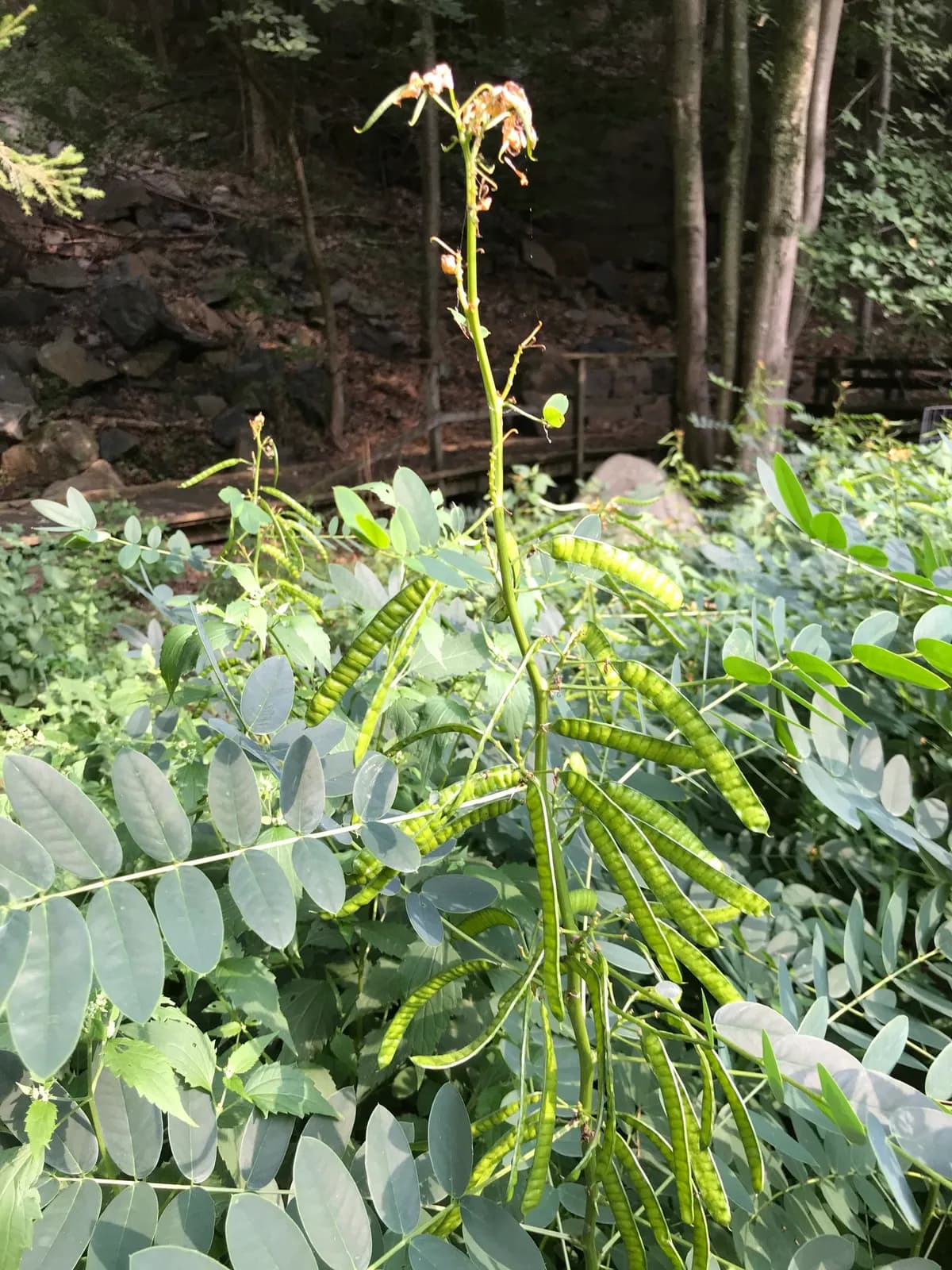
- Let the brown seed pods mature and stay on the plant through October, they feed quail and dove and are not a mess to clean up.
- Wait to cut the plant back until foliage blackens after a hard freeze, typically after mid November in North Texas.
- If you do not want it to spread by seed, snip pods off before they split open rather than letting them scatter.
- Fall is not the ideal time to plant this species since it is a perennial that comes back from the roots each year, spring planting gives it a full growing season to establish first.
Standing seed pods late in the season can read as an unkempt bed; leaving just the pods (not the whole plant) upright while keeping edges trimmed reads as intentional over messy.
Winter
American Senna dies back to the ground each winter in North Texas and needs no protection through the cold season.
- Cut dead stems back to 2 to 3 inches above the soil once they turn brown and brittle, any time from late November through February.
- A layer of mulch over the crown helps it through short hard freezes and the occasional severe Arctic outbreak.
- Do not worry if nothing is visible above ground for weeks, new stems return from the base once spring warms up.
- Skip watering unless the area goes several weeks without any rain.
A cut-back clump leaves a bare, empty-looking spot in the bed all winter; a plant marker or mulch ring signals it is dormant, not dead or abandoned.
Spring
Spring is the best time to put American Senna in the ground, right as new growth is starting to come up from the crown.
- Plant after the last frost, usually mid March in North Texas, so tender new growth is not caught by a late freeze.
- New stems come up from the base starting in April, this is normal even if the spot looked bare all winter.
- Water new plantings twice a week for the first month to help roots establish before summer heat arrives.
- The sandy loam soils common on the west side of the metro drain fast, so mix in compost at planting time if your soil is thin or rocky so roots hold moisture longer.
A newly planted, still-small clump can look like an empty bed for the first few weeks; a layer of mulch around it keeps the spot looking tended while it fills in.
Summer
Summer is bloom season for American Senna, with clusters of yellow flowers from June through August, right through the hottest stretch of the year.
- Expect the main flower show from June into August, followed by long brown seed pods.
- Water once or twice a week during the driest, hottest weeks of July and August, especially for plants in their first summer.
- Established plants (in the ground more than one summer) tolerate short dry spells without extra water.
- Sulphur butterfly caterpillars will chew leaves and flower buds this time of year, some leaf loss is expected and does not need any treatment.
Chewed leaves from caterpillars can look like pest damage to a passerby; a small sign or simply keeping the surrounding bed edged and tidy signals it is an intentional pollinator planting.
Sources: Senna marilandica, Lady Bird Johnson Wildflower Center, Plants for Pollinators: Wild Senna, Xerces Society, Maryland Senna, NC State Extension Plant Toolbox
Texas Blackland Prairies (includes Dallas, TX)
Year-round
American Senna is a clumping native perennial that thrives in the Blackland Prairies' heavy black clay, giving you tidy upright growth, summer yellow flowers, and butterfly value with very little work.
- Native to the Texas Blackland Prairies and much of the eastern and central US
- Grows in a neat clump 24 to 48 inches tall in full sun to part shade
- Handles the heavy black clay here and needs only medium water once settled
- Larval host for cloudless sulphur and little yellow (sleepy orange) butterflies, so expect some leaf nibbling and let it happen
- USDA lists it as non-toxic to horses and livestock
- Low maintenance overall, so plan on a light cleanup once a year
Its upright clumping habit reads as intentional, making it a good HOA-friendly mid-zone or back-of-border plant.
Fall
Fall is the other good planting time and the season the bean-like seed pods form, giving you a choice between a tidy look now or winter food for birds.
- Fall is a strong second planting window as the heat breaks
- Dark bean-like seed pods form after the summer flowers
- Remove the pods now if you want the cleanest look at the curb
- Or leave the pods for winter interest and seed-eating birds
- Ease off watering as fall rains return and temperatures drop
The dark seed pods can look untidy to some HOAs, so trim them for a neat look or leave them for birds if your yard allows a more natural style.
Winter
Winter is the rest season here, so the plant dies back and your only task is a late-winter cutback before new spring growth begins.
- The plant goes dormant and dies back over winter
- A few hard freezes are normal and will not harm this native
- Cut spent stems back near the ground in late winter
- Leave standing pods and stems until late winter if you want cover for birds
- No watering is needed while the plant is dormant
A late-winter cutback keeps the spot looking cared for before spring, which reads as intentional to an HOA.
Spring
Spring is the main planting and setup window, using the season's rain to help new American Senna root into the black clay before summer heat arrives.
- Plant new senna in spring so roots settle before the hot months
- Water new plants deeply about once a week when spring rain is light
- Skip heavy fertilizer, as this native does fine in local prairie clay
- Pull weeds around the young clump so it is not crowded early on
- Watch for fresh green growth returning from the crown after any winter cutback
Summer
Summer is bloom season and the stress season, so your job is steady water during the worst heat while the plant flowers and feeds butterflies.
- Expect clusters of yellow flowers from June through August
- Give a deep soak during long dry, mid-90s to 100F stretches
- Let caterpillars chew some leaves, as feeding sulphur butterflies is the goal here
- Do not spray the leaves for insects, since that kills the butterfly young
- Leave the plant standing, as it holds an upright tidy shape through summer
Even in full summer growth it stays upright and tidy, so it keeps a neat front-yard look during peak bloom.
Sources: USDA PLANTS Profile: Senna marilandica (SEMA11), Lady Bird Johnson Wildflower Center: Senna marilandica, Xerces Society: native plants for pollinators and butterfly hosts
In an HOA neighborhood
Maryland Senna is an HOA-friendly choice. Maintenance level: low. Tidiness: 4 out of 5.
Works well in: front yard, foundation, street edge, mid zone.
- Seed pods may look untidy if not removed
Wildlife value
Host plant for cloudless sulphur, little yellow butterfly.
The flowers attract native bees and butterflies, while the foliage serves as a host plant for some butterfly species. Seeds provide food for birds in fall and winter.
Common questions
- When does American senna bloom?
- American senna typically blooms from June through August, producing tall spikes of bright yellow flowers.
- What light and water conditions does Senna marilandica prefer?
- It grows best in full sun to part sun with medium soil moisture, and established plants can handle brief dry spells.
- Which pollinators visit American senna flowers?
- Bees and butterflies are commonly seen visiting the yellow summer flowers of American senna.
- Is American senna a woody plant or a perennial forb?
- It is a herbaceous perennial forb that dies back to the ground in winter and resprouts from its root crown each spring.
- Is Maryland Senna toxic to livestock?
- The USDA PLANTS Database does not flag Maryland Senna as toxic to livestock.
- Is Maryland Senna HOA-friendly?
- Maryland Senna is generally an HOA-friendly choice in the right placement, with low maintenance.
These answers were drafted with an AI model from this plant's data. Verify care details with a local expert.
Native range data from vouchered herbarium specimen records and regional native plant society lists. Pollinator and host plant associations compiled from GBIF, iNaturalist, and published ecological literature.
If something looks wrong
Common plant problems, and what to check first
These come up on almost any plant. Each guide lists the likely causes in the order they are worth ruling out, with one thing to check before you act on any of them, and links to the source it came from.
- It is dying right after planting
- Leaves turning yellow
- Wilting even though I watered it
- Brown crispy leaf tips
- Bugs on the plant
Ready to grow Maryland Senna? Add it to your garden in Pollinator Patch to track it and get season-by-season care guidance.