Bird-foot violet
Viola pedata
Last reviewed: September 2026
Toxicity unknown
Bird-foot violet (Viola pedata) is not listed by the ASPCA Animal Poison Control Center (opens in new tab) or the other sources we check, so we have no verdict for it either way. Absence from those lists is not a clearance. If your pet shows symptoms after eating any plant, call the ASPCA at (888) 426-4435.
Light
full sun
Water
low
Size
4"–8" H × 6"–10" W
Bloom
Apr, May, Jun
Native to
AL, AR, CT, DC and 30 more states
Pollinators
bees
Before you buy
Your city may pay you to plant this
Cities and water utilities offer rebates for replacing lawn with native and water-wise plants. We track 452 programs across 44 states, each with a link to the provider and the date we last checked it.
Find rebates in your areaBrowse plants for this ecoregion
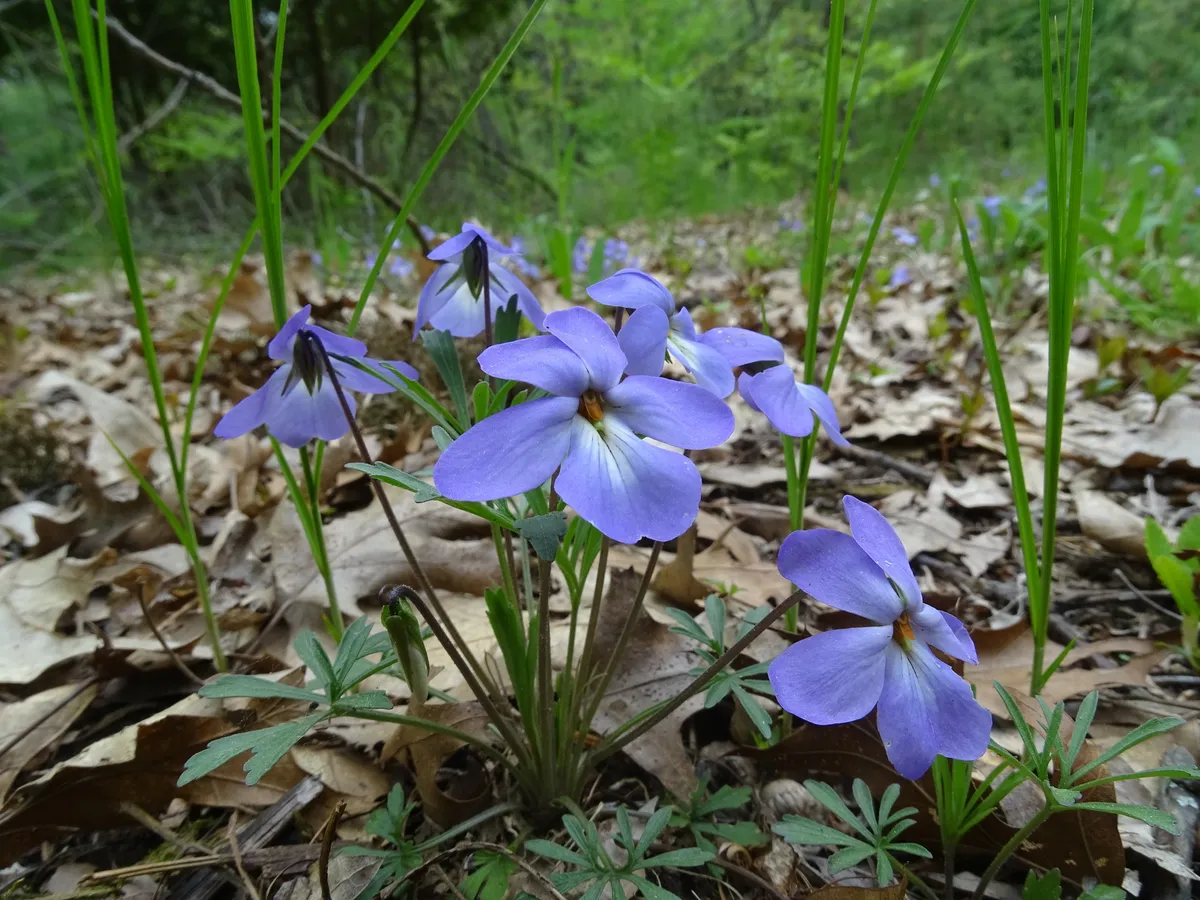
A low, tidy rosette of deeply lobed, birdfoot-shaped leaves topped with distinctive flat-faced purple to bicolor flowers. It prefers dry, well-drained sandy or rocky soils and stays compact all season.
How to care for Bird-foot violet, by region
How to care for Bird-foot violet where it is actually grown: year-round basics plus what to do each season, region by region, with the sources for each.
Care guidance last updated: September 2026
Ouachita Mountains (includes Hot Springs, AR)
Year-round
Bird's foot violet is a low, native wildflower around Hot Springs that needs lean, well drained, slightly acidic soil rather than rich garden beds, and blooms lavender blue in spring.
- Plant in full sun to light shade in dry, sandy or rocky soil. Rich garden soil or heavy mulch tends to rot the crown.
- Skip the fertilizer. This species actually performs worse in fertile soil.
- Site it on a slope, in a rock garden, or in a gravelly bed where water drains quickly.
- It is a documented larval host plant for fritillary butterflies, including the regal fritillary, per the Xerces Society.
- It is short lived for a perennial, so let a few seed pods mature each year to help the patch renew itself.
- Divide crowded clumps in early fall if needed, though this species often prefers to be left alone.
Its low, tidy rosette stays under a foot tall and reads as neat groundcover along a front walk or bed edge.
Fall
Fall is a good window in the Hot Springs area to plant or divide bird's foot violet, once summer heat breaks but before the ground gets cold.
- Plant new starts in September or October so roots establish before winter.
- Divide overcrowded clumps now if needed, into well drained, lean soil.
- Clear fallen leaves off the crown so it is not smothered over winter.
- Let any seed pods that formed over summer scatter naturally to help the patch spread.
- Skip fertilizer at planting and use only a lean, sandy backfill mix.
Clearing fallen leaves off the crown each fall keeps this low, ground hugging plant visible and tidy at a bed edge instead of disappearing under leaf litter.
Winter
Bird's foot violet is evergreen to semi evergreen through the Hot Springs area's mild winters, holding its low rosette through most cold snaps.
- Expect foliage to persist through USDA zone 8a winters with only minor dieback in hard freezes.
- Avoid piling mulch or leaves over the crown. This species needs to stay dry and exposed even in winter.
- Check the site after any ice storm for pooling water and improve drainage before spring if needed.
- Leave the plant undisturbed. Winter is not a good time to divide or transplant.
- Mark the spot now if the foliage is sparse, since shallow rooted rosettes are easy to accidentally disturb during late winter cleanup.
Because it holds its low foliage through winter, it keeps a bed edge looking green and tended when neighboring perennials have died back.
Spring
Spring, roughly March through June in the Hot Springs area, is bird's foot violet's main bloom and growth season.
- Watch for flowers appearing as early as March once nighttime temperatures stay reliably above freezing.
- Check drainage after spring rains. Standing water after a storm is the most common way this plant is lost.
- Let fritillary caterpillars feed on the foliage if seen. Violets are documented as their only larval food source.
- Avoid heavy mulch around the crown even in a cool spring. Airflow at the base matters more than moisture retention.
- Do not fertilize spring growth. Lean soil keeps the plant compact and less prone to rot.
Summer
By summer, Hot Springs' heat and humidity push bird's foot violet into a quieter, mostly non blooming phase, and good drainage matters most.
- Expect little to no bloom during peak summer heat. This is normal for the species.
- Water only during extended drought, and even then just enough to keep the crown from drying out completely. Avoid soggy soil.
- Keep the area free of dense mulch or fallen leaf litter that traps moisture against the crown in humid weather.
- Watch for any remaining fritillary caterpillars feeding on foliage in early summer before they pupate.
- Hold off on moving or dividing plants now. Wait for cooler weather in fall.
Sources: Lady Bird Johnson Wildflower Center: Viola pedata, Xerces Society: Plants for Pollinators, Violets, Old Farmer's Almanac: Frost Dates for Hot Springs, AR (community tip), NC State Extension Gardener Plant Toolbox: Viola pedata
Want these tasks as reminders timed to your yard? Pollinator Patch turns this guidance into a season-by-season care plan for the plants you actually grow.
Wildlife value
Host plant for great spangled fritillary, variegated fritillary.
Violets are the required larval host for fritillary butterflies, whose caterpillars feed exclusively on this genus.
Common questions
- How much sun does Bird-foot violet need?
- Bird-foot violet grows best in full sun conditions.
- When does Bird-foot violet bloom?
- Bird-foot violet blooms in April, May, and June.
- Where is Bird-foot violet native?
- Bird-foot violet (Viola pedata) is native to AL, AR, CT, DC and 30 more states, per the World Checklist of Vascular Plants (Kew).
- What butterflies or moths does Bird-foot violet host?
- Bird-foot violet is a larval host plant for great spangled fritillary and variegated fritillary.
Native range data from the World Checklist of Vascular Plants (Kew). Pollinator and host plant associations compiled from GBIF, iNaturalist, and published ecological literature.
If something looks wrong
Common plant problems, and what to check first
These come up on almost any plant. Each guide lists the likely causes in the order they are worth ruling out, with one thing to check before you act on any of them, and links to the source it came from.
- It is dying right after planting
- Leaves turning yellow
- Wilting even though I watered it
- Brown crispy leaf tips
- Bugs on the plant
Ready to grow Bird-foot violet? Add it to your garden in Pollinator Patch to track it and get season-by-season care guidance.
Planning a bed around it? Start a free plan with this plant
Not sure where to start? Take the 2-minute yard quiz