Closed Gentian
Gentiana andrewsii
Last reviewed: September 2026
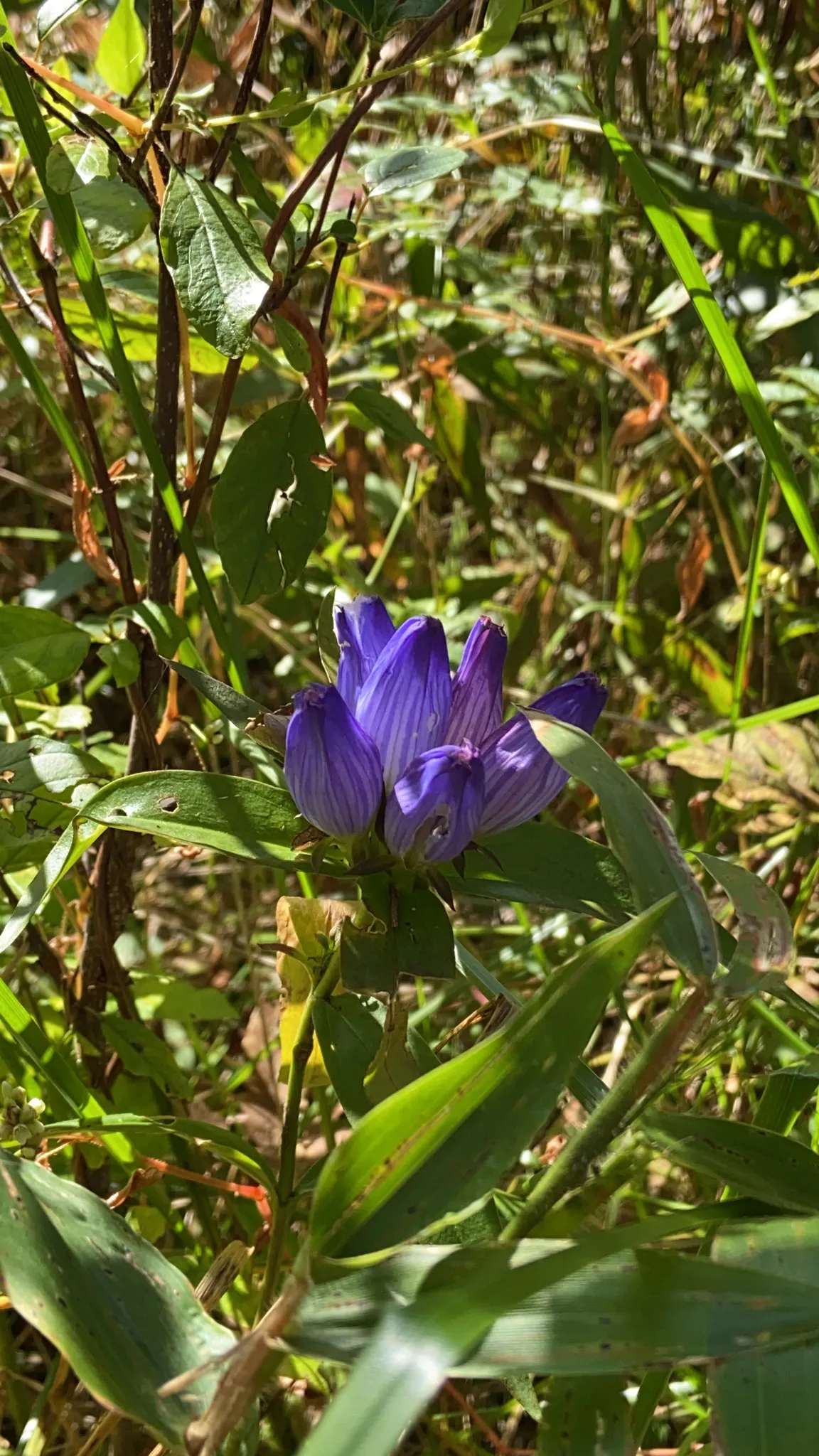
Gentiana andrewsii, or closed gentian, forms bottle shaped blue flowers that stay closed at the tip and bloom from August through October in moist meadows, woodland edges, and streambanks.
Toxicity unknown
Closed Gentian (Gentiana andrewsii) is not listed by the ASPCA Animal Poison Control Center (opens in new tab) or the other sources we check, so we have no verdict for it either way. Absence from those lists is not a clearance. If your pet shows symptoms after eating any plant, call the ASPCA at (888) 426-4435.
The USDA PLANTS Database (opens in new tab) does not flag Closed Gentian as toxic to livestock.
Light
part shade
Water
medium
Size
12"–36" H × 6"–12" W
Bloom
Aug, Sep, Oct
Native to
CO, CT, IA, IL and 18 more states
Pollinators
bees, butterflies
Deer
Resistant (per Prairie Moon Nursery)
Before you buy
Your city may pay you to plant this
Cities and water utilities offer rebates for replacing lawn with native and water-wise plants. We track 459 programs across 44 states, each with a link to the provider and the date we last checked it.
Find rebates in your areaPicture natives in your own yard
Upload a photo of your yard and Patch Vision shows a rendering of it planted with natives for your region, like Closed Gentian.


Browse plants for this ecoregion
Closed gentian produces distinctive deep blue bottle-shaped flowers that never fully open, creating an unusual and eye-catching display in late summer and fall. This native perennial thrives in partial shade with consistent moisture and forms neat clumps that work well in both formal and naturalistic garden settings.
Growing Closed Gentian
Grow Closed Gentian in part shade and medium water. Mature plants reach 12 to 36 inches tall and spread 6 to 12 inches wide. Expect low maintenance to keep it looking intentional in a front yard.
How to care for Closed Gentian, by region
How to care for Closed Gentian where it is actually grown: year-round basics plus what to do each season, region by region, with the sources for each.
Care guidance last updated: August 2026
Atlantic Coastal Pine Barrens (includes Riverhead, NY)
Year-round
Bottle Gentian is a native perennial wildflower with a documented Suffolk County record, bringing rare true blue color to the garden from late summer into fall.
- It is native to New York, with a voucher specimen recorded in Suffolk County, and it favors consistently moist, humus rich soil in part sun to light shade.
- Its closed, bottle shaped flowers never fully open on their own. Only bumblebees are heavy and strong enough to pry the petals apart and reach the nectar inside.
- Most nurseries rate it for USDA zones 3 to 6, cooler than Riverhead's zone 7a, so the bigger challenge here tends to be summer heat and humidity rather than winter cold.
- Long Island's naturally sandy Haven-Riverhead loam drains fast. Working compost into the planting hole and mulching well helps this plant hold the moisture it needs.
- It is slow and difficult to establish from seed, so a nursery transplant or a root division is the more reliable starting point in a home garden.
- It does not appear on the ASPCA's toxic plant list for cats or dogs.
Fall
Fall is Bottle Gentian's moment. Its true blue, bottle shaped flowers open from late summer into fall and can hold on close to Long Island's first frost.
- Flowers open from August into October and sometimes later, right up to the first hard frost, making this one of the last true blues left in the fall garden.
- The flowers never fully open on their own. Only bumblebees are strong enough to pry the petals apart, making this a genuine late-season nectar source after most other blooms have finished.
- Skip deadheading here. Removing spent or unopened flowers takes away the exact nectar source the season's last bumblebees are relying on.
- At roughly two feet tall and growing in a tight clump, it reads as tidy, intentional color in a front bed rather than a sprawling wildflower patch.
- Pairing it with other fall bloomers like New England aster or blazing star extends the color show and gives its leaning stems something sturdier to lean on.
Its compact, clumped habit and late blue color read as deliberate seasonal interest rather than overgrowth, which makes it an easy plant to leave visible in a front bed through fall.
Winter
Bottle Gentian dies back to the ground for winter, so the main decision is when to cut back the old stems rather than any active care.
- Once hard frost hits, usually by mid to late fall on Long Island, the top growth dies back completely. This is normal dormancy, not a sign of a struggling plant.
- Leaving the dried stems standing through winter rather than cutting them back in fall gives overwintering insects a place to shelter, a general practice recommended for native perennial beds.
- If a neater winter look matters more than habitat value in a visible front bed, the dried stems can be cut down to a few inches in late winter, just before new growth starts, rather than in fall.
- New divisions or transplants benefit from a light mulch layer over the crown once the ground freezes, to buffer the freeze-thaw cycles common in Riverhead's coastal winters.
A late-winter cutback, timed just before spring growth resumes, keeps a front bed looking intentional through the dormant months without giving up the shelter value of standing stems for most of winter.
Spring
Spring on Long Island is when Bottle Gentian slowly breaks dormancy, so patience and steady moisture matter more than any single task.
- New growth is easy to miss since this plant leafs out later in spring than many neighboring perennials. Marking its spot in fall helps avoid clearing it out along with the winter mulch.
- If dividing an established clump, do it while the plant is still mostly dormant in early spring, using the same root-division method nurseries use for propagation.
- Wait until after Long Island's last frost, typically mid-spring, before setting out new nursery transplants, and water them in well since the area's sandy soil drains and dries out quickly.
- Young shoots can draw deer and rabbit browsing. A low wire cage around a new planting protects it without looking out of place in a front bed.
- A spring topdressing of compost or leaf mulch helps the naturally sandy local soil hold onto the moisture this plant needs through the coming summer.
A small wire cage around a young plant reads as ordinary garden upkeep from the street and is far less noticeable than losing the plant to browsing.
Summer
Summer is a waiting game for Bottle Gentian here. It spends the season building foliage before its late blooms, so steady moisture is the main job.
- Expect green growth only through most of summer. Buds do not open into flower until late summer at the earliest, so this is not a plant that rewards impatience.
- Riverhead's warm, humid zone 7a summers run hotter than the zones 3 to 6 most nurseries rate this plant for, so keep it out of full afternoon sun and check soil moisture during dry stretches rather than assuming it can tough out drought.
- Because the naturally sandy local soil drains fast, one deep watering during a multi-week dry spell does more good than frequent light sprinkles.
- As stems lengthen through summer they start to lean. Setting a light stake or planting it next to a sturdier late bloomer like aster now, before flowering starts, keeps it from flopping into a path later.
Staking or tucking it beside a sturdier neighbor mid-summer, before the flowers open, is a quieter fix than propping up a flopped plant once it is in bloom and visible from the street.
Sources: USDA PLANTS Profile: Gentiana andrewsii, New York Flora Atlas: Gentiana andrewsii var. andrewsii, Lady Bird Johnson Wildflower Center: Gentiana andrewsii, Xerces Society: Pollinator Plants, Great Lakes Region, Prairie Moon Nursery: Gentiana andrewsii, ASPCA Toxic and Non-Toxic Plant List: Cats
In an HOA neighborhood
Closed Gentian is an HOA-friendly choice. Maintenance level: low. Tidiness: 3 out of 5.
Works well in: front yard, foundation, mid zone.
- May appear bare in early spring before emergence
Wildlife value
The unique closed flowers are specifically adapted for pollination by bumblebees, which are strong enough to force their way inside. This plant provides crucial late-season nectar when few other native flowers are blooming.
Common questions
- Why do closed gentian flowers never fully open?
- The petal lobes of Gentiana andrewsii stay pinched together at the top, forming a bottle shape. Bumblebees are strong enough to force the flower open to reach the nectar and pollen inside, which is why bumblebees are considered the plant's main pollinator.
- When does closed gentian bloom?
- Closed gentian typically flowers from August into October, making it one of the later bloomers in prairies and moist woodland edges.
- What growing conditions suit closed gentian best?
- It is a forb that does well in part shade with medium soil moisture, often found along stream edges, wet meadows, and the dappled light of woodland margins.
- What pollinates closed gentian flowers?
- Bees, especially bumblebees, are the primary visitors and pollinators since they can push into the closed flower tip. Butterflies are occasional visitors as well.
- Is Closed Gentian toxic to livestock?
- The USDA PLANTS Database does not flag Closed Gentian as toxic to livestock.
- Is Closed Gentian HOA-friendly?
- Closed Gentian is generally an HOA-friendly choice in the right placement, with low maintenance.
These answers were drafted with an AI model from this plant's data. Verify care details with a local expert.
Native range data from vouchered herbarium specimen records and regional native plant society lists. Pollinator and host plant associations compiled from GBIF, iNaturalist, and published ecological literature.
If something looks wrong
Common plant problems, and what to check first
These come up on almost any plant. Each guide lists the likely causes in the order they are worth ruling out, with one thing to check before you act on any of them, and links to the source it came from.
- It is dying right after planting
- Leaves turning yellow
- Wilting even though I watered it
- Brown crispy leaf tips
- Bugs on the plant
Ready to grow Closed Gentian? Add it to your garden in Pollinator Patch to track it and get season-by-season care guidance.