Scarlet Indian Paintbrush
Castilleja coccinea
Last reviewed: September 2026
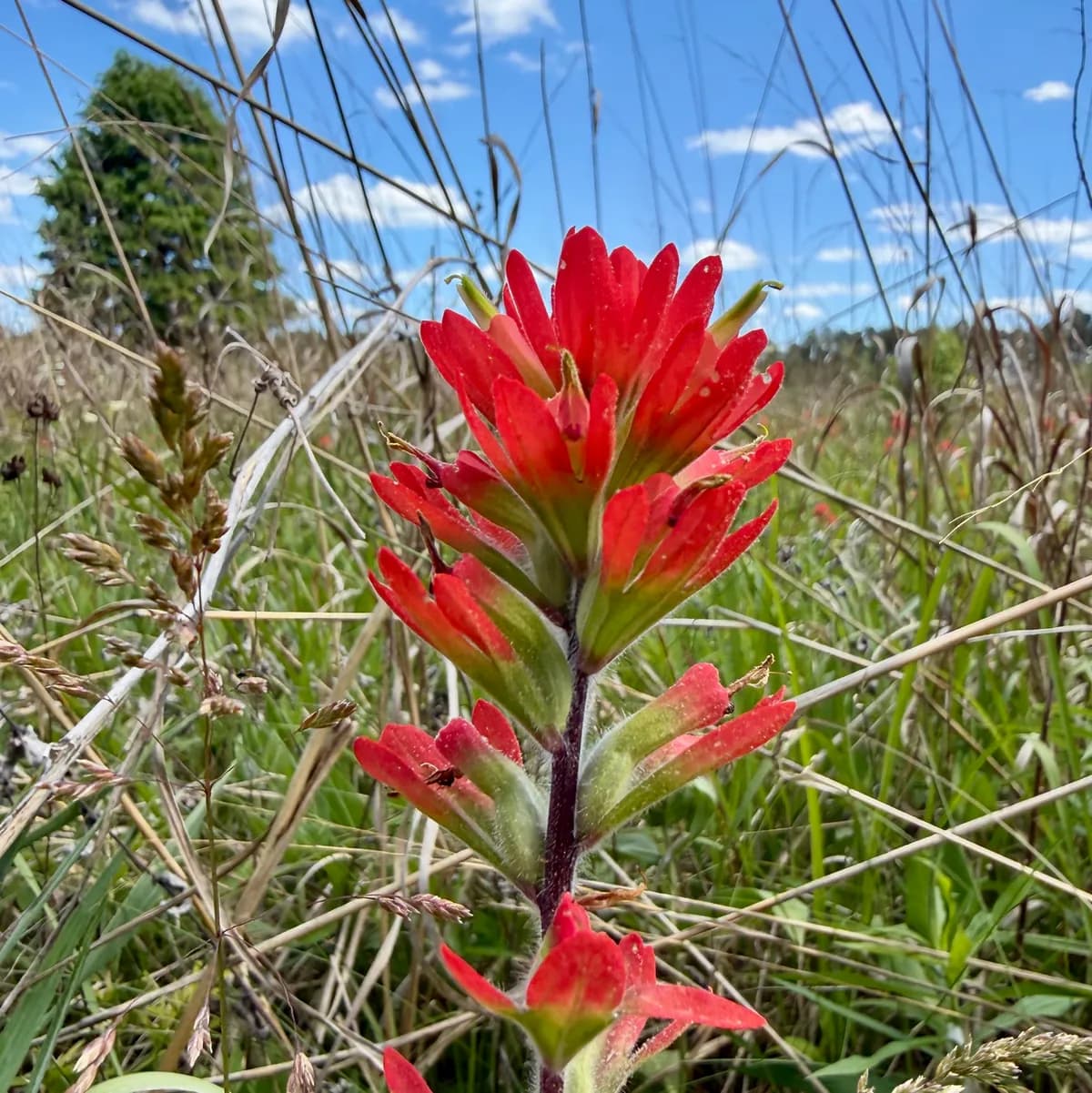
Scarlet Indian Paintbrush is a low-growing forb with brilliant red bracts that bloom from May through July. It thrives in full sun on prairies, meadows, and open woodland edges with average to dry soil.
Toxicity unknown
Scarlet Indian Paintbrush (Castilleja coccinea) is not listed by the ASPCA Animal Poison Control Center (opens in new tab) or the other sources we check, so we have no verdict for it either way. Absence from those lists is not a clearance. If your pet shows symptoms after eating any plant, call the ASPCA at (888) 426-4435.
The USDA PLANTS Database (opens in new tab) does not flag Scarlet Indian Paintbrush as toxic to livestock.
Light
full sun
Water
medium
Size
12"–24" H × 6"–12" W
Bloom
May, Jun, Jul
Native to
AL, AR, CT, DE and 29 more states
Pollinators
bees, butterflies, hummingbirds
Before you buy
Your city may pay you to plant this
Cities and water utilities offer rebates for replacing lawn with native and water-wise plants. We track 459 programs across 44 states, each with a link to the provider and the date we last checked it.
Find rebates in your areaPicture natives in your own yard
Upload a photo of your yard and Patch Vision shows a rendering of it planted with natives for your region, like Scarlet Indian Paintbrush.


Browse plants for this ecoregion
Scarlet Indian paintbrush produces distinctive bright red-orange flower bracts that create stunning color displays from May through July. This compact native wildflower grows in neat clumps and thrives in sunny, well-drained locations with minimal water needs.
Growing Scarlet Indian Paintbrush
Grow Scarlet Indian Paintbrush in full sun and medium water. Mature plants reach 12 to 24 inches tall and spread 6 to 12 inches wide. Expect low maintenance to keep it looking intentional in a front yard.
How to care for Scarlet Indian Paintbrush, by region
How to care for Scarlet Indian Paintbrush where it is actually grown: year-round basics plus what to do each season, region by region, with the sources for each.
Care guidance last updated: September 2026
North Central Hardwood Forests (includes Minneapolis, MN)
Year-round
Indian paintbrush is a hemiparasitic native wildflower that draws part of its nutrients from a neighboring host plant. It is native to Minnesota, found in prairies, meadows, and open sandy woods across the Minneapolis area, according to Minnesota Wildflowers. It grows best in full sun to light shade with well drained, often sandy soil, and it behaves as an annual or biennial, so most gardeners let it reseed rather than expecting one plant to come back for many years.
- Plant it next to a host grass such as little bluestem, prairie dropseed, or June grass, since paintbrush needs those roots to grow well.
- Choose a sunny to lightly shaded spot with sandy or well drained soil rather than heavy wet clay.
- Avoid moving an established plant, disturbing its root connection to the host usually kills it.
- Let some flowers go to seed each season so the patch can refresh itself, since individual plants are often short lived.
- It does not currently appear on the ASPCA's toxic or non-toxic plant lists, so no published toxicity finding exists for it yet.
Fall
Fall is the best time to start new Indian paintbrush plants from seed in the Minneapolis area, since the seed needs a period of cold before it will sprout. A hard frost, usually in early to mid October, blackens the top growth on the year's flowering plants and ends the bloom season. This is also a good window to add more host grass around existing paintbrush so next year's plants have roots to connect to.
- Nick a small slit in the soil right next to an established host grass and press the tiny paintbrush seed in, rather than sowing it alone.
- Let the winter cold and snow handle the seed stratification, no indoor treatment is needed for a fall sowing.
- After frost blackens the top growth on this year's flowering plants, cut the dead stalks back to keep a front bed looking tended.
- Leave a light layer of fallen leaves over the planting area, it helps insulate seed and rosettes through a Minnesota winter.
Cutting back the blackened stalks after frost keeps a front-facing bed tidy heading into winter, while leaving the seed already in the soil undisturbed.
Winter
Through a Minneapolis winter, first year Indian paintbrush plants sit as low rosettes at ground level and rely on snow cover for insulation, while any seed sown in fall stays dormant in the cold soil until spring. There is little active care to do this time of year beyond leaving the planting undisturbed. It is a reasonable stretch to plan next year's host grass additions, since paintbrush performs best when paired with an actively growing host.
- Avoid walking on the bed or piling shoveled snow over it, rosettes sit close to the ground and can be crushed.
- Skip a thick winter mulch, paintbrush prefers to stay in direct contact with open soil rather than being smothered.
- Leave fall sown seed alone, the cold and snow are already doing the stratification work it needs.
- Use the quiet months to plan where to add host grasses like little bluestem for spring, since paintbrush needs that living root connection.
Spring
Spring in the Minneapolis area is when paintbrush seedlings and any fall sown seed begin to show above ground, usually once the coldest weather breaks in April. New plantings need to go in right next to an already growing host grass, since the paintbrush root has to make contact with a host to establish. Rosettes that overwintered from last year are cold hardy and can handle a late frost without protection.
- If you are adding new plants, tuck seedlings or plugs in beside an already growing host grass as soon as the soil can be worked.
- Watch bare sandy patches for small rosettes coming up on their own, these are volunteers from last year's seed drop.
- Skip heavy fertilizer, both paintbrush and its host grasses do better in average to lean soil.
- Hold off on mulching over the crown, paintbrush grows best in open ground with little competition.
Summer
Summer is bloom time for Indian paintbrush in the Minneapolis area, with the scarlet bracts typically showing from late spring into August. The flower shape is suited to hummingbirds, which visit often while it is in bloom. Because the plant shares roots with its host grass, how well it handles summer heat and dry spells depends a lot on how that host grass is doing.
- Water new plantings during dry stretches in the first summer, established clumps sharing roots with a host usually need less help.
- Leave the spent flower heads in place through the season, the seed they drop is how a paintbrush patch keeps itself going.
- Check on the host grass too, if it wilts in summer heat the paintbrush connected to it will struggle as well.
- Expect individual plants to decline and die back after they set seed, that is normal for this short lived wildflower.
If tidiness matters on a front-facing bed, the browning stems after bloom can be trimmed back once the seed heads have clearly dried and dropped, instead of left standing through the rest of summer.
Sources: Minnesota Wildflowers: Castilleja coccinea (Indian Paintbrush), Lady Bird Johnson Wildflower Center: Castilleja coccinea, ASPCA Toxic and Non-Toxic Plant List for Cats, Prairie Moon Nursery: Castilleja coccinea growing guide, USDA Forest Service: Indian Paintbrush (Castilleja coccinea)
In an HOA neighborhood
Scarlet Indian Paintbrush takes more care to keep looking intentional in a front yard. Maintenance level: low. Consider it for backyard or mid-zone beds rather than the street edge.
Works well in: backyard only.
- Appearance too wild/weedy for most HOA standards
- May be unfamiliar to traditional gardeners
- Can look sparse when not blooming
Wildlife value
The vibrant blooms attract hummingbirds, native bees, and butterflies throughout the growing season. This plant serves as an important nectar source during peak summer months.
Common questions
- When does Castilleja coccinea bloom?
- Castilleja coccinea typically flowers from May through July, with bract color ranging from scarlet red to orange-red.
- What growing conditions does Scarlet Indian Paintbrush need?
- This forb prefers full sun and low to medium moisture. It grows best in open prairies, meadows, and savannas with well-drained soil.
- What pollinators visit Castilleja coccinea?
- Bees, butterflies, and hummingbirds are drawn to the tubular flowers hidden beneath the colorful bracts.
- Is Scarlet Indian Paintbrush easy to establish in a garden?
- It can be difficult to establish because it is hemiparasitic and often grows best alongside host grasses or forbs that support its root system.
- Is Scarlet Indian Paintbrush toxic to livestock?
- The USDA PLANTS Database does not flag Scarlet Indian Paintbrush as toxic to livestock.
- Is Scarlet Indian Paintbrush HOA-friendly?
- Scarlet Indian Paintbrush takes more care to look intentional in a front yard. Consider it for backyard or mid-zone beds rather than the street edge.
These answers were drafted with an AI model from this plant's data. Verify care details with a local expert.
Native range data from the World Checklist of Vascular Plants (Kew). Pollinator and host plant associations compiled from GBIF, iNaturalist, and published ecological literature.
If something looks wrong
Common plant problems, and what to check first
These come up on almost any plant. Each guide lists the likely causes in the order they are worth ruling out, with one thing to check before you act on any of them, and links to the source it came from.
- It is dying right after planting
- Leaves turning yellow
- Wilting even though I watered it
- Brown crispy leaf tips
- Bugs on the plant
Ready to grow Scarlet Indian Paintbrush? Add it to your garden in Pollinator Patch to track it and get season-by-season care guidance.